



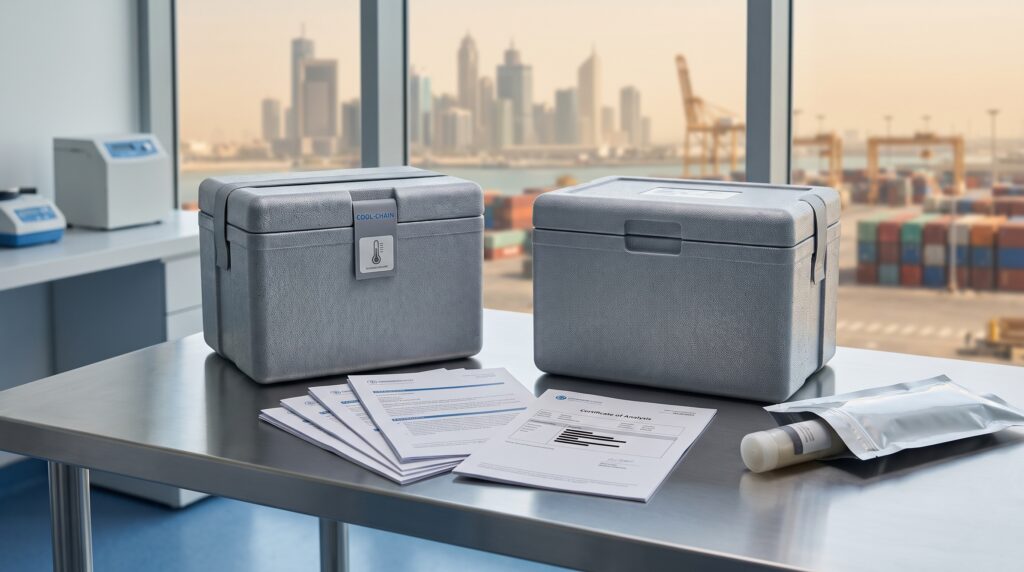
Procuring specialised mitochondrial peptides in the Gulf region presents a unique set of logistical and regulatory challenges. For laboratories and dedicated researchers looking to study the tetrapeptide known as Elamipretide (SS-31), finding a reliable supplier is only the first step. Navigating extreme ambient heat, strict import protocols, and rigorous purity standards requires a highly precise, compliant sourcing strategy.
If your institution intends to procure this compound in the GCC, you must evaluate suppliers on much more than straightforward pricing. A successful procurement cycle demands independent purity verification, robust cold-chain infrastructure to prevent degradation, and perfectly accurate documentation that aligns with local customs requirements. This guide breaks down exactly how informed buyers can secure high-grade SS-31 for analytical research without risking transit damage or compliance delays.
How to buy SS-31 in Bahrain: Safe Sourcing Strategies
Quick Answer: To securely buy SS-31 in Bahrain, researchers must verify that a supplier provides third-party HPLC-MS Certificates of Analysis proving >99% purity. Ensure the vendor utilizes active cold-chain shipping to survive GCC temperatures and provides compliant documentation for swift NHRA OFOQ customs clearance. Avoid vendors selling for personal use.
Key Takeaways for Procurement Teams
- Purity Verification: Demand batch-specific HPLC and MS data; a simple percentage on a website is inadequate for laboratory study.
- Cold-Chain Logistics: GCC heat can degrade lyophilised peptides in hours. Active thermal packaging and temperature loggers are non-negotiable.
- Customs Compliance: Commercial invoices must clearly state “For Analytical Research Purposes Only” alongside accurate Harmonised System (HS) codes to clear Bahrain’s NHRA checkpoints.
- Vendor Specialisation: Partner with suppliers who handle GCC logistics daily, as standard international shippers frequently fail at regional ports of entry.
Far too many international suppliers handle GCC orders like standard shipments, leading to degraded peptides and seized packages. In Bahrain, where the National Health Regulatory Authority (NHRA) heavily scrutinises biological imports, buyers must partner with suppliers who understand regional logistics natively. From the exact phrasing on the commercial invoice to the thickness of the insulated packaging, every detail matters when sourcing delicate tetrapeptides.
Understanding SS-31 (Elamipretide) in Analytical Research
SS-31, frequently referenced in scientific literature as Elamipretide, MTP-131, or Bendavia, is a synthetic, mitochondria-targeted tetrapeptide. Its amino acid sequence (D-Arg-Dmt-Lys-Phe-NH2) features alternating aromatic and basic residues. Unlike compounds that act systemically on broader cellular receptors, SS-31 possesses a unique structural motif that allows it to selectively bind to cardiolipin, a phospholipid located almost exclusively on the inner mitochondrial membrane (IMM).
In highly controlled in vitro laboratory settings, researchers study how this binding mechanism influences mitochondrial membrane curvature, modulates reactive oxygen species (ROS) production, and impacts the efficiency of the electron transport chain under various simulated stress conditions. Because of its distinct interaction with cardiolipin, SS-31 remains firmly classified as an active research compound used to investigate cellular bioenergetics and mitochondrial dysfunction models.
For analytical study, SS-31 is synthesized and supplied as a white, lyophilised (freeze-dried) powder. It is commonly packaged in sterile 10 mg or 50 mg glass vials to maintain chemical stability prior to reconstitution. Because it is highly sensitive to environmental factors—particularly extreme heat and humidity—maintaining the structural integrity of this powder from the laboratory to the final destination is critical for establishing reproducible research outcomes.
The Critical Role of HPLC-MS Purity Verification
Before you select an SS-31 supplier in Bahrain, establishing chemical purity is your paramount concern. The industry standard for high-level peptide research is a minimum of 99% purity, verified through a comprehensive Certificate of Analysis (COA). However, buyers must look beyond marketing claims and demand access to the underlying analytical data.
When evaluating a supplier’s COA, procurement teams must verify two specific testing methodologies:
High-Performance Liquid Chromatography (HPLC)
HPLC separates the target peptide from any synthesis byproducts, truncated amino acid sequences, or manufacturing impurities. In a high-quality report, the resulting chromatogram should display one sharp, dominant peak representing the SS-31 molecule, confirming the absence of unwanted chemical residue that could confound experimental results.
Mass Spectrometry (MS)
While HPLC confirms purity, MS verifies the absolute identity of the compound. Mass spectrometry measures the mass-to-charge ratio of the ions in the sample. For SS-31, the MS report must confirm the exact molecular weight (approximately 639.8 g/mol), proving the amino acid sequence synthesized is exactly what it claims to be.
If an SS-31 vendor cannot provide an up-to-date, batch-specific HPLC-MS report from a reputable, independent testing facility, they are fundamentally unsuitable for rigorous laboratory procurement. Trustworthy suppliers make this documentation readily available to buyers prior to any financial transaction.
Navigating GCC Heat: The Cold-Chain Imperative
Bahrain’s climate is notoriously unforgiving for biological shipments. With summer temperatures frequently exceeding 40 degrees Celsius, standard international shipping methods are entirely inadequate. If a delicate lyophilised peptide sits on a hot tarmac at Bahrain International Airport during a logistical delay, its molecular structure can degrade rapidly, rendering it useless for precise study.
When securing an SS-31 supplier, you must interrogate their shipping protocols thoroughly. End-to-end cold-chain logistics are mandatory. This involves:
- Active Thermal Packaging: Polystyrene or vacuum-insulated panels (VIPs) designed specifically for pharmaceutical and chemical transit, insulating against external temperature spikes.
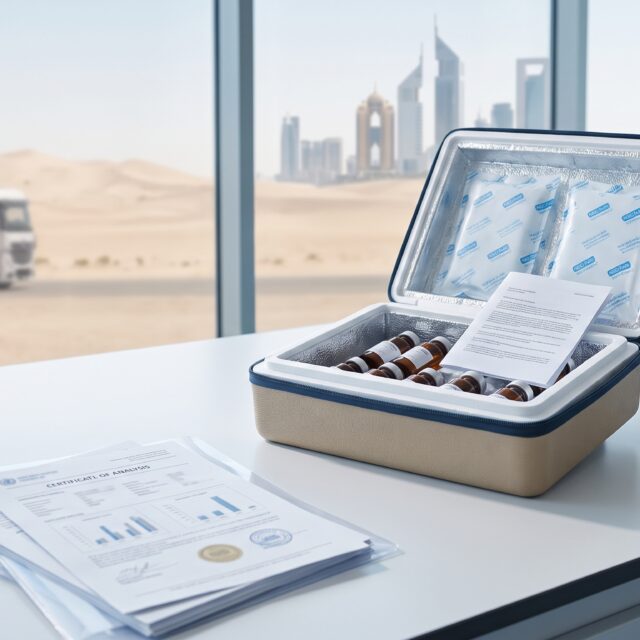
- Temperature Regulators: The inclusion of sufficient phase-change materials (PCMs) or medical-grade gel ice packs configured to maintain an internal environment of 2 to 8 degrees Celsius throughout the journey.
- Transit Speed: Express courier shipping (via specialised divisions of services like DHL, FedEx, or Naqel Express) that guarantees rapid customs transit, minimising the window for temperature excursions.
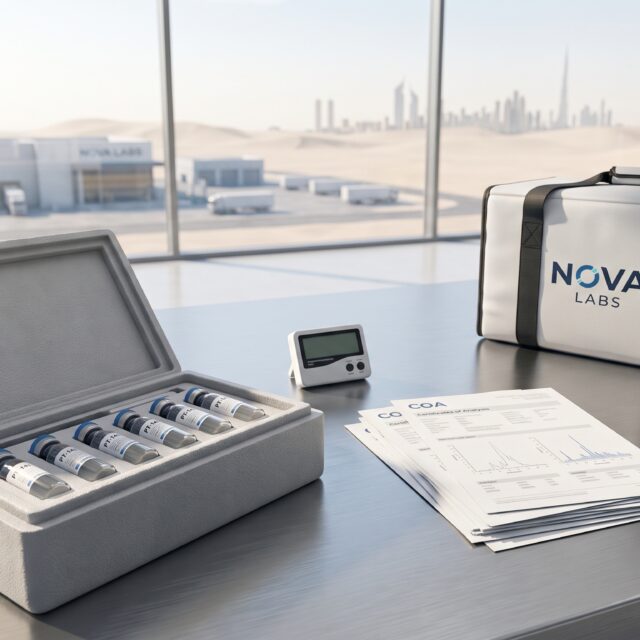
To see how a premium supplier manages these exact regional challenges, review how NOVA Labs handles specialised GCC and UAE cold-chain delivery to ensure sensitive compounds remain perfectly stable in transit.
Customs Clearance and the NHRA OFOQ System
The most common point of failure when attempting to secure an international supplier is customs clearance. Bahrain’s National Health Regulatory Authority (NHRA) and Customs Affairs heavily regulate the importation of all pharmaceutical and chemical substances to prevent unauthorised consumer use.
Clearance in Bahrain is managed through the official OFOQ online system. Because of the strict screening processes, many standard international peptide suppliers simply refuse to ship to Bahrain, leaving buyers frustrated by cancelled orders or, worse, seized shipments at the border.
To ensure successful importation, the supplier must provide impeccable, transparent documentation. This includes:
- Accurate Commercial Invoicing: Stating the exact chemical nomenclature and declaring the material explicitly for “analytical laboratory research purposes only.”
- Harmonised System (HS) Codes: Utilising the correct global tariff codes for research chemicals to avoid misclassification.
- Accompanying COA: A physical copy of the Certificate of Analysis included with the shipping manifest to satisfy customs officers immediately upon inspection.
Packages lacking proper labelling or attempting to masquerade as cosmetic or nutritional products will face immediate rejection by Bahraini authorities. Only work with suppliers who have a proven track record of clearing NHRA checkpoints.
Institutional Procurement and Vendor Assessment
Evaluating peptide suppliers requires a systematic, risk-averse approach. Before processing a payment or setting up a vendor account, procurement officers should run through this commercial checklist:
- Logistics Transparency: Does the supplier explicitly detail their cold-chain shipping methods, or do they rely on standard postal mail that leaves packages vulnerable?
- Customs Expertise: Can they demonstrate a track record of successfully navigating GCC customs and providing compliant commercial invoices?
- Payment and Support: Do they offer secure institutional payment gateways and accessible local support channels (like WhatsApp or a dedicated account manager) to track your high-value shipment?
- Stock Availability: Is the product actually held in stock and ready for immediate dispatch, or is it drop-shipped from an overseas facility with unpredictable, lengthy lead times?
By demanding transparency across these pillars, researchers can mitigate financial risk, avoid compliance headaches, and ensure the integrity of their analytical materials.
Proper Laboratory Handling and Storage
Once the SS-31 arrives at your facility in Bahrain, proper handling dictates the ongoing viability of the compound. Upon receipt, inspect the temperature data logger (if included) to verify the cold chain remained unbroken.
Lyophilised SS-31 should be immediately transferred to a freezer (ideally at -20°C) for long-term storage. When preparing for an experiment, the peptide must be allowed to reach room temperature before opening the vial to prevent condensation from introducing moisture to the powder.
Following reconstitution with bacteriostatic or sterile water, the solution should be stored away from direct light in a refrigerator at 2 to 8 degrees Celsius. To prevent degradation from repeated freeze-thaw cycles, researchers are advised to aliquot the reconstituted solution into single-use microcentrifuge tubes.
Final Thoughts on Procuring SS-31
Acquiring specialised mitochondrial compounds in the Gulf requires extreme diligence, from verifying chemical identity to ensuring robust cold-chain handling. Bahrain’s unique regulatory environment and harsh climate mean buyers cannot afford to use opaque, cut-rate suppliers. By prioritising independent COAs, professional express shipping, and precise customs documentation, laboratories can ensure their research remains uncompromised.
When you are ready to secure high-purity materials, you can safely order SS-31 for your laboratory through a supplier fully equipped to handle rigorous GCC logistics and quality demands.
Disclaimer: The products mentioned in this article are strictly for in vitro analytical and laboratory research purposes only. They are not intended for human consumption, diagnostic, or therapeutic use.
*
References
- National Health Regulatory Authority (NHRA) Bahrain. “Guidelines for the Importation of Pharmaceuticals and Research Chemicals.”
- Bahrain Customs Affairs. “OFOQ Electronic System for Customs Clearance Procedures and Integration.”
- Birk, A. V., et al. (2013). “The mitochondria-targeted compound SS-31 re-energizes ischemic mitochondria by interacting with cardiolipin.” Journal of the American Society of Nephrology, 24(8), 1250-1261.
- Chacko, B. K., et al. (2014). “Mitochondria-targeted peptide CGP-31/SS-31 prevents oxidative stress-induced mitochondrial dysfunction.” Biochemical Journal, 460(1), 135-142.
- SS-31 50 mg – lyophilized powder – Limitless BioChem
- Peptide Import Laws: Customs & Personal Use | PeptideJournal
- Importation – National Health Regulatory Authority Bahrain
- Shipping Policy – Pure Peptides
- From Manufacturer to End Customer: How AlGenome International Guarantees a Reliable Cold Chain for Your Critical Supplies
- What SS-31 actually is, and what the trials really showed : r/NTNPerformance – Reddit
Frequently asked questions
Is it legal to buy SS-31 in Bahrain?
Yes, it is strictly permitted to purchase SS-31 in Bahrain for analytical and laboratory research purposes, provided the shipment is correctly documented, declared for research use, and cleared through the NHRA OFOQ customs system.
How should SS-31 be stored in GCC climates?
Lyophilised SS-31 powder should be kept in a laboratory freezer at -20°C for long-term stability. Once reconstituted for research use, it must be stored away from light in a refrigerator at 2 to 8 degrees Celsius.
What documentation is required to clear peptide imports in Bahrain?
Shipments require an accurate commercial invoice declaring the item for research use only, appropriate HS chemical codes, and ideally, an accompanying Certificate of Analysis (COA) to satisfy NHRA customs officers upon inspection.
How long does peptide delivery to Bahrain take?
Delivery times depend heavily on the supplier's logistics network. Premium vendors utilising express courier services with dedicated active cold-chain packaging can typically clear customs and deliver within a few working days.
Why is HPLC-MS testing important for SS-31?
HPLC-MS testing confirms the purity (absence of synthesis byproducts) and precise molecular weight of the peptide. This ensures researchers are using accurate compounds, which is critical for reproducible in vitro study results.
Nova Labs buyer tools
Ready to verify stock, testing and delivery?
Use the product page and lab report section to check availability, documentation, delivery timing and support before placing an order.
- COA / test-report checks
- Bahrain delivery context
- Cold-chain handling
- COD and card payment options
- WhatsApp support