
How to Buy SS-31 in Saudi Arabia: 2026 Procurement Guide
Quick Answer: To securely buy SS-31 in Saudi Arabia, researchers must select a supplier that provides batch-specific COAs, utilizes FASAH-compliant customs routing for ‘Research Use Only’ materials, and maintains strict 2-8°C cold-chain logistics. Avoiding grey markets ensures analytical integrity and compliance with SFDA guidelines.
For laboratory procurement teams and scientific investigators looking to source peptides in Saudi Arabia, the acquisition landscape has transformed significantly. Following recent regulatory updates from the Ministry of Health (MoH) and the Saudi Food and Drug Authority (SFDA), informal distribution channels and social media grey markets face strict enforcement. Today, purchasing research peptides requires navigating stringent compliance protocols, verifying analytical documentation, and ensuring robust cold-chain logistics to survive the harsh GCC climate.
This guide breaks down exactly what informed researchers need to check before initiating an order, how to verify supplier claims, and why proper handling is non-negotiable for mitochondrial research compounds.
The Scientific Context: Why SS-31 is Crucial for Research
SS-31, also known as Elamipretide (D-Arg-Dmt-Lys-Phe-NH2), is a highly specialised mitochondria-targeted tetrapeptide. It has garnered significant attention within institutions across the Kingdom, including leading research centres like KAUST, due to its unique mechanisms of action.
In in-vitro and animal model studies, SS-31 is observed to selectively target and bind to cardiolipin, a vital phospholipid located in the inner mitochondrial membrane. This interaction is currently being studied for its potential to stabilise the membrane structure, optimise electron transport chain function, and reduce the production of reactive oxygen species (ROS) under conditions of oxidative stress.
Because its efficacy in laboratory settings relies entirely on its structural integrity, acquiring an intact, pure compound is the foundational step of any valid study. Degraded or contaminated peptides will immediately skew data, making supplier vetting the most critical phase of the research programme.
Verifying Your SS-31 Supplier in Saudi Arabia: A Buyer’s Checklist
The crackdown on unauthorised peptide sellers operating on platforms like Salla has pushed legitimate buyers back toward highly professional, B2B-oriented suppliers. When evaluating an SS-31 supplier in Saudi Arabia, visual branding is insufficient. You must demand verifiable, technical proof of quality.
Certificate of Analysis (COA) and HPLC Testing
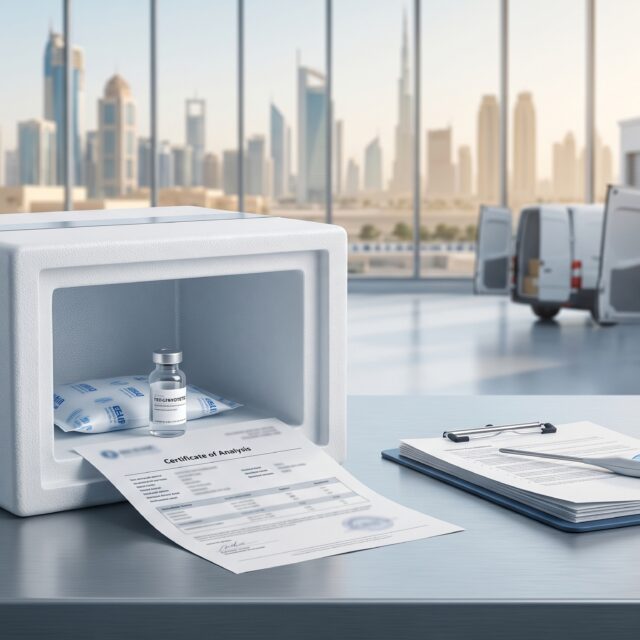
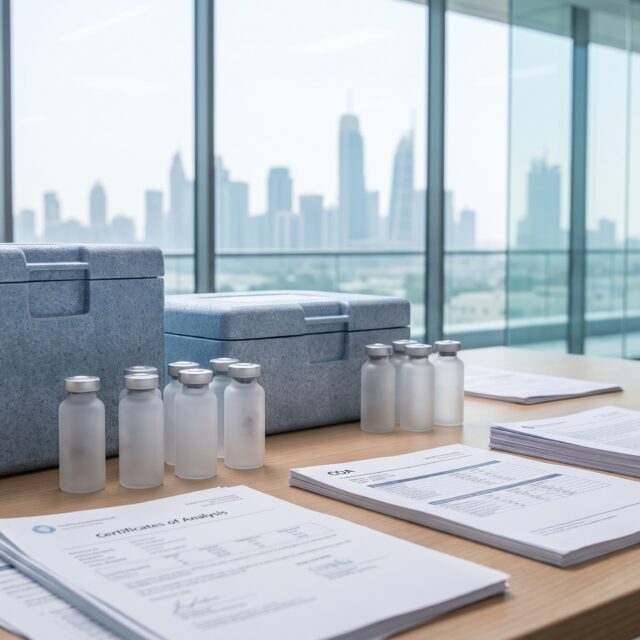
Serious buyers reject generic, manufacturer-provided certificates. If you are preparing to order SS-31 in Saudi Arabia, your supplier must provide a batch-specific Certificate of Analysis (COA).
This document should include:
- High-Performance Liquid Chromatography (HPLC) Chromatograms: This confirms the purity percentage. For rigorous research applications, SS-31 should test at >=98% purity.
- Mass Spectrometry (MS): This verifies the identity and molecular weight of the compound, ensuring you have received genuine Elamipretide rather than a cheaper analogue.
- Batch Alignment: The batch number on the vial must match the batch number on the COA.
Payment Processing and Financial Compliance
Payment gateways are often a strong indicator of a supplier’s legitimacy. While local consumer platforms might easily use mada or Apple Pay, legitimate B2B suppliers of research chemicals must navigate global credit card restrictions, including Mastercard BRAM rules. A supplier that maintains compliant, secure, high-risk payment routing demonstrates long-term operational stability.
For researchers looking to procure premium research compounds for their facility, ensuring the supplier uses encrypted, institutionally acceptable payment methods is a key part of the vendor approval process.
Surviving the GCC Heat: Cold-Chain Logistics for Peptides
One of the greatest hurdles for any SS-31 peptide Saudi Arabia order is the environment. Ambient summer temperatures routinely exceed 40°C. If lyophilised (freeze-dried) SS-31 sits on a hot tarmac in Riyadh or Jeddah without proper insulation, the peptide bonds can degrade rapidly, rendering the compound useless before it even reaches the laboratory.
The 2-8°C Requirement
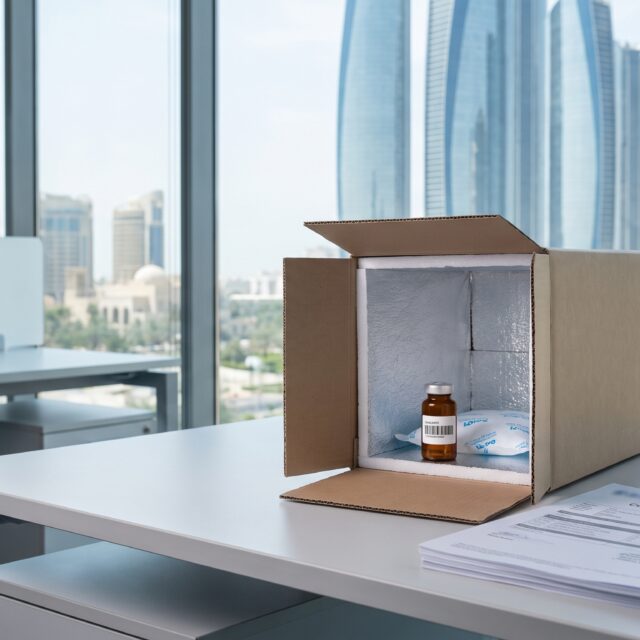
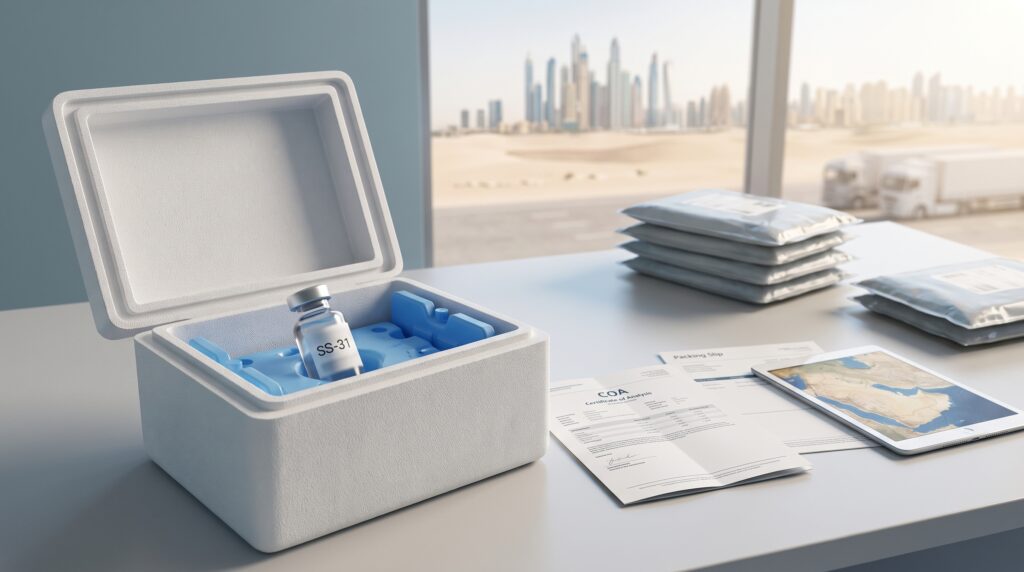
Continuous cold-chain shipping is non-negotiable. SS-31 requires a stable environment of 2-8°C during transit. Top-tier suppliers achieve this by utilising:
- High-density insulated packaging.
- Calibrated cold packs or dry ice (depending on the transit duration).
- Temperature data loggers that allow the receiving lab to verify that the shipment remained within the safe threshold throughout its journey.
Navigating FASAH Customs and RUO Compliance
Seamless delivery to Saudi research facilities requires flawless customs integration. Shipments must comply with the SABER and FASAH customs systems. Legitimate suppliers ensure that shipments are explicitly labelled as “Research Use Only” (RUO) and use correct Harmonised System (HS) codes, such as HS 3504.00.10 for lyophilised powders.
Failure to provide correct documentation often results in indefinite customs detention. Suppliers operating a reliable GCC logistics and UAE dispatch framework understand these bureaucratic intricacies, effectively shielding the buyer from import friction and delays.
How to Order SS-31 with NOVA Labs
For informed procurement staff and research buyers, NOVA Labs offers a compliant, transparent pathway to acquire SS-31. Operating with a deep understanding of GCC logistical challenges, we provide the technical documentation and cold-chain security required by modern laboratories.
When you source through NOVA Labs, you gain access to:
- Unobscured Transparency: Up-to-date, batch-specific HPLC and MS testing documents are readily available to confirm purity before you commit your research budget.
- Optimised GCC Delivery: We utilise premium insulation and temperature-controlled logistics designed specifically to defeat the extreme Saudi climate, ensuring your compounds arrive intact.
- Customs Competence: Our dispatch team prepares all necessary RUO documentation and HS coding to interface smoothly with Saudi import regulations.
- Responsive Support: Direct support channels, including WhatsApp, ensure that procurement teams can check stock, verify batches, and track shipments in real-time.
Conclusion
The current regulatory environment in Saudi Arabia has made it essential to carefully vet your peptide sources. Whether you are conducting baseline in-vitro assessments of cardiolipin interactions or advanced mitochondrial assays, the integrity of your SS-31 dictates the validity of your results. By demanding lot-specific COAs, ensuring strict FASAH-compliant shipping, and requiring unbroken 2-8°C cold-chain logistics, researchers can protect their work from degraded compounds and customs seizures.
Ready to secure verifiable compounds for your next study? Review our latest batch data and explore our research catalogue today.
Disclaimer: The products mentioned in this article are for research purposes only and are not intended for human consumption or therapeutic use.
References
- Saudi Food and Drug Authority (SFDA). (2026). Guidelines on the Importation of Laboratory and Research Chemicals.
- Ministry of Health (MoH). (2026). Regulatory Enforcement Actions on Unregistered Chemical Distribution.
- King Abdullah University of Science and Technology (KAUST) Repository. Reducing ROS Production in Mitochondria via Cardiolipin Interactions.
- World Customs Organization. Harmonized System (HS) Nomenclature 2022 Edition (HS 3504.00.10).
- Wholesale Peptides Saudi Arabia: B2B Supplier & Procurement – NOVA Labs
- Peptide Laws in Saudi Arabia — Can You Buy, Travel & Import? (2026)
- MoH Warns Against Using Unregistered Drugs and Seizes Violators
- Buying Research Peptides UAE — the 2026 buyer-evaluation guide – Wellness Labs
- Reducing ROS Production in Mitochondria via Cardiolipin | KAUST Repository
- SS-31 – PEPKSA
Frequently asked questions
Is SS-31 legal to buy in Saudi Arabia?
Yes, it is legal to purchase SS-31 in Saudi Arabia strictly for laboratory and in-vitro research purposes. It must be explicitly labelled 'Research Use Only' (RUO) to comply with SFDA and MoH regulations.
How should SS-31 be shipped to Saudi Arabia?
Due to ambient temperatures frequently exceeding 40°C, SS-31 must be shipped using strict 2-8°C cold-chain logistics, including insulated packaging and temperature monitoring, to prevent peptide degradation.
What is the correct HS code for importing lyophilised SS-31?
For legitimate laboratory importation through FASAH customs, lyophilised research peptides like SS-31 are typically declared under the Harmonised System (HS) code 3504.00.10.
How can I verify the purity of my SS-31 peptide in Saudi Arabia?
Researchers should demand a batch-specific Certificate of Analysis (COA) from their supplier. This document must include High-Performance Liquid Chromatography (HPLC) chromatograms confirming >=98% purity and Mass Spectrometry (MS) to verify the molecular identity.
Nova Labs buyer tools
Ready to verify stock, testing and delivery?
Use the product page and lab report section to check availability, documentation, delivery timing and support before placing an order.
- COA / test-report checks
- Saudi Arabia delivery context
- Cold-chain handling
- COD and card payment options
- WhatsApp support