
When procurement staff and independent researchers look to buy Thymosin Alpha-1 in Bahrain, they frequently run into two distinct operational hurdles: navigating local import regulations and protecting fragile compounds from the aggressive GCC climate. While international aggregators dominate the search landscape, many fail to localize their logistics for Middle Eastern buyers, resulting in degraded vials or packages stalled at the border.
For buyers evaluating a Thymosin Alpha-1 supplier in Bahrain, securing high-purity (≥99%) compounds requires more than just a well-designed website. It requires scrutinizing batch-specific documentation, confirming thermal transit capabilities, and understanding exactly how customs in Manama processes laboratory reagents.
This guide outlines the critical procurement signals buyers must verify before placing an order, from reading complex Certificates of Analysis (COAs) to managing the logistics of cold-chain peptide delivery.
Where to Buy Thymosin Alpha-1 in Bahrain: Quick Buyer Checklist
Quick answer: When looking to buy Thymosin Alpha-1 in Bahrain, prioritize suppliers offering third-party HPLC/MS Certificates of Analysis proving ≥99% purity. Ensure the vendor utilizes climate-controlled shipping to survive GCC temperatures, provides localized payment options, and strictly designates the peptide for Laboratory Research Use Only to navigate customs efficiently.
Navigating NHRA Rules and Bahrain Customs
The Kingdom of Bahrain maintains strict oversight of all pharmaceutical and chemical imports. The National Health Regulatory Authority (NHRA) regulates these products under Law No. 39 of 2015. For researchers and informed buyers seeking to order Thymosin Alpha-1 in Bahrain without facing medical registration barriers, documentation is everything.
Peptides intended for in-vitro analysis must be strictly classified as “Laboratory Research Use Only” (RUO). If a vendor implicitly or explicitly markets the compound for human consumption, clinical application, or unverified treatments, customs officials are highly likely to flag, delay, or seize the shipment pending pharmaceutical licensing.
Additionally, buyers should account for standard import taxation. Laboratory reagents imported into Bahrain are typically subject to a standard customs duty of 5% on the CIF (Cost, Insurance, and Freight) value, alongside a standard VAT of 10% (effective since January 2022). Partnering with a regional supplier who understands these specific commercial invoices reduces friction at the border and ensures smooth delivery.
The GCC Heat Shield: Why Cold-Chain Delivery Matters
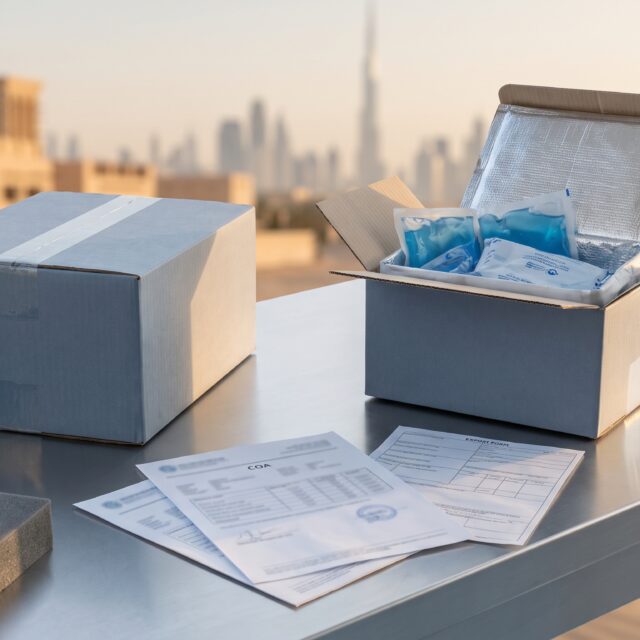
Bahrain’s desert climate presents a severe risk to peptide stability, with summer temperatures frequently exceeding 40 degrees Celsius. Standard international shipping, which may route packages through multiple un-airconditioned sorting facilities over several days or weeks, is often insufficient for fragile biochemicals.
Stability of Lyophilized Vials in Transit
Lyophilized (freeze-dried) peptides are inherently more stable than liquid suspensions. Current literature indicates that in a lyophilized state, a Thymosin Alpha-1 shipment can remain physically stable at room temperature for short durations.
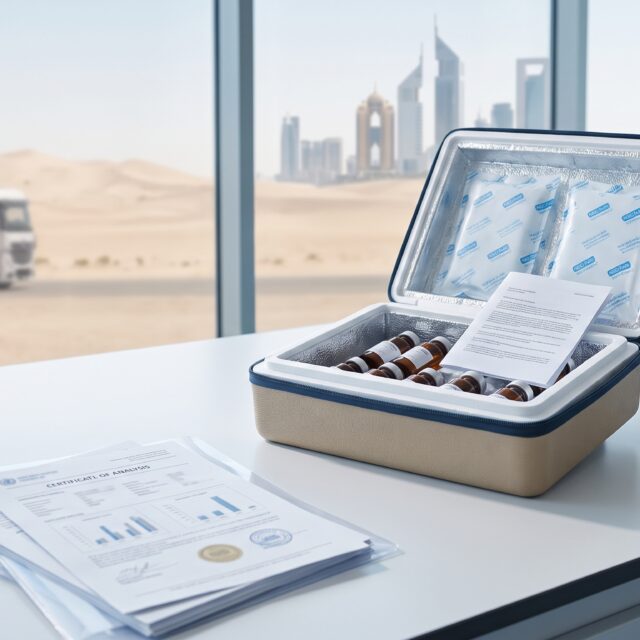
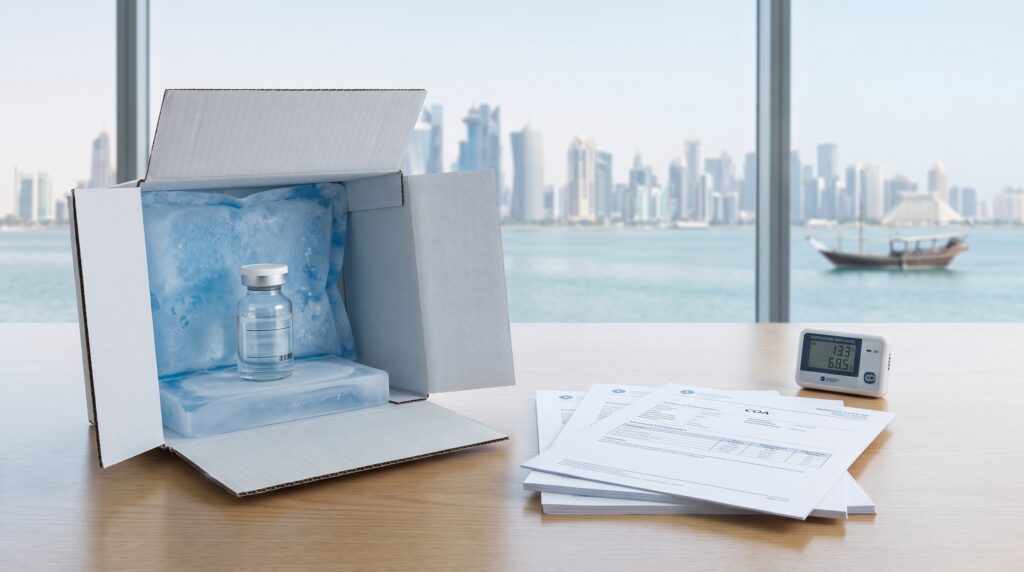
However, “room temperature” in a climate-controlled lab is vastly different from the interior of a non-insulated delivery van in Manama. Accelerated chemical degradation occurs when peptides are exposed to extreme heat. Therefore, thermal packaging, insulation, or established cold-chain protocols are non-negotiable. Suppliers utilizing fast regional delivery capabilities can dramatically minimize the transit window, ensuring that the structural integrity of the compound is preserved upon arrival.
How to Verify Purity and COA Documentation
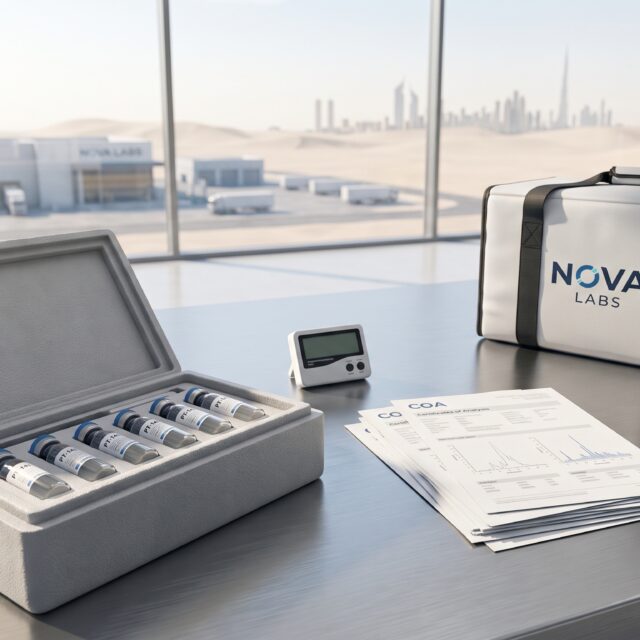
The most critical step when evaluating any Thymosin Alpha-1 supplier in Bahrain is validating their analytical testing. Premium research-grade peptides require a minimum purity level of 99%. This is not something a vendor can simply state on a product page; it must be proven through independent, verifiable documentation.
When reviewing a Certificate of Analysis (COA), buyers should look for two specific analytical methods:
- Reversed-Phase High-Performance Liquid Chromatography (RP-HPLC): This technique separates the components of a sample, ensuring that the primary peptide accounts for at least 99% of the vial’s contents, with minimal degradation byproducts.
- Liquid Chromatography-Mass Spectrometry (LC-MS/MS): This confirms the exact molecular weight of the peptide. For Thymosin Alpha-1, the mass identity should be confirmed at precisely 3108.3 Da. If the mass report shows a different number, the compound has either degraded or is incorrectly synthesized.
Spotting Hidden Fillers
One prominent issue in the gray-market peptide space is the use of bulking agents. Many generic vendors supply vials containing up to 50mg of mannitol to make the vial look “fuller” to the naked eye. While mannitol is generally harmless in a laboratory setting, it skews weight-to-mass analytical accuracy and can interfere with delicate in-vitro assays. High-integrity suppliers offer pure, lyophilized ‘mannitol-free’ powder to ensure researchers are working with precisely what is stated on the label.
Proper Storage Protocols Upon Delivery
Once you have successfully received your order, proper handling dictates the longevity of the compound. Do not leave the package sitting on a loading dock or at a reception desk.
- Long-term storage: Unreconstituted lyophilized vials should be placed in a freezer at -20 degrees Celsius. Under these conditions, the peptide can remain stable for years.
- Post-reconstitution: Once the peptide is reconstituted with bacteriostatic water for active analysis, it must be stored in a refrigerator at 2 to 8 degrees Celsius and protected from direct ultraviolet light. Repeated freeze-thaw cycles of a liquid solution will rapidly degrade the molecular structure.
Payment and Procurement Friction in the GCC
International peptide credit transactions are frequently flagged by mainstream financial institutions due to the complex regulatory environment surrounding research chemicals. This often leaves GCC buyers frustrated by declined cards or lengthy wire transfer holds.
Secure, localized payment options are a hallmark of a reliable regional supplier. Vendors that offer localized GCC payment gateways, direct bank wire options, Cash on Delivery (COD) for certain regional zones, or even cryptocurrency transactions demonstrate an understanding of the local procurement landscape. Furthermore, responsive support channels—such as WhatsApp communication—allow procurement teams to quickly verify stock availability, request batch COAs, and coordinate delivery windows in real-time.
Evaluating Your Sourcing Options
For researchers in Bahrain, minimizing variables is the core of successful procurement. Relying on overseas suppliers often means gambling with long transit times, unpredictable thermal exposure, and convoluted customs processes.
By sourcing through regional experts like NOVA Labs, buyers benefit from localized logistics designed specifically for the Middle East. When evaluating a Thymosin Alpha-1 peptide vial, priority should always be given to transparent HPLC/MS testing, verifiable mannitol-free formulations, and logistical networks capable of bypassing the extreme GCC heat.
Taking the time to verify these elements ensures your research materials arrive intact, legally compliant, and ready for analytical precision.
References
- Importation Regulations – National Health Regulatory Authority Bahrain (Law No. 39 of 2015).
- Thymosin alpha 1: A comprehensive review of the literature – PMC – NIH.
- Bahrain Country Guide | Shipping Rules and Customs.
Disclaimer: The products mentioned in this article are for Laboratory Research Use Only and are not intended for human consumption, diagnostic, or therapeutic use.
Disclaimer: The products mentioned in this article are for research purposes only and are not intended for human consumption.
- Thymosin alpha 1: A comprehensive review of the literature – PMC – NIH
- Importation – National Health Regulatory Authority Bahrain
- Bahrain Country Guide | Shipping Rules and Customs – BoxIt4me
- International Peptide Laws – PeptideLaws.com
- 5 Things to Know About the FDA’s Peptide Reversal – AJMC
- Thymosin Alpha 1 (10mg) for Sale | 99% Purity & COA Included – BioLongevity Labs
Frequently asked questions
Is it legal to import Thymosin Alpha-1 into Bahrain?
Yes, provided the peptide is strictly designated for Laboratory Research Use Only (RUO) and complies with Bahrain's National Health Regulatory Authority (NHRA) guidelines for laboratory reagents.
How should I store Thymosin Alpha-1 upon delivery in Bahrain?
Unreconstituted lyophilized vials should be stored at -20°C for long-term preservation, while reconstituted solutions must be kept between 2 to 8°C and protected from direct light.
What purity level is required for research-grade Thymosin Alpha-1?
High-integrity research requires a minimum purity of 99%, verifiable through third-party Reversed-Phase High-Performance Liquid Chromatography (RP-HPLC) and mass spectrometry testing.
Do Bahrain customs apply duties to peptide imports?
Yes, laboratory reagents imported into the Kingdom of Bahrain are typically subject to a 5% customs duty on the CIF value and a 10% standard VAT.
Nova Labs buyer tools
Ready to verify stock, testing and delivery?
Use the product page and lab report section to check availability, documentation, delivery timing and support before placing an order.
- COA / test-report checks
- Bahrain delivery context
- Cold-chain handling
- COD and card payment options
- WhatsApp support