


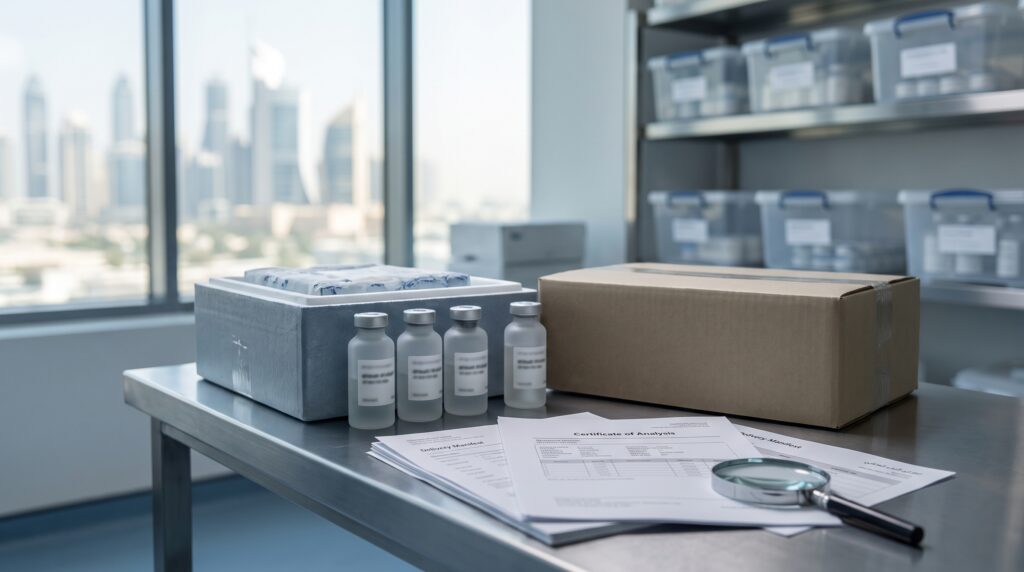
Quick Answer: How to Spot Fake Peptides Dubai
To spot fake peptides in Dubai, buyers must verify third-party Certificates of Analysis (COAs) via independent QR codes, demand LC-MS testing to confirm molecular identity alongside HPLC purity, and avoid overseas vendors relying on unregulated cold chains. Always watch for hidden customs fee scams and crypto-only payment portals.
Procuring high-quality research compounds in the Gulf region presents a unique set of challenges. Between stringent local regulatory environments, an influx of grey-market sellers, and extreme summer temperatures, acquiring verified research materials requires a highly critical eye. Researchers, procurement staff, and informed buyers must move beyond surface-level marketing to understand the technical, analytical, and logistical markers of authentic products.
This guide focuses on actionable, evidence-based steps to evaluate vendors, read laboratory documentation correctly, and navigate the specific procurement hurdles of the UAE.
The UAE Regulatory Crackdown and the Grey Market
The necessity for strict vendor vetting was underscored recently when UAE health authorities, including the Ministry of Health and Prevention (MoHAP), enforced rigorous regulatory actions across the emirates. This major crackdown targeted unapproved compound sources and social media influencers marketing unauthorized products.
The landscape of the market shifted immediately. Unregulated, overseas suppliers who previously shipped unchecked parcels into the region began resorting to deceptive practices to bypass regulatory friction. Consequently, buyers must be exceptionally vigilant. Many opportunistic vendors rely on the fact that standard researchers may not know how to interrogate testing data or spot logistical red flags.
When evaluating how to spot fake peptides in Dubai, the first line of defence is understanding exactly what analytical data should accompany a genuine product, how scammers manipulate these documents, and what a physical vial actually tells you.
Identifying Under-Dosed vs. Completely Fake Peptides
A major misconception in the research community is that a “fake” peptide is always an empty vial. In reality, deception in the grey market takes several forms:
- The Bait and Switch (Bunk Product): The vial contains zero active peptide. It is entirely composed of a filler, typically mannitol or glycine, which forms a perfect-looking white lyophilised (freeze-dried) puck. Visual inspection cannot confirm the presence of an active compound.
- Under-Dosing: A vendor claims a vial contains 10mg of a target peptide, but it actually contains only 2mg. This maximizes their profit margin while leaving researchers with skewed, invalid data due to incorrect concentration calculations.
- Substitution: Substituting an expensive, complex peptide sequence with a cheaper, easier-to-synthesize alternative.
Because visual inspection is useless for determining molecular structure or concentration, objective laboratory testing is the only viable method for verification.
The Anatomy of a Genuine COA (And How to Spot Forgeries)
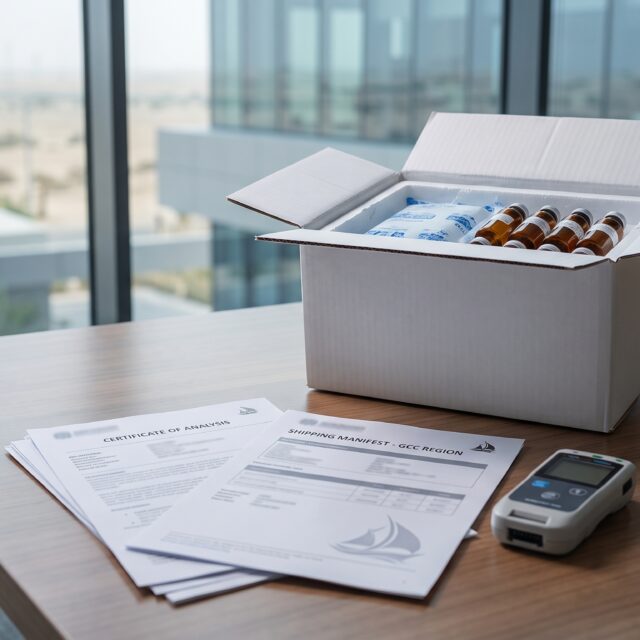
A Certificate of Analysis (COA) is a document issued by a laboratory detailing the precise composition and purity of a specific batch. Unfortunately, in the modern grey market, scammers regularly use generic, stolen, or even AI-generated COAs that present realistic chromatograms but contain no authentic test data.
Verifying the Testing Laboratory
A legitimate COA must never be an internal document drafted by the supplier themselves. It must originate from a third-party, independent analytical laboratory.
To verify a COA, look for a scannable QR code or a direct reference link. When scanned, this code should route you directly to the independent laboratory’s official database, where the matching report is hosted. If a vendor provides a low-resolution PDF, a screenshot, or an image with no live verification link, the document should be treated with extreme suspicion. Scammers frequently use Photoshop to change the date, batch number, or vendor name on legitimate COAs stolen from reputable suppliers.
HPLC vs. LC-MS: Why Purity Isn’t Enough
Many buyers mistakenly believe that a “99% Purity” stamp is definitive proof of authenticity. While High-Performance Liquid Chromatography (HPLC) is essential, it is only half of the required analytical picture.
- HPLC (High-Performance Liquid Chromatography): This measures the concentration and purity of a compound within a vial. On an HPLC chromatogram, you want to see a single, sharp, distinct peak indicating the primary compound. Multiple jagged peaks or a wide “tail” signify impurities, byproducts, or incomplete synthesis. However, HPLC only separates components; it cannot definitively confirm what that primary compound is.
- LC-MS (Liquid Chromatography-Mass Spectrometry): To establish the exact molecular identity of the synthesised peptide, the laboratory must use Mass Spectrometry (such as LC-MS or MALDI-TOF). Mass Spectrometry measures the exact mass-to-charge ratio of the molecules.
If a vendor offers an HPLC report but no LC-MS data, you only know that the vial contains 99% of something—but you have no scientific proof that it is the specific research peptide you ordered. A high-purity batch of a completely wrong compound is useless for research.
Furthermore, for in vitro or sensitive cellular research, buyers should look for endotoxin testing to confirm sterility. Clear measurements should be indicated in Endotoxin Units (EU/mg or EU/mL).
Gulf Heat as the Silent Degrader
A crucial factor in learning how to spot fake peptides Dubai researchers often overlook is environmental degradation. A peptide can leave a laboratory in North America perfectly pure, but arrive in the UAE entirely compromised.
Dubai’s summer temperatures regularly reach 40°C to 48°C. Peptides are highly complex, fragile molecular chains held together by delicate bonds. When exposed to extreme heat, they undergo rapid degradation pathways, including hydrolysis, oxidation, and deamidation.
Standard international shipping exposes unregulated shipments to unconditioned airport tarmacs, hot sorting facilities, and non-refrigerated delivery vans. Furthermore, UAE customs clearance for chemical compounds can sometimes face delays. A parcel held in transit or at a non-temperature-controlled customs warehouse for 7 to 14 days in the Gulf summer effectively renders the compound useless.
While the product may not be “fake” in origin, it is chemically dead upon arrival. Your research results will mimic those of a bunk product.
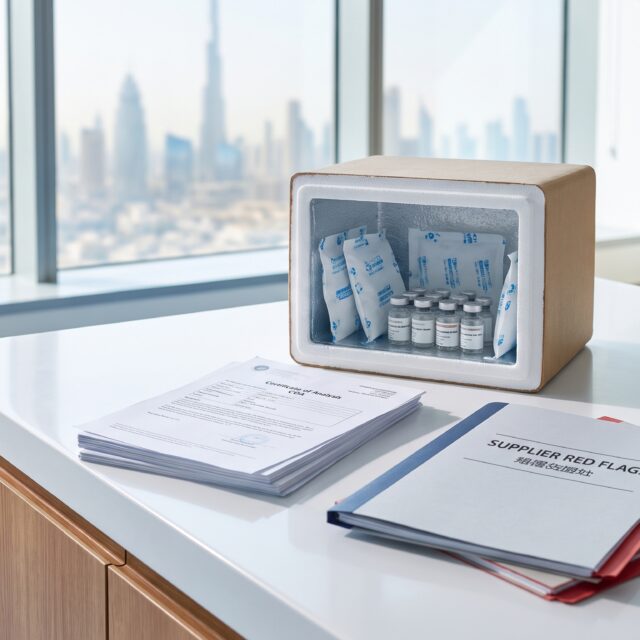
This highlights the critical importance of regional logistics. Lyophilised peptides should ideally be kept away from extreme heat, and reconstituted peptides require strict storage at 2°C to 8°C. Sourcing from vendors with local UAE infrastructure ensures that your compounds spend minimal time in transit and are protected from catastrophic thermal exposure. For researchers looking to mitigate this risk, evaluating specialised local delivery options is a non-negotiable step to ensuring compound integrity.
Payment, Support, and Procurement Red Flags
Beyond laboratory reports and shipping temperatures, the operational behaviour of a vendor provides clear signals regarding their legitimacy. When sourcing in the GCC, watch out for these prominent red flags:
- Encrypted Apps and Crypto-Only Transactions: Unregulated grey-market sellers often operate exclusively via encrypted messaging applications like Telegram and accept only cryptocurrency. While privacy is valued, a complete lack of traditional, secure payment gateways indicates a supplier unwilling to attach a formal business identity or banking footprint to their operations.
- The Customs Fee Scam: A highly common fraudulent tactic in the UAE involves a seller “shipping” the product, providing a fake tracking number, and then contacting the buyer a few days later demanding an unexpected “customs release fee,” “clearance stamp fee,” or “insurance payment” to clear Dubai borders. Genuine suppliers calculate all shipping and clearance transparently at checkout and do not ask for secondary wire transfers.
- No Stock Transparency: Sellers who claim to have endless supplies of highly complex, rare compounds without batch numbers or current dates on their testing data are frequently drop-shipping from overseas factories without performing any quality control upon receipt.
- Lack of Accountable Support: A legitimate operation will have a professional support apparatus—such as a responsive email ticketing system or a verifiable WhatsApp business line—to handle inquiries regarding batch data, shipping, and handling protocols.
Evaluating Your Supplier: The NOVA Labs Standard
Mitigating risk in peptide procurement requires aligning with suppliers who prioritise transparency, stringent testing, and regional logistical expertise. At NOVA Labs, we understand the specific challenges UAE researchers face, from navigating complex quality requirements to managing the harsh environmental variables of the Gulf climate.
We provide independent, verifiable COAs containing both HPLC purity and LC-MS identity testing for our catalogue. Rather than relying on extended international shipping timelines that threaten compound stability, we utilise localised fulfilment networks to ensure rapid, secure delivery. This operational structure safeguards the integrity of the compounds from the moment they are synthesised until they reach your laboratory bench.
If you are evaluating suppliers and require verifiable, precision-synthesised compounds supported by transparent analytical data, you can explore our full catalogue of research compounds to see how proper documentation and logistics should look.
Final Buyer Checklist
Understanding how to spot fake peptides Dubai researchers encounter means transitioning from trusting marketing claims to demanding verifiable data. Fraudulent vendors capitalise on knowledge gaps regarding analytical chemistry and international logistics.
Before placing an order for research materials, consult this final checklist:
- Verify the COA: Ensure the report is from a third-party analytical lab and verifiable via QR code or direct database link. Do not accept screenshots.
- Demand LC-MS: Do not accept HPLC purity alone; verify molecular identity through Liquid Chromatography-Mass Spectrometry.
- Check Logistics: Avoid 14-day international shipping windows. Demand local, temperature-conscious dispatch to avoid heat degradation.
- Evaluate Payment and Support: Avoid vendors who operate solely on Telegram, demand crypto-only payments, or surprise you with post-shipping customs fees.
By enforcing these rigorous standards, UAE researchers can ensure the integrity of their materials, avoid financial scams, and guarantee the validity of their subsequent research outcomes.
*
Disclaimer: The products and information mentioned in this article are strictly for research and laboratory purposes only. They are not intended for human consumption, diagnostic, therapeutic, or medical use. Always handle compounds in accordance with standard laboratory safety protocols.
References
- Gulf News (2024). UAE MoHAP Cracks Down on Unapproved Weight-Loss Drugs and Social Media Promoters.
- VaultLabs Technical Whitepaper. Thermal Stability of Lyophilized Peptides in the Gulf Climate.
- NorthPeptide (2024). Peptide Vendor Scams: 8 Red Flags + COA Checklist.
- NOVA Labs Internal QA Protocols (2024). Peptide Storage Temperature Saudi Arabia & UAE: Stability & Cold Chain.
Disclaimer: The products mentioned in this article are for research purposes only and are not intended for human consumption.
- UAE Cracks Down on Unapproved Peptide Weight-Loss Drugs: 71 Sources and 14 Influencers Face Action – Gulf News
- Thermal Stability of Lyophilized Peptides in the Gulf Climate | VaultLabs Technical Whitepaper
- How To Spot Fake Peptides Bahrain & UAE: Practical Buyer Guide – NOVA Labs
- Peptide Vendor Scams: 8 Red Flags + COA Checklist (2026) – NorthPeptide
- Peptide Storage Temperature Saudi Arabia: Stability & Cold – NOVA Labs
Frequently asked questions
How can I verify a peptide COA in Dubai?
A genuine Certificate of Analysis (COA) should have a QR code or a direct link that routes to the independent testing laboratory's official database. If a vendor provides only a low-resolution PDF or screenshot without external verification, the document may be forged or altered.
Why is HPLC purity testing not enough to spot fake peptides?
HPLC testing measures the concentration and purity of a compound but cannot confirm its exact molecular identity. You must also require Liquid Chromatography-Mass Spectrometry (LC-MS) to scientifically prove the vial contains the specific peptide sequence you ordered rather than a high-purity substitute.
How does Dubai's heat affect shipped peptides?
Dubai's summer temperatures of 40°C to 48°C can rapidly accelerate degradation pathways like hydrolysis and oxidation in complex peptides. Extended international shipping without cold-chain control can effectively destroy the compound before it arrives, making local, temperature-controlled delivery critical.
What is the customs release fee scam in peptide buying?
Many fraudulent overseas vendors provide fake tracking numbers and later contact buyers demanding hidden 'customs release fees' or 'insurance payments' to supposedly clear UAE borders. Legitimate suppliers calculate all logistics and clearance fees transparently at checkout without post-purchase demands.
Can I tell if a peptide is fake by looking at the vial?
No. Visual inspection cannot confirm authenticity. A perfectly solid, white lyophilised puck could be 100% active peptide, severely under-dosed, or entirely composed of a filler like mannitol. Objective laboratory testing (HPLC and LC-MS) is the only way to verify contents.
Nova Labs buyer tools
Ready to verify stock, testing and delivery?
Use the product page and lab report section to check availability, documentation, delivery timing and support before placing an order.
- COA / test-report checks
- Dubai delivery context
- Cold-chain handling
- COD and card payment options
- WhatsApp support