
NAD+ vs GHK-Cu: the short answer
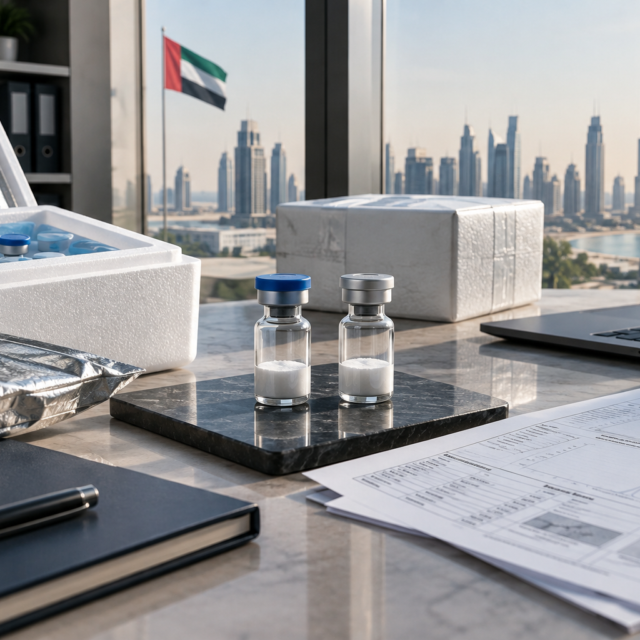
NAD+ vs GHK-Cu is a comparison of two different research materials, not interchangeable peptides. NAD+ is a nucleotide coenzyme studied in cellular metabolism; GHK-Cu is a copper-associated tripeptide studied in copper–peptide chemistry. For a UAE order, match the material to your research specification, then verify batch documentation, storage requirements and delivery arrangements.
Quick answer — buyer checklist
- Identify the material: NAD+ is not a peptide; GHK-Cu is not simply another name for the uncomplexed peptide GHK.
- Match the batch: Compare the lot number on the listing, certificate of analysis (COA) and supplied vial.
- Read the tests: Ask what establishes identity and purity; for GHK-Cu, ask what supports the copper-associated designation.
- Check UAE logistics: Confirm stock, labelled storage conditions, packaging, delivery window and available payment methods before checkout.
| Procurement question | NAD+ | GHK-Cu |
| — | — | — |
| What is being specified? | A nucleotide coenzyme in a stated chemical form | A copper-associated complex of the tripeptide GHK |
| What does the literature commonly examine? | Redox chemistry and NAD-dependent enzymes | Copper–peptide interactions and tissue-related experimental models |
| What deserves particular attention on a COA? | Chemical form, identity method and relevant related species | Peptide identity and evidence supporting the copper-associated product |
This comparison considers molecular identity, published research and procurement checks. It does not rank suppliers or independently validate either product listing.
What is the structural difference between NAD+ and GHK-Cu?
NAD+, or nicotinamide adenine dinucleotide, is a nucleotide-derived coenzyme. NAD+ and its reduced form, NADH, are distinct chemical species involved in cellular redox reactions. NAD+ also participates in reactions involving NAD-consuming enzymes discussed in the research literature. A catalogue may place NAD+ alongside peptide vials for convenience, but that does not make it a peptide.[1,2]
GHK-Cu refers to a copper-associated complex of glycyl-L-histidyl-L-lysine (GHK), a tripeptide. GHK and GHK-Cu are related descriptions, not interchangeable specifications. Published work discusses GHK-Cu in copper–peptide chemistry and experimental tissue-related models.[3] Those studies do not establish a human outcome for a commercial research vial.
The practical consequence is that the product name must agree with the research protocol. If a method specifies a particular NAD+ form, a report for a differently described material needs clarification. If a method specifies GHK-Cu, evidence identifying the GHK peptide alone does not settle whether the supplied material meets that specification.
Which material fits the research question?
Start with the test article described in the study or protocol, not with a shared catalogue category. A project examining NAD-dependent biochemistry calls for a different material from one examining a copper–peptide complex. Published NAD+ research addresses redox reactions, metabolism and NAD-consuming enzymes.[1] The GHK-Cu literature addresses other experimental questions, including copper binding and tissue-associated models.[3]
Check the exact material named by the method, along with its stated form, analytical requirements and any control materials. Do not silently substitute GHK for GHK-Cu, or infer that a preparation described only as NAD-related is the NAD+ form your experiment requires. Neither the number of papers about a substance nor a supplier category establishes suitability for a particular assay; that decision depends on the study design and your laboratory’s acceptance criteria.
For a first purchase, it helps to write a short internal specification before contacting a supplier: required identity, acceptable analytical methods, minimum documentation, quantity and receiving conditions. That makes it easier to compare a listing with the experiment and to ask a precise question if a report leaves something unclear.
How should you read the COA and test results?
A COA is most useful when it connects the batch being offered to named tests and reported results. Compare the product name, stated chemical form and lot identifier on the report with the listing; compare them again with the vial when it arrives. Check the test date, analytical method, units and any stated acceptance limits. A report with no lot number, or one covering a different lot, is not batch-matched evidence for your order.
For NAD+, look for an identity method appropriate to the stated form. Chromatographic and mass-spectrometric data can support aspects of identification when the methods and results are described, but ask whether the testing addresses related species relevant to your specification. In particular, do not read a purity percentage as proof of the amount in the vial. Identity, chromatographic purity and content are different questions.
For GHK-Cu, separate peptide identification from complex characterisation. HPLC may report chromatographic purity, and mass spectrometry may support peptide identity, but neither result by itself necessarily establishes copper content or the state of the copper-associated product. Ask what evidence supports the GHK-Cu designation and whether a suitable copper-related assay or other characterisation is available. A COA for GHK alone is not automatically a COA for GHK-Cu.
A claim such as 98% purity needs context: 98% by which method, against what specification and for which lot? It does not independently establish identity, quantity, copper association or suitability for an experiment. Likewise, a third-party report adds useful independent evidence only to the extent that it identifies the sample, testing laboratory, method, date and actual findings. Do not assume a test covered attributes it does not name.
NOVA Labs lists available documentation on its lab-results page. A posted report should still be checked against the lot offered for the order; the presence of a report on a website does not establish that every current batch has the same results.
What should Dubai and GCC buyers confirm before payment?
Analytical documentation and shipping arrangements answer different questions. For a Dubai or other UAE delivery address, check the labelled storage conditions for the specific material and ask how the order will be packed for the expected transit time and local temperatures. If your procurement rules require temperature-controlled shipping, establish what service is actually provided and whether temperature records are available. Insulation by itself is not evidence that a parcel stayed within a defined temperature range.
Confirm whether the item is in stock, where it dispatches from and the estimated delivery window for your address. If timing matters for a scheduled experiment, distinguish an estimated delivery date from a guaranteed service. Ask how delays or damaged parcels are handled and what evidence the supplier needs if a shipment arrives outside your acceptance criteria.
For destinations elsewhere in the GCC, clarify who is responsible for import documentation, customs clearance and any associated charges. Requirements can differ by destination and shipment, so a successful UAE delivery does not establish the process for another country. Confirm the accepted payment methods at checkout or with support, including whether cash on delivery is available for the particular address; do not infer it from a general site banner. If support is offered through WhatsApp, email or another channel, retain written confirmation of any batch, shipping or payment details that affect your purchase approval.
Neither product name establishes a universal storage temperature or shipping method. Use the supplied material’s instructions and your organisation’s receiving criteria rather than assuming the two products can be handled alike.
What should you check when the parcel arrives?
Before accepting a shipment into inventory, compare the vial label and lot number with the order and COA. Check that the packaging and any required shipping records meet the conditions agreed before dispatch. Record the arrival date, visible packaging condition and any discrepancy under your laboratory’s normal receiving procedure. If documentation or transit evidence is missing, keep the material’s status unresolved until the supplier clarifies it; a matching product name alone does not close a batch or shipping question.
The purchase decision
The decisive distinction in NAD+ vs GHK-Cu is identity: a nucleotide coenzyme versus a copper-associated tripeptide. Choose against the research specification, then check batch-matched analytical evidence and the storage, delivery and payment terms that apply to your address. A headline purity figure cannot replace those checks.
If either material matches your specification, review the NAD+ research vial listing or GHK-Cu research vial listing and ask NOVA Labs support to confirm the current lot documentation and delivery terms before ordering.
Research-use notice: These materials are for research purposes only and are not intended for human consumption.
References
- Covarrubias AJ, Perrone R, Grozio A, Verdin E. “NAD+ metabolism and its roles in cellular processes during ageing.” Nature Reviews Molecular Cell Biology (2021). https://doi.org/10.1038/s41580-020-00313-x.
- National Center for Biotechnology Information. “Nicotinamide adenine dinucleotide.” PubChem Compound Summary. https://pubchem.ncbi.nlm.nih.gov/compound/5893.
- Pickart L, Margolina A. “Regenerative and Protective Actions of the GHK-Cu Peptide in the Light of the New Gene Data.” International Journal of Molecular Sciences (2018). https://doi.org/10.3390/ijms19071987.
Frequently asked questions
Is NAD+ a peptide like GHK-Cu?
No. NAD+ is a nucleotide coenzyme. GHK-Cu is a copper-associated tripeptide complex. They are different research materials and should not be substituted for one another without reference to the research specification.
What is the difference between GHK and GHK-Cu on a COA?
GHK names the tripeptide; GHK-Cu describes its copper-associated form. A COA identifying GHK alone does not necessarily verify copper content or characterise the GHK-Cu product.
Does 98% HPLC purity prove NAD+ or GHK-Cu identity?
No. An HPLC purity figure is a result obtained under a particular method. It does not independently establish identity, amount or, for GHK-Cu, copper association. Check the lot-specific method and supporting results.
Do NAD+ and GHK-Cu need cold-chain delivery in the UAE?
Their names alone do not establish a shipping requirement. Check the storage instructions for each supplied material and confirm whether the proposed packaging and transit conditions meet your laboratory's requirements.
What should I ask a UAE supplier before ordering NAD+ or GHK-Cu?
Ask for the current lot number and matching COA, the tests supporting identity and purity, labelled storage conditions, stock status, delivery arrangements for your address and available payment methods. For GHK-Cu, ask what evidence supports the copper-associated designation.
Nova Labs buyer tools
Ready to verify stock, testing and delivery?
Use the product page and lab report section to check availability, documentation, delivery timing and support before placing an order.
- COA / test-report checks
- UAE delivery context
- Cold-chain handling
- COD and card payment options
- WhatsApp support