




Procuring laboratory compounds in the GCC can be a logistical and legal minefield. For procurement officers, independent scientists, and institutional researchers in Dubai, Abu Dhabi, and the wider UAE, compliance is paramount. Before authorizing a purchase order, one question overrides all others: are research peptides legal to buy and possess in the UAE?
The regulatory landscape has tightened significantly. The days of relying on international grey-market shippers who casually mislabel shipments are permanently over. With the Emirates Drug Establishment (EDE) assuming full federal regulatory authority, the line between what is permitted for scientific study and what is strictly prohibited has been crystalized. If you are evaluating suppliers for your next in-vitro study, understanding these legal boundaries is non-negotiable.
Are Research Peptides Legal in the UAE?
Quick answer: Yes, research peptides are legal in the UAE exclusively for in-vitro scientific and laboratory studies. However, they are strictly prohibited for human consumption. Under EDE regulations, therapeutic use requires a prescription, while unauthorized personal imports face high customs seizure rates. Ensure compliant local sourcing.
To operate compliantly within the UAE and the broader GCC, researchers must understand that intent, documentation, and supplier verification dictate the legality of a compound. The legal status of these compounds is divided sharply by their classification and intended use. Misunderstanding this distinction can lead to supply chain disruptions, seized shipments, and potential legal liabilities.
The Regulatory Reality: Federal Decree-Law No. 68
Historically, the global market for laboratory compounds operated in a persistent grey area, with vendors slapping a simple “Not for Human Consumption” sticker on a vial and shipping it across borders. In the UAE, that regulatory loophole has been firmly shut.
Under Federal Decree-Law No. 68 of 2023, the Emirates Drug Establishment (EDE) became the sole federal authority regulating pharmaceutical and medical products in the UAE, taking over key responsibilities from the Ministry of Health and Prevention (MOHAP). The EDE does not recognize the “legal fiction” of selling peptides marketed for human use under the guise of an analytical standard.
If a peptide is intended for therapeutic, cosmetic, or human use, it is classified as a Prescription-Only Medicine (POM). These require formal EDE marketing authorization and can only be obtained via a prescription from a DHA- (Dubai Health Authority) or DOH- (Department of Health Abu Dhabi) licensed physician. Conversely, research peptides are permitted strictly for in-vitro, laboratory-based research settings. They are unauthorized for human consumption, and any vendor attempting to market them as supplements, cosmetics, or weight-loss aids without Dubai Municipality (Montaji) or EDE registration is operating illegally.
Recent EDE Crackdowns on Unapproved Sources
The enforcement of these regulations is not merely theoretical; it is highly active. Recently, UAE health authorities launched a major nationwide crackdown targeting the illegal distribution of unapproved metabolic research peptides.
During this sweeping initiative, authorities shut down 71 unapproved peptide sources and pursued legal action against 14 social media influencers who were illegally marketing research compounds as consumer weight-loss solutions. This aggressive enforcement underscores a critical reality for buyers: the government actively monitors the market to protect public health. Legitimate researchers and laboratory procurement officers must distance themselves from vendors making medical claims and exclusively source from suppliers who operate with strict analytical, operational, and marketing integrity.
Customs Friction and the Risks of Personal Import
For many researchers in Dubai, Sharjah, or Abu Dhabi, the first instinct is often to order from large international catalogs based in the United States or China. While this might seem cost-effective initially, it introduces severe logistical, financial, and regulatory friction.
UAE Customs actively intercepts and inspects inbound chemical and biological shipments at major hubs like Dubai International (DXB) and Zayed International (AUH). When an international package containing biological compounds arrives without the requisite commercial licenses, EDE import permits, and proper batch documentation, it is almost universally flagged.
Unauthorized personal shipments of research peptides face extremely high seizure rates. Even if a shipment is eventually cleared, the administrative process can take weeks of back-and-forth communication, requiring detailed chemical declarations and proof of institutional affiliation.
The Threat of the GCC Climate
Beyond the legal hurdles, international shipping poses a severe threat to the viability of the compounds. During customs delays, packages often sit in non-climate-controlled processing facilities. In the UAE, where summer temperatures frequently exceed 45°C (113°F), the environmental stress is immense.
Given that many lyophilized (freeze-dried) peptides are highly sensitive to extreme heat, a delay in the GCC climate often results in the complete degradation of the compound before it ever reaches your laboratory bench. Degraded peptides yield wildly inaccurate experimental data, rendering your research invalid and wasting valuable grant money or operational budgets.
Fulfilling the Scientific Checklist: What UAE Buyers Must Verify
If you are conducting legitimate in-vitro research in the UAE, finding a domestic supplier that understands local compliance is critical. A reputable supplier implicitly provides a safe regulatory framework through their transparent business practices. Here is the mandatory checklist procurement officers must verify before approving a purchase order.
1. Visible, Batch-Specific COAs and HPLC Testing
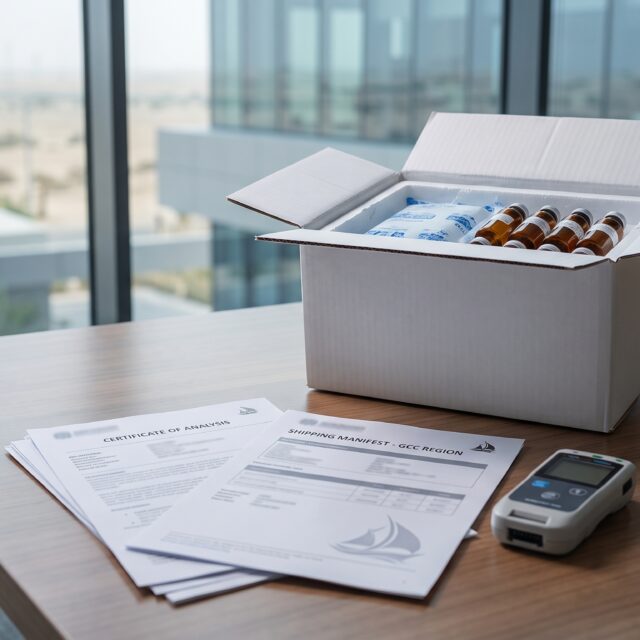
Never take a supplier’s word for the purity of a compound. The industry standard requires a Certificate of Analysis (COA) supported by third-party High-Performance Liquid Chromatography (HPLC) and Mass Spectrometry (MS).
These documents verify two crucial factors:
- Purity (HPLC): Indicates the percentage of the target peptide in the vial. For accurate in-vitro data, researchers should demand a minimum of 99% purity, ensuring no byproducts interfere with cellular assays.
- Identity (MS): Confirms the exact molecular sequence and molecular weight, ensuring you have received the correct compound and not a substituted filler or a degraded byproduct.
Before ordering, check if the supplier makes these documents accessible. At NOVA Labs, we prioritize analytical transparency. You can review our comprehensive, batch-specific verified lab results directly on our platform, ensuring that every batch you procure meets stringent scientific standards.
2. Localized Cold-Chain Logistics
The GCC climate presents a unique challenge for peptide stability. While intact lyophilized peptides are relatively stable at controlled room temperatures for short periods, prolonged exposure to the intense UAE heat during transit can compromise their structural integrity.
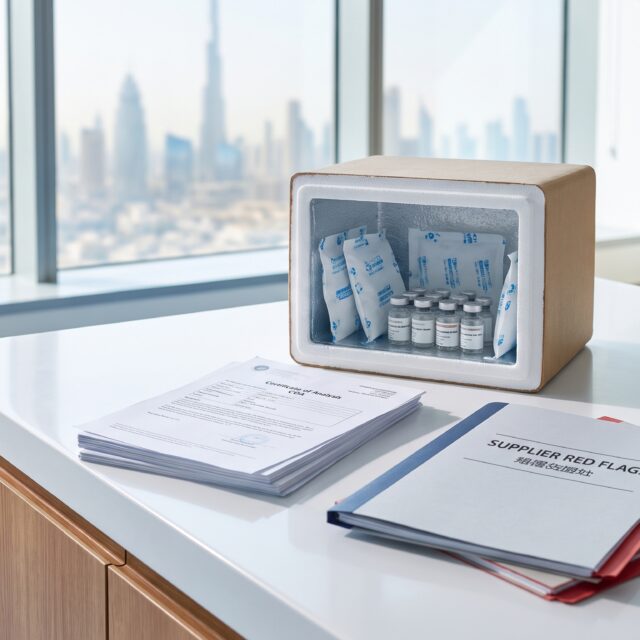
A compliant, high-quality supplier must guarantee rapid, localized fulfillment that keeps transit times strictly under 24 to 48 hours. Using insulated packaging and reliable local courier networks minimizes temperature fluctuations. If an international supplier cannot explain how they protect the peptide from the desert heat during a multi-week delivery window, they are not a viable partner for serious research.
3. Clear Research-Only Positioning
Evaluate the supplier’s website and communication tone. Are they offering dosage advice, discussing human trials, providing treatment protocols, or promoting miraculous body-composition changes? If so, they are actively violating EDE regulations and putting their entire operation—and your supply chain—at risk of seizure and shutdown.
A trustworthy supplier will communicate exclusively in commercial, scientific terms. They will provide factual information on molecular weights, amino acid sequences, reconstitution guidelines for laboratory settings, and purity benchmarks—nothing more.
4. Seamless Payment and Procurement Support
International transactions for biological compounds are often flagged by UAE banks, leading to frozen funds or delayed orders. A local supplier circumvents this by offering localized payment gateways. Look for suppliers that support Cash on Delivery (COD) for immediate procurement needs, secure local bank transfers, or even cryptocurrency options for privacy-focused researchers. Additionally, having access to direct WhatsApp support ensures that lab managers can quickly resolve inventory inquiries or secure emergency stock without dealing with time-zone delays.
Best Practices for Handling Peptides in UAE Laboratories
Once your compliant compounds arrive, preserving their integrity in the GCC climate is your responsibility.
- Storage: Unreconstituted lyophilized peptides should be immediately stored in a freezer at -20°C upon arrival for long-term stability, away from intense light and moisture.
- Reconstitution: When preparing the compound for in-vitro assays, use strictly sterile environments. Reconstitute using bacteriostatic water or sterile water for injection, depending on the requirements of your specific assay.
- Post-Reconstitution: Once in liquid form, the peptide must be kept refrigerated at 2°C to 8°C and typically utilized within 14 to 30 days to prevent bacterial growth and molecular degradation.
Streamline Your Sourcing with NOVA Labs
Navigating the legalities and logistical hurdles of peptide procurement in the UAE does not have to be a headache. By sourcing from a local, compliance-aware supplier, researchers can bypass the severe friction of international customs, entirely avoid the risk of heat degradation, and streamline their institutional procurement process.
At NOVA Labs, we have built our operations around the specific, rigorous needs of the UAE and GCC research community. We hold our inventory locally, meaning our shipments are not subject to the unpredictable delays of cross-border customs clearance. We offer practical local payment options, including COD, and provide direct WhatsApp support to handle procurement inquiries efficiently.
When you need to replenish your laboratory supplies, you require speed, analytical transparency, and absolute reliability. We ensure your compounds arrive rapidly, maintaining their structural integrity so your important research can proceed without interruption.
Ready to upgrade your procurement process and source locally? Browse our full catalog of premium, analytically verified compounds in our online shop.
Bottom Line
The answer to the pressing question—”are research peptides legal” in the UAE—is clear: they are strictly regulated, entirely legal for verified in-vitro research, and unequivocally banned for unauthorized human consumption. The EDE’s tightening of regulations and subsequent crackdowns have eliminated the irresponsible grey market, leaving room only for professional, compliant, and transparent suppliers. By demanding third-party testing, prioritizing local logistics to beat the heat, and partnering with scientifically responsible suppliers, UAE researchers can seamlessly source the high-purity compounds their work demands without running afoul of local laws.
Disclaimer: NOVA Labs products are strictly for in-vitro scientific research and laboratory use only. They are not intended for human consumption, therapeutic use, or diagnostic applications.
References
- Emirates Drug Establishment (EDE): UAE Federal Decree-Law No. 68 of 2023 on the Establishment of the Emirates Drug Establishment.
- Gulf News (2024): UAE Cracks Down on Unapproved Peptide Weight-Loss Drugs: 71 Sources and 14 Influencers Face Action.
- Pharma Knowledge Consulting: UAE Drug Registration and EDE Regulatory Framework.
Disclaimer: The products mentioned in this article are for research purposes only and are not intended for human consumption.
- How to Register Peptides in the UAE: A Regulatory Guide for Brands and Manufacturers
- UAE Cracks Down on Unapproved Peptide Weight-Loss Drugs: 71 Sources and 14 Influencers Face Action – Gulf News
- United Arab Emirates Peptide Laws & Regulations – PeptideLaws.com
- Peptide Supplier Checklist Sharjah: Verify Purity & Delivery – NOVA Labs
- Legal & Compliance Standards – UAE Peptide Clinic
- UAE Drug Registration | MOHAP & EDE Guide 2026 | PKCS – Pharma Knowledge Consulting and Services
Frequently asked questions
Are research peptides legal to buy in the UAE?
Yes, research peptides are legal to purchase and possess in the UAE exclusively for in-vitro scientific and laboratory research. They are strictly prohibited for human consumption or therapeutic use without EDE marketing authorization.
Will UAE customs seize my peptide order from overseas?
Yes, UAE Customs actively intercepts and frequently seizes unauthorized personal shipments of research peptides from international vendors. Sourcing from a local supplier avoids cross-border customs friction and transit delays.
What is the EDE and how does it regulate peptides?
The Emirates Drug Establishment (EDE) is the federal authority regulating pharmaceuticals in the UAE. The EDE mandates that any peptide intended for human use is a Prescription-Only Medicine, while research peptides are heavily restricted to verified laboratory settings.
How can I verify the quality of a research peptide in Dubai?
You should verify quality by requesting a batch-specific Certificate of Analysis (COA) that includes third-party High-Performance Liquid Chromatography (HPLC) and Mass Spectrometry (MS) results showing 99% or higher purity.
Why is cold-chain shipping important for peptides in the GCC?
The extreme heat in the GCC can rapidly degrade lyophilized peptides. Reliable suppliers use local fulfillment and temperature-controlled logistics to ensure the compounds remain structurally stable and viable for laboratory use.
Nova Labs buyer tools
Ready to verify stock, testing and delivery?
Use the product page and lab report section to check availability, documentation, delivery timing and support before placing an order.
- COA / test-report checks
- UAE delivery context
- Cold-chain handling
- COD and card payment options
- WhatsApp support