



Bacteriostatic Water For Peptides Bahrain: Essential Procurement Guide
Quick Answer: Procuring bacteriostatic water for peptides in Bahrain requires navigating NHRA customs and extreme GCC temperatures. Researchers must select solvents containing 0.9% benzyl alcohol for multi-dose vial stability, utilize regional UAE distributors to minimize transit times, and ensure all imports include valid Certificates of Analysis.
Key Takeaways for Bahrain Researchers
- Required Diluent: Use strictly 0.9% benzyl alcohol formulations to ensure a 28-day refrigerated shelf life for reconstituted compounds.
- Customs Clearance: Ensure imports are clearly declared as “In-Vitro Research Use Only” with supporting MSDS to pass Bahrain’s OFOQ system.
- Transit Speed: Prioritize regional UAE hubs over global forwarders to cut delivery times from 3 weeks to just 2-4 days.
- Quality Assurance: Never purchase laboratory solvents without verifying third-party HPLC purity reports.
When sourcing laboratory solvents in Manama and across Bahrain, researchers require sterile, non-pyrogenic diluents that protect delicate lyophilized compounds during reconstitution. For scientific investigators, acquiring high-quality reconstitution solvents often involves navigating a complex supply chain. Historically, local researchers have relied on generic third-party import platforms, resulting in extended wait times, severe retail markups, and compromised product integrity.
Furthermore, the extreme heat of the GCC summer presents unique logistical hurdles that must be mitigated to prevent the thermal degradation of valuable research materials. This guide breaks down the science of solvent selection, the mechanics of reconstitution, and the operational realities of importing laboratory supplies in Bahrain while complying with local regulatory frameworks.
Bacteriostatic Water vs. Sterile Water: Why Solvent Selection Matters
The fundamental difference between bacteriostatic water (BAC water) and standard sterile water dictates the stability, lifespan, and safety of your reconstituted research compounds. Selecting the wrong diluent is a frequent laboratory error that can lead to rapid peptide degradation or microbial contamination, ultimately invalidating costly research data.
The Chemical Role of 0.9% Benzyl Alcohol
Bacteriostatic water is formulated with precisely 0.9% benzyl alcohol (BnOH). This aromatic alcohol acts as a bacteriostatic preservative, meaning it actively inhibits the reproduction of bacteria within the vial by disrupting microbial cell walls, without damaging the delicate peptide chains suspended in the solution.
Once a lyophilized (freeze-dried) peptide is reconstituted with BAC water, the resulting solution can typically be stored in a laboratory refrigerator (2°C to 8°C) for up to 28 days without compromising its structural integrity or sterility. This extended window makes bacteriostatic water the mandatory standard for multi-dose research vials.
The Limitations of Unpreserved Sterile Water
In contrast, standard sterile water for injection contains zero preservatives. It is strictly manufactured for single-use applications. If a multi-dose peptide vial is reconstituted using sterile water, the protective barrier is broken the moment the vial stopper is punctured. Any compound not immediately utilized becomes highly susceptible to bacterial contamination within 24 to 48 hours. Furthermore, peptides dissolved in unpreserved sterile water degrade at a much faster rate, compromising the accuracy of longitudinal research studies.
Navigating Bahrain Customs, NHRA, and GCC Heat
Procuring laboratory supplies in the Middle East involves stringent regulatory compliance and severe environmental challenges. A robust understanding of local customs procedures and cold-chain principles is strictly necessary to secure your research investment.
The OFOQ System and Required Documentation
Bahrain’s customs clearance procedures are managed digitally through the OFOQ system and overseen by the National Health Regulatory Authority (NHRA). When importing biological compounds, peptides, or laboratory solvents, documentation is everything. Standard international shipments often face significant delays, or even seizure, if they are vaguely manifested.
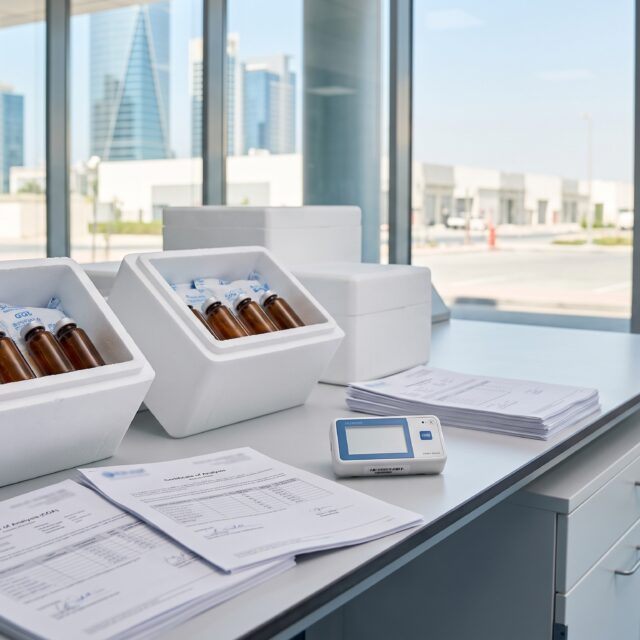
To ensure smooth passage, researchers must rely on suppliers who provide clear, accurate commercial invoices. Items should be declared explicitly with their exact INCI naming and clearly marked as “In-Vitro Research Use Only.” Furthermore, premium vendors supply Material Safety Data Sheets (MSDS) and Certificates of Analysis (COA) directly alongside the shipping documents. Failing to contextualize the import as a laboratory supply rather than a consumer pharmaceutical often triggers prolonged NHRA review periods.
Mitigating Thermal Degradation During Transit
The extreme GCC summer climate—where temperatures routinely exceed 40°C to 45°C—poses a significant threat to fragile peptide chains. While lyophilized powder is relatively resilient to temporary heat exposure during transit, post-reconstitution liquid peptides are highly volatile and degrade rapidly if exposed to thermal stress.
For this reason, transit must always occur while the compounds remain in their stable, freeze-dried state. Proper cold-chain or temperature-controlled logistics, utilizing insulated packaging, is non-negotiable during the summer months. Reconstitution should only take place within a controlled, climate-regulated laboratory environment upon arrival.
Sourcing in Bahrain: Overcoming Supply Chain Bottlenecks
Finding a reliable source for laboratory solvents in Bahrain inevitably leads to the topic of vendor selection and supply chain efficiency. Historically, the local market has been underserved, leaving researchers with suboptimal, expensive procurement options.
The Drawbacks of Third-Party Importers
Many investigators initially turn to third-party consumer import platforms like Ubuy or Desertcart. While these platforms list imported solutions, they operate strictly as middlemen. This results in heavy retail markups—often pricing standard vials anywhere from BHD 14 to BHD 34.
More critically, these platforms rely on generic global freight forwarders. This means shipments of vital laboratory solvents can take 2 to 3 weeks to arrive, often sitting in non-climate-controlled international transit hubs where they are subjected to fluctuating temperatures and rough handling.
The Regional Hub Advantage (UAE to Manama)
By contrast, specialized regional vendors drastically streamline this process. Operating out of central UAE distribution hubs, top-tier suppliers bypass the delays of global freight entirely. Utilizing daily direct flights to Manama, the transit window is reduced to an efficient 2 to 4 days.
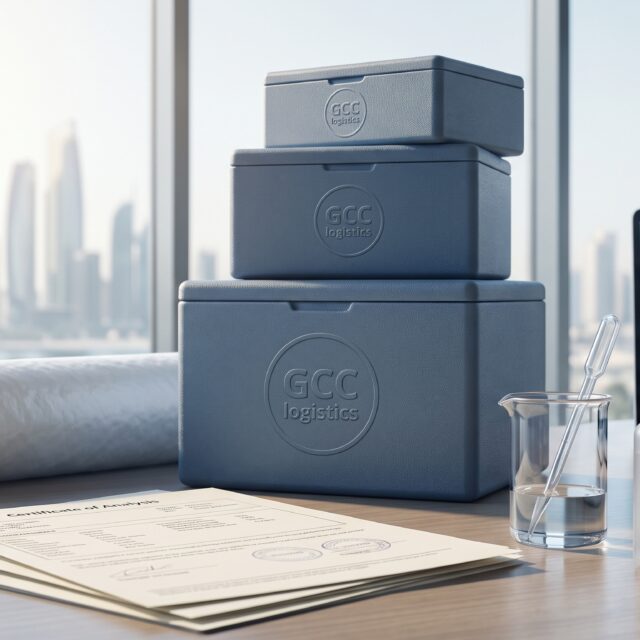
While our core operations are headquartered in Dubai—allowing us to offer services like peptides UAE next day delivery—our robust GCC logistics network ensures that researchers across Bahrain benefit from the exact same standard of care. Additionally, localized suppliers offer regional payment gateways including Tamara, local cards, and cryptocurrency, alongside dedicated WhatsApp support to assist with local transit and clearance queries.
Quality Control: COAs and Laboratory Protocols
Once your bacteriostatic water and lyophilized peptides arrive in Manama, strict adherence to quality control and laboratory protocol is paramount.
Verifying Solvent and Compound Purity
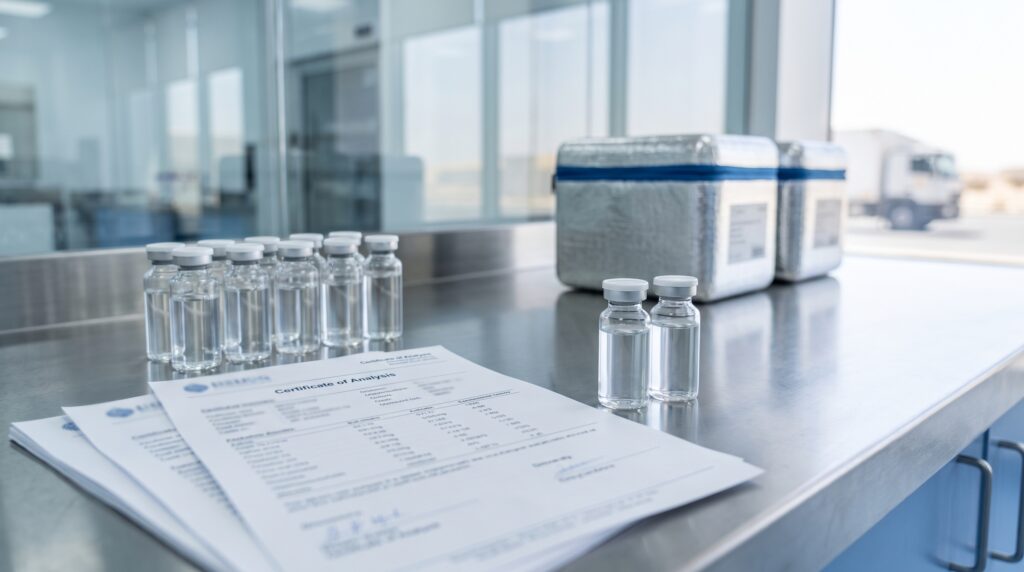
Never introduce an unverified solvent into a high-purity peptide. Discerning buyers should verify operational competence before purchasing. A reliable vendor will provide transparent, third-party High-Performance Liquid Chromatography (HPLC) and Mass Spectrometry (MS) testing for their compounds. This ensures that the lyophilized powder is free from heavy metals, residual synthesis reagents, and biological contaminants.
Best Practices for Laboratory Reconstitution
The physical act of reconstitution must be handled with precision to preserve fragile amino acid bonds:
- Equalize Pressure: Before drawing the BAC water, inject an equal volume of air into the solvent vial to prevent a vacuum.
- Protect the Lyophilized Puck: When transferring the bacteriostatic water into the peptide vial, angle the needle so the liquid drips slowly down the glass wall. Do not forcefully blast the stream directly onto the delicate freeze-dried puck.
- Swirl, Do Not Shake: Allow the powder to dissolve organically. If needed, gently roll or swirl the vial between your fingers. Never shake the vial, as mechanical agitation can shear and destroy fragile peptide bonds.
- Immediate Storage: Once fully dissolved, label the vial with the exact reconstitution date, the concentration ratio, and immediately place it in the refrigerator (2°C to 8°C). Ensure it is protected from UV light exposure.
Procurement Checklist and Final Thoughts
For researchers based in Bahrain, securing a reliable supply of bacteriostatic water and high-purity peptides doesn’t have to mean enduring three-week wait times or excessive import markups. By partnering with a dedicated GCC-based supplier, you ensure faster delivery, superior climate control, and direct access to essential testing documentation.
To ensure the integrity of your research, always prioritize pharma-grade reconstitution solvents, respect the strict temperature requirements of the GCC climate, and maintain precise documentation for NHRA compliance.
Ready to upgrade your laboratory sourcing? Browse our complete inventory of verifiable, third-party tested compounds and pharma-grade solvents at the research peptide shop today.
Disclaimer: The products and information mentioned in this article are strictly for in-vitro laboratory research purposes only. They are not intended for human consumption, diagnostic, therapeutic, or clinical use. NOVA Labs does not endorse or provide guidance on human use.
*
References
- National Health Regulatory Authority (NHRA) Bahrain. (n.d.). Importation & Customs Clearance Guidelines for Medical and Research Products.
- World Health Organization (WHO). (2015). Good Laboratory Practice (GLP) Storage and Handling of Reagents.
- National Center for Biotechnology Information. (2024). PubChem Compound Summary for CID 244, Benzyl Alcohol.
- NOVA Labs Internal Logistics Data (2024). Cold Chain Transit Protocols for GCC Deliveries.
- Pharma-Grade BAC Water – NOVA Labs
- Cold Chain Peptide Delivery Bahrain: Heat, Timing and Packaging – NOVA Labs
- Nova Labs Review 2026: UAE Peptide Supplier COA and Cold-Chain Audit
- Nova Biolabs vs Peptide Lab Bahrain: 2026 Buyer Guide
- Bacteriostatic Water For Peptides GCC | Storage & Buyer – NOVA Labs
- How to Reconstitute Peptides: Complete UK Laboratory Guide (2026)
Frequently asked questions
Can I use sterile water instead of bacteriostatic water for peptides in Bahrain?
Sterile water can only be used for single-use applications as it contains no preservatives. For multi-dose peptide research vials, bacteriostatic water containing 0.9% benzyl alcohol is required to inhibit bacterial growth and preserve the compound for up to 28 days under refrigeration.
How long does delivery take for bacteriostatic water to Bahrain?
While third-party international importers can take 2 to 3 weeks, regional vendors operating from UAE hubs utilize direct flights to Manama, reducing transit times for bacteriostatic water and laboratory supplies to just 2 to 4 days.
Does NHRA block peptide and bacteriostatic water imports?
The NHRA oversees customs clearance via the OFOQ system. Imports are generally cleared efficiently when properly documented with Material Safety Data Sheets (MSDS) and explicitly declared on the commercial invoice as 'In-Vitro Research Use Only'.
How should I store reconstituted peptides in the Middle East?
Due to extreme GCC temperatures, peptides must be shipped in their resilient lyophilized form. Once reconstituted with bacteriostatic water in the lab, they must be kept away from direct sunlight and immediately stored in a regulated laboratory refrigerator at 2°C to 8°C.
Nova Labs buyer tools
Ready to verify stock, testing and delivery?
Use the product page and lab report section to check availability, documentation, delivery timing and support before placing an order.
- COA / test-report checks
- Bahrain delivery context
- Cold-chain handling
- COD and card payment options
- WhatsApp support