



Procuring high-quality research compounds in the Gulf Cooperation Council (GCC) requires more than just finding a vendor with a functioning website. For buyers prioritizing scientific accuracy, sourcing genuine hplc tested peptides bahrain demands strict attention to analytical documentation, regional logistics, and climate-resilient packaging.
Whether you are an academic researcher, a laboratory procurement manager, or an informed buyer evaluating regional suppliers, navigating the local landscape involves distinct challenges. Extreme Middle Eastern summer temperatures, rigid customs protocols via Bahrain’s National Health Regulatory Authority (NHRA) and OFOQ systems, and a gray market flooded with unverified sellers mean that blind trust is no longer an option.
This guide breaks down exactly how to verify peptide purity claims, read Certificate of Analysis (COA) data, and ensure that your chosen supplier has the operational infrastructure to deliver stable, high-purity compounds directly to your facility in Bahrain.
Verifying HPLC Tested Peptides Bahrain
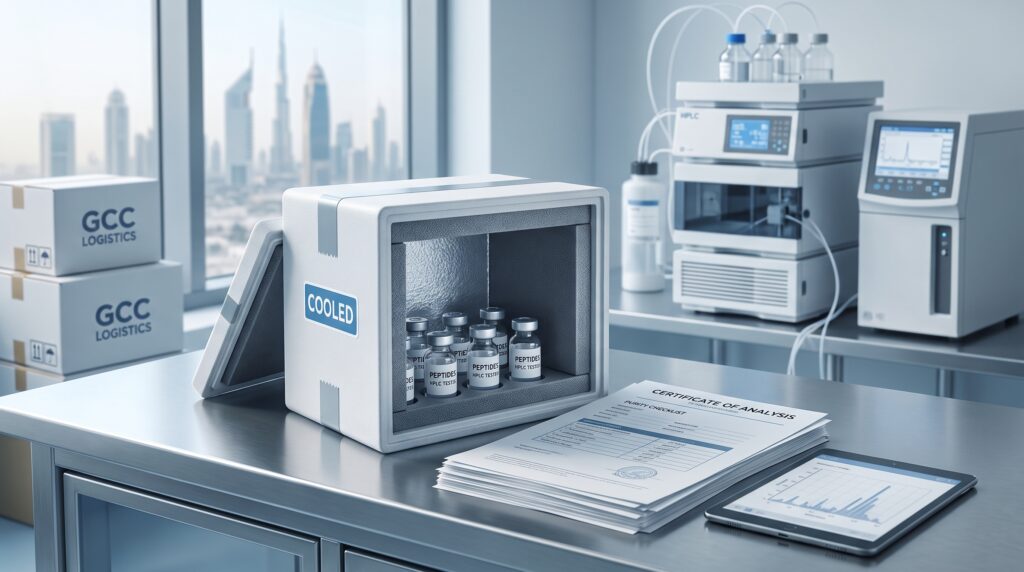
To verify HPLC tested peptides in Bahrain, researchers must demand batch-specific Certificates of Analysis (COAs) from independent laboratories. These documents should feature High-Performance Liquid Chromatography (HPLC) proving ≥99% purity and Mass Spectrometry (MS) confirming exact molecular identity, ensuring compound stability despite harsh regional climates.
Key Takeaways: Bahrain Buyer Checklist
Before placing an order for research peptides in the GCC, ensure your supplier meets the following baseline criteria:
- Independent COAs: Dual HPLC and MS testing must be available and batch-matched to the specific vials you are ordering.
- Lyophilized Format: Compounds must be shipped as a freeze-dried powder, never in pre-reconstituted liquid form, to survive GCC transit temperatures.
- Regional Fulfillment: Choose suppliers with fulfillment hubs in the UAE or GCC to bypass multi-week international customs delays.
- Clear Labeling: Products must be explicitly labeled “For Research Purposes Only” (RUO) with accurate Harmonized System (HS) codes to clear Bahrain customs smoothly.
- Localized Support: Reliable vendors offer accessible, local customer service (e.g., WhatsApp) and region-friendly payment options.
The Analytical Standards: HPLC and MS Explained
In the context of peptide synthesis, precision is paramount. Minor errors in the manufacturing process can result in truncated sequences, missing amino acids, or residual synthesis solvents. To detect these impurities, reputable laboratories rely on two primary analytical technologies.
High-Performance Liquid Chromatography (HPLC)
HPLC is the gold standard for determining the purity of a chemical compound. During this process, the peptide sample is dissolved in a solvent and forced through a specialized column under high pressure. Because different molecules interact with the column’s filling material differently, they separate at distinct rates.
The resulting report, called a chromatogram, displays a series of peaks. In high-purity research materials, you should see one massive, distinct primary peak (representing the target peptide) and very minimal secondary peaks (representing impurities). For rigorous in-vitro research applications, an HPLC purity rating of ≥99% is considered the baseline standard.
Mass Spectrometry (MS)
While HPLC tells you how pure a substance is, it does not tell you what the substance is. Mass Spectrometry (MS) solves this by measuring the mass-to-charge ratio of the molecules in the sample. Every peptide has a specific, mathematically calculated molecular weight based on its unique amino acid sequence.
The MS report confirms that the molecular weight of the vial’s contents matches the theoretical weight of the requested peptide. This ensures you haven’t received a mislabeled compound or a cheaper substitute—a common tactic among disreputable gray-market vendors.
Common Impurities Detected by HPLC
Understanding what HPLC tests look for can help researchers grasp why this documentation is so crucial. Unverified peptides often contain hidden contaminants that can entirely invalidate experimental results:
- Truncated Sequences: During synthesis, not all amino acid chains form completely. This leaves shorter, ineffective peptide fragments in the vial.
- Trifluoroacetic Acid (TFA): TFA is heavily used during the cleavage stage of solid-phase peptide synthesis. If not properly removed during the purification stage, residual TFA can cause cellular toxicity in cell-culture experiments.
- Cross-Contamination: Facilities that lack strict clean-room protocols may accidentally mix trace amounts of different compounds, which shows up as anomalous peaks on a chromatogram.
Anatomy of a Trustworthy Certificate of Analysis (COA)
A common issue when sourcing an hplc tested peptides shop in Bahrain is the prevalence of generic, doctored, or outdated lab reports. A legitimate COA is a highly specific, mathematical document. When reviewing batch-specific, third-party verified chromatograms, buyers must look for the following non-negotiable elements:
- Batch and Lot Numbers: The COA must explicitly state the batch or lot number, and this identifier must perfectly match the label on the physical vial you receive. Generic COAs with no lot numbers are a major red flag.
- Recent Testing Dates: Peptides can degrade if stored improperly over long periods. A valid COA should reflect a reasonably recent manufacturing and testing date to guarantee current stability.
- Independent Laboratory Details: The document should clearly display the name, logo, and contact information of the third-party analytical laboratory that performed the test. Highly transparent suppliers will include a verifiable tracking ID or QR code that links directly to the independent lab’s database.
- Clear Integration Data: The chromatogram must include a data table (integration table) showing the exact percentage area of the primary peak versus any impurity peaks.
Be wary of suppliers whose testing documents are restricted to “upon request only” or obscured by heavy watermarks. Transparent vendors make their testing data publicly accessible and easy to verify prior to purchase.
Surviving the GCC Heat: Lyophilization and Logistics
The climate in Bahrain and the wider GCC poses a severe threat to peptide stability. Peptides in a liquid state (pre-reconstituted) are highly fragile; their molecular bonds can rapidly break down when exposed to the extreme ambient temperatures typical of Middle Eastern summers or unregulated cargo holds.
The Science of Freeze-Drying
To ensure compound integrity during transit, high-quality peptides must be shipped as a lyophilized (freeze-dried) powder. Lyophilization is a complex dehydration process where the peptide solution is frozen, and the surrounding pressure is reduced to allow the frozen water to sublimate directly from a solid phase to a gas phase.
This process leaves behind a stable, solid chemical “cake” or powder that is significantly more resilient to temperature fluctuations. A vacuum-sealed vial of lyophilized powder can survive brief periods at room temperature (such as during transit) without suffering meaningful degradation.
Laboratory Storage Post-Delivery
Once your hplc tested peptides arrive in Bahrain, environmental control becomes the researcher’s responsibility.
- Pre-reconstitution: Lyophilized vials should be stored in a freezer (ideally -20°C) for long-term preservation. Protect them from frequent freeze-thaw cycles.
- Post-reconstitution: Once you reconstitute the powder (typically using sterile bacteriostatic water for in-vitro use), the solution becomes fragile again. Reconstituted compounds must be stored under strict refrigeration (2-8°C) and completely shielded from direct UV light.
Navigating Bahrain Customs and Delivery Bottlenecks
International shipping into Bahrain can be fraught with delays. Parcels arriving from North America or Asia often sit in customs clearance facilities for weeks while paperwork is processed. For temperature-sensitive research materials, this delay can compromise the entire batch.
Furthermore, Bahrain utilizes stringent regulatory gateways, including the OFOQ customs clearance system and oversight by the National Health Regulatory Authority (NHRA). If research compounds are improperly declared, lack correct Harmonized System (HS) codes, or fail to feature explicit “Research Use Only” (RUO) labeling, shipments will likely be seized, destroyed, or heavily delayed.
The Regional UAE Fulfillment Advantage
Choosing a supplier with a regional fulfillment hub drastically minimizes these risks. Suppliers operating out of the UAE can typically route packages to Bahrain within 3 to 5 working days using trusted local couriers. This rapid transit minimizes the time vials spend outside of cold-chain storage and largely bypasses the prolonged international customs bottlenecks that plague overseas shipments. Because the shipment originates within the GCC, cross-border logistics are often significantly streamlined.
Evaluating Regional Suppliers: Beyond the Telegram Trap
The GCC market has recently seen a surge in peer-to-peer sellers operating through Telegram groups, WhatsApp broadcasts, and anonymous social media accounts. These gray-market vendors frequently offer compounds at suspiciously low prices, claiming “99.9% purity” without any verifiable analytical backup.
When evaluating an hplc tested peptides supplier for delivery to Bahrain, consider these operational trust signals:
- Accessible Lab Data: Are the COAs publicly posted on the product pages, or are they hidden behind a paywall or email request?
- Responsive, Localized Support: Does the supplier offer instant WhatsApp support, or are you forced to use an unresponsive email ticketing system? Localized customer service indicates an established, reliable regional presence.
- Sensible Shipping Policies: Look for vendors utilizing tracked, expedited regional couriers rather than cheap, untracked postal services that offer no climate control.
- Secure, Flexible Payment Options: Professional suppliers offer secure credit card processing, localized digital wallets, or even Crypto options, avoiding shady wire transfers to unverified personal accounts.
Conclusion: Securing Your Research Compounds
When you commit to procuring laboratory materials, the burden of verification ultimately falls on the buyer. True quality cannot be determined by marketing claims, slick packaging, or unverified forum reviews; it is proven through rigorous, independent analytical data.
Before you place an order, run through the checklist: verify the presence of batch-matched COAs featuring both HPLC and MS data, ensure the product is shipped in a lyophilized format, and confirm that the supplier utilizes rapid, regional fulfillment to bypass damaging customs delays.
Ready to elevate your laboratory standards? Browse our full catalog of premium research compounds today. NOVA Labs ensures every batch is backed by publicly available, third-party analytical testing, with fast, reliable shipping across the UAE, Bahrain, and the wider GCC.
Disclaimer: The products mentioned in this article are strictly for in-vitro laboratory and research purposes only. They are not intended for human consumption, diagnostic, or therapeutic use. Handle all research compounds with appropriate protective equipment and in accordance with local Bahraini regulations.
References
- National Health Regulatory Authority (NHRA) Bahrain. Importation Guidelines for Laboratory & Research Materials.
- Journal of Analytical Chemistry. Chromatography Standards and Practices in Peptide Synthesis.
- NOVA Labs Internal Quality Control Documentation. Best Practices for Peptide Purity Verification and GCC Cold-Chain Logistics.
- Best Peptide Shop Bahrain: Verify Purity, COAs & GCC – NOVA Labs
- Peptides Online Bahrain: What to Check Before Ordering – NOVA Labs
- Nova Labs Review 2026: UAE Peptide Supplier COA and Cold-Chain Audit
- Nova Biolabs vs Peptide Lab GCC: Buyer Comparison & Guide
- Buy Peptides Online | Research Peptides & Quality Guide
- Exploring the Peptide Market in UAE/GCC – Looking for Vendors : r/SmallBusinessUAE
- Peptides : r/Bahrain – Reddit
- is UAE peptide research a legit and trust worthy source for petides? – Reddit
Frequently asked questions
What does HPLC tested mean for peptides?
HPLC (High-Performance Liquid Chromatography) testing is a laboratory method used to separate and measure the components of a mixture. For peptides, it verifies the exact purity percentage of the compound, ensuring minimal impurities remain from the synthesis process.
Why is MS testing important alongside HPLC?
While HPLC confirms how pure a sample is, Mass Spectrometry (MS) verifies the exact molecular weight. This proves the compound's identity, ensuring the contents of the vial perfectly match the mathematical weight of the requested peptide sequence.
How should lyophilized peptides be stored in Bahrain?
Before reconstitution, lyophilized (freeze-dried) peptides should be stored in a laboratory freezer at -20°C or below for long-term stability. Once reconstituted with sterile bacteriostatic water, they must be kept strictly refrigerated between 2-8°C and protected from direct light.
How long does delivery take from the UAE to Bahrain?
When ordering from a supplier with a regional fulfillment hub in the UAE, standard courier shipping to Bahrain typically takes 3 to 5 working days. This rapid timeframe minimizes transit exposure to heat and avoids extended international customs delays.
How can I verify a peptide COA is legitimate?
A legitimate Certificate of Analysis (COA) must include a batch or lot number that precisely matches your vial, a recent testing date, detailed HPLC integration data showing purity percentages, and clear contact details or a tracking ID linking back to an independent testing laboratory.
Nova Labs buyer tools
Ready to verify stock, testing and delivery?
Use the product page and lab report section to check availability, documentation, delivery timing and support before placing an order.
- COA / test-report checks
- Bahrain delivery context
- Cold-chain handling
- COD and card payment options
- WhatsApp support