
Procuring specialised laboratory compounds in the Middle East requires strict attention to logistics and quality control. For laboratory professionals and procurement staff looking to buy PT-141 GCC standards, challenges range from intense summer heat that threatens molecular stability to inconsistent supplier documentation and peer-to-peer market risks.
PT-141 (Bremelanotide) is a melanocortin receptor agonist widely studied in controlled research settings. Because this compound is highly sensitive in its lyophilised form, researchers must evaluate more than just price. Ensuring chemical integrity requires verifying third-party laboratory testing, confirming strict ‘Research Use Only’ (RUO) compliance, and auditing a supplier’s regional logistics network to guarantee the peptide survives transit intact.
Evaluating Where to Buy PT-141 in the GCC
Buyer Checklist: If you plan to buy PT-141 in the GCC, prioritize local suppliers providing batch-specific third-party COAs demonstrating >98% HPLC purity. Ensure they utilize insulated cold-chain packaging to prevent heat degradation, and offer secure payment options like Cash on Delivery alongside responsive regional support.
Historically, researchers in the UAE, Saudi Arabia, Kuwait, and Oman relied almost entirely on international imports from the United States or the European Union. However, importing research chemicals frequently results in customs delays, exposing temperature-sensitive compounds to degradation in un-air-conditioned transit facilities for weeks at a time. Today, the regional market is serviced by local, specialised vendors who maintain regional stock in Dubai or Abu Dhabi, bypass international customs friction entirely for local buyers, and implement strict quality control protocols.
The Risk of Unverified Marketplaces
Online forums and small-business communities frequently issue warnings regarding unverified peer-to-peer sellers or Telegram-based brokers operating within the GCC. These grey-market entities often fail to provide verifiable batch testing, lack temperature-controlled warehousing, and offer no recourse for transit damage. Sourcing from unverified vendors introduces unknown synthesis byproducts into delicate experiments, which can entirely invalidate research data. To ensure laboratory integrity and protect research budgets, procurement must be channelled through secure, established suppliers that publicly host testing data and offer dedicated regional support.
Deciphering the Certificate of Analysis (COA) for PT-141
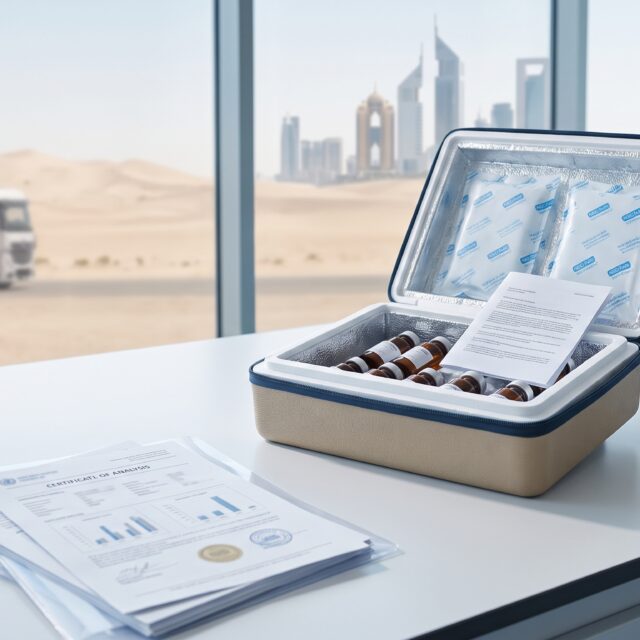
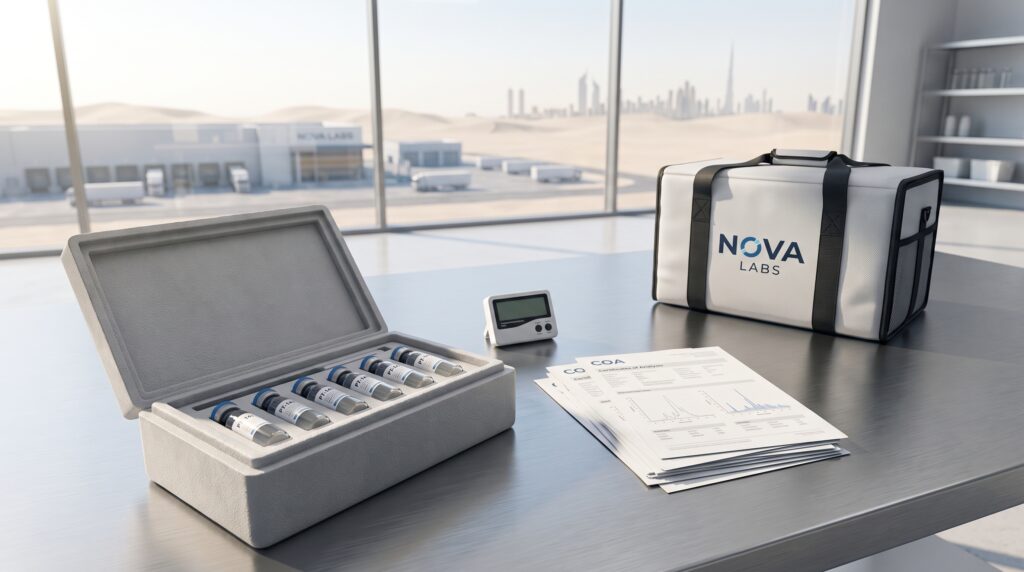
The absolute cornerstone of evaluating a PT-141 supplier in the GCC is the Certificate of Analysis. A legitimate COA is not a generic PDF downloaded from a manufacturer; it must be a batch-specific report generated by an independent analytical laboratory.
When reviewing a COA for Bremelanotide, researchers and procurement managers should meticulously check three primary data points:
- HPLC Purity (High-Performance Liquid Chromatography): HPLC testing separates the active PT-141 peptide from synthesis impurities, truncated sequences, or heavy metals left over from the manufacturing process. Top-tier GCC suppliers provide vials with a verified HPLC purity of 98% to 99% or higher. Anything below 98% should generally be rejected for precise in-vitro research.
- Mass Spectrometry (MS): While HPLC measures the purity of the sample, MS verifies the exact molecular weight. This ensures the compound in the vial is genuinely the specific PT-141 sequence and not a mislabelled peptide or a structurally compromised analogue.
- Batch Number Alignment: The most critical anti-fraud measure is batch tracking. The batch identifier on the analytical report must match the printed label on the physical vial delivered to your facility. If a supplier cannot correlate their stock to their paperwork, the COA is meaningless.
Vendors that refuse to provide a batch-specific COA, or who obscure the contact details and accreditation of their testing laboratory, should be immediately disqualified from your procurement list.
The Desert-Proof Cold Chain: Essential GCC Logistics
Even a 99.9% pure peptide will degrade rapidly if exposed to the prolonged 40°C+ ambient temperatures common in the Gulf region. Therefore, evaluating a vendor’s logistics infrastructure is just as vital as checking their chemistry.
Lyophilised (freeze-dried) peptides possess a reasonable degree of stability at standard room temperature, but optimal preservation during transit requires a rigorous cold-chain approach. Premium regional suppliers use specialised insulated packaging—often integrating polystyrene or dense polyurethane shells—equipped with gel packs or Phase Change Materials (PCM) to maintain a controlled internal environment during transport across the desert.
Delivery speed is the vital second half of this equation. The longer a package remains in the courier network, the higher the risk of temperature excursions. Leading local suppliers counter this by maintaining local inventory and offering a highly specialized peptides UAE next-day delivery network. Within major hubs like Dubai, Sharjah, and Abu Dhabi, delivery is typically finalized within 24 hours. For wider GCC nations such as Saudi Arabia (Riyadh, Jeddah), Kuwait, Bahrain, and Oman, express tracked couriers finalize delivery within 2 to 5 business days, ensuring the internal temperature controls are not outlasted by the transit time.
Vendor Support, Payment Security, and Pricing Expectations
A professional peptide supplier operation should mirror the customer service standards expected in modern B2B procurement. Given the fragile nature of research compounds and the complexities of regional courier networks, robust customer support is non-negotiable.
Informed buyers should look for vendors that offer:
- Real-Time Concierge Support: The best local suppliers offer active communication channels, such as WhatsApp, to rapidly assist with delivery routing, COA inquiries, and stock availability checks.
- Transparent Pricing: Standard regional pricing for a high-purity, lyophilised 10mg vial of PT-141 sits at approximately AED 399 (SAR 369). Significantly lower prices usually indicate compromised purity, imported expired stock, or the total absence of specialized cold-chain packaging.
- Transit Guarantees: A reliable supplier will explicitly offer a transit damage guarantee, authorising immediate reshipment if a vial arrives damaged, cracked, or delayed beyond the safe window for its temperature controls.
- Flexible and Secure Payment: Look for secure credit card gateways. In many UAE cases, the availability of Cash on Delivery (COD) is a massive indicator of trust, as it shifts the initial transit risk entirely away from the buyer until the product physically arrives at the laboratory.
Finalising Your Laboratory Order
When selecting your materials, verify the format required for your specific laboratory protocol. Most research facilities require standard lyophilised vials, which offer the best stability prior to reconstitution with bacteriostatic water. PT-141 is typically supplied and researched in a 10mg format.
For researchers ready to secure batch-tested, regionally stocked materials, you can directly review the COA, mass spectrometry data, and structural specifications for PT-141 10mg vials via NOVA Labs. By combining rigorous third-party analytical transparency with a robust, temperature-controlled logistics network across the Gulf, researchers can eliminate the variables of thermal degradation and chemical contamination from their experimental data.
Bottom Line
When you choose to buy PT-141 GCC options, your priority must be chemical verification and thermal protection above all else. Dismiss unverified social media sellers in favour of established regional suppliers who proudly display their HPLC/MS testing data, utilise advanced cold-chain packaging, and guarantee fast, trackable transit times. By treating logistics and transparency as equal to the price tag, informed buyers secure the integrity of their research materials and protect their procurement investments.
Ready to elevate your lab’s procurement standards? Explore the full range of purity-verified research compounds and secure your next order today with NOVA Labs.
Disclaimer: All products mentioned in this article are strictly for in-vitro research and laboratory purposes only. They are not intended for human consumption, therapeutic use, or medical treatment.
—
References:
- United States Pharmacopeia (USP). (2022). Guidelines on the Stability and Handling of Lyophilized Peptides.
- Journal of Chromatography A. (2021). Best Practices for HPLC and Mass Spectrometry in Peptide Analysis.
- UAE Ministry of Economy. (2023). E-commerce, Logistics, and Import Regulations for Laboratory Reagents.
Disclaimer: The products mentioned in this article are for research purposes only and are not intended for human consumption.
References
- PT-141 – DXB Peptides
- GulfPeps PT-141 Research Compound | Lab Reagent
- Shipping & Returns – Peptides DXB
- Shipping Policy – Pure Peptides
- Exploring the Peptide Market in UAE/GCC – Sourcing Vendors : r/SmallBusinessUAE
Frequently asked questions
What is the standard price for a 10mg PT-141 vial in the GCC?
The standard regional pricing for a third-party tested, 10mg lyophilised PT-141 vial is approximately AED 399 or SAR 369. Prices significantly lower than this may indicate compromised purity or lack of proper cold-chain shipping.
How long does peptide delivery take within the UAE and GCC?
Top-tier regional suppliers offer next-day delivery within major UAE cities like Dubai and Abu Dhabi. Express shipping to wider GCC countries such as Saudi Arabia, Kuwait, and Oman generally takes 2 to 5 business days.
Why is cold-chain shipping necessary for PT-141 in the Middle East?
Lyophilised peptides are susceptible to degradation under the extreme heat of the GCC summer. Specialised insulated packaging with gel packs or phase change materials ensures the compound remains stable during transit.
How can I verify the purity of PT-141 before purchasing?
Always request a batch-specific Certificate of Analysis (COA) from an independent testing laboratory. You should look for an HPLC purity rating of 98% or higher and ensure the batch number matches the vial you receive.
Nova Labs buyer tools
Ready to verify stock, testing and delivery?
Use the product page and lab report section to check availability, documentation, delivery timing and support before placing an order.
- COA / test-report checks
- GCC delivery context
- Cold-chain handling
- COD and card payment options
- WhatsApp support