
Procuring high-quality research compounds in the Gulf Cooperation Council (GCC) requires careful attention to logistics, environmental factors, and local regulatory guidelines. For laboratories and independent researchers evaluating where to buy Selank in Oman, the process involves far more than simply finding a supplier with active stock. It requires verifying compound purity, ensuring stable transit through extreme regional heat, and understanding local import expectations.
Because Oman’s climate frequently sees temperatures exceeding 40°C during peak months, the physical format of the peptide—and how it is shipped—dictates its viability upon arrival in Muscat or Salalah. Furthermore, clearing the Directorate General of Customs necessitates specific documentation from the supplier.
Here is an overview of how research buyers can evaluate Selank suppliers, verify testing documentation, and ensure secure, compliant delivery into Oman.
Quick Answer: What to Know Before Ordering
For laboratories evaluating where to buy Selank in Oman, the most reliable approach is sourcing lyophilized peptide vials from suppliers providing third-party HPLC and Mass Spectrometry certificates. Ensure the supplier provides accurate commercial invoices and Certificates of Analysis to navigate Oman customs and maintain compound stability during GCC transit.
Surviving the Heat: Lyophilized vs. Reconstituted Peptides
One of the most critical decisions when you order Selank in Oman is selecting the correct format of the compound. Peptides are sensitive chains of amino acids, and their structural stability is heavily influenced by temperature and moisture.
Why Pre-Mixed Solutions Fail in GCC Transit
Some international suppliers offer pre-mixed or reconstituted peptide solutions for convenience. While these may survive short-distance domestic shipping in colder climates, they are highly susceptible to thermal degradation. Once a peptide like Selank is introduced to bacteriostatic water or a saline solution, its molecular bonds begin to break down if exposed to ambient heat or UV light.
Shipping a liquid peptide internationally to Oman—a process that can take several days through non-refrigerated regional sorting hubs—frequently results in significant degradation. By the time the compound reaches the laboratory bench, its efficacy for in-vitro research is heavily compromised, rendering experimental data unreliable.
The Superiority of Lyophilized Powder
To ensure compound integrity, informed researchers strictly source lyophilized (freeze-dried) peptides. Lyophilization removes water from the compound under a vacuum, leaving behind a stable, solid puck of peptide powder.
In this state, Selank is remarkably resilient to temperature fluctuations. While long-term storage of lyophilized peptides still requires refrigeration or freezing, they can comfortably survive standard transit times of 1 to 3 weeks at room temperature—or even elevated Middle Eastern temperatures—without losing purity. For any Selank peptide Oman shipments, the lyophilized format is non-negotiable.
Navigating Oman Customs and Regulatory Compliance
Shipping research chemicals across borders in the GCC requires strict adherence to local laws. The Directorate General of Customs in Oman, alongside the Ministry of Health’s Drug Safety Center, monitors the import of chemical and pharmaceutical substances.
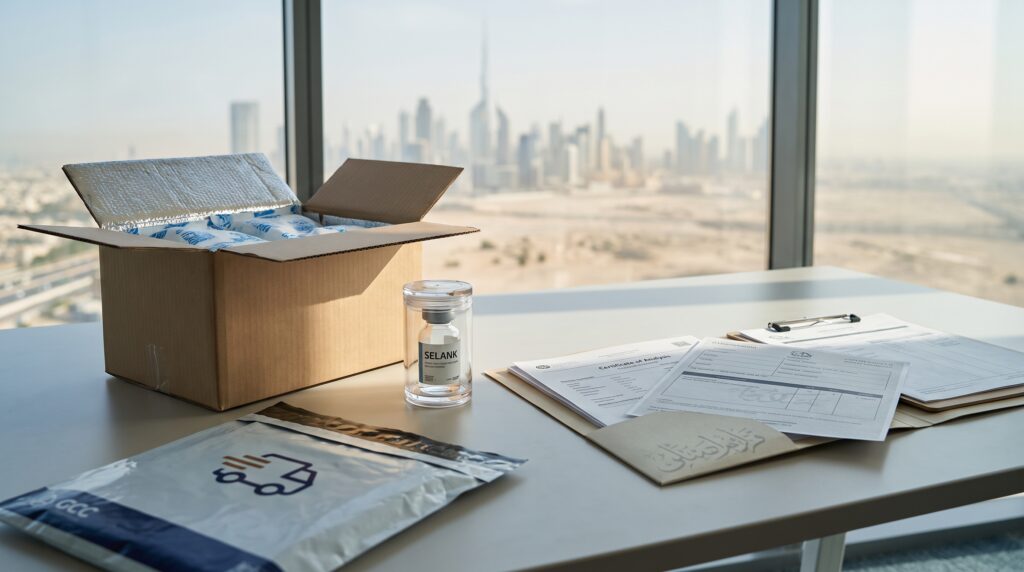
When a parcel containing peptides arrives at the border, customs officials look for verifiable documentation to clear the shipment. A premium Selank supplier Oman researchers can trust will proactively provide the following:
- Accurate Commercial Invoices: Parcels must have clearly stated commercial values and descriptions. Misdeclaring contents or obscuring the true nature of the materials often leads to immediate confiscation or severe delays.
- Certificates of Analysis (COA): Customs officials may request proof of the compound’s identity and purity. A batch-specific COA demonstrates that the material is a standardized research chemical rather than an unknown or prohibited substance.
- Research-Only Labeling: The vials and packaging must explicitly state that the contents are for in-vitro laboratory research purposes only, not for human or animal consumption.
“Proper documentation is the difference between a peptide shipment clearing customs in 24 hours and being held indefinitely at the border. Always verify that your supplier understands GCC commercial invoicing.”
How to Verify Your Selank Supplier in Oman
Identifying a reliable source requires looking past marketing claims and demanding hard data. High-intent buyers in the GCC verify compound quality by reviewing specific third-party lab results before committing to a purchase.
High-Performance Liquid Chromatography (HPLC)
HPLC is the gold standard for determining the purity of a peptide batch. The resulting chromatogram shows a series of peaks representing the substances detected in the sample. The primary peak represents the Selank compound itself. For rigorous laboratory research, you should expect a purity level of 99% or higher. If a supplier cannot produce a recent, batch-matched HPLC report, their stock quality cannot be verified.
Mass Spectrometry (MS)
While HPLC confirms purity, Mass Spectrometry confirms identity. MS analyzes the molecular weight of the compound to ensure the correct amino acid sequence was synthesized. Because many peptides appear visually identical as white powder, an MS report is the mathematical proof that the vial actually contains Selank.
Before finalizing an order, cross-reference the batch number on the supplier’s website with the COA provided. Leading suppliers make this documentation visible directly on their product pages.
Regional Logistics: Sourcing from the UAE
While some researchers attempt to source peptides from overseas suppliers in North America or Europe, the transit times can range from 14 to 30 days. This prolonged shipping window introduces unnecessary risk regarding package loss, extended heat exposure, and complex international customs hurdles.
Sourcing from a regional hub like the UAE significantly mitigates these risks. NOVA Labs operates out of Dubai and offers streamlined logistics for researchers in neighboring GCC nations.
For laboratories looking to secure high-purity Selank peptide vials, NOVA Labs provides comprehensive third-party testing documentation, ensuring the compound meets strict analytical standards.
Furthermore, when evaluating regional peptide delivery logistics, proximity matters. NOVA Labs offers express shipping to Oman via standard courier for AED 80, with a standard delivery window of just 5 days. Because active trans-border cold-chain cooling is difficult and cost-prohibitive for small regional parcels, supplying Selank strictly in its stable, lyophilized form guarantees that the peptide arrives in pristine condition, ready for reconstitution in the lab.
Best Practices for Receiving and Storing Selank
Once your order of Selank successfully clears Oman customs and is delivered to your facility, proper handling protocols must be implemented immediately to preserve the peptide’s 99%+ purity for experimental use.
- Visual Inspection: Upon unboxing, verify that the vials are intact. The lyophilized powder should appear as a solid white puck or a loose powder.
- Cold Storage Pre-Reconstitution: Before adding any solvent, place the lyophilized vials in a freezer at -20°C for long-term storage (months to years), or a refrigerator at 2°C to 8°C for short-term storage (weeks).
- Proper Reconstitution: When ready for the assay, reconstitute the Selank using sterile bacteriostatic water or another appropriate laboratory solvent. Introduce the solvent slowly, allowing it to slide down the side of the vial to prevent shearing the amino acid bonds.
- Cold Storage Post-Reconstitution: Once reconstituted into a liquid solution, the peptide becomes highly susceptible to degradation. It must be kept refrigerated at 2°C to 8°C at all times and typically utilized within 20 to 30 days of mixing.
Procurement Summary for Oman Laboratories
Successfully procuring Selank in Oman comes down to prioritizing stability, transparency, and regional logistics. By demanding lyophilized compounds to combat the GCC heat, requiring batch-specific HPLC and MS testing to guarantee 99%+ purity, and partnering with a supplier that understands local customs documentation, researchers can eliminate guesswork from their supply chain.
Prioritize suppliers that make their testing data publicly accessible and offer efficient, trackable courier services across the UAE-Oman border. Doing so ensures your laboratory receives compounds that yield accurate, reproducible research data.
Disclaimer: The products mentioned in this article are strictly for in-vitro research and laboratory use only and are not intended for human or animal consumption.
References
- Omani Directorate General of Customs. Guidelines on Commercial Invoicing and Import Declarations.
- Clarion Shipping. Cold Chain Logistics Oman for Pharmaceutical Distribution. (General overviews on regional supply chain constraints).
- Ministry of Health, Sultanate of Oman. Regulations on biochemical and research substances.
- Customs release and drug release to markets
- Selank Nasal Spray – NOVA Labs
- Cold Chain Logistics Oman for Pharmaceutical Distribution – Clarion Shipping
- Shipping Policy – Pure Peptides
- Peptide Import Laws: Customs & Personal Use | PeptideJournal
Frequently asked questions
Can liquid Selank solutions be shipped to Oman?
Shipping pre-mixed or liquid peptide solutions to Oman is strongly discouraged. The extreme regional heat combined with non-refrigerated transit can cause reconstituted peptides to rapidly degrade before they reach your laboratory.
How long does it take to ship Selank to Oman from the UAE?
Regional suppliers like NOVA Labs typically deliver to Oman within 5 business days via express courier. This is significantly faster than international sourcing, drastically reducing the compound's exposure to uncontrolled environments.
What customs documents are needed to import research peptides into Oman?
To successfully clear the Directorate General of Customs, shipments require an accurate commercial invoice declaring the value, a Certificate of Analysis (COA) proving the compound's identity, and clear labeling stating the material is strictly for in-vitro research purposes.
How should I store Selank once it arrives in Muscat?
Upon arrival, store the unmixed lyophilized vials in a refrigerator (2°C to 8°C) or freezer (-20°C). Once reconstituted for research, the liquid solution must be kept refrigerated at all times to maintain stability.
How can I verify the purity of my Selank order?
Always require High-Performance Liquid Chromatography (HPLC) and Mass Spectrometry (MS) reports from the supplier. These documents mathematically confirm the compound's identity and ensure a laboratory-grade purity level of 99% or higher.
Nova Labs buyer tools
Ready to verify stock, testing and delivery?
Use the product page and lab report section to check availability, documentation, delivery timing and support before placing an order.
- COA / test-report checks
- Oman delivery context
- Cold-chain handling
- COD and card payment options
- WhatsApp support