





Metabolic research has advanced dramatically in recent years, pushing beyond standard incretin pathways into highly specialized multi-receptor and selective agonism. For laboratories and principal investigators in the UAE and GCC, sourcing pure, stable investigational compounds is critical to replicating global clinical data accurately. When evaluating next-generation metabolic candidates, a frequent topic of inquiry among local biomedical facilities is the molecular comparison of eloralintide vs retatrutide.
While both compounds are currently the subject of extensive late-stage clinical trials targeting metabolic regulation, their mechanisms of action, receptor targets, and physiological effects studied in published literature diverge significantly. This guide explores the foundational differences between eloralintide and retatrutide, how published studies evaluate their efficacy, and the rigorous documentation required to source these peptides securely within the UAE climate.
Quick Answer: Eloralintide vs Retatrutide
The primary difference between eloralintide and retatrutide is their specific receptor targets. Eloralintide (LY3841136) is a highly selective amylin receptor agonist modulating central satiety pathways. Conversely, retatrutide (LY3437943) is a triple agonist stimulating GLP-1, GIP, and glucagon (GCGR) pathways, combining satiety signaling with significantly increased basal energy expenditure.
Structural Differences and Cellular Mechanisms
To understand eloralintide vs retatrutide research, investigators must look closely at their distinct molecular structures and the cellular cascades they trigger in controlled laboratory models.
Eloralintide: Selective Amylin Agonism
Eloralintide, designated in early research as LY3841136, is an investigational peptide that acts as an analog of the naturally occurring hormone amylin. Its structural design is intentionally selective. Published pharmacological data indicates that it binds with high affinity to the AMY1R and AMY3R receptors while maintaining selectivity over the calcitonin receptor (CTR).
By targeting these amylin receptors, eloralintide acts centrally on the area postrema and other brainstem centers to regulate meal termination and satiety. Importantly, it bypasses the traditional incretin (GLP-1 and GIP) pathways entirely. This makes it an invaluable compound for researchers looking to study metabolic interventions that operate independently of gut-derived incretin signaling, providing a novel pathway for observation in metabolic syndrome models.
Retatrutide: The Triple Agonist Pathway
Retatrutide (LY3437943) takes a fundamentally different structural approach. It is categorized as a “triple-G” agonist. The peptide sequence is engineered to bind to three distinct receptors simultaneously:
- GLP-1 (Glucagon-Like Peptide-1): Mediates insulin secretion and delays gastric emptying.
- GIP (Glucose-Dependent Insulinotropic Polypeptide): Enhances insulin response and modulates fat metabolism.
- GCGR (Glucagon Receptor): Increases hepatic glucose output and, crucially, drives increased basal energy expenditure.
The inclusion of glucagon receptor agonism is what differentiates retatrutide from dual-agonists. In clinical models, this triple combination is studied for its synergistic ability to reduce intake while simultaneously forcing the biological model into a higher state of metabolic energy utilization.
Insights from Published Research Literature
Both compounds are investigational and strictly not approved for clinical use or human prescription. However, analyzing recent Phase 2 and Phase 3 trial data provides insight into why laboratories might select one over the other for specific experimental protocols.
The Eloralintide Phase 2 Data
A recent 48-week Phase 2 clinical trial (NCT06230523), published in prominent journals like The Lancet, investigated the efficacy of eloralintide across varying concentrations. Researchers noted highly significant metabolic shifts, observing profound reductions in targeted body mass metrics at the highest investigational concentrations.
One of the most notable findings in the eloralintide literature is cardiovascular monitoring. Traditional GLP-1 and dual-agonists often induce tachycardia (an elevated resting heart rate) in test subjects. Because eloralintide operates via amylin receptors rather than incretin pathways, studies highlighted a distinct lack of this tachycardia side effect. For laboratories investigating cardiovascular-safe metabolic interventions, eloralintide presents a highly unique profile.
The Retatrutide TRIUMPH Trials
Retatrutide’s Phase 2 trial data demonstrated profound metabolic alterations, heavily driven by the glucagon component. Over a similar 48-week period, studies recorded dramatic reductions in body mass metrics. Researchers studying retatrutide often focus on its unique ability to clear hepatic fat rapidly, a direct consequence of the GCGR stimulation. The literature surrounding retatrutide emphasizes this dual-pronged approach: incretin-driven intake suppression combined with glucagon-driven thermogenesis and hepatic lipid clearance.
The Logistical Challenge: UAE Climate and Cold-Chain Storage
For UAE and GCC researchers, selecting a compound based on molecular mechanism is only the first step. The extreme ambient temperatures of cities like Dubai, Abu Dhabi, and Riyadh introduce critical logistical challenges for peptide integrity.
Both eloralintide and retatrutide are structurally fragile biological molecules. When exposed to heat, UV light, or mechanical agitation, the peptide bonds can rapidly degrade, leading to oxidation, aggregation, and a complete loss of biological viability. Ordering liquid-suspended peptides from international suppliers often means the compounds sit in unconditioned customs warehouses at 40°C+, rendering them useless before they even reach the laboratory bench.
Therefore, credible scientific work in the UAE dictates that these compounds must be sourced as lyophilized (freeze-dried) powder rather than pre-mixed liquid solutions. A professional laboratory will always procure lyophilized powder, storing it in sub-zero environments (-20°C) locally until the precise moment of controlled reconstitution with bacteriostatic water.
Evaluating Suppliers: Documentation and Purity Checks
When evaluating a supplier for these high-value investigational compounds, UAE procurement staff must enforce strict quality control standards. The difference between a compromised batch and a research-grade compound lies entirely in the analytical documentation provided by the supplier.
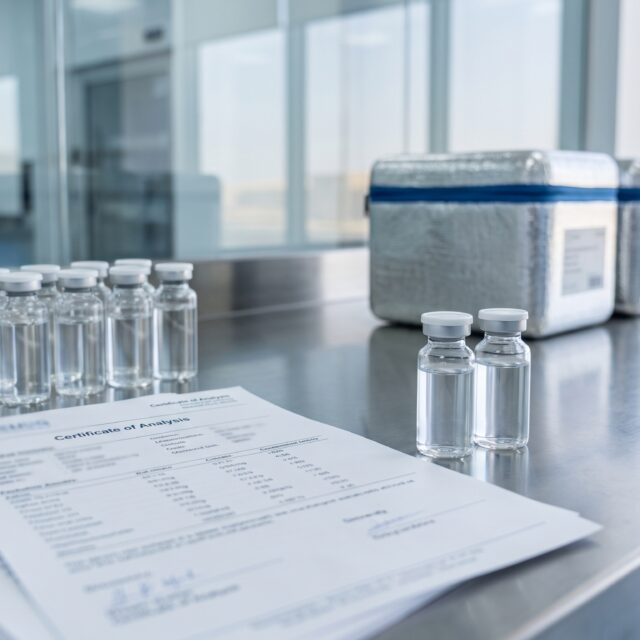
Before authorizing a purchase order, laboratory buyers must demand to see lot-specific Certificates of Analysis (COA). A valid, verifiable COA must include two critical tests:
- HPLC (High-Performance Liquid Chromatography): This confirms the purity percentage of the peptide. Reputable suppliers mandate a minimum of 99% purity. High purity ensures that no truncated peptide chains, unbound amino acids, or synthesis byproducts interfere with the accuracy of your experimental data.
- MS (Mass Spectrometry): This verifies the exact molecular weight of the compound. While HPLC confirms purity, MS confirms identity, ensuring that the synthesized compound matches the exact amino acid sequence of eloralintide or retatrutide.
At NOVA Labs, transparency is foundational to our procurement process. We ensure that researchers have full access to third-party testing documentation. You can confidently verify lab results and Certificates of Analysis directly through our portal, ensuring that every vial meets rigorous global scientific standards.
Streamlining Laboratory Sourcing in the GCC
Sourcing locally eliminates the friction of international customs delays, import duties, and broken cold chains. NOVA Labs provides streamlined UAE delivery, allowing research facilities to maintain strict project timelines. We support institutional buying with cash-on-delivery (COD) options and offer dedicated WhatsApp support for laboratory procurement staff to confirm real-time stock availability, handle batch inquiries, and assist with bulk order logistics.
For facilities specifically investigating amylin pathways, you can review our highly purified Eloralintide (LY3841136) peptide vials to secure verifiable, research-grade compounds for your upcoming protocols.
Conclusion: Choosing the Right Investigative Pathway
Determining whether to focus on eloralintide or retatrutide depends entirely on the specific physiological pathways your laboratory aims to investigate. If the research protocol requires exploring central satiety mechanisms via amylin receptors—particularly in models where avoiding incretin-induced cardiovascular side effects is highly desirable—eloralintide presents a compelling, highly selective candidate. Conversely, if the study aims to evaluate the synergistic effects of simultaneous satiety signaling and heavily induced energy expenditure via the glucagon receptor, retatrutide’s triple-agonist structure is the standard.
Whichever investigational compound your facility requires, prioritizing stable cold-chain logistics, localized UAE delivery, and verified HPLC/MS purity is non-negotiable for reproducible data.
Ready to equip your laboratory with the highest-tier compounds available in the GCC? Browse our full catalogue of research compounds to support your facility’s metabolic research today.
Disclaimer: The products mentioned in this article are for research purposes only and are not intended for human consumption, prescription, or clinical treatment. They are strictly for in vitro or approved laboratory animal research.
References
- The Lancet: “Eloralintide, a selective amylin receptor agonist for the treatment of obesity: a 48-week phase 2, multicentre, double-blind, randomised, placebo-controlled trial.”
- PubMed Central (PMC): “Eloralintide (LY3841136), a novel amylin receptor agonist for the treatment of obesity: From discovery to clinical proof of concept.”
- Eli Lilly and Company Clinical Trial Registry: Data on LY3841136 and LY3437943 Phase 2/3 progression.
- Eloralintide, a selective amylin receptor agonist for the treatment of obesity: a 48-week phase 2, multicentre, double-blind, randomised, placebo-controlled trial – PubMed
- Eloralintide (LY3841136), a novel amylin receptor agonist for the treatment of obesity: From discovery to clinical proof of concept – PMC
- Peptides for Weight Loss: What They Are and How They Work – GoodRx
- Lilly’s selective amylin agonist, eloralintide, demonstrated meaningful weight loss and favorable tolerability in a Phase 2 study of adults with obesity or overweight – PR Newswire
- Where to Buy Retatrutide Research Peptide in 2026 – Musculoskeletal Key
Frequently asked questions
What is the main difference between eloralintide and retatrutide?
The primary difference is their receptor targets. Eloralintide is a selective amylin receptor agonist targeting AMY1R and AMY3R for central satiety, whereas retatrutide is a triple agonist targeting GLP-1, GIP, and glucagon (GCGR) pathways.
Does eloralintide cause the same heart rate increases as GLP-1 peptides?
According to published Phase 2 clinical data, eloralintide avoids the tachycardia (elevated resting heart rate) commonly associated with traditional GLP-1 and dual-agonist peptides because it operates via the amylin pathway rather than the incretin system.
How should these research peptides be stored in the UAE?
Investigational peptides must be stored as lyophilized (freeze-dried) powder in a laboratory freezer at -20°C. They should only be reconstituted in a sterile environment immediately prior to experimental use to prevent degradation from the GCC ambient heat.
What purity level is required for published metabolic research?
Scientific research requires a minimum of 99% purity, verified by third-party High-Performance Liquid Chromatography (HPLC) and Mass Spectrometry (MS) to ensure no synthesis byproducts interfere with experimental data.
Are eloralintide and retatrutide approved for human use?
No. Both eloralintide and retatrutide are strictly investigational compounds currently in clinical trials. They are not approved by any global regulatory body for human consumption, prescription, or clinical treatment.
Nova Labs buyer tools
Ready to verify stock, testing and delivery?
Use the product page and lab report section to check availability, documentation, delivery timing and support before placing an order.
- COA / test-report checks
- UAE delivery context
- Cold-chain handling
- COD and card payment options
- WhatsApp support