

The Challenges of Sourcing Liquid Peptides in the GCC
Quick Answer: When sourcing kpv nasal spray in the UAE, researchers must prioritize local cold-chain logistics. Pre-mixed KPV requires uninterrupted storage between 2°C and 8°C to prevent rapid hydrolytic degradation. Ensure your supplier offers UAE-based climate-controlled inventory, active-cooling last-mile delivery, and batch-specific HPLC and Mass Spectrometry documentation.
For scientific laboratories and research procurement teams operating in the Middle East, acquiring intact, biologically viable peptide formulations is a complex logistical challenge. When investigating the tripeptide Lys-Pro-Val, often searched as kpv nasal spray, buyers face a distinct set of hurdles that go far beyond standard chemical procurement. The extreme climate of the Arabian Gulf makes importing pre-mixed aqueous peptides from international vendors highly risky, as extended transit times and customs friction frequently expose liquid formats to thermal degradation.
Evaluating a supplier requires looking past surface-level marketing to examine their underlying operational protocols. Does the supplier maintain local climate-controlled inventory? Do they provide batch-specific analytical testing? Have they engineered their aqueous formulations with precise pH buffers rather than basic solvents? This commercial guide outlines exactly what researchers in the UAE must verify before committing to a purchase, ensuring that their laboratory investments remain structurally sound from the point of dispatch to final delivery.
The Structural Chemistry of Lys-Pro-Val (KPV)
To understand why formatting and handling are so critical, it is necessary to examine the molecular profile of the compound itself. KPV (Lysine-Proline-Valine) is a synthetic tripeptide with a molecular weight of 342.4 Daltons. It originates from the C-terminal region of alpha-melanocyte-stimulating hormone (alpha-MSH). However, unlike the parent hormone or other widely studied MSH analogues, KPV lacks melanocortin receptor-binding activity. This means it does not stimulate pigmentation pathways in preclinical models.
In laboratory settings, KPV is heavily researched for its unique interactions with cellular inflammatory pathways. In-vitro studies often focus on its ability to utilize the PepT1 transporter for cellular entry, subsequently interacting with NF-kB signaling cascades in mucosal environments. Because research predominantly investigates KPV’s impact on mucosal surfaces, non-invasive delivery vehicles—specifically intranasal sprays—have become a primary focus for formulation scientists. However, translating a stable tripeptide into a reliable liquid spray introduces significant stability barriers that procurement teams must account for.
Form Factors: Lyophilized Vials vs. Aqueous Nasal Sprays
Researchers evaluating how to procure aqueous KPV formats must recognize the stark contrast in stability between lyophilized (freeze-dried) powder and ready-to-use liquid solutions.
The Longevity of Lyophilized Peptides
In its lyophilized state, KPV is highly resilient. Kept away from direct light and stored at standard laboratory freezer temperatures (typically -20 degrees Celsius), the raw powder can remain stable for extended periods, often years. The freeze-drying process removes the moisture necessary for hydrolytic degradation, making vials the preferred format for long-term archiving.
The Vulnerability of Pre-Mixed Liquid Formats
Conversely, once a peptide is introduced to an aqueous environment, the clock on its structural integrity begins ticking. Pre-mixed nasal sprays are vulnerable to hydrolysis, a chemical reaction where water molecules gradually cleave the peptide bonds holding the amino acids together. As a result, aqueous KPV formulations have a strict stability window and must be continuously stored between 2 and 8 degrees Celsius to slow this degradation process.
Furthermore, independent compounding frequently results in rapid degradation. Validated intranasal delivery vehicles are complex biochemical environments. They require precise tonicity matching and a tightly controlled pH range (typically between 4.5 and 6.5) to maintain the ionic state of the peptide and prevent molecular breakdown. Suppliers offering true research-grade aqueous formats must demonstrate advanced formulation capabilities beyond basic reconstitution in sterile water.
The Threat of Hydrolytic Degradation in the UAE Climate
The most prominent threat to peptide integrity in the UAE is the extreme local climate. Sourcing pre-mixed KPV from North American or European vendors often results in the package spending days in ambient-temperature customs warehouses. A pre-mixed peptide exposed to temperatures exceeding 35 degrees Celsius for even a short window will undergo accelerated thermal and hydrolytic degradation. This breakdown leaves researchers with fragmented amino acids rather than the intact tripeptide, rendering any subsequent experimental data derived from the sample entirely useless.
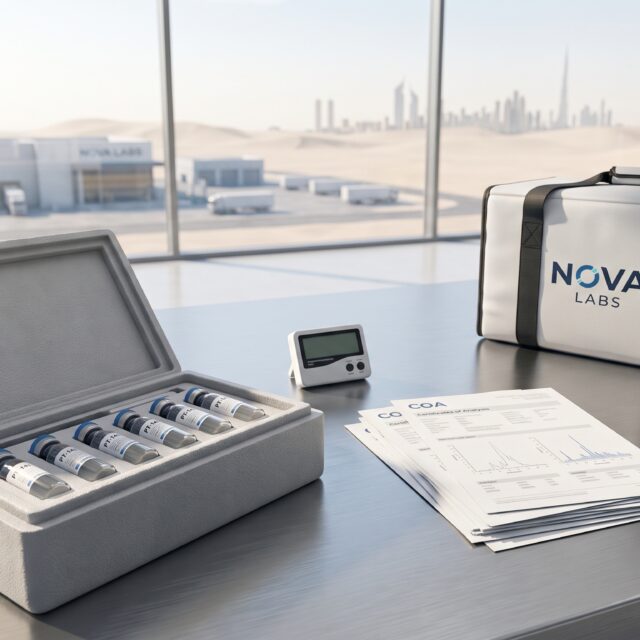
This logistical reality makes local fulfillment an absolute necessity for aqueous formats. NOVA Labs mitigates this risk by maintaining all temperature-sensitive inventory within climate-controlled warehousing located directly in Dubai. By removing international transit delays, researchers can access uncompromised chemical structures that have never been subjected to the volatility of global air freight and regional customs clearance.
Cold-Chain Delivery and Fulfillment Protocols
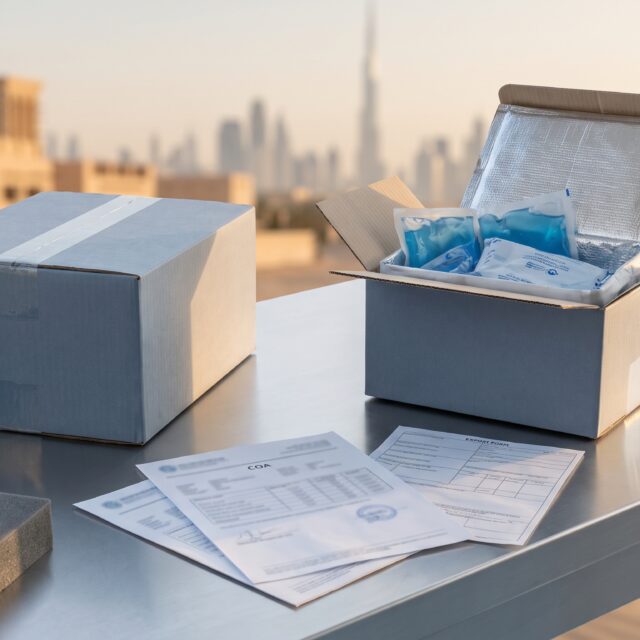
Because KPV nasal sprays require uninterrupted refrigeration, standard courier methods are insufficient. Generic ice packs melt rapidly in the Gulf heat, leaving aqueous solutions exposed. Evaluating a supplier’s last-mile logistics is just as important as verifying their chemical purity.
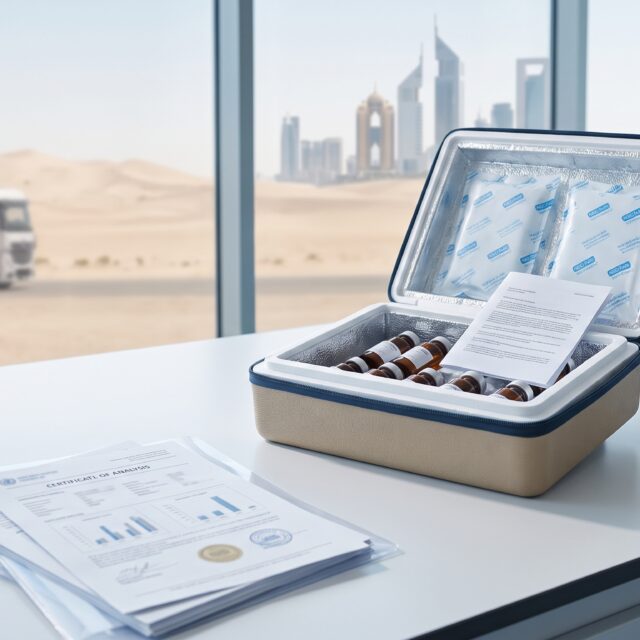
At NOVA Labs, pre-filled nasal sprays and pens do not qualify for generic free shipping offers due to the strict necessity of active cold-chain handling. To guarantee stability, these formats are strictly limited to peptides UAE next-day delivery protocols. Specialized cooled-delivery transit utilizes active cooling modules or vacuum-insulated thermos packaging to maintain the critical 2 to 8 degrees Celsius window from the warehouse shelf to the laboratory door. This incurs a localized fulfillment fee of AED 30 for locations in Dubai and Sharjah, and AED 60 for other Emirates.
For procurement officers operating under tight deadlines, the availability of specialized UAE delivery routes means that time-sensitive research is not delayed by logistical bottlenecks. Additionally, flexible payment models such as Cash on Delivery (COD) allow local buyers to inspect the integrity of the packaging and cooling materials before completing the transaction, providing an essential layer of quality assurance.
Validating Supplier Documentation: HPLC and MS
No commercial claims regarding stability or formulation quality are valid without supporting analytical documentation. A rigorous Certificate of Analysis (COA) is the definitive proof of a peptide’s identity and purity. Procurement staff should never accept a generic COA; the document must match the exact batch number printed on the supplied vial or bottle.
When evaluating a supplier’s COA for research formulations, researchers must verify two primary testing methodologies:
- High-Performance Liquid Chromatography (HPLC): This analytical technique separates the components in the mixture to quantify the exact purity of the KPV peptide. By examining the chromatogram, researchers can identify the main peak (the target peptide) versus any minor peaks (impurities). A research-grade standard requires a minimum purity of 99 percent, ensuring that truncated peptide fragments or synthesis impurities do not interfere with sensitive cellular assays.
- Mass Spectrometry (MS): While HPLC confirms purity, MS verifies identity. This test measures the mass-to-charge ratio of ions to confirm the exact molecular weight of the compound. For KPV, the mass spectrometry results must clearly show a peak at 342.4 Da, confirming that the correct amino acid sequence was synthesized without post-translational errors or missing residues.
Suppliers who obscure their testing data or refuse to provide updated COAs upon request introduce unacceptable variables into the research environment. Reputable vendors provide direct support channels—such as a dedicated WhatsApp line—allowing researchers to request real-time stock checks and verify current batch documentation prior to placing an order.
Conclusion: Secure Sourcing for Advanced Research
Securing liquid peptide formats in the Arabian Gulf demands a procurement strategy focused heavily on localized logistics and precise formulation science. Because aqueous KPV is highly susceptible to hydrolytic and thermal degradation, international importation is rarely a viable option for rigorous research environments. By prioritizing suppliers who utilize climate-controlled Dubai warehousing, specialized cold-chain delivery transit, and batch-specific analytical validation, laboratories can ensure the structural integrity of their experimental compounds.
For procurement staff and researchers ready to source validated formulations locally, evaluating the exact logistics and documentation provided by the supplier is the critical first step in achieving reliable, reproducible data. To explore purity-verified aqueous formats that utilize strict cold-chain logistics, view the KPV Nasal Spray available for immediate dispatch to UAE laboratories.
Disclaimer: The products mentioned in this article are strictly for in-vitro and laboratory research purposes only. They are not intended for human consumption, therapeutic use, or diagnostic applications. Always handle peptides within appropriate laboratory safety protocols.
References
- Luger, T. A., & Brzoska, T. (2007). α-MSH related peptides: a new class of anti-inflammatory and immunomodulating agents in preclinical models. Annals of the Rheumatic Diseases, 66(suppl 3), iii52-iii55.
- Dalmasso, G., Nguyen, H. T., Yan, Y., Charrier-Hisamuddin, L., Sitaraman, S. V., & Merlin, D. (2008). PepT1-mediated epithelial transport of the peptide KPV in-vitro. American Journal of Physiology-Gastrointestinal and Liver Physiology, 294(2), G415-G422.
- Frokjaer, S., & Otzen, D. E. (2005). Protein and peptide stability: a formulation challenge. Nature Reviews Drug Discovery, 4(4), 298-306.
- Banga, A. K. (2015). Peptide Formulation, Processing, and Delivery Systems. CRC Press.
- KPV Nasal Spray: 2026 Clinical Guide, Dosing & Safety – Dr. Seinfeld
- KPV 10mg Nasal Spray | USA Made 99%+ Purity – PrymaLab
- KPV Peptide: Benefits, Dosage & 2026 Legal Status | Rite Aid
- Buy Semax Nasal Spray UAE: Sourcing & Stability Guide – NOVA Labs
- KPV UAE – Inflammation Research Peptide
- KPV Nasal Spray – NOVA Labs
- KPV nasal spray DIY guides: what the peptide science actually shows… – FormBlends
- Buy DSIP in Sharjah: Supplier COAs & Cold-Chain Logistics – NOVA Labs
Frequently asked questions
How long is aqueous KPV stable at room temperature?
Pre-mixed aqueous peptides like KPV degrade rapidly at room temperature due to hydrolysis. They must be stored strictly between 2 and 8 degrees Celsius to prevent accelerated breakdown and maintain molecular viability for research applications.
Why is standard bacteriostatic water insufficient for KPV nasal sprays?
Validated intranasal delivery requires precise pH balancing (typically 4.5 to 6.5) and exact tonicity matching to maintain peptide stability in a liquid state. Basic bacteriostatic water lacks the specialized biochemical buffers necessary to prevent degradation in a spray format.
What documentation is required to verify KPV purity?
A verifiable Certificate of Analysis (COA) must include batch-specific High-Performance Liquid Chromatography (HPLC) and Mass Spectrometry (MS) results. These documents confirm the peptide's exact molecular weight (342.4 Da) and ensure a chemical purity of 99 percent or higher.
How is cold-chain delivery managed for liquid peptides in the UAE?
Suppliers must utilize active cooling transit to keep products between 2 and 8 degrees Celsius. NOVA Labs uses specialized local routes, carrying specific fulfillment fees (AED 30 to AED 60), to prevent thermal degradation during transit in the extreme GCC climate.
Nova Labs buyer tools
Ready to verify stock, testing and delivery?
Use the product page and lab report section to check availability, documentation, delivery timing and support before placing an order.
- COA / test-report checks
- UAE delivery context
- Cold-chain handling
- COD and card payment options
- WhatsApp support