
NAD+ vial: what should UAE buyers check before ordering?
Before ordering a NAD+ vial in the UAE, confirm the labelled material and quantity, obtain documentation for the lot you will receive, and compare its storage instructions with the proposed delivery arrangements. Check stock, delivery eligibility, charges and payment options for your address. A headline purity percentage cannot replace these checks.
Quick answer — buyer checklist
- Identify the material: Does the listing specify oxidised NAD+ rather than NADH, and state the quantity per vial?
- Trace the batch: Does the certificate of analysis (COA) identify the same material and lot number as the supplied vial?
- Read the results: Are identity, chromatographic purity and measured content clearly distinguished?
- Plan receipt: Do storage instructions, packaging and the estimated arrival window work for your receiving location?
- Confirm the order: Are stock, the total delivered price, payment methods and a route to support clear before checkout?
For a Dubai laboratory, these questions help prevent an avoidable mismatch between a product listing, a certificate and the material that arrives. They also apply elsewhere in the UAE, although dispatch and delivery arrangements may differ by emirate and address.
What does a lyophilised NAD+ research vial contain?
NAD+ is the oxidised form of nicotinamide adenine dinucleotide, a coenzyme involved in cellular redox reactions and studied in NAD+-dependent processes. NADH is its reduced form. They are related, but a listing for one should not be read as a listing for the other. PubChem’s compound record and a review of NAD+ metabolism provide background on identity and research context; neither verifies a seller’s particular batch.
NAD+ is not a peptide. A retailer may place it within a peptide-vial catalogue for navigation, so rely on the compound name, product specification and batch documentation rather than the collection name. If a listing uses only an abbreviation or gives inconsistent names across its page, label and COA, ask the seller to reconcile them before purchasing.
“Lyophilised” means freeze-dried. It tells you the material is supplied in a dry presentation, not that a particular purity, shelf life or sterility standard has been met. Likewise, the presence of a sealed vial does not establish how it was tested or what shipping conditions it can tolerate. Those details need product- and batch-specific evidence.
Which label details should match the order?
Start with the material name, labelled quantity, lot or batch number and research-use designation. Check that the quantity refers to one vial rather than an entire pack. For a multi-vial order, ask whether every unit will carry traceable lot information and whether the paperwork covers every lot supplied. A single certificate may be sufficient for several vials from one documented lot; it should not be assumed to cover a different lot.
Compare the product page with the purchasing record as well. If your team requires a particular chemical form or specification, confirm that information in the supplier’s documentation rather than inferring it from “NAD+” alone. Record the stated storage conditions before ordering so the receiving team can check the parcel against the same instructions when it arrives.
Price comparisons are most useful when the basis is consistent: labelled quantity per vial, number of vials, available batch records and delivered cost. A lower per-vial price does not compensate for a missing lot number if your procurement process requires traceability.
How should you read a NAD+ COA and HPLC result?
A COA is useful only when you can connect it to the goods offered. Match the material name and lot number, then check the issuer, report date, tests performed, methods or method references, results and any stated acceptance criteria. A sample COA from a previous lot can show a supplier’s document format; it cannot establish the results for the lot you will receive.
Read the reported measurements separately:
- Identity addresses what material was tested. If a seller cites mass spectrometry or another identity method, look for a corresponding result or report reference. An HPLC purity percentage alone should not be treated as proof of identity.
- Chromatographic purity describes a result under a specified separation and reporting method. An HPLC main-peak area percentage is not automatically the fraction by mass of NAD+ in a vial.
- Content or assay addresses a measured amount or concentration when the COA actually reports one. Check its units, method and relationship to the labelled quantity; do not calculate content from the purity figure alone.
- Other claims, such as independent testing or sterility, need their own supporting records. “Third-party tested” is more informative when the external laboratory, test and lot can be identified.
Not every research-material COA contains every test, and the word “COA” is not a substitute for reading its contents. The ICH quality guidelines explain broader principles for analytical procedures and validation; they do not certify an individual supplier or its NAD+ vials. Decide which records your own research procurement procedure requires, then ask about any missing result before paying.
How do UAE delivery and storage requirements affect the order?
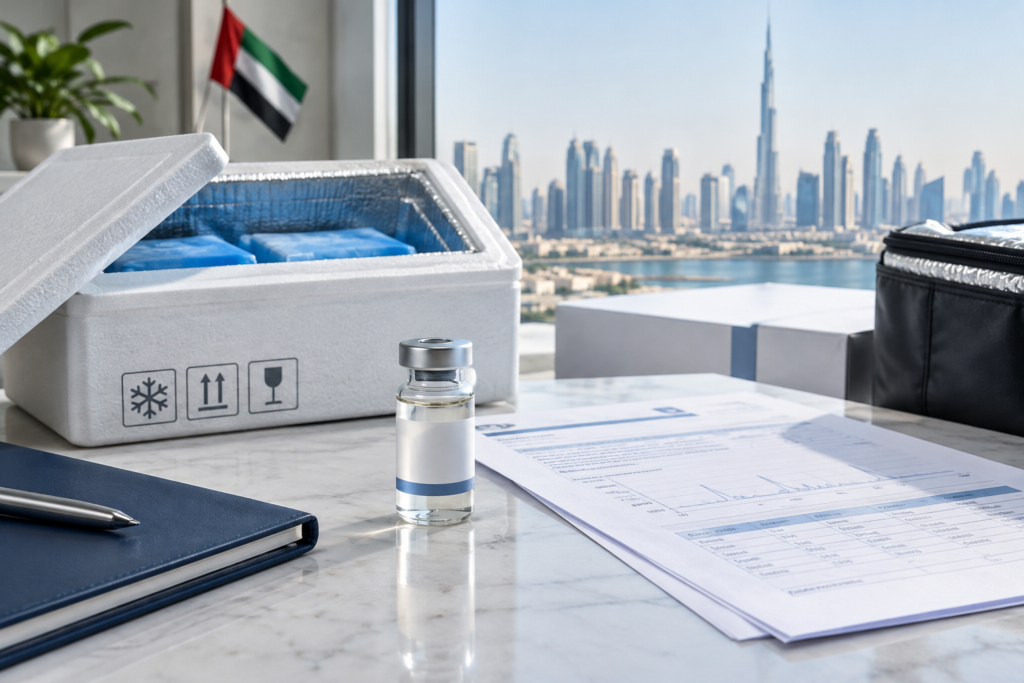
The relevant question is not just how quickly a parcel reaches Dubai, Abu Dhabi or another emirate. It is whether the product’s stated storage conditions can be met through dispatch, transit and receipt. UAE outdoor temperatures can be high, while time in a vehicle or at an unattended delivery point may be uncertain. Do not infer temperature-controlled shipping from a short delivery estimate or a photograph of insulated packaging.
Check the product-specific storage wording on the listing, label or supporting paperwork. Then ask what packaging and delivery service are offered for your address, whether any protective handling is available if your procedure calls for it, and how a failed delivery attempt is managed. Arrange a receiving contact for the expected window if the material cannot be left unattended under its stated conditions. Document the parcel condition and lot number at receipt according to your organisation’s process.
NOVA Labs publishes UAE next-day delivery information, but a general delivery page is not confirmation that a particular NAD+ order, destination or checkout time qualifies. Check item eligibility, dispatch cut-off, delivery fee and estimated arrival for the actual address. If a shipment is going to another GCC country, confirm carrier acceptance, paperwork, import requirements and any handling limitations separately; a UAE delivery promise does not establish cross-border eligibility. Abu Dhabi Customs’ restricted-goods guidance is general information, not a classification or clearance decision for an individual shipment.
What should you confirm about payment and support?
Before checkout, compare the total payable amount with the quoted item price, including delivery charges and any applicable fees shown for your address. Review the payment methods actually offered at checkout rather than assuming cash on delivery, bank transfer or a particular card option is available. For an institutional purchase, confirm whether your team needs an invoice, purchase-order reference or other records before placing the order.
Support is most valuable when the question is specific. Provide the product name and required vial quantity, then ask which lot is available, whether its COA can be supplied, and how the proposed delivery arrangements relate to the stated storage instructions. If you contact a seller through WhatsApp or another support channel, keep the response with your purchasing records. A verbal assurance about “high purity” is less useful than an identifiable batch document and clear order terms.
Make a documented purchase decision
The right fit is a vial whose identified material, labelled quantity, available lot records and delivery arrangements meet your research procurement requirements. If a COA belongs to another lot, an assay claim lacks a report, or the storage and shipping terms conflict, resolve that point before ordering rather than relying on the product headline.
Review the NOVA Labs NAD+ vial listing and use its support channel to request the current lot documentation and confirm stock and delivery terms for your address.
For research purposes only. The product discussed is not intended for human consumption.
References
- PubChem, Nicotinamide adenine dinucleotide — compound identity and chemical information; not verification of a commercial batch.
- Nature Reviews Molecular Cell Biology, review of NAD+ metabolism — biochemical research background; not evidence of product quality or suitability.
- International Council for Harmonisation, Quality Guidelines — analytical-procedure guidance; not a certificate for any seller or lot.
- Abu Dhabi Customs, Restricted and Prohibited Goods — general customs information; shipment requirements must be checked for the destination and goods concerned.
- Regulation of and challenges in targeting NAD+ metabolism | Nature Reviews Molecular Cell Biology
- Beta-Nicotinamide adenine dinucleotide | PubChem
Frequently asked questions
What does lyophilised mean on a NAD+ vial?
It means the research material is supplied freeze-dried. The term alone does not establish purity, sterility, shelf life or shipping requirements; check the specific product documentation.
How can I check whether a NAD+ COA belongs to the vial I receive?
Match the material name and lot or batch number on the COA with the vial label. Check the issuer, report date and tests performed; a certificate for a different lot does not document yours.
Does an HPLC purity percentage tell me how much NAD+ is in a vial?
Not necessarily. An HPLC peak-area percentage is a chromatographic result, not automatically a measurement of the vial’s NAD+ mass. Look for a separate content or assay result if your procurement procedure requires one.
How should a NAD+ research vial be stored during UAE delivery?
Follow the storage instructions for the specific product. Before ordering, confirm that the offered packaging, transit arrangements and receiving window are compatible with those instructions; do not assume temperature control from a delivery estimate.
Is next-day delivery available for a NAD+ vial in the UAE?
Availability depends on current stock, item eligibility, the dispatch cut-off and your address. Confirm the estimated arrival and delivery charge for the actual order before checkout.
Can I pay cash on delivery for a NAD+ vial in Dubai?
Do not assume cash on delivery is offered. Check the payment methods displayed for the item and Dubai address at checkout, or ask the seller’s support team before placing the order.
Nova Labs buyer tools
Ready to verify stock, testing and delivery?
Use the product page and lab report section to check availability, documentation, delivery timing and support before placing an order.
- COA / test-report checks
- UAE delivery context
- Cold-chain handling
- COD and card payment options
- WhatsApp support