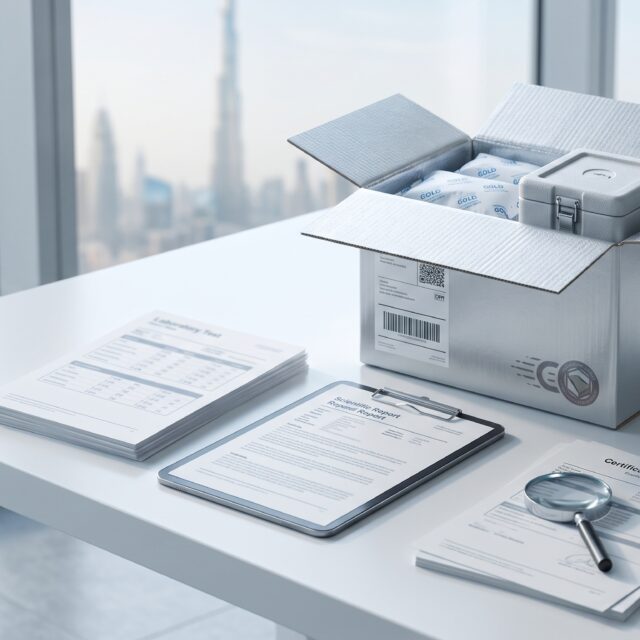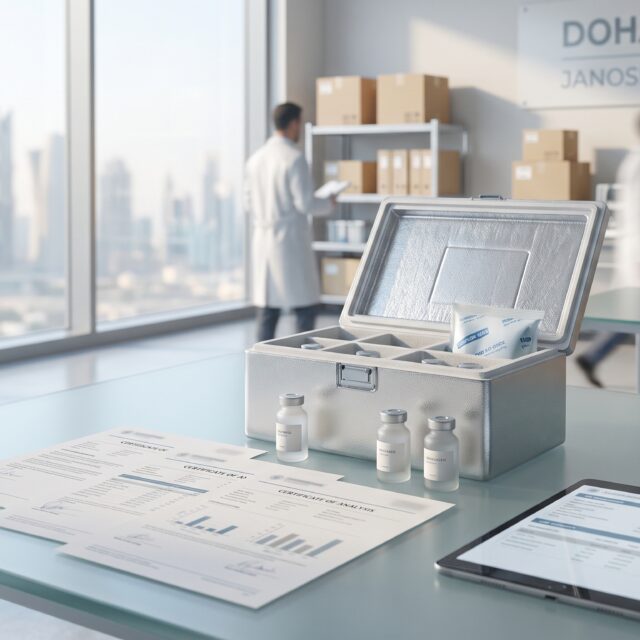






Procuring sensitive research materials in the Gulf Cooperation Council (GCC) presents a unique set of logistical hurdles. For researchers and laboratory procurement specialists in Kuwait, the primary threats to product integrity are twofold: extreme environmental temperatures and stringent international customs regulations. Without robust thermal protections and highly accurate import documentation, expensive molecular compounds can easily degrade on a hot tarmac or face indefinite seizure by border authorities.
Addressing these specific regional risks requires specialized supply chain solutions. This guide details the logistics of safe peptide transport, explaining how environmental heat impacts molecular stability, what modern thermal packaging actually entails, and why regional fulfillment networks are rapidly replacing slow, unpredictable international shipping routes.
The Fundamentals of Cold Chain Peptide Delivery in Kuwait
Quick Answer: Secure cold chain peptide delivery in Kuwait requires phase-change thermal packaging to survive 50°C heat and regional GCC fulfillment to bypass strict MOH customs delays. Ensure your supplier provides active temperature control, authentic ‘Research Use Only’ documentation, and third-party HPLC/MS purity testing to guarantee viability upon arrival.
Understanding how your supplier handles these variables is the difference between receiving highly pure, viable research compounds and receiving degraded, compromised vials. High ambient temperatures do not merely warm a package; they actively catalyze destructive chemical reactions that compromise the structural integrity of complex amino acid chains.
To navigate these challenges successfully, independent researchers and procurement staff must evaluate a supplier’s entire fulfillment pathway—from initial warehouse storage temperatures down to the last-mile courier vehicles utilized for local delivery.
How Extreme GCC Heat Threatens Peptide Stability
The climate in Kuwait is notoriously severe, with summer temperatures routinely exceeding 50 degrees Celsius (122 degrees Fahrenheit). When a package sits on an airport loading dock or inside an un-air-conditioned delivery van, internal temperatures can spike even higher. For delicate biological and chemical reagents, this environment is highly destructive. Sustained temperatures exceeding 40 degrees Celsius catalyze peptide degradation, inducing rapid hydrolysis, deamidation, and irreversible molecular aggregation.
Lyophilized Powder vs. Reconstituted Solutions
The physical state of the chemical compound dictates its thermal vulnerability. The vast majority of high-quality research peptides are shipped as lyophilized (freeze-dried) powder. In a completely moisture-free, vacuum-sealed vial, lyophilized peptides possess a significant degree of thermal resilience compared to their liquid counterparts. They can often withstand short-term exposure to ambient temperatures (up to a few days) during transit without significant loss of purity, provided they remain entirely dry and shielded from direct UV light.
However, international transit times in the Middle East can be highly unpredictable. If an international package is delayed at a customs checkpoint and left exposed to the elements, the internal temperature of a standard cardboard box can quickly skyrocket, effectively cooking the contents and breaking fragile peptide bonds.
Furthermore, once a peptide is reconstituted with bacteriostatic water or a similar solvent in the lab, its stability profile drops drastically. Reconstituted solutions must be continuously refrigerated between 2 and 8 degrees Celsius to prevent rapid degradation. When optimizing local peptide logistics, Kuwaiti laboratories must insist on shipping protocols that minimize tarmac time and utilize insulated packaging—even for lyophilized powders—to buffer against the region’s intense thermal spikes.
Navigating Kuwait Customs: The Advantage of Regional Fulfillment
Beyond the severe weather, the biggest obstacle to importing research materials into Kuwait is regulatory friction. International parcel delivery to Kuwait faces notably high customs seizure and delay rates. The Kuwait Ministry of Health (MOH) strictly monitors chemical and biological imports, and unverified packages are frequently held for extended inspection, delayed for weeks, or outright destroyed if documentation is lacking.
The Role of the Kuwait Ministry of Health (MOH)
Importing chemical products into Kuwait successfully requires rigorous, precise documentation. Shipments typically need a detailed Commercial Invoice, a Certificate of Origin (COO), Material Safety Data Sheets (MSDS), and an MOH-compliant packing list. Crucially, research peptides must be clearly, explicitly, and accurately declared as Research Use Only (RUO) chemical reagents.
Ambiguous labeling, missing paperwork, or consumer-oriented packaging will trigger immediate red flags at the border. If an international supplier does not understand these specific GCC regulatory requirements, the burden of clearance falls entirely on the buyer, often resulting in lost shipments and wasted research budgets.
Why Local Supply Chains Win
Because of these international shipping bottlenecks, regional GCC logistics have become the preferred procurement route for serious laboratories. Suppliers operating regional fulfillment hubs within the UAE or broader GCC have already navigated the complex initial importation into the region.
By leveraging localized warehousing, suppliers can dispatch packages via regional courier networks that are highly accustomed to intra-GCC commerce. This routing drastically reduces transit times, limits customs exposure, and keeps the package in controlled environments rather than sitting in long-haul international sorting facilities. For delivery-sensitive buyers in Kuwait, utilizing a supplier with a regional hub is the most effective way to guarantee rapid, secure delivery.
The Science of Thermal Packaging: What Protects Your Order
True cold-chain logistics involves much more than tossing a frozen gel pack into a cardboard box. Advanced suppliers and specialized logistics providers validate their packaging systems to guarantee continuous temperature maintenance during the critical transit window. When evaluating a supplier’s shipping protocols, look for the use of specialized insulating technologies designed for desert climates:
- Phase-Change Materials (PCMs): Unlike standard water-based ice packs that melt rapidly and create dangerous condensation, PCMs are engineered chemical packets designed to absorb ambient heat while maintaining a specific, sustained internal temperature. They are often precisely calibrated to hold a 2-8°C or 15-25°C environment for 48 to 72 hours.
- Vacuum-Insulated Panels (VIPs): High-end medical logistics utilize VIPs, which offer exponentially higher thermal resistance than standard EPS (Styrofoam). These panels create a rigid barrier that prevents external heat from penetrating the payload area, even in a 50°C environment.
- Moisture Barriers and Desiccants: Condensation is the absolute enemy of lyophilized powder. Quality packaging includes moisture-absorbing desiccants and sealed metallic or mylar barrier bags to ensure humidity does not compromise the vial’s rubber stopper or vacuum seal.
- Active Temperature Data Loggers: For large-scale or highly sensitive laboratory orders, suppliers may include active data loggers. These small electronic devices record the package’s internal temperature at regular intervals, providing a verifiable audit trail of the shipment’s thermal history upon arrival to ensure the cold chain remained unbroken.
Evaluating Suppliers: Documentation, Payment, and Support
A robust logistics chain is only as valuable as the chemical product it delivers. Before placing a procurement order, Kuwaiti buyers must verify that the supplier maintains rigorous quality control standards alongside their shipping capabilities.
Verifying Purity with COAs (HPLC and MS)
Always demand transparency regarding product purity. Reputable suppliers provide up-to-date, batch-specific Certificates of Analysis (COAs) conducted by independent, third-party analytical laboratories. These documents should feature High-Performance Liquid Chromatography (HPLC) to verify purity levels (which should exceed 99%) and Mass Spectrometry (MS) results to confirm that the compound exactly matches the expected molecular weight without heavy metal or synthesis byproduct contamination.
Secure Payment and Responsive Local Support
Cross-border transactions in the GCC require trust and security. Look for suppliers that offer secure, localized payment gateways. While international credit card processing is standard, integration with regional payment systems (such as KNET for Kuwaiti buyers, where applicable) or robust corporate invoicing options signals a supplier’s commitment to the local market.
Additionally, real-time customer support is vital when coordinating time-sensitive deliveries. Suppliers that offer direct communication channels, such as dedicated WhatsApp support, allow buyers to track dispatch times, resolve last-mile courier delays instantly, and receive proper handling and storage instructions immediately upon arrival.
NOVA Labs: Regional Expertise and Reliable Dispatch
At NOVA Labs, we understand the distinct challenges of operating a research facility within the Middle East. We focus on bridging the gap between rigorous analytical purity and highly reliable regional logistics. By maintaining strategic operational hubs within the UAE, we bypass the severe delays and uncertainties of long-haul international shipping into Kuwait and the wider GCC.
Our handling protocols are specifically designed to respect the fragile nature of research reagents in desert climates. From climate-controlled storage facilities to insulated, phase-change dispatch packaging, we prioritize product stability at every step. If you are building out your laboratory’s inventory and require prompt, secure fulfillment, you can explore our research collections to review our documented HPLC/MS testing standards and available compounds.
Furthermore, for researchers operating within our primary dispatch zones across the GCC, we offer streamlined logistics designed to minimize transit times and entirely mitigate heat exposure. Learn more about our robust infrastructure and fast regional dispatch networks to see how localized fulfillment protects your research investments.
Conclusion and Next Steps
Procuring high-quality molecular compounds in Kuwait requires a proactive, educated approach to logistics. The combination of intense summer heat and strict Ministry of Health regulations means that standard international shipping routes are often highly insufficient. To protect your research budget and ensure experimental integrity, prioritize suppliers who utilize proven thermal packaging, provide verifiable third-party HPLC/MS documentation, and leverage regional GCC fulfillment networks to bypass customs delays.
By demanding transparency in both purity testing and supply chain handling, informed buyers can confidently secure the reliable reagents they need, regardless of the challenging local climate.
Disclaimer: The products and information mentioned in this article are strictly for laboratory research and development purposes only. They are not intended for human consumption, diagnostic, or therapeutic use.
*
References
- International Trade Administration. “Kuwait – Import Requirements and Documentation.” Trade.gov.
- Lone Star Peptide Co. “Cold Chain Shipping: What the Science Actually Says.”
- RapidFulfillment. “Cold Chain Peptide Shipping Services Explained.”
- Cold Cargo Logistics. “When to Use Cold Chain for Middle East Logistics Parcel?”
Disclaimer: The products mentioned in this article are for research purposes only and are not intended for human consumption.
- Best Peptide Shop Kuwait: Supplier Guide & Customs Tips – NOVA Labs
- Peptides Lab GCC – High-Purity Research Peptides | GCC Supply for Laboratories
- How to Store Research Peptides: Complete UK Guide to Stability and Shelf Life (2026)
- Cold Chain Shipping: What the Science Actually Says – Lone Star Peptide Co.
- Kuwait – Import Requirements and Documentation – International Trade Administration
- When to Use Cold Chain for Middle East Logistics Parcel? Cold Cargo
- Peptides shipping in kuwait – Reddit
- Cold Chain Peptide Shipping Services Explained – RapidFulfillment.com
Frequently asked questions
Do research peptides need to be shipped on ice to Kuwait?
While lyophilized (freeze-dried) peptides possess short-term stability at ambient temperatures, Kuwait's extreme 50°C summer heat requires insulated packaging and phase-change materials to prevent rapid thermal degradation during transit.
How does Kuwait customs handle research peptide imports?
The Kuwait Ministry of Health strictly regulates chemical imports. Research materials face high seizure rates unless accompanied by proper Commercial Invoices, Certificates of Origin, Material Safety Data Sheets, and clear 'Research Use Only' declarations.
What happens if lyophilized peptides are exposed to severe heat?
Sustained exposure to extreme temperatures above 40°C can catalyze chemical degradation, leading to hydrolysis, deamidation, and molecular aggregation, which permanently compromises the purity and viability of the research compound.
Why is regional GCC fulfillment better than international shipping for peptides?
Regional suppliers based in the UAE or broader GCC bypass long-haul international customs bottlenecks, significantly reducing transit times and minimizing the window in which delicate shipments are exposed to uncontrolled environmental heat.
How can I verify the quality of peptides ordered online?
Always review the supplier's Certificate of Analysis (COA) for the specific batch being purchased. The COA should feature independent High-Performance Liquid Chromatography (HPLC) and Mass Spectrometry (MS) testing to verify a purity level exceeding 99 percent.
Nova Labs buyer tools
Ready to verify stock, testing and delivery?
Use the product page and lab report section to check availability, documentation, delivery timing and support before placing an order.
- COA / test-report checks
- Kuwait delivery context
- Cold-chain handling
- COD and card payment options
- WhatsApp support