




Peptide Purity Guide Oman: Procurement and Logistics Setup
Quick answer for buyers: A reliable peptide purity guide in Oman requires verifying that a supplier provides third-party HPLC and Mass Spectrometry testing, proving purity above 98%. Buyers must also confirm the vendor utilizes validated regional cold-chain shipping to protect compounds from extreme heat and ROP Bayan customs delays.
For scientific researchers, academic institutions, and independent laboratories in the Sultanate of Oman, sourcing research compounds presents a unique set of logistical and administrative hurdles. Procurement goes far beyond basic biochemical definitions. It requires navigating the practical reality of importing fragile compounds into a region where summer temperatures routinely exceed 45°C and customs regulations demand uncompromising, meticulous documentation.
Whether you are managing chemical procurement for a laboratory in Muscat or facilitating independent research in Sohar, you need verifiable proof of chemical integrity before authorizing a purchase. This guide provides Oman-based procurement teams with the critical steps for supplier evaluation: analyzing Certificates of Analysis (COAs), understanding cold-chain stability, and anticipating the stringent requirements of the Royal Oman Police (ROP) Bayan Single-Window Portal.
Establishing the Baseline: What Constitutes Peptide Purity?
In chemical terms, peptide purity refers to the percentage of the total sample that consists of the exact, intact target sequence. The synthesis of amino acid chains is a complex process. Even under the most tightly controlled laboratory conditions, truncated sequences, missing amino acids, or misfolded structures can occur during the manufacturing phase.
For rigorous scientific research, premium-grade peptides must achieve a purity of 98% or higher. Utilizing compounds with lower purity levels introduces significant risk into in-vitro biological assays. Unquantified impurities can bind to non-target receptors, trigger unintended cellular responses, and ultimately confound your experimental data, leading to wasted time and budget.
HPLC and Mass Spectrometry: The Dual Verification Standard
To confidently verify the integrity of a compound, researchers must look for two specific analytical methods on the supplier’s testing documentation:
- High-Performance Liquid Chromatography (HPLC): This analytical technique quantifies the purity of the sample. HPLC separates the components of a liquid mixture, producing a chromatogram with a dominant peak representing the primary peptide. The area under this peak, relative to the total area of all peaks, determines the purity percentage.
- Mass Spectrometry (MS): While HPLC measures how pure a substance is, it does not confirm what the substance actually is. Mass Spectrometry determines the precise molecular weight of the compound, ensuring that the primary peak identified by HPLC is exactly the specific peptide sequence you intend to purchase, rather than an unknown byproduct.
Decoding the Certificate of Analysis (COA) for Oman Customs
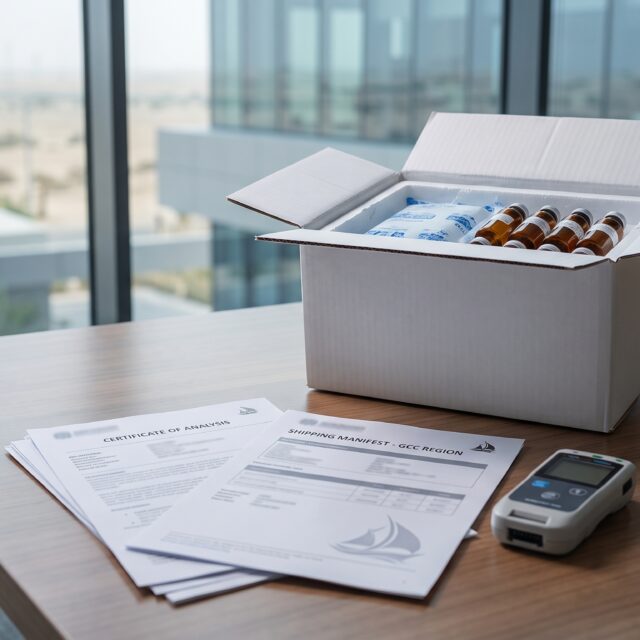
An authentic, verifiable Certificate of Analysis is the absolute cornerstone of safe laboratory procurement. However, possessing a piece of paper labeled “COA” is not enough. Informed buyers must actively audit these documents for specific compliance markers, especially when dealing with stringent Middle Eastern customs agencies.
Batch Number Alignment
The most common error made by researchers is accepting a generic COA that does not apply to their specific purchase. The batch number printed on your physical vial must precisely match the batch number listed on the testing documentation. If a supplier cannot provide batch-specific testing, they cannot guarantee the purity of the specific product in your hands.
Independent Laboratory Accreditation (ISO 17025)
Internal testing—where a supplier tests their own product and generates their own report—carries an inherent conflict of interest. Top-tier vendors utilize independent, third-party analytical laboratories to perform their HPLC and MS testing. Ideally, look for testing facilities that hold ISO/IEC 17025 accreditation, which dictates the global standard for testing and calibration laboratories. This ensures the chemical analytical mobile phase ratios and testing methodologies are beyond reproach, which is critical if Oman customs officials decide to spot-test the import.
Beating the Heat: Cold-Chain Logistics in the GCC
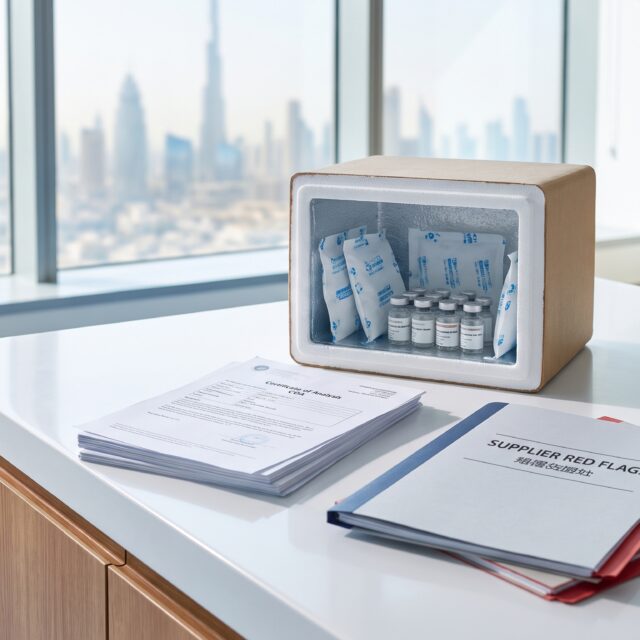
Verifying a 99% purity rating on a COA is useless if the compound degrades before it reaches your laboratory bench. The GCC climate introduces severe degradation risks to molecular structures.
The Risks of Thermal Degradation
When exposed to the extreme 45°C+ summer heat common in Oman, peptide bonds are highly susceptible to hydrolysis (the chemical breakdown due to reaction with water) and residue oxidation. These reactions alter the molecular weight and structure of the compound, effectively destroying its research viability and rendering your initial purity checks meaningless.
Lyophilization and Validated Regional Transport
Reputable suppliers ship peptides in a lyophilized (freeze-dried) state. By removing the water content, the compound becomes remarkably stable, even at room temperature for brief periods. However, prolonged transit times through un-air-conditioned international customs warehouses require specialized handling.
This is why sourcing from vendors with established regional infrastructure is vastly superior to ordering from overseas dropshippers. Suppliers operating within the GCC can execute rapid delivery models that minimize environmental exposure. For example, utilizing regional logistics networks that support rapid dispatch—such as peptides UAE next day delivery transit models that branch efficiently into Oman—provides a massive advantage for preserving compound stability compared to week-long international transit from the US or China.
Once received and reconstituted with bacteriostatic water, these compounds must immediately transition into strict refrigerated storage, maintained carefully between 2°C and 8°C.
Navigating ROP Bayan and Oman Customs Clearance
Securing chemical compounds in Oman involves strict adherence to the import regulations enforced by the Royal Oman Police (ROP) and the Ministry of Health (MOH) Drug Safety Center. Regional standards are tightening across the GCC, and failure to provide perfect documentation can result in seized goods, port delays at Muscat International Airport, and escalating demurrage fees.
The Bayan Single-Window Portal
Commercial and laboratory imports into Oman are managed via the ROP Bayan Single-Window Portal. For shipments exceeding certain commercial valuation thresholds, the importing entity must typically set up an electronic authorization and provide detailed HS (Harmonized System) codes for laboratory reagents.
When your shipment arrives at the port of entry, customs officials may elect to sample the product. If there is a discrepancy between your supplier’s provided COA and the local customs testing lab results, your shipment will be held. Working with a supplier who provides globally recognized, ISO-compliant testing data minimizes the risk of these expensive and time-consuming disputes.
Evaluating Payment Security and Vendor Support
Beyond purity and shipping, the operational framework of your supplier matters. Time zone differences can be a massive hurdle when a shipment is unexpectedly flagged by Omani customs.
- Accessible Support: A supplier who only communicates via email across a 12-hour time zone gap cannot help you if your shipment is delayed at 9:00 AM in Muscat. Prioritize vendors offering direct WhatsApp support and clear GCC-focused logistical knowledge.
- Secure Transactions: Look for modern B2B payment gateways. Suppliers demanding unsecure bank transfers or cryptocurrency without a traditional corporate invoicing option often lack the commercial legitimacy required to pass corporate procurement audits.
Your Supplier Evaluation Checklist
To streamline your procurement process and protect your research budget, we recommend adopting a strict evaluation framework before you explore our complete catalog of research compounds or engage any other supplier.
- Demand Current, Matching Testing Data: Never accept a COA that is over a year old or lacks a matching batch number for your specific vials.
- Verify Third-Party Independence: Ensure the laboratory name on the HPLC report is entirely distinct from the supplier brand.
- Assess Cold-Chain Shipping Protocols: Ask directly about their packaging materials and regional dispatch locations. Do they use insulated mailers? Can they guarantee rapid regional transit to Muscat?
- Confirm Customs Competence: Ensure the vendor includes appropriate commercial invoices, HS codes, and MSDS (Material Safety Data Sheets) required for ROP Bayan clearance.
Conclusion: Sourcing with Confidence
Executing successful biological assays begins long before you load a pipette. It starts with a rigorous procurement strategy. By establishing a clear baseline for acceptable purity, demanding batch-specific independent testing, and prioritizing regional cold-chain logistics, you protect against thermal degradation and customs delays. Ensure your vendor understands the complexities of the ROP Bayan customs portal. By holding your suppliers to these uncompromising standards, you protect the integrity of your research and optimize your operational budget.
Disclaimer: The products and compounds mentioned in this article are strictly for laboratory and research purposes only. They are not intended for human consumption, diagnostic use, or therapeutic application.
References
- International Organization for Standardization (ISO). ISO/IEC 17025:2017 – General requirements for the competence of testing and calibration laboratories.
- Directorate General of Customs, Royal Oman Police. Bayan Customs Single-Window System Guidelines and Procedures.
- Oman Ministry of Health (MOH). Drug Safety Center Regulations for Chemical and Laboratory Reagent Imports.
- NOVA Labs Quality Assurance. Peptide Handling, Lyophilization, and GCC Cold-Chain Logistics Standards.
- Peptide Purity Testing: How to Verify Quality and Safety (2026 Guide) | Peptidepedia
- Copper Peptide GHK-Cu Bulk Wholesale Supplier | Factory Price Oman
- Peptide Laws in Oman — Can You Buy, Travel & Import? (2026)
- Peptide Supplier Checklist Oman: Buyer Guide & Import – NOVA Labs
- Cold-Chain Peptide Delivery and Stability in the UAE
- How to Get Customs Clearance in Oman: First-Timer Guide – Express Freight Services
- Ministry prohibits use and promotion of unlicensed peptides in Qatar – ILoveQatar.net
Frequently asked questions
What is the minimum acceptable peptide purity for research in Oman?
Premium research-grade peptides should test at a minimum of 98% purity. This strict threshold is necessary to prevent unquantified impurities from binding to non-target receptors and confounding your biological assay results.
How do Oman customs handle research peptide imports?
Imports must be cleared through the ROP Bayan Single-Window Portal. Accurate, batch-specific COA documentation and correct HS codes are strictly required by local customs to prevent port delays and demurrage fees.
Does Oman's extreme heat affect lyophilized peptides during shipping?
Yes, prolonged exposure to temperatures frequently exceeding 45°C can cause rapid peptide bond hydrolysis and residue oxidation. Validated GCC cold-chain logistics and rapid regional shipping are essential for preserving compound integrity before reconstitution.
How can I verify a peptide's Certificate of Analysis (COA)?
To verify a COA, ensure the batch number printed on your physical vial exactly matches the batch number on the testing documentation. Additionally, verify that the HPLC and Mass Spectrometry testing was performed by an independent, ISO/IEC 17025 accredited analytical laboratory.
Nova Labs buyer tools
Ready to verify stock, testing and delivery?
Use the product page and lab report section to check availability, documentation, delivery timing and support before placing an order.
- COA / test-report checks
- Oman delivery context
- Cold-chain handling
- COD and card payment options
- WhatsApp support