
Sourcing Reliable Materials: A Peptide Purity Guide Sharjah
Quick answer: A dependable peptide purity guide Sharjah buyers can rely on demands verifying independent High-Performance Liquid Chromatography (HPLC) reports demonstrating at least 98% purity. Researchers must check batch-specific Certificates of Analysis (COAs) and utilize local suppliers offering expedited delivery to prevent thermal degradation during transit.
Sourcing high-quality research compounds in the United Arab Emirates presents a unique set of challenges. For laboratories, independent researchers, and informed procurement staff, verifying chemical authenticity and ensuring proper logistics are critical steps that cannot be overlooked. A fragmented market—split between stringent medical compounding clinics and unregulated offshore vendors—means buyers must know exactly what documentation to request. This resource is designed to serve as your definitive benchmark for evaluating local suppliers, demystifying laboratory reports, and ensuring delicate compounds survive the region’s extreme climate.
Why Laboratory Verification is Non-Negotiable
When evaluating vendors locally, the foundational rule is simple: never purchase research materials without verifiable, independent laboratory testing. Peptides are intricate chains of amino acids, and the synthesis process naturally yields impurities, truncated sequences, and byproducts. If a supplier cannot prove the exact composition of their vial, the material is unsuitable for precise laboratory investigation.
The Role of HPLC and Mass Spectrometry
Legitimate vendors benchmark their research-grade products at a minimum of 98% or 99% purity. Verifying this requires two distinct analytical methods:
- High-Performance Liquid Chromatography (HPLC): This technique separates the components of a mixture to quantify purity. A valid HPLC report will display a clean, dominant peak representing the target compound, alongside minimal baseline noise that would indicate impurities.
- Mass Spectrometry (MS): While HPLC shows how pure the sample is, MS confirms that the sample is actually the correct compound. It measures the mass-to-charge ratio to verify the molecular weight and exact amino acid sequence.
By following this testing methodology, laboratories can avoid substandard materials that might skew experimental data or cause unpredictable cellular reactions in in-vitro studies.
Decoding the Certificate of Analysis (COA)
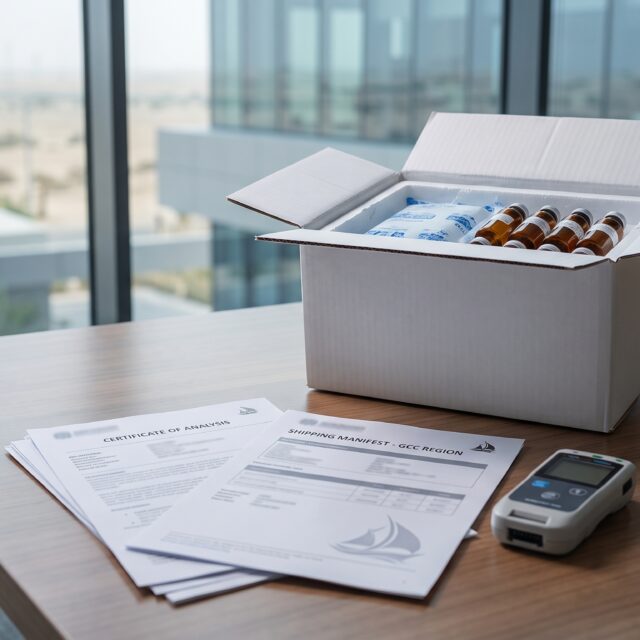
A Certificate of Analysis (COA) is the essential document that binds a vendor’s quality claims to reality. However, not all COAs are created equal. Substandard suppliers frequently utilize outdated, generalized, or forged documents to pass off low-grade products.
When auditing a supplier’s documentation, buyers should cross-reference the batch number on the physical vial with the batch number listed on the COA. Furthermore, authentic testing documents must display the credentials of an independent, third-party laboratory. If the COA is generated entirely in-house without external verification, a conflict of interest exists.
Another common red flag to watch for in the GCC market is the inappropriate use of “pharmaceutical grade” labelling on Research Use Only (RUO) compounds. Unless a product is manufactured in a licensed, regulated compounding pharmacy under MOHAP/DHA guidelines for a specific patient, it should be categorized accurately as a research chemical. Transparent vendors are clear about this distinction and rely on empirical HPLC/MS data rather than misleading marketing jargon.
The Sharjah Heat Factor: Cold-Chain Logistics and Storage
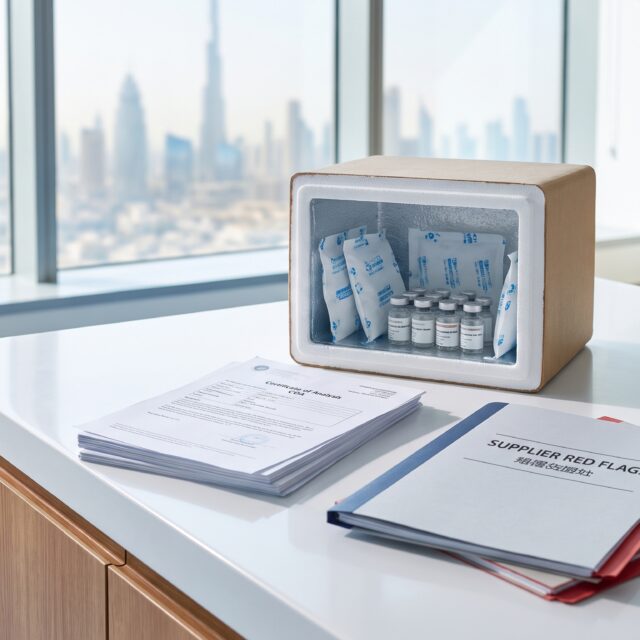
Even a compound synthesised at 99.9% purity is useless if it degrades during shipping. The ambient summer temperatures in Sharjah and the wider UAE frequently exceed 40 degrees Celsius. Peptides, particularly once reconstituted, are thermally unstable and degrade rapidly when exposed to high heat.
Lyophilized vs. Reconstituted Stability
Research compounds are typically shipped in a lyophilized (freeze-dried) state. In this powder form, they are remarkably resilient and can withstand short transit times at room temperature, provided they are kept out of direct sunlight. However, for long-term storage, lyophilized vials must be kept in cold-storage between 2 to 8 degrees Celsius, where they can remain stable for several years.
Once a researcher introduces a solvent to reconstitute the peptide, the stability window shrinks dramatically. Reconstituted peptides must never be left at room temperature and must be refrigerated immediately.
The choice of solvent also dictates the compound’s viable lifespan. Reconstituting with bacteriostatic (BAC) water—which contains 0.9% benzyl alcohol to prevent bacterial growth—allows the solution to remain viable for 4 to 8 weeks when stored at 2 to 8 degrees Celsius. In contrast, using standard sterile water drops the stability window down to a mere 5 to 7 days before rapid degradation occurs.
Expedited Delivery Solutions
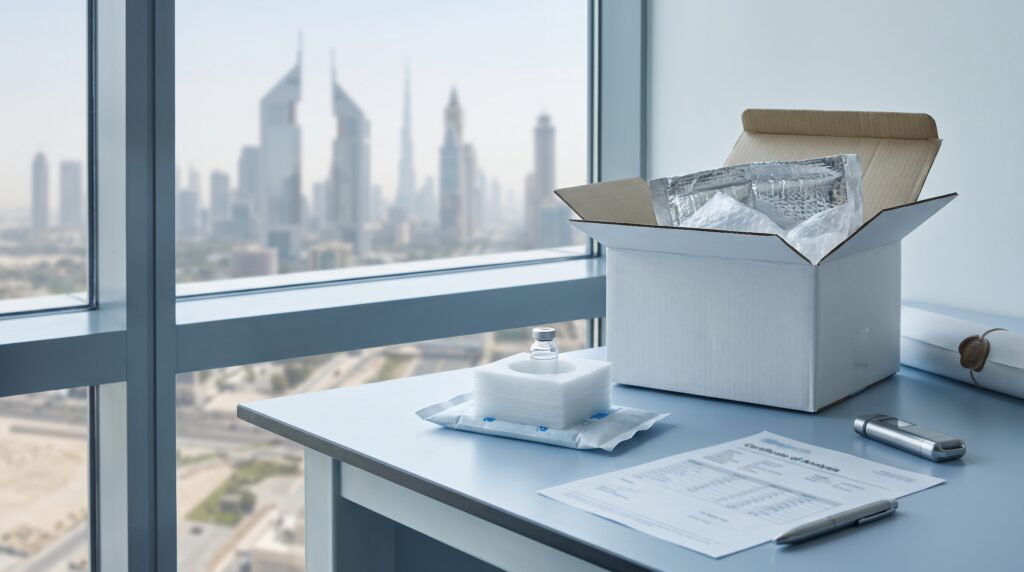
Because of the harsh local climate, international shipments that sit in unairconditioned customs warehouses for weeks pose a severe risk to product integrity. Procuring from suppliers with localized logistics ensures that products bypass international transit delays. For researchers needing reliable, temperature-secure logistics, utilizing expedited UAE delivery services ensures that sensitive materials arrive promptly, maintaining their structural integrity for your laboratory work.
Navigating Compliance and Payments in the UAE
Understanding the regulatory landscape is just as crucial as verifying chemical purity. In the UAE, the Ministry of Health and Prevention (MOHAP) and the Dubai Health Authority (DHA) draw a sharp line between clinical treatments and laboratory chemicals.
Prescription peptides and custom formulations intended for therapeutic use must be dispensed by licensed compounding pharmacies under direct medical supervision. Conversely, vendors supplying pure peptides for laboratory evaluation sell them strictly as ‘Research Use Only’ (RUO) materials. These are not approved prescription drugs and are not intended for human consumption.
This regulatory distinction deeply impacts how legitimate suppliers process transactions. Under standard BRAM (Business Risk Assessment and Mitigation) guidelines enforced by major credit card networks like Visa and Mastercard, standard payment processors frequently restrict or prohibit the sale of research chemicals. Therefore, when you encounter a vendor offering alternative, transparent payment methods—such as Cash on Delivery (COD), direct bank transfers, or secure payment links—this is often a sign of a compliant vendor adhering strictly to international processing regulations.
How to Evaluate Your UAE Peptide Supplier
To consolidate this information into a practical checklist, researchers in Sharjah should evaluate prospective vendors against the following strict criteria:
- Batch-Specific COAs: Does the vendor provide visible, up-to-date HPLC and Mass Spectrometry reports for the exact batch you are purchasing?
- Clear RUO Categorization: Do they transparently state that their products are for research purposes, avoiding unauthorized “pharmaceutical” branding?
- Climate-Aware Logistics: Do they offer fast, localized shipping specifically tailored to bypass UAE customs delays and limit heat exposure?
- Accessible Support: Is there a reliable point of contact, such as a local support line, to address technical questions regarding batch numbers or delivery windows?
If a vendor meets these requirements, they are likely a reliable partner. For laboratories seeking verifiable, premium-grade materials backed by independent testing, you can safely explore our research peptide catalogue to find compounds that meet strict purity standards.
Conclusion
Ensuring the integrity of your laboratory materials requires vigilance, an understanding of analytical testing, and a healthy respect for the local climate. By applying the procurement principles outlined above, you can confidently navigate the market, audit supplier documentation, and safeguard your research data from degraded or impure compounds.
References & Methodology
- Analytical Benchmarks: Laboratory standards dictate >98% purity for in-vitro research applications, verifiable via HPLC and Mass Spectrometry.
- Storage Protocols: Standard biochemical handling guidelines recommend cold-storage (2-8°C) to prevent thermal degradation of peptide structures, especially in environments like the GCC where ambient heat frequently exceeds 40°C.
- Payment Compliance: Payment restrictions for RUO compounds conform to Mastercard and Visa BRAM compliance frameworks for specialized chemical distribution.
Disclaimer: The products mentioned in this article are provided strictly for in-vitro research purposes and are not intended for human or animal consumption, treatment, or diagnosis.
Disclaimer: The products mentioned in this article are for research purposes only and are not intended for human consumption.
References
- Buying Research Peptides UAE — the 2026 buyer-evaluation guide – Wellness Labs
- Peptide Storage Guide | UAE Core Peptides
- Peptides Compounding Pharmacy Dubai – CureCell
- Shipping Policy – Fast Delivery Across UAE – nanopep
- Peptide Purity Testing: How to Verify Quality and Safety (2026 Guide) | Peptidepedia
Frequently asked questions
What is the minimum acceptable purity for research peptides in Sharjah?
Legitimate research suppliers benchmark their peptides at a minimum of 98% to 99% purity. This should always be verified by an independent High-Performance Liquid Chromatography (HPLC) report provided by the vendor.
How long do peptides last in the UAE summer heat?
Lyophilized (freeze-dried) peptides can survive short transit times in the heat but must be moved to cold storage (2 to 8 degrees Celsius) for long-term viability. Reconstituted peptides degrade rapidly at room temperature and must be refrigerated immediately.
Why do some UAE peptide suppliers not accept standard credit cards?
Standard credit card networks classify 'Research Use Only' chemicals as restricted under their BRAM compliance guidelines. Legitimate, compliant vendors utilize transparent alternative payments like Cash on Delivery (COD) or direct bank transfers to adhere to these financial regulations.
What is the difference between bacteriostatic water and sterile water for peptides?
Bacteriostatic (BAC) water contains 0.9% benzyl alcohol, keeping reconstituted peptides stable and sterile for 4 to 8 weeks when refrigerated. Standard sterile water lacks this preservative, reducing the stability window to just 5 to 7 days.
Nova Labs buyer tools
Ready to verify stock, testing and delivery?
Use the product page and lab report section to check availability, documentation, delivery timing and support before placing an order.
- COA / test-report checks
- Sharjah delivery context
- Cold-chain handling
- COD and card payment options
- WhatsApp support