

Evaluating the Retatrutide Pen for Research Applications
Quick Answer: A retatrutide pen is a pre-mixed, liquid peptide delivery format utilized in laboratory settings for its handling convenience. Unlike lyophilized vials requiring manual reconstitution, these pens demand strict, uninterrupted temperature control between 2°C and 8°C to prevent thermal degradation during in vitro testing. UAE buyers must verify third-party HPLC purity (≥99%) and ensure the supplier uses validated cold-chain logistics.
For procurement staff and researchers operating in the UAE, sourcing the right peptide format involves balancing experimental convenience against environmental realities. The retatrutide pen has become a focal point in local research circles because it bypasses the need for manual mixing, standardizing the concentration for precise laboratory dispensing. Retatrutide itself is an investigational triple agonist being extensively studied in laboratory environments. Because its structure is highly complex, maintaining the stability of the compound is paramount.
While the convenience of a pre-filled liquid format is undeniable for streamlining lab workflows and reducing the risk of contamination during reconstitution, it introduces a distinct set of handling constraints. Buyers must evaluate their laboratory’s infrastructure, the supplier’s analytical documentation, and the rigorous cold-chain logistics required to move liquid peptides safely across the GCC.
The Structural Complexity of Retatrutide
To understand why a retatrutide pen requires such meticulous handling, researchers must first understand the molecule itself. Retatrutide (LY3437943) is a synthetic peptide engineered to act as a tri-agonist, simultaneously targeting the GLP-1, GIP, and glucagon receptors. This functionality necessitates a complex secondary structure and a specific sequence of amino acids.
Large, multi-receptor synthetic peptides are inherently vulnerable to environmental stressors. When researchers opt for a liquid format over a lyophilized (freeze-dried) powder, they are choosing a format where the peptide bonds are actively suspended in a solvent. This active state means the peptide is continuously at risk of chemical reactions that are otherwise stalled in a lyophilized state.
Stability Profiles: Pre-Mixed Pens vs. Lyophilized Vials
The fundamental difference between sourcing a lyophilized vial and a retatrutide pen lies in their respective stability profiles. Understanding this distinction is critical for maintaining the integrity of your research programme.
Lyophilized powder is highly stable. When stored in a laboratory freezer at -20°C, a lyophilized retatrutide vial can remain viable for up to 24 months. It is highly resistant to minor temperature fluctuations during transit, making it a robust choice for international or long-distance shipping.
Conversely, a retatrutide pen contains the peptide in a pre-reconstituted state. Once suspended in solution, the peptide chains are actively interacting with the solvent, making them highly susceptible to three main threats: hydrolysis, oxidation, and mechanical shear.
The Threat of Hydrolysis and Oxidation
In a liquid state, water molecules can begin to cleave the peptide bonds (hydrolysis), breaking the compound down into smaller, inactive fragments. Additionally, exposure to light and trace amounts of oxygen can lead to the oxidation of specific amino acid residues. These reactions alter the molecular structure, skewing any binding affinity data gathered during in vitro assays. Strict temperature control slows these kinetic reactions, which is why refrigeration is non-negotiable.
Mechanical Shear in Liquid Formats
One of the least understood risks of liquid formats is mechanical shear. Continuous physical movement can actually fracture delicate triple-agonist peptide chains. For this reason, a retatrutide pen should never be stored in the door of a laboratory refrigerator. The constant opening and closing of the door creates enough agitation over time to degrade the solution. Researchers must ensure that liquid pens are placed securely on a stable, interior shelf where they are protected from unnecessary vibration.
The 30-Day Operational Window
Furthermore, once a liquid peptide format is put into active use, a countdown begins. Analytical data indicates that a retatrutide pen maintains optimal stability for approximately 28 to 30 days post-opening when kept refrigerated between 2°C and 8°C. Procurement teams must plan their purchasing schedules accordingly, ensuring that orders align tightly with their testing phases to prevent product expiration and wasted laboratory resources.
Decoding the Chromatogram: COA and HPLC Verification
When you buy a retatrutide pen, you are entirely reliant on the supplier’s initial reconstitution process. Unlike a vial where you control the bacteriostatic water ratio and mixing protocol, a pre-mixed pen requires total trust in the vendor’s sterile compounding capabilities and raw material quality. This trust must be verified through rigorous documentation.
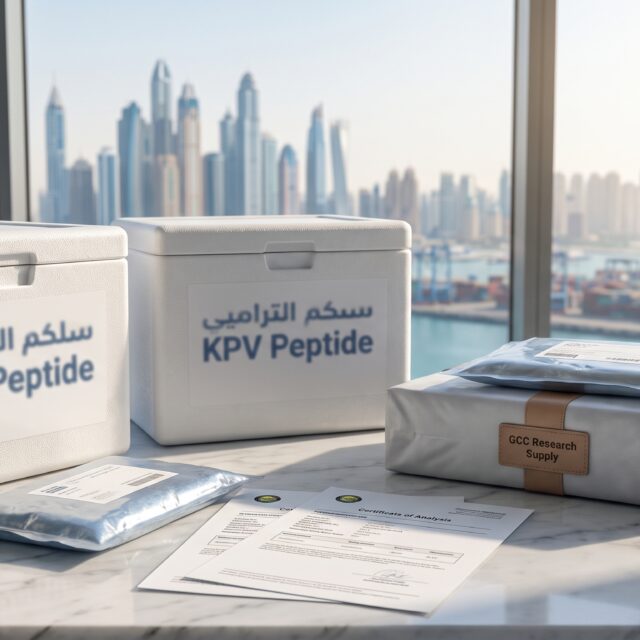
A reputable supplier in the UAE must provide a batch-specific Certificate of Analysis (COA) conducted by an independent, third-party laboratory. Standard in-house testing is insufficient for advanced peptide research. When reviewing the COA for a retatrutide pen research batch, laboratory technicians should verify two primary metrics:
1. RP-HPLC (Reversed-Phase High-Performance Liquid Chromatography):
This test measures the purity of the compound by separating its components based on hydrophobicity. For viable in vitro testing, the RP-HPLC report should show a purity level exceeding 99 percent. Any chromatogram displaying excessive secondary peaks indicates impurities, incomplete synthesis, or degradation. Trace impurities, such as leftover trifluoroacetic acid (TFA) from the synthesis process, must be heavily reduced to prevent cell toxicity in cellular assays.
2. ESI-MS (Electrospray Ionization Mass Spectrometry):
Purity alone does not guarantee identity. ESI-MS verifies that the substance in the pen is actually retatrutide by measuring its exact molecular mass. The target molecular weight for retatrutide is approximately 4731.4 g/mol. If the MS report deviates significantly from this figure, the molecular structure is incorrect, and the batch must be rejected.
At NOVA Labs, technical credibility is non-negotiable. We ensure that our procurement network insists on transparent, verifiable batch documentation so that UAE researchers can proceed with their analytical studies with complete confidence.
Navigating the UAE Cold-Chain: Why Logistics Matter
The GCC region’s climate introduces distinct, extreme challenges for peptide logistics. In Dubai and Abu Dhabi, summer temperatures routinely exceed 45°C. Even during milder winter months, the interior of a standard delivery van can rapidly reach temperatures capable of destroying a liquid peptide within hours.
Because a retatrutide pen is highly sensitive to heat excursions, standard ambient shipping is not an option. If a pre-mixed pen is exposed to elevated temperatures, thermal degradation will break the peptide bonds, rendering the compound biologically inert and useless for laboratory analysis.
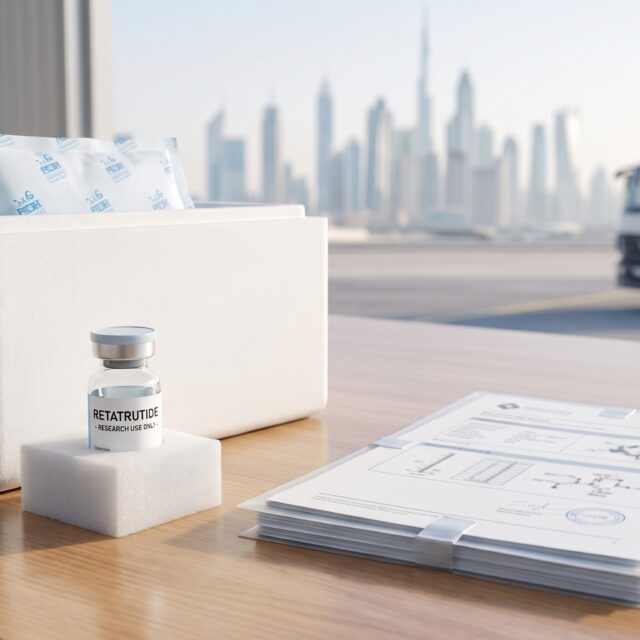
To combat this, professional suppliers must employ specialized cold-chain logistics. This involves packing the product in medical-grade insulated containers (such as high-density EPS foam) accompanied by active phase-change material (PCM) gel packs designed to maintain an internal temperature of 2°C to 8°C throughout the transit lifecycle.
For researchers in the Emirates, local fulfillment is a major strategic advantage. By eliminating international customs delays—which can leave packages stranded in hot warehouses for days—local suppliers dramatically reduce thermal risk. If you are coordinating a time-sensitive study, utilizing a service that provides specialized next-day delivery for peptides in the UAE is essential. Expedited local routing keeps the transit time under 24 hours, ensuring the cold chain remains entirely unbroken from the warehouse to your laboratory fridge.
Procurement Checklist for UAE Laboratories
The local competitive landscape for peptide procurement in the UAE has matured significantly. Currently, specialized suppliers offer research-grade retatrutide pens in varying configurations, with market pricing typically reflecting the volume, batch purity, and cold-chain infrastructure required to move the product safely.
When evaluating where to place your laboratory’s order, consider the operational support the supplier provides. A vendor optimized for the GCC market should offer more than just a product listing. Before finalizing procurement, review this checklist:
- Payment Flexibility: Institutional and independent researchers often require versatile payment structures. Look for suppliers offering Cash on Delivery (COD) for immediate local procurement, direct bank transfers for institutional invoicing, or secure cryptocurrency options.
- Responsive Support: In the fast-paced UAE research environment, asynchronous email support is often too slow. Leading suppliers coordinate closely via WhatsApp, allowing for real-time stock checks, immediate COA sharing, and delivery window confirmation.
- Inventory Reliability: Given the 30-day degradation window of liquid peptides, researchers cannot afford backorders or long lead times. Ensure your supplier maintains active, locally warehoused stock rather than operating on an international dropshipping model.
By prioritizing these operational signals, buyers can filter out substandard vendors and ensure they are receiving premium, accurately synthesized compounds that support rigorous scientific inquiry.
Bottom Line for Procurement
The decision to integrate a retatrutide pen into your laboratory workflow offers distinct advantages in handling, standardization, and preparation. However, it demands uncompromising attention to stability and logistics. For UAE researchers, successfully procuring this format requires verifying third-party HPLC and MS data, insisting on strict 2°C to 8°C cold-chain shipping, and managing internal storage protocols to avoid mechanical shear and thermal degradation.
By partnering with a locally optimized supplier that understands the unique environmental challenges of the GCC, your laboratory can secure high-purity compounds safely and efficiently. To view our current inventory, batch reports, and available formats for the local market, explore the NOVA Labs Shop.
References
- American Peptide Society. General Guidelines for Peptide Storage and Handling.
- National Center for Biotechnology Information (NCBI). PubChem Compound Summary for Retatrutide (LY3437943).
- Journal of Pharmaceutical Sciences. Impact of Mechanical Agitation and Thermal Stress on Liquid Biologics.
- UAE Ministry of Health and Prevention (MOHAP). Good Distribution Practice (GDP) for Temperature-Sensitive Compounds (Adapted for laboratory logistics).
Disclaimer: The products mentioned in this article are for in vitro research purposes only and are strictly not intended for human or animal consumption, diagnostic, or therapeutic use.
- How Long Does Retatrutide Last in the Fridge? (2026) – Doctronic
- Verifying Retatrutide Quality: A Researcher’s Guide to Purity, HPLC, and COAs
- How to Verify Retatrutide Purity for Laboratory Research – Nextday Peptides
- Retatrutide Research Formats: Vials, Pens & Bulk – BulkGLP
- Retatrutide Half-Life, Storage and Stability: A Handling Reference | PX1 Research
- Retatrutide Storage and Handling Guide for Laboratory Research – Alpha Carbon Labs
- Retatrutide (LY3437943) Injector Pen | Triple Agonist Research Peptide | UAE
Frequently asked questions
What is the correct storage temperature for a retatrutide pen?
A pre-mixed retatrutide pen must be stored in a laboratory refrigerator at a consistent temperature between 2°C and 8°C. It should never be frozen or exposed to ambient room temperatures.
Can a liquid peptide pen be stored in the refrigerator door?
No. The constant opening and closing of a refrigerator door causes mechanical shear, which can fracture delicate liquid peptide chains and degrade the structural integrity of the compound. Store it on a stable interior shelf.
How long is a retatrutide pen stable after opening?
Once put into active laboratory use, a liquid retatrutide pen format maintains optimal analytical stability for approximately 28 to 30 days when kept under proper, continuous refrigeration.
What should a COA for a retatrutide pen show?
A verifiable Certificate of Analysis should include an RP-HPLC report demonstrating greater than 99 percent purity and an ESI-MS report confirming a molecular mass of approximately 4731.4 g/mol.
How is a retatrutide pen shipped safely in the UAE heat?
To prevent thermal degradation in the GCC climate, reliable suppliers ship liquid peptide pens in specialized, medical-grade insulated packaging equipped with active cold gel packs to maintain a strict 2°C to 8°C cold-chain environment. Expedited local delivery is heavily recommended.
Nova Labs buyer tools
Ready to verify stock, testing and delivery?
Use the product page and lab report section to check availability, documentation, delivery timing and support before placing an order.
- COA / test-report checks
- UAE delivery context
- Cold-chain handling
- COD and card payment options
- WhatsApp support