
Finding a reliable domestic source to buy Sermorelin in Abu Dhabi requires navigating local regulations, severe summer climates, and international customs bottlenecks. For UAE-based laboratories, university procurement teams, and independent scientific researchers, securing high-purity GHRH (Growth Hormone-Releasing Hormone) analogues is a stringent process. It is not just about comparing prices—it is about verifying batch authenticity, maintaining strict compliance, and ensuring the structural integrity of the delicate compound upon arrival.
Historically, procurement teams relied heavily on overseas suppliers. However, shifting regulatory frameworks and the logistical realities of the GCC have fundamentally changed how institutional buyers evaluate vendors. This comprehensive guide outlines exactly how informed researchers can assess a Sermorelin supplier in Abu Dhabi, from examining third-party Certificates of Analysis (COA) to understanding local payment compliance and mandatory cold-chain delivery protocols.
Buy Sermorelin in Abu Dhabi: Quick Answer
To safely buy Sermorelin in Abu Dhabi for laboratory use, researchers must prioritize domestic UAE suppliers. This avoids routine customs confiscations associated with international shipping. Always demand a batch-specific COA with HPLC testing proving ≥99% purity, and ensure the vendor utilizes insulated, cold-chain packaging to protect the lyophilized peptide from extreme GCC temperatures during transit.
Navigating EDE Regulations and Sourcing Risks
The regulatory framework governing research chemicals, pharmaceuticals, and active pharmaceutical ingredients (APIs) in the UAE has become notably stricter over the past two years. Under recent directives and the formal establishment of the Emirates Drug Establishment (EDE) via Federal Decree-Law No. 28 of 2023, the oversight of medical and therapeutic products has tightened significantly. Therapeutic peptides intended for human consumption are classified strictly as Prescription-Only Medicines (POM), available only through licensed medical clinics under physician supervision.
However, research-grade peptides remain legally permissible specifically for in-vitro scientific and laboratory settings. The critical distinction for laboratories is ensuring that all procurement activities remain strictly separated from consumer markets. In mid-2024, health authorities initiated a widespread crackdown on unauthorized online sources and social media figures unlawfully promoting research chemicals for inappropriate applications.
For the informed buyer looking to order Sermorelin in Abu Dhabi, this regulatory landscape translates to two primary operational realities:
- International Import Friction: Abu Dhabi Customs routinely intercepts and inspects unauthorized imports of research chemicals from international sellers, regardless of their intended use. Relying on an overseas Sermorelin supplier in Abu Dhabi often results in seized packages, heavily delayed research timelines, and lost laboratory funds.
- The Domestic Advantage: Sourcing from a supplier that already holds tested stock within the borders of the UAE bypasses international customs entirely. This ensures a frictionless procurement process for valid in-vitro laboratory needs and keeps supply chains entirely domestic.
The Science of Verification: Decoding the COA
Peptide synthesis is an incredibly complex biochemical process, and yield quality varies significantly among manufacturers. Sermorelin is a 29-amino-acid polypeptide, representing the shortest functional fragment of endogenous GHRH. Errors during the synthesis process can lead to truncated sequences, impurities, or degraded byproducts that will ultimately compromise delicate laboratory research or receptor-binding assays.
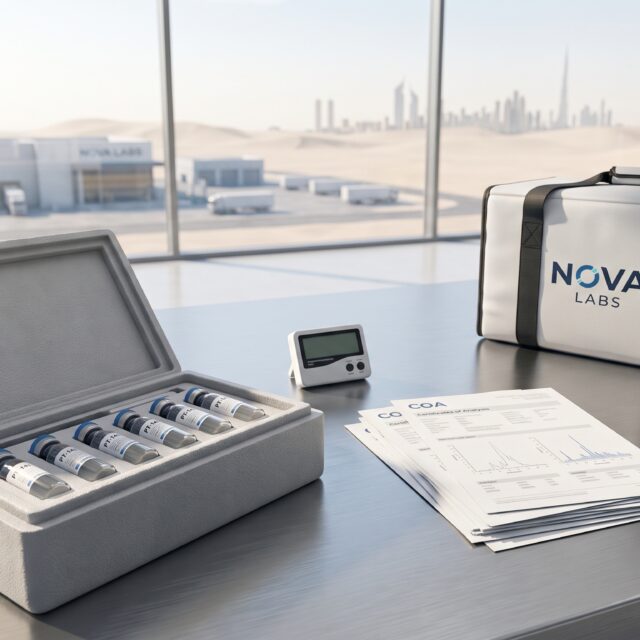
Before you select a vendor to supply your Sermorelin peptide in Abu Dhabi, you must demand transparent documentation. The industry standard for verification relies on the Certificate of Analysis (COA), which must include two primary testing methodologies.
High-Performance Liquid Chromatography (HPLC)
The HPLC chromatogram is the primary analytical tool for measuring the purity of the sample. It separates the components in the vial, isolating the primary Sermorelin peak from underlying impurities or degraded fragments. A reputable supplier will not just claim high purity; they will provide a batch-specific HPLC report demonstrating a purity level of 99% or higher. For rigorous in-vitro cellular assays, any purity lower than this introduces variables that can invalidate experimental data.
Mass Spectrometry (MS)
While HPLC confirms how pure the sample is, Mass Spectrometry (MS) confirms the exact identity of the molecule. It measures the molecular weight of the peptide within the vial, which must perfectly match the theoretical molecular weight of Sermorelin (approximately 3357.9 g/mol). Without MS verification, a researcher cannot be certain that the lyophilized powder is the exact 29-amino-acid sequence required, rather than a cheaper, structurally similar substitute.
Handling and Storage: The Abu Dhabi Climate Challenge
Thermal stability is a critical factor when handling delicate peptide chains. Lyophilized (freeze-dried) peptides are generally stable at room temperature for short periods, but ambient temperatures in the UAE frequently exceed 45 degrees Celsius (113 degrees Fahrenheit) during the height of summer, with high humidity compounding logistical challenges.
If a package sits in a non-air-conditioned delivery van or a hot warehouse sorting facility for several hours, the peptide risks rapid thermal degradation—specifically through deamidation or oxidation. This renders the compound practically useless for in-vitro endocrine research. Because of this, standard shipping methods are unacceptable for research peptides in the GCC; cold-chain logistics are entirely non-negotiable.
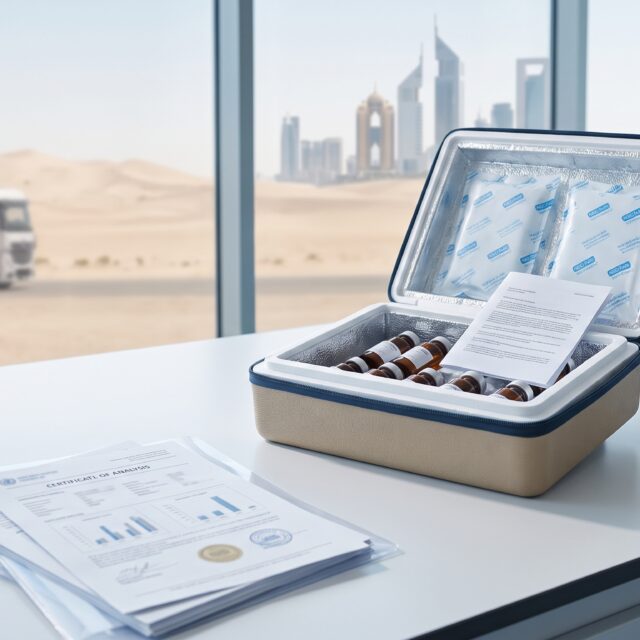
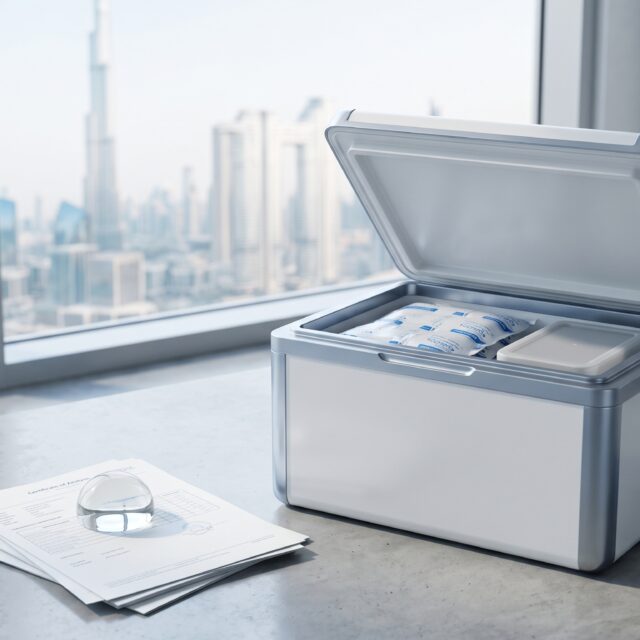
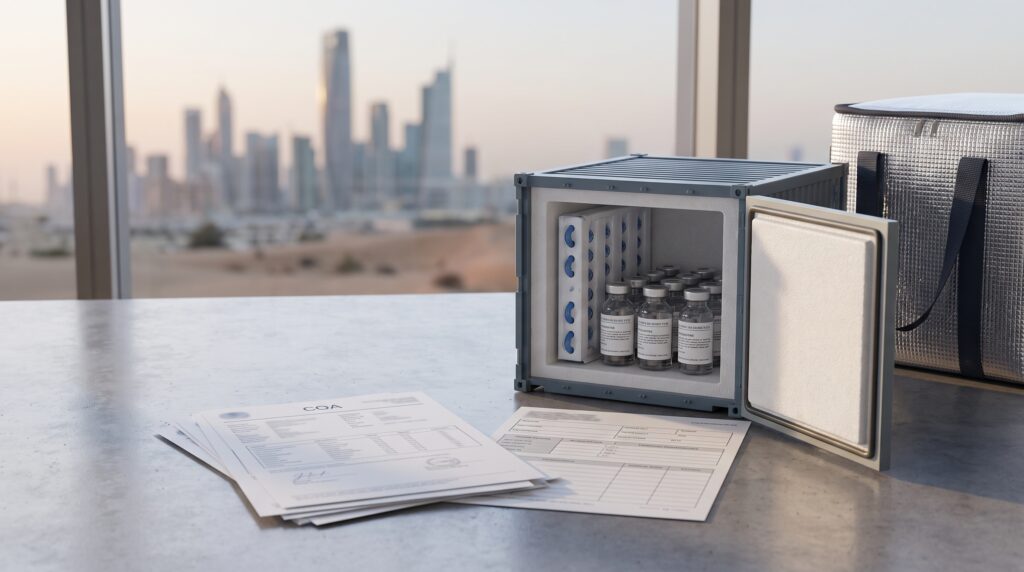
Reputable domestic suppliers protect the structural integrity of these compounds by utilizing insulated packaging, ice packs, and temperature-controlled handling. Choosing a vendor that offers fast, secure domestic peptide delivery in the UAE dramatically reduces transit exposure. This ensures that delicate vials arrive structurally intact and ready for immediate proper laboratory storage. Once received, researchers should store lyophilized Sermorelin at -20 degrees Celsius for optimal long-term preservation.
Navigating Payment Gateways for Research Chemicals
Another frequent, yet rarely discussed, hurdle for laboratories buying research materials online is payment processing. Standard international credit card processors regularly block transactions for research peptides under strict BRAM (Business Risk Assessment and Mitigation) guidelines. This leaves procurement managers frustrated when attempting to checkout internationally, as their institutional cards are repeatedly declined despite having valid laboratory credentials.
Locally adapted UAE suppliers understand these complex financial constraints and offer flexible, compliant payment alternatives tailored to the region. In the Abu Dhabi market, working with vendors who offer Cash on Delivery (COD) or direct local bank transfers guarantees payment security and provides peace of mind that the transaction is fully localized.
Furthermore, accessible support channels are just as important as the payment itself. Being able to confirm current stock availability, request the latest COA for a specific batch, or coordinate a narrow delivery window via WhatsApp is a hallmark of a professional operation prioritizing the researcher’s demanding schedule.
Sourcing Sermorelin for Your Next In-Vitro Project
When evaluating GHRH analogues for your upcoming scientific projects, structural stability and receptor-binding dynamics are the key focus areas. Sermorelin is widely studied in endocrine research for its unique ability to bind to the growth hormone-releasing hormone receptor (GHRHR). Ensuring that you are working with an uncompromised, correctly synthesized molecule is the foundation of reproducible science.
For procurement teams and lead researchers ready to secure high-purity, laboratory-ready materials without the typical logistical headaches, choosing the right local partner is paramount. NOVA Labs provides meticulously tested, locally stocked research-grade Sermorelin vials. By maintaining local UAE inventory, providing transparent batch testing, and adhering to strict cold-chain handling protocols, the friction of international sourcing is completely eliminated.
Conclusion and Next Steps
To successfully and legally source Sermorelin in Abu Dhabi, research laboratories must pivot away from risky international imports and focus entirely on domestic suppliers prioritizing compliance, transparency, and advanced logistics. By ensuring your chosen vendor provides recent, batch-specific HPLC and MS testing, utilizes temperature-protected next-day delivery, and offers secure local payment methods, you safeguard both your research integrity and your laboratory’s procurement budget.
Ready to elevate your research standards? Browse NOVA Labs’ complete catalog of thoroughly vetted, locally stocked peptides to secure high-purity compounds for your next in-vitro study.
*
Disclaimer: The products mentioned in this article, including Sermorelin, are strictly for in-vitro research and laboratory use only. They are not intended for human consumption, therapeutic application, or clinical diagnostics. All buyers must comply with local UAE regulations regarding research chemicals.
References
- UAE Government Portal (2023). Federal Decree-Law No. 28 of 2023 on the Establishment of the Emirates Drug Establishment.
- Gulf News (July 2024). “UAE weight-loss drug crackdown: 71 sources, 14 influencers face action.”
- National Institutes of Health (NIH) / PubChem. Sermorelin Compound Summary and Molecular Weight.
Disclaimer: The products mentioned in this article are for research purposes only and are not intended for human consumption.
- Are Research Peptides Legal in the UAE? Complete Compliance – NOVA Labs
- Buying Research Peptides UAE — the 2026 buyer-evaluation guide – Wellness Labs
- UAE weight-loss drug crackdown: 71 sources, 14 influencers face action – Gulf News
- Research Policy | For Scientific Use Only – UAE Peptide Lab
- Longevity Peptides UAE | Research Peptide Supplier | Hayat BioLabs
Frequently asked questions
Is it legal to buy Sermorelin in Abu Dhabi?
Yes, it is legally permissible to purchase research-grade Sermorelin in Abu Dhabi strictly for in-vitro laboratory and scientific research purposes. It is not approved or sold for human consumption or therapeutic use.
How can I verify the purity of my Sermorelin peptide?
You should request a batch-specific Certificate of Analysis (COA) from your supplier. This documentation must include an HPLC chromatogram showing ≥99% purity and Mass Spectrometry confirming the exact molecular weight of the peptide.
Why is domestic delivery important for peptides in the UAE?
Domestic delivery prevents international customs seizures and minimizes transit time. This is critical in the UAE, as prolonged exposure to extreme heat during shipping can degrade the peptide's structural integrity and ruin the compound for scientific study.
Can I use standard credit cards to order Sermorelin online?
International credit card processors often block peptide transactions due to strict BRAM guidelines. Reliable UAE suppliers typically bypass this issue by offering secure local payment methods like Cash on Delivery (COD) or direct local bank transfers.
Nova Labs buyer tools
Ready to verify stock, testing and delivery?
Use the product page and lab report section to check availability, documentation, delivery timing and support before placing an order.
- COA / test-report checks
- Abu Dhabi delivery context
- Cold-chain handling
- COD and card payment options
- WhatsApp support