
Growth hormone-releasing hormone (GHRH) analogues are foundational tools in modern endocrine research. For laboratories, procurement staff, and independent researchers operating in the UAE, selecting the appropriate compound often requires evaluating tesamorelin vs sermorelin. While both of these peptides are designed to bind to pituitary GHRH receptors—thereby stimulating endogenous, pulsatile human growth hormone release without replacing the hormone directly—their structural variations dictate highly distinct pharmacokinetic profiles and stability metrics.
Understanding the exact difference between tesamorelin and sermorelin is critical for designing accurate experimental models. The decision extends beyond basic mechanisms of action; it encompasses enzymatic resistance, observable half-lives, historical focus in published trials, and environmental vulnerabilities when handling these delicate amides in the hot GCC climate. This guide unpacks the molecular mechanics of both compounds and outlines the strict documentation standards required to procure research-grade peptides with confidence.
Quick Answer: The Core Difference in Tesamorelin vs Sermorelin Research
When comparing tesamorelin vs sermorelin, the core difference lies in their molecular structure and resulting half-life. Sermorelin is a truncated 29-amino-acid GHRH analogue with a shorter half-life of 11 to 26 minutes, while Tesamorelin is a full-length 44-amino-acid peptide modified to resist enzymatic breakdown, extending its half-life to 38 minutes.
Molecular Mechanics: Truncation vs N-Terminal Modification
To comprehend why researchers might select tesamorelin or sermorelin for a given study, one must look at the physical architecture of the peptides. Endogenous human growth hormone-releasing hormone is a 44-amino-acid polypeptide. Both synthetic analogues aim to replicate its function, but they take entirely different structural approaches.
Sermorelin: The Truncated Core
Sermorelin is a historically significant peptide that represents a synthetic segment of endogenous GHRH. Rather than replicating the full 44-amino-acid chain, Sermorelin consists only of the first 29 amino acids. Researchers identified early on that this 29-amino-acid sequence constitutes the minimum functional core required to retain full binding affinity at the GHRH receptor site. However, because it lacks the protective elements of the complete chain, Sermorelin remains highly sensitive to enzymatic degradation, particularly cleavage by dipeptidyl peptidase-4 (DPP-4).
Tesamorelin: The Shielded Chain
In contrast, Tesamorelin is a full-length 44-amino-acid GHRH analogue. The defining structural difference between tesamorelin and sermorelin is found at the N-terminus. Tesamorelin features an added trans-3-hexenoic acid modification. This specific lipid-like attachment serves as a biochemical shield, actively preventing rapid enzymatic cleavage by DPP-4. As a result, Tesamorelin demonstrates significantly higher metabolic stability when introduced to biological environments compared to its truncated counterpart.
Pharmacokinetics: Observing Peptide Half-Life
The structural variations directly dictate the pharmacokinetic behaviour of each compound in research settings. The half-life of a peptide—the time it takes for its concentration to decrease by half—determines the duration of receptor activation and shapes observational windows in laboratory trials.
Due to its susceptibility to enzymatic breakdown, Sermorelin exhibits a brief half-life, typically recorded between 11 and 26 minutes in clinical observations. This rapid clearance creates a sharp, transient spike in GHRH receptor activity followed by a quick return to baseline.
Tesamorelin, benefiting from its trans-3-hexenoic acid modification, provides a longer, more sustained activation phase. Its half-life is measured at 26 to 38 minutes. For researchers comparing tesamorelin vs sermorelin research data, this extended duration allows for different experimental designs, particularly when a longer, steadier pulse of endogenous hormone release is the objective of the study.
Efficacy Profiles in Published Trials
While both compounds stimulate the same receptor pathway, their primary areas of focus in published clinical trials have diverged significantly over the years.
Historically, Sermorelin has been studied extensively in the context of paediatric growth hormone deficiency. Its profile, characterised by a rapid onset and clearance, was closely evaluated for its ability to encourage natural endocrine function without causing receptor desensitisation. More recently, studies involving Sermorelin have expanded to observe its effects on age-related endocrine decline, focusing on generalised, gradual physiological changes.
Conversely, Tesamorelin has been the subject of highly specific, large-scale investigations regarding metabolic parameters and fat distribution. Tesamorelin holds robust phase III clinical evidence and achieved FDA approval specifically for the reduction of visceral adipose tissue (VAT) in adults with HIV-related lipodystrophy. In these trials, the peptide was observed to target deep abdominal fat deposits specifically, prompting intense interest in its unique metabolic targeting capabilities compared to other GHRH analogues.
Environmental Stability: Handling GHRH Peptides in the GCC
Regardless of whether a researcher selects tesamorelin or sermorelin, environmental stability is a paramount concern—especially in the UAE and the wider GCC region. Both compounds are delicate molecules held together by amide bonds that are highly vulnerable to thermal hydrolysis.
Improper climate storage and repeated temperature cycling can cause moisture condensation inside the vial, accelerating enzymatic or hydrolytic degradation. Once a lyophilised powder begins to degrade due to heat exposure, the structural integrity of the peptide fractures, rendering the sample useless for precise analytical research.
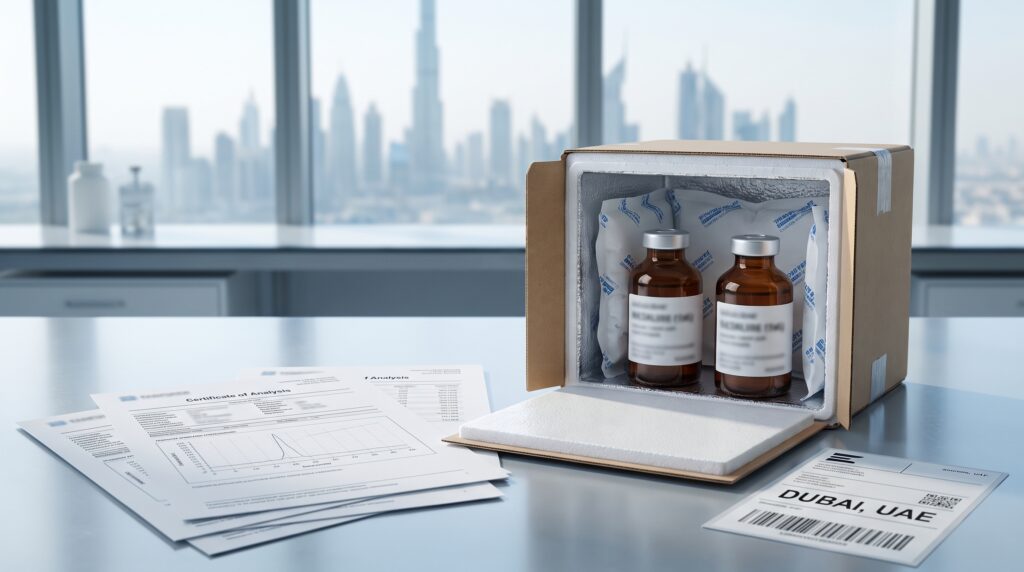
To mitigate these risks, researchers must ensure their procurement involves strict cold-chain handling. Lyophilised vials must remain sealed, protected from UV light, and stored at freezing temperatures until reconstitution. Following reconstitution with bacteriostatic water or sterile saline, the solution must remain refrigerated to preserve the delicate amino acid sequences of both the 29-chain and 44-chain structures.
Supplier Evaluation: Verifying Purity and Documentation in the UAE
When evaluating tesamorelin vs sermorelin for an upcoming project, identifying a credible supplier is just as important as selecting the correct molecular structure. The UAE market often presents friction points for researchers, from customs delays that jeopardise peptide stability to an influx of low-grade, untested research chemicals.
Operational transparency and verified documentation are non-negotiable. A premium supplier will not simply claim high purity; they will prove it through independent, third-party laboratory verification.
The Janoshik Testing Standard
At NOVA Labs, we understand that research integrity relies on uncompromising chemical purity. Researchers evaluating compounds must look for independent high-performance liquid chromatography (HPLC) and mass spectrometry reports. NOVA Labs guarantees research-grade authenticity by providing independent Janoshik mass-spectrometry tests showing >=99% purity, alongside comprehensive heavy metal assays.
Before making a purchasing decision, buyers can independently review our current batch data by visiting our lab results and documentation page to verify the purity of our GHRH analogues.
Logistics and Operations
Sourcing peptides in Dubai, Abu Dhabi, or the wider GCC requires a supplier who understands the local climate and infrastructure. NOVA Labs supports regional research by ensuring:
- Cold-Chain Delivery: Expedited, temperature-controlled shipping across the UAE to prevent the thermal hydrolysis of delicate amide bonds.
- Local Stock Availability: Eliminating unpredictable international customs delays that can compromise sample integrity.
- Versatile Payment Frameworks: Supporting procurement departments and independent researchers with multiple secure payment methods, including Visa, Mastercard, SEPA, Bank Transfer, and Crypto.
- Responsive Support: Direct communication channels via WhatsApp for rapid stock checks and logistical coordination.
For researchers ready to explore our catalogue of rigorously tested compounds, you can view the full range of available GHRH analogues by visiting the NOVA Labs shop.
Conclusion
The choice between tesamorelin vs sermorelin ultimately hinges on the specific parameters of your research model. Sermorelin provides a rapid, truncated 29-amino-acid intervention suitable for studying acute, transient pulses of endocrine activity. Tesamorelin, equipped with its advanced 44-amino-acid structure and trans-3-hexenoic acid modification, offers a longer half-life and boasts a strong history of clinical trials targeting visceral adipose tissue distribution.
Both require meticulous handling, rigorous cold-chain logistics, and strict verification of chemical purity to yield valid experimental data. By partnering with suppliers who prioritise transparency and third-party Janoshik testing, researchers in the UAE can ensure their trials are built on a foundation of chemical integrity.
Disclaimer: The products mentioned in this article are for research purposes only and are not intended for human consumption or therapeutic use.
References
- Falutz, J., et al. (2007). “Metabolic effects of a growth hormone-releasing factor in patients with HIV.” New England Journal of Medicine, 357(23), 2359-2370.
- Prakash, A., & Goa, K. L. (1999). “Sermorelin: a review of its use in the diagnosis and treatment of children with idiopathic growth hormone deficiency.” BioDrugs, 12(2), 139-157.
- Ferdinandi, E. S., et al. (2007). “Non-clinical pharmacology and safety evaluation of TH9507, a human growth hormone-releasing factor analogue.” Basic & Clinical Pharmacology & Toxicology, 100(1), 49-58.
- Comparing Tesamorelin and Sermorelin: A Detailed Overview
- Tesamorelin and Sermorelin – Key Differences
- Peptide Half-Life Chart: Complete Reference Guide for Researchers
- The Growth Hormone Releasing Hormone Analogue, Tesamorelin, Decreases Muscle Fat and Increases Muscle Area in Adults with HIV
- Tesamorelin: How This GHRH Analog Works
- NOVA Labs: Research Peptides UAE with Fast Delivery
Frequently asked questions
What is the main structural difference between tesamorelin and sermorelin?
The main difference is their molecular chain length. Sermorelin is a truncated analogue containing 29 amino acids, whereas tesamorelin is a full-length 44-amino-acid peptide with an added trans-3-hexenoic acid modification at the N-terminus.
Which peptide has a longer half-life, tesamorelin or sermorelin?
Tesamorelin has a significantly longer half-life of 26 to 38 minutes compared to sermorelin's half-life of 11 to 26 minutes, due to tesamorelin's structural resistance to enzymatic cleavage by DPP-4.
What is the primary difference in how tesamorelin and sermorelin are used in clinical trials?
Historically, sermorelin was researched for paediatric growth hormone deficiency applications. Tesamorelin, conversely, has been extensively studied—and achieved FDA approval—specifically for its ability to reduce visceral adipose tissue in adult HIV-related lipodystrophy.
How should researchers store GHRH analogues in the UAE?
To prevent thermal hydrolysis and degradation in the local climate, lyophilised GHRH peptides must be kept in cold-chain conditions away from light and moisture, and securely frozen until they are ready for reconstitution in the laboratory.
How can researchers verify the purity of these compounds?
Buyers should verify purity by examining independent, third-party laboratory documentation such as Janoshik HPLC and mass spectrometry reports, ensuring the compound meets a strict 99% or higher purity standard with no heavy metal contamination.
Nova Labs buyer tools
Ready to verify stock, testing and delivery?
Use the product page and lab report section to check availability, documentation, delivery timing and support before placing an order.
- COA / test-report checks
- UAE delivery context
- Cold-chain handling
- COD and card payment options
- WhatsApp support