
How to Buy PT-141 Oman: The Procurement Landscape
Quick Answer: To successfully buy PT-141 Oman researchers require, source exclusively from regional GCC suppliers utilizing established overland or rapid air logistics. Ensure the supplier provides the peptide in a lyophilized powder format to prevent thermal degradation, supplies verifiable third-party Certificates of Analysis (COAs) showing >99% purity, and manages the documentation needed to clear ROP Bayan customs without holding delays.
For procurement managers, university researchers, and informed laboratory buyers in the GCC, securing high-quality research compounds is rarely as simple as clicking a checkout button. If you are attempting to buy PT-141 oman facilities need for in vitro study, you face a unique, highly fragmented market. International cross-border shippers routinely face substantial customs hurdles, while unverified local marketplaces often import pre-mixed, heavily degraded solutions.
To successfully order PT-141 (Bremelanotide) in Oman, buyers must evaluate three critical factors: the chemical stability of the product in extreme heat, the supplier’s ability to navigate local customs infrastructure, and the presence of verifiable, independent purity documentation.
Understanding PT-141 (Bremelanotide) in Research
Before diving into logistics and supplier verification, it is important to establish what PT-141 is from a structural and functional standpoint.
PT-141, scientifically categorized as Bremelanotide, is a synthetic cyclic heptapeptide. In scientific and laboratory settings, it acts as a non-selective melanocortin receptor agonist, exhibiting distinct binding affinity and activity at both the MC3R and MC4R pathways. Unlike other compounds that operate via mechanical vascular mechanisms, PT-141 is primarily studied for its unique neurological signaling pathways in the central nervous system.
Because it is a complex cyclic peptide with a molecular weight of 1025.2 g/mol, its molecular bonds are inherently sensitive to environmental stress, particularly oxidation and hydrolysis. This makes the physical state of the compound—and how it is handled from the synthesis laboratory to your facility—a critical consideration for any researcher analyzing the peptide’s efficacy and receptor binding behavior.
Defeating the Desert Heat: Lyophilized vs. Liquid Peptides
The most significant threat to peptide viability in the GCC is the climate. Oman’s summer temperatures routinely exceed 45°C. When sensitive biological materials are exposed to this level of heat, they undergo rapid thermal degradation. The molecular bonds break down, rendering the sample useless for precise scientific study.
The Danger of Pre-Mixed Solutions
Many international consumer marketplaces attempt to sell pre-reconstituted liquid nasal sprays or dropper solutions. While these may seem convenient for a buyer, liquid peptides are incredibly fragile. Water acts as a catalyst for hydrolysis. Once reconstituted, a peptide’s shelf life plummets from years down to weeks, and it requires strict, continuous refrigeration between 2°C and 8°C. If a liquid spray sits in a non-refrigerated transit hub in Muscat or Sohar for even 24 hours, the compound will likely degrade entirely, leaving the researcher with an inactive, denatured sample.
The Lyophilized Advantage
For successful procurement, researchers should exclusively order PT-141 that suppliers offer in a lyophilized (freeze-dried) format. Lyophilization is a specialized dehydration process that removes moisture from the peptide while preserving its exact structural integrity.
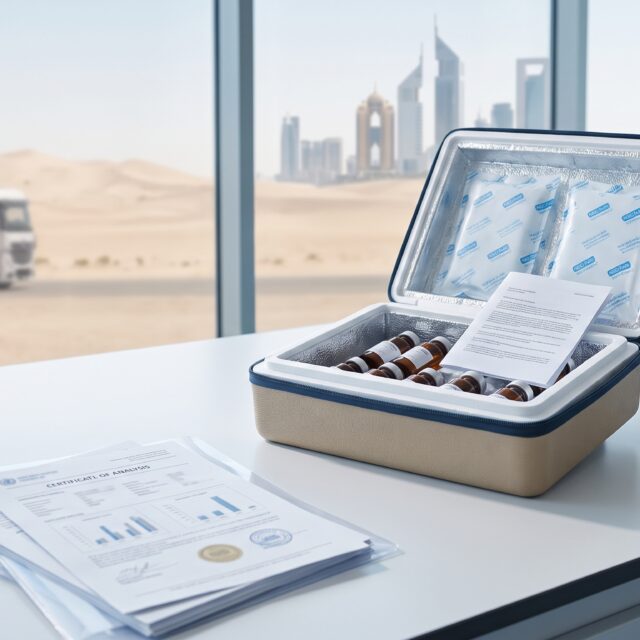
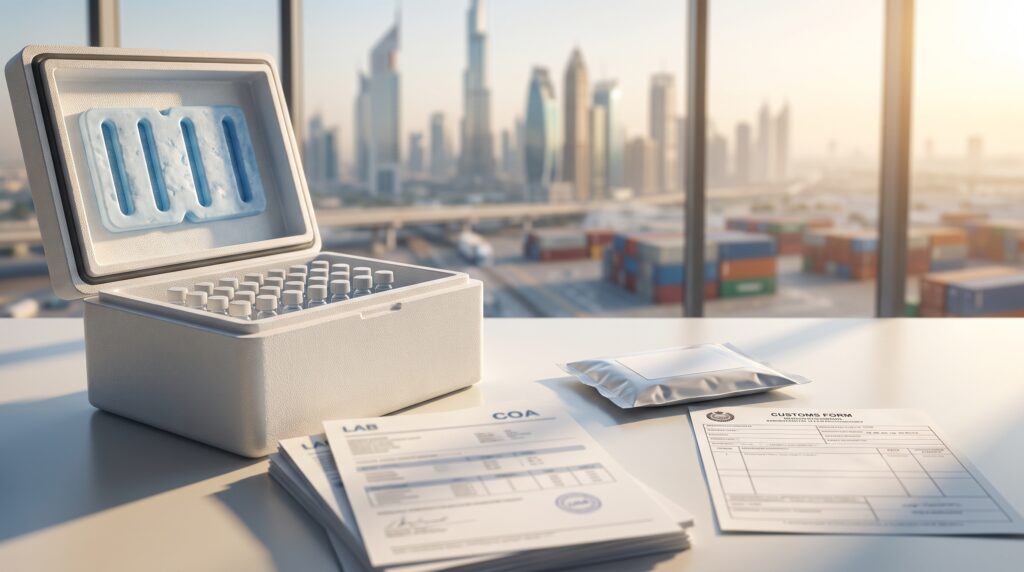
In this dormant powder state, the peptide is significantly more stable. A properly lyophilized vial can withstand the temperature fluctuations associated with regional transit for weeks without significant degradation. Once the lyophilized vial reaches a temperature-controlled environment in your laboratory, it can be safely stored in a freezer (-20°C) until it is properly reconstituted with bacteriostatic water immediately prior to the start of the study.
ROP Bayan Portal Compliance: Navigating Omani Customs
One of the primary reasons direct international shipments from North America or Europe fail to reach Omani buyers is a severe lack of customs compliance. The Sultanate of Oman manages its import control through the Royal Oman Police (ROP) Directorate General of Customs, utilizing the digitized Bayan single-window system.
If a package arrives from an international carrier without the precise documentation required by the Bayan portal, it will be flagged, held, or ultimately destroyed.
Key Customs Documentation Requirements
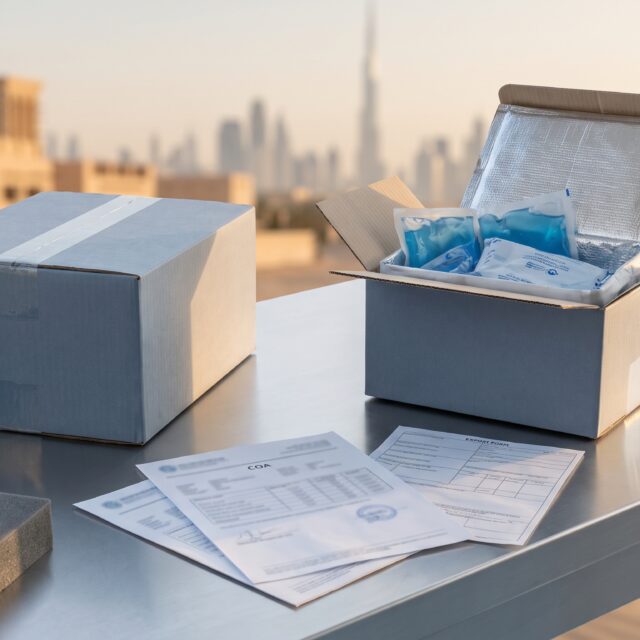
To clear research chemicals through Oman’s borders efficiently, shipments generally require:
- Accurate HS Classifications: Incorrect Harmonized System codes lead to immediate holds. Research peptides must be accurately classified as laboratory reagents or non-restricted biological compounds depending on their exact formulation.
- Material Safety Data Sheet (MSDS): This is essential for declaring the handling requirements of the chemical and proving to customs agents that the material is not hazardous.
- Source-Certified Commercial Invoice: Detailing the exact contents, value, and explicitly stating a Research Use Only (RUO) designation.
- Batch-Specific Documentation: Customs officials increasingly look for paperwork verifying the exact nature of the synthetic peptide to ensure it does not violate restricted substance lists.
When international packages sit in customs holding facilities for days or weeks awaiting clearance, they are rarely kept in cold-chain storage. Prolonged exposure destroys the samples.
Utilizing the UAE-to-Oman Logistics Corridor
To bypass massive international delays, informed buyers rely on regional distribution hubs rather than direct US or UK imports. Shipping peptides from a central GCC hub like Dubai directly into Muscat, Salalah, or Nizwa takes advantage of established, rapid overland and regional air logistics.
Working with suppliers embedded in this regional infrastructure—particularly those leveraging a localized UAE next-day delivery network—ensures the product remains in transit for a fraction of the time. This preserves sample viability and streamlines the regulatory friction associated with inter-continental imports.
Sourcing Checklist: How to Verify a PT-141 Supplier in Oman
Not all suppliers are equal, and the global peptide market is largely unregulated. This places the burden of due diligence entirely on the laboratory buyer. Whether you represent a university lab, a private research institution, or are an independent researcher, use this definitive checklist to evaluate any PT-141 supplier shipping to Oman.
1. Demand Cryptographically Verifiable COAs
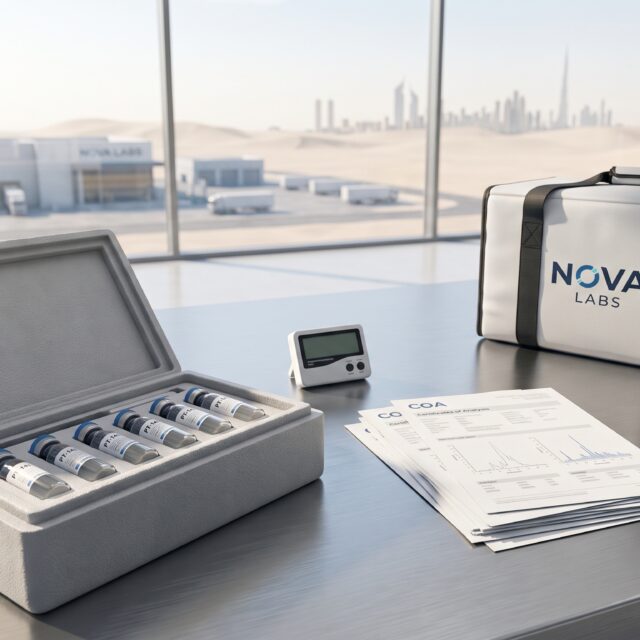
A Certificate of Analysis (COA) is the definitive proof of a peptide’s identity and purity. However, a supplier’s in-house COA is essentially meaningless, as it can be easily manipulated. You must look for reports generated by accredited, independent third-party laboratories specializing in peptide synthesis (such as Janoshik or MZ Biolabs).
The report should clearly display:
- High-Performance Liquid Chromatography (HPLC): This measures chemical purity. For viable research, the HPLC chart must show a distinct, single peak proving a chemical purity level of >98% or >99%.
- Mass Spectrometry (MS): This verifies the exact molecular weight of Bremelanotide (1025.2 g/mol) to ensure you are receiving the correct compound and not a cheaper substitute.
- Batch Matching: The batch or lot number on the COA must perfectly match the batch number printed on the vial you receive.
2. Check for Regional GCC Infrastructure
Does the supplier understand the region? Look for operational markers that prove they are equipped to handle Gulf logistics. This includes utilizing specialized courier networks capable of swift cross-border dispatch to Oman, rather than relying on generic, slow international postal services that hand off to Oman Post without tracking continuity.
3. Evaluate Payment and Operational Support Systems
Cross-border banking friction and high SWIFT transfer fees often complicate procurement for Omani buyers dealing with Western suppliers. A specialized regional supplier will provide localized purchasing solutions. Look for:
- Local Payment Gateways: Acceptance of local currency or established regional Buy Now, Pay Later (BNPL) gateways like Tamara.
- Cash on Delivery (COD): The ability to pay via COD offers ultimate buyer protection. It proves the supplier trusts their logistics network to successfully deliver the product.
- Accessible Support: Dedicated, timezone-aligned customer support via direct channels like WhatsApp is crucial when tracking sensitive biological packages across the border.
Making an Informed Procurement Decision
Finding a reliable PT-141 supplier comes down to actively mitigating risk. The extreme Omani climate and strict ROP Bayan customs regulations dictate that cheap, internationally shipped liquid solutions will almost certainly fail to arrive in a viable state.
By prioritizing lyophilized formulations, demanding verifiable third-party COAs (HPLC/MS), and utilizing established regional UAE-to-Oman logistics networks, researchers can successfully secure highly pure samples ready for accurate study. Furthermore, prioritizing suppliers that offer localized support, flexible payment structures, and absolute transparency regarding their testing protocols is essential for ongoing lab supply.
For buyers looking to confidently source research compounds without the traditional headaches of cross-border delays, you can explore the rigorously tested catalog at the NOVA Labs shop. Every batch is backed by independent, third-party COA data, ensuring researchers have precise analytical proof before conducting their studies, alongside localized delivery and payment options for GCC researchers.
Disclaimer: The products and compounds mentioned in this article are strictly for in vitro laboratory and research purposes only. They are not intended for human consumption, therapeutic use, or medical treatment.
References
- Oman Directorate General of Customs. (2024). Bayan Customs Clearance System Guidelines.
- Pfaus, J. G., et al. (2004). Bremelanotide: an overview of pre-clinical and clinical development.
- Regional Logistics & Cold Chain Infrastructure. (2023). Evaluating Biological Sample Transit in the GCC.
- Oman Cold Chain Peptide Delivery Guide | Transport & – NOVA Labs
- Peptide Purity Guide Oman: Verifying COAs & Customs – NOVA Labs
- Nova Biolabs vs Barq Peptides Oman: 2026 Supplier Comparison
- Importing into Oman: Bayan, customs duty and clearing agents
- Nova Biolabs vs Peptide Lab Oman: Buyer Comparison
- Buy PT-141 Saudi Arabia: Purity, Customs & Supplier Guide – NOVA Labs
Frequently asked questions
What documents are needed to clear research peptides through Oman customs?
To successfully clear research peptides through the ROP Bayan system, shipments typically require an accurate HS classification code, a Material Safety Data Sheet (MSDS), a source-certified commercial invoice denoting Research Use Only, and batch-specific Certificates of Analysis (COAs).
Why is lyophilized PT-141 better for shipping to Oman than liquid sprays?
Lyophilized (freeze-dried) powder is significantly more stable and resistant to thermal degradation. Pre-mixed liquid sprays are susceptible to rapid hydrolysis and break down quickly when exposed to Oman's extreme summer heat during transit, which destroys the research sample.
How can I verify the purity of PT-141 before buying?
Always request a Certificate of Analysis (COA) from an independent, accredited third-party laboratory. Ensure the report includes High-Performance Liquid Chromatography (HPLC) proving >98% purity and Mass Spectrometry (MS) verifying the exact molecular weight.
Are local payment options available for peptide suppliers in Oman?
Yes, specialized regional suppliers operating within the GCC often bypass costly international SWIFT fees by offering Cash on Delivery (COD) in local currency, as well as regional Buy Now, Pay Later options like Tamara.
How long does peptide delivery take to Oman from regional hubs?
When utilizing established logistics corridors from the UAE to Oman, overland or regional air freight can generally clear ROP Bayan customs and deliver lyophilized peptides within 2 to 5 business days, drastically reducing the risk of sample degradation.
Nova Labs buyer tools
Ready to verify stock, testing and delivery?
Use the product page and lab report section to check availability, documentation, delivery timing and support before placing an order.
- COA / test-report checks
- Oman delivery context
- Cold-chain handling
- COD and card payment options
- WhatsApp support