



What to Know Before You Buy CJC-1295 No DAC in Dubai
Buyer Checklist & Quick Answer
If you are evaluating suppliers to buy CJC-1295 No DAC in Dubai, ensure they meet these four non-negotiable criteria to protect your research:
- Local UAE Stock: Bypasses international customs delays and extreme heat exposure at border checkpoints.
- Third-Party COAs: The vendor must display recent, independent HPLC/MS test results proving ≥99% purity.
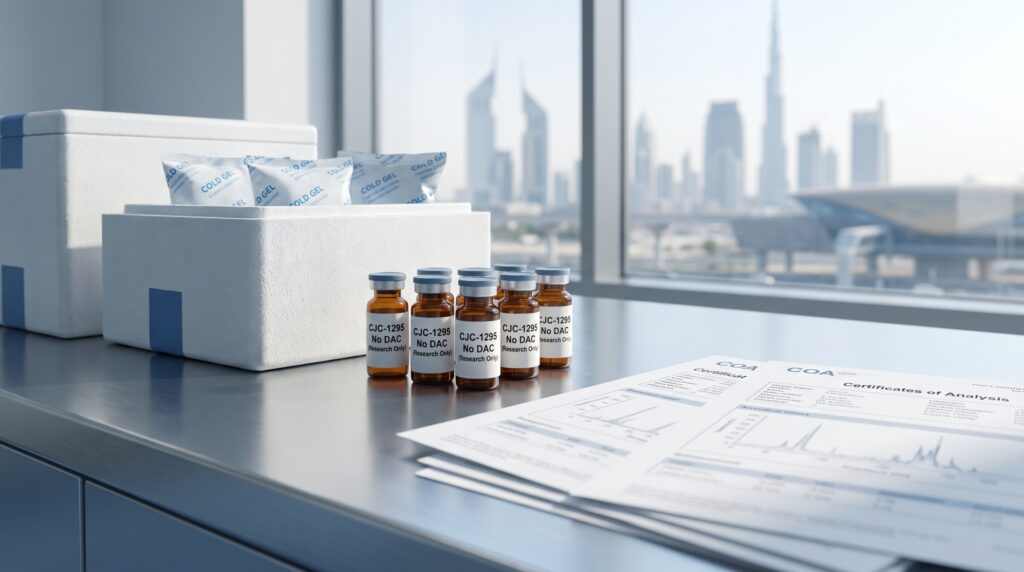
- Cold-Chain Logistics: Packaging must include insulated mailers and gel packs, ideally supporting same-day dispatch.
- Regulatory Compliance: Vendors must explicitly supply compounds for in vitro research and analytical purposes only.
To safely buy CJC-1295 No DAC in Dubai, researchers and procurement teams must rigorously evaluate their suppliers. The UAE search landscape for research peptides is evolving rapidly. With increased regulatory oversight from the Emirates Drug Establishment (EDE) targeting unapproved medical claims, procuring high-quality analytical peptides requires heightened diligence.
Legitimate online suppliers operating in the GCC must strictly supply these compounds for laboratory testing, cellular assays, and analytical research, steering clear of unregulated consumer marketing. For procurement staff and informed buyers, this means vetting a CJC-1295 No DAC supplier in Dubai relies heavily on verifiable documentation, secure local logistics, and transparent communication.
This guide outlines the critical operational markers you should look for before deciding to order CJC-1295 No DAC in the UAE, ensuring your laboratory receives viable, high-purity compounds without friction or degradation.
Understanding CJC-1295 No DAC (Modified GRF 1-29)
Before evaluating a supplier’s inventory, it is vital to understand the structural properties of the compound being sourced. CJC-1295 No DAC, appropriately referred to in scientific literature as Modified GRF 1-29, is a 29-amino acid synthetic analogue of endogenous growth hormone-releasing hormone (GHRH).
It features four distinct amino acid substitutions compared to the naturally occurring GHRH(1-29) fragment. These substitutions were designed to prevent rapid cleavage by dipeptidyl peptidase-4 (DPP-IV) enzymes during testing. However, it deliberately lacks the maleimidopropionic acid linkage—the “Drug Affinity Complex” or DAC—that binds to serum albumin. Because of this absence, the “No DAC” version possesses a short half-life of roughly 30 minutes in physiological environments.
This abbreviated window allows researchers to study pulsatile release mechanisms in cellular assays rather than continuous receptor activation. In many laboratory settings, it is investigated alongside Growth Hormone Releasing Peptides (GHRPs) like Ipamorelin to observe synergistic metabolic pathways in vitro. Because of its specific pharmacokinetic profile, the structural integrity of the peptide chain is paramount. Even minor degradation due to heat or poor synthesis can drastically skew experimental data, underscoring the need for meticulous, local sourcing.
The UAE Regulatory and Purchasing Climate
Procuring research compounds in the GCC involves navigating a highly structured regulatory environment. The 2024 Medical Products Law, overseen by the EDE, has implemented strict crackdowns on unauthorized vendors promoting peptides for cosmetic, weight loss, or general consumer use.
As a result, clinical-grade peptides meant for human consumption remain strictly prescription-only via licensed clinics and compounding pharmacies. Online vendors supplying the CJC-1295 No DAC peptide Dubai market operate exclusively within the analytical sector.
When evaluating a supplier, their adherence to this framework is a primary trust signal. Suppliers making bold medical claims or offering human dosage protocols are operating outside local compliance. This non-compliance often correlates with poor quality control, supply chain disruptions, and unreliable product testing. Reputable sellers focus strictly on scientific nomenclature, rigorous analytical data, and laboratory handling protocols.
Verifying Supplier Authenticity: The COA Checklist
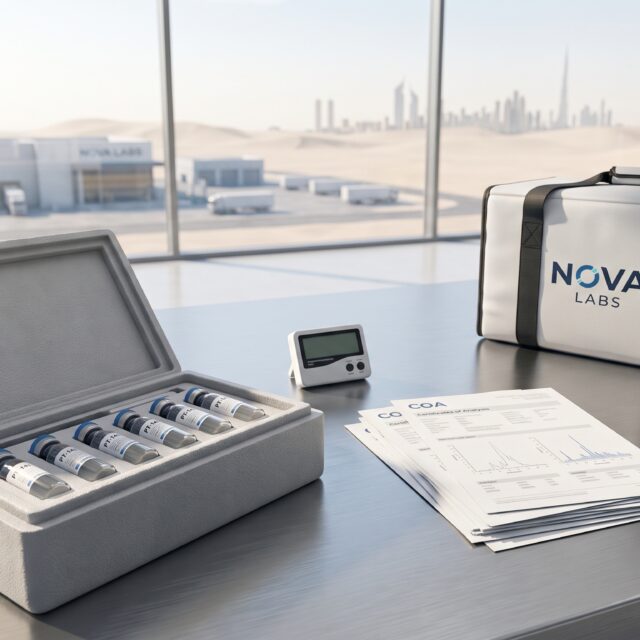
The most critical step when you buy CJC-1295 No DAC in Dubai is validating the product’s chemical purity. Trustworthy suppliers do not rely on generic factory-issued labels; they provide accessible, batch-specific Certificates of Analysis (COA) conducted by independent testing laboratories.
When reviewing a supplier’s documentation prior to procurement, look for the following criteria:
- HPLC Chromatogram: High-Performance Liquid Chromatography (HPLC) separates the compound into its individual components. You must analyze the area under the primary peak. For Modified GRF 1-29, this peak should indicate a purity threshold of at least 99%, ensuring minimal synthesis byproducts or truncated sequences.
- Mass Spectrometry (MS): The MS report confirms the actual molecular weight of the peptide. For CJC-1295 No DAC, the experimental mass shown on the report must closely match the theoretical mass (approx. 3367 g/mol), proving the compound’s identity is exactly what is advertised.
- Batch Matching: Ensure the batch number printed on the physical vial directly corresponds to the batch number on the published COA on the vendor’s website.
- Moisture and TFA Content: Premium reports will often list moisture content via Karl Fischer titration and residual Trifluoroacetic acid (TFA), which can impact peptide stability and cell viability in sensitive assays.
At NOVA Labs, transparency is foundational to our operations in the UAE. We ensure that our buyers have direct access to relevant testing documentation, allowing you to confidently evaluate the CJC-1295 No DAC you procure for your institutional studies.
Navigating Dubai Delivery and Cold-Chain Logistics
The extreme climate of the GCC presents one of the biggest hurdles in global peptide procurement. Lyophilised (freeze-dried) peptides are relatively stable at room temperature for short durations, but prolonged exposure to the intense summer heat of the UAE (frequently exceeding 45°C) can cause rapid, irreversible peptide degradation.
The Risks of International Shipping
Ordering from overseas suppliers introduces significant variables. International shipments are frequently subject to stringent Dubai Customs documentation checks. When a package arrives at clearing facilities in DXB or DWC, it can be held for several days. A package held without temperature control during a UAE afternoon is highly likely to suffer compromised integrity. Furthermore, international shipping terms (DDU/DAP) often leave the buyer responsible for customs clearance, creating unwanted administrative friction for research labs.
Why Local Dispatch Matters
To mitigate these logistical risks, informed UAE buyers heavily favour local inventory. A supplier with stock held in climate-controlled facilities within the Emirates—such as those operating near Dubai Science Park or Jebel Ali—can completely bypass international transit delays.
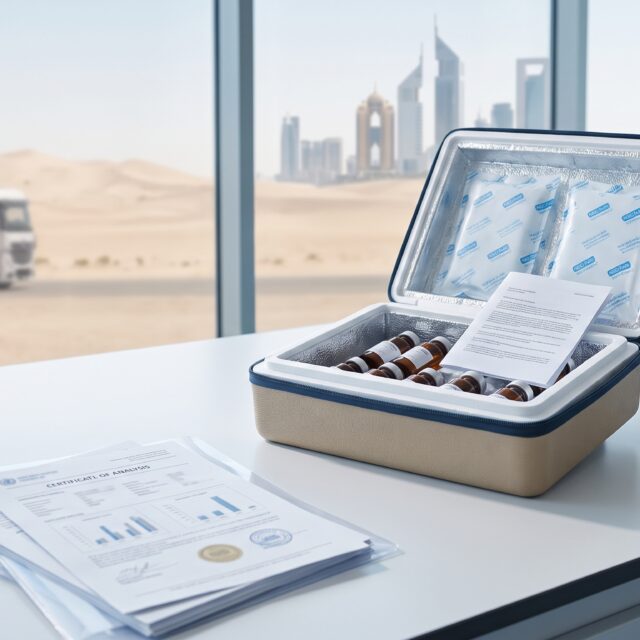
Premium local suppliers utilize insulated mailers equipped with frozen gel packs and temperature-reflective materials, ensuring the peptide remains within a safe temperature range during transit. If your laboratory requires immediate access to vital compounds, opting for a supplier that offers peptides in Dubai with same-day delivery ensures that transit time is reduced to a matter of hours. This rapid deployment maximally preserves the fragile molecular chains from thermal stress.
Payment Methods, Customer Support, and Institutional Trust
Beyond product purity and logistics, the overall purchasing experience is a crucial part of long-term supplier evaluation. The GCC market places a high premium on flexible payment options, institutional support, and highly responsive local communication.
- Cash on Delivery (COD): COD is a vital trust factor in the UAE. It allows researchers and procurement officers to inspect the physical packaging, verify security seals, and check batch numbers before finalizing the transaction.
- Direct Communication: A reliable CJC-1295 No DAC supplier in Dubai will offer direct communication channels, such as local WhatsApp support. This allows procurement teams to verify current stock levels, request up-to-date COAs before raising a purchase order, and coordinate specific delivery windows to ensure a technician is available to immediately refrigerate the package upon arrival.
- Storage Guidance: While reputable suppliers will not provide human-use protocols, they will provide clear guidance on proper laboratory storage. Lyophilised vials should generally be stored away from direct light in a cold environment (usually below -20°C for long-term storage, or refrigerated at 2-8°C once reconstituted with bacteriostatic water for immediate assay use).
Conclusion: Making an Informed Procurement Decision
Successfully procuring analytical-grade peptides in the UAE requires looking past marketing hype and focusing heavily on verifiable commercial markers. Whether you are ordering a single vial for a preliminary assay or securing bulk stock for an extended institutional study, your evaluation checklist should remain rigorous.
Prioritize suppliers who operate strictly within EDE compliance guidelines, offer transparent third-party HPLC/MS testing, and possess the local infrastructure required to execute flawless cold-chain delivery. By insisting on local UAE dispatch and responsive support, you protect your research timeline, laboratory budget, and the structural integrity of your compounds.
Ready to equip your laboratory with verified, analytical-grade compounds? Protect your research timeline and ensure pristine cold-chain handling by securing your inventory today. Order your CJC-1295 No DAC directly from NOVA Labs for guaranteed UAE logistics, full analytical transparency, and unparalleled chemical purity.
Disclaimer: The products mentioned in this article are for in vitro research and analytical purposes only and are strictly not intended for human consumption or medical use.
References
- Gulf News. (2024). UAE Cracks Down on Unapproved Peptide Weight-Loss Drugs: 71 Sources and 14 Influencers Face Action. Retrieved from Gulf News.
- Al Tamimi & Co. Clinical trial agreements in the UAE: regulatory requirements and contract structure. Retrieved from Al Tamimi & CO.
- Ministry of Health and Prevention (MOHAP) / Emirates Drug Establishment (EDE). Guidelines on Medical Products (2024).
Disclaimer: The products mentioned in this article are for research purposes only and are not intended for human consumption.
- UAE Cracks Down on Unapproved Peptide Weight-Loss Drugs: 71 Sources and 14 Influencers Face Action – Gulf News
- Clinical trial agreements in the UAE: regulatory requirements and contract structure – Al Tamimi & CO
- Peptides Compounding Pharmacy Dubai – CureCell
- CJC-1295 + Ipamorelin UAE – VaultLabs
Frequently asked questions
What should I look for on a CJC-1295 No DAC COA?
You should verify the HPLC chromatogram for a purity peak of 99% or higher, and check the Mass Spectrometry (MS) report to ensure the experimental molecular weight matches the theoretical weight of Modified GRF 1-29 (approx. 3367 g/mol).
Why is local Dubai delivery important for peptides?
Local delivery bypasses international customs delays and minimizes the time temperature-sensitive compounds spend in the extreme GCC heat. This significantly reduces the risk of peptide chain degradation during transit to your laboratory.
Does CJC-1295 No DAC require cold shipping in the UAE?
Yes, to preserve structural integrity, reputable UAE suppliers dispatch lyophilised peptides using insulated mailers and gel packs, ensuring safe temperatures until the product reaches your laboratory refrigerator.
What is the difference between CJC-1295 DAC and No DAC?
CJC-1295 with DAC includes a Drug Affinity Complex that significantly extends its half-life. The 'No DAC' version (Modified GRF 1-29) lacks this complex and has a short half-life of roughly 30 minutes, allowing researchers to study pulsatile rather than continuous release.
Are online peptide suppliers in Dubai regulated?
Yes, the Emirates Drug Establishment (EDE) strictly regulates medical claims. Legitimate online suppliers in the UAE provide peptides strictly for in vitro laboratory and analytical research purposes, never for human consumption.
Nova Labs buyer tools
Ready to verify stock, testing and delivery?
Use the product page and lab report section to check availability, documentation, delivery timing and support before placing an order.
- COA / test-report checks
- Dubai delivery context
- Cold-chain handling
- COD and card payment options
- WhatsApp support