




Acquiring highly sensitive research compounds in the United Arab Emirates presents a unique set of logistical hurdles. With summer temperatures frequently soaring above 45°C across the GCC, standard shipping practices are entirely insufficient for preserving the molecular integrity of fragile biological materials. For laboratory technicians, procurement staff, and informed principal investigators, evaluating a supplier’s logistics network is just as crucial as verifying their analytical testing reports. If a compound is structurally degraded before it even reaches your laboratory workbench, the purity indicated on its Certificate of Analysis (COA) becomes entirely irrelevant. This guide examines the critical mechanics of local delivery, outlining the packaging standards, transit timing, and post-arrival handling protocols required to protect your investment.
Understanding Cold Chain Peptide Delivery Sharjah
Cold chain peptide delivery in Sharjah utilizes domestic fulfilment, EPS insulated packaging, and clinical-grade gel ice packs to protect fragile research compounds from severe 45°C summer heat. Next-day local transit bypasses international customs delays, preventing thermal degradation and ensuring lyophilised vials arrive structurally intact for laboratory use.
Key Takeaways for UAE Researchers
- Local Dispatch is Crucial: International shipping exposes vials to lengthy, unconditioned customs holds that compromise thermal packaging.
- Proper Thermal Shielding: Expanded Polystyrene (EPS) insulation and phase-change gel packs are mandatory to block ambient radiant heat.
- Equilibration Rule: Vials must sit for 10 to 15 minutes at room temperature before opening to prevent internal condensation and immediate degradation.
- Analytical Verification: Always demand third-party HPLC/MS COAs prior to purchase to ensure baseline purity.
For many researchers, the phrase ‘cold chain’ evokes images of dry ice and deep-freeze transport trucks. However, the logistical reality for lyophilised (freeze-dried) compounds is more nuanced. During the lyophilisation process, water is systematically removed from the compound, vastly improving its thermal stability compared to its reconstituted liquid form. While lyophilised vials can tolerate brief periods at room temperature without suffering immediate catastrophic damage, the extreme and sustained heat of a typical UAE summer fundamentally alters this safety margin. Prolonged exposure to temperatures exceeding 35°C accelerates hydrolysis and structural unravelling. Therefore, effective delivery relies not on freezing the product, but on aggressively slowing down thermal transfer from the outside environment during the final crucial hours of last-mile transit.
Why International Shipping Fails the Summer Heat Test
Many procurement teams initially look overseas to source their materials, drawn by broad international catalogues or perceived bulk cost savings. However, international shipping introduces a profound risk of thermal degradation that no amount of standard cold packaging can entirely mitigate.
When cross-border packages arrive in the UAE, they must clear strict customs processing. Depending on local backlogs, regulatory checks, and weekend schedules, a package might sit in an airport holding facility for anywhere from 48 hours to several weeks. Tarmac temperatures in Dubai or Sharjah can easily exceed 50°C during the day. Under these conditions, standard dry ice sublimates quickly, gel ice packs melt, thermal barriers reach ambient temperature, and the vial contents are subjected to aggressive, fluctuating heat cycles. Even expedited global couriers cannot guarantee the temperature of secondary customs inspection areas.
This is precisely why researchers are increasingly pivoting to suppliers with established local operational hubs. Domestic fulfilment entirely bypasses the unpredictable timeline of international customs. When a package is dispatched from within the UAE, the logistics window shrinks from unpredictable weeks to highly manageable hours. This ensures that the cold chain remains demonstrably unbroken from the supplier’s climate-controlled facility directly to your institution.
The Anatomy of Reliable Cold-Aware Packaging
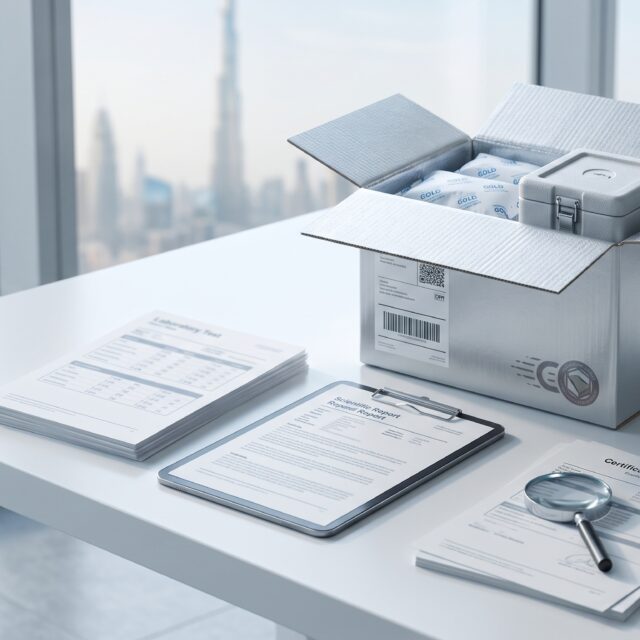
When evaluating a supplier’s capability for cold chain peptide delivery for research peptides Sharjah, buyers must look far beyond vague promises of ‘secure shipping’. True thermal protection requires specific, verifiable packaging layers designed to combat conductive and radiant heat simultaneously.
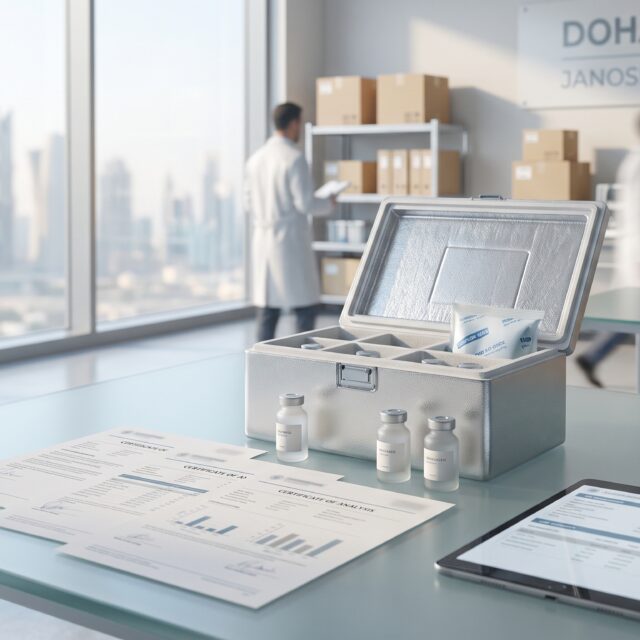
First, the vials must be shielded from direct impact and physical vibration. This is typically achieved using custom-cut foam inserts or rigid plastic casing, which prevents the pharmaceutical-grade glass vials from shattering or micro-fracturing during transit over uneven roads.
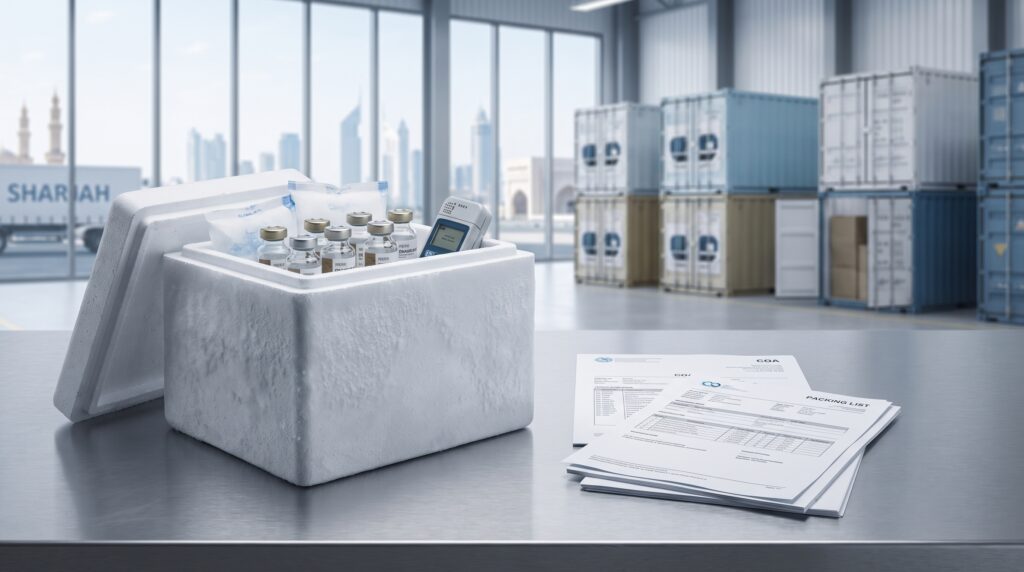
Second, the protective casing is enclosed within a dedicated insulating barrier. The gold standard for regional GCC transit utilises Expanded Polystyrene (EPS) panels or thick polyurethane-lined thermal boxes. These materials have exceptionally low thermal conductivity, meaning the high ambient heat outside struggles to penetrate the core of the package.
Finally, the internal temperature is actively maintained using phase-change materials, most commonly clinical-grade gel ice packs. Unlike standard water-based ice, which melts quickly and creates severe condensation risks, specialised gel packs absorb a massive amount of thermal energy as they slowly transition from a solid to a liquid state. Combined with a reflective, heat-shielding bubble mailer as the outermost layer to deflect direct sunlight, this multi-layered approach guarantees that the internal climate remains highly stable throughout the courier’s route across the Northern Emirates.
Next-Day Delivery: The Crucial Logistics Window
Even the most advanced thermal packaging has a defined, scientifically measurable lifespan. In the height of a GCC summer, heavy-duty insulated shippers might only guarantee internal temperature stability for 36 to 48 hours maximum. Therefore, transit speed is just as critical as the physical packaging itself.
To secure the integrity of your materials, local transit must be completed within a strict 24-hour window. Leading regional suppliers operate on a rapid fulfilment model, picking and packing orders in climate-controlled environments and handing them directly to specialised local couriers. This ensures that a package dispatched in the late afternoon reaches its destination in Sharjah by the following morning, well within the safety margin of the thermal packaging.
If you are evaluating suppliers for your next analytical project, prioritise those who can explicitly guarantee domestic next-day dispatch. To explore how streamlined regional logistics effectively safeguard compound stability, you can review dedicated peptides UAE next day delivery protocols designed specifically to counter the local climate.
Verification and Analytical Testing
Cold chain logistics only preserve the existing quality of a compound; they do not improve it. Therefore, securing a supplier with a robust logistics network is only half the battle. The other half is ensuring the product being shipped is of the highest verifiable purity.
A reliable supplier will provide batch-specific Certificates of Analysis (COA) that detail High-Performance Liquid Chromatography (HPLC) and Mass Spectrometry (MS) results. HPLC confirms the purity percentage of the compound, ensuring that synthesis byproducts and truncations have been adequately filtered out. Mass Spectrometry verifies the molecular weight, confirming the exact identity of the peptide sequence. Before placing a local order for delivery to Sharjah, ensure these documents are readily available and match the specific batch number you are purchasing.
Laboratory Protocol: What to Do When Your Cold Order Arrives
Receiving a cold-shipped package requires adherence to a strict handling protocol. A common, yet highly damaging mistake made by laboratory staff is immediately opening the cold vials in an unconditioned environment to inspect the contents.
Sharjah’s climate is not only hot but exceptionally humid, particularly during the coastal summer months. If a chilled glass vial is opened immediately upon arrival, the warm, moist ambient air will rush inside. This moisture instantly condenses on the cold inner glass and the lyophilised powder itself. Because lyophilised compounds are highly hygroscopic (they rapidly absorb ambient moisture), this microscopic condensation triggers immediate and uncontrolled hydrolysis, degrading the compound before you have even begun formal reconstitution.
To prevent this, adopt the ‘equilibration rule’. When you unbox your delivery, remove the vials from the cold packaging but leave them completely sealed. Let them sit at room temperature in a dry, air-conditioned laboratory environment for 10 to 15 minutes. Allowing the glass to gradually reach ambient temperature ensures that no condensation forms when the protective seal is finally breached. Once equilibrated and opened, the compound can be properly reconstituted with bacteriostatic water or another appropriate diluent, after which it must immediately be transferred to a stable 2°C to 8°C refrigerator for long-term liquid storage.
Evaluating Your Supplier: A Sharjah Buyer’s Checklist
When committing departmental funds to high-grade research materials, you must holistically evaluate the supplier’s operational infrastructure. A reliable provider servicing the UAE should excel in three distinct areas:
- Documentation and Transparency: Purity claims are meaningless without verifiable proof. Ensure the supplier provides independent HPLC and MS testing.
- Verified Domestic Logistics: Confirm that the supplier is dispatching from a physical hub within the UAE, not drop-shipping from an overseas warehouse. Local dispatch is the only reliable way to guarantee the cold chain remains intact.
- Local Support and Payment Flexibility: Navigating B2B procurement in the UAE often requires direct, responsive communication. Look for suppliers offering dedicated WhatsApp support for rapid logistics updates, as well as Cash on Delivery (COD) options which provide ultimate peace of mind for first-time institutional buyers.
Secure Your Research Materials with Confidence
At NOVA Labs, we understand that exceptional, repeatable research requires uncompromising compound integrity. Our logistics infrastructure is purpose-built from the ground up for the UAE’s demanding climate. From multi-layered thermal EPS insulation and clinical gel-pack cooling to our robust domestic courier network, we ensure that every order dispatched to Sharjah arrives the next day, securely packaged, and structurally pristine.
Every batch we supply is backed by transparent, third-party HPLC/MS analytical testing, giving your laboratory total confidence in the baseline purity of your materials. For procurement teams, principal investigators, and informed buyers seeking a dependable regional partner, we offer streamlined ordering, COD availability, and highly responsive local support.
Browse our comprehensive research catalogue today to discover high-purity compounds supported by the most reliable, climate-aware cold chain network in the United Arab Emirates.
*
Disclaimer: All products mentioned are strictly for in-vitro laboratory research purposes only. They are not intended for human consumption, diagnostic use, or therapeutic treatment. Always handle compounds in accordance with standard laboratory safety protocols.
References
- Bachem. (2024). Handling and Storage Guidelines for Peptides. Retrieved from official Bachem technical library.
- World Health Organization (WHO). (2023). Good Storage and Shipping Practices for Time- and Temperature-Sensitive Pharmaceutical Products. WHO Technical Report Series.
- UAE Ministry of Health and Prevention (MOHAP). Guidelines on Cold Chain Management for Pharmaceuticals in the UAE.
- International Society for Lyophilization – Freeze Drying (ISL-FD). Thermal Stability of Lyophilized Biologicals in Transit.
- About – UAEPeptide.ai
- About & Research Use | Khaleej Peptides
- PepcoLab | Research-Grade Peptides & Laboratory Compounds — UAE & UK
- Cold Chain Solution UAE | Freezepak UAE – Dry Ice Supplier & Gel Ice Packs
- Peptide Storage, Handling & Stability Guide 2026 – Luxara Research Company
- Handling and Storage Guidelines for Peptides – Bachem
- Lyophilized Peptide Storage: Temperature, Humidity, & Light
- FAQ – Answers About Peptides & Dn Research
Frequently asked questions
How long does cold chain peptide delivery to Sharjah take?
When ordering from a domestic UAE supplier with a local fulfilment hub, cold chain deliveries to Sharjah are typically completed the next day. This rapid 24-hour transit ensures the thermal packaging effectively protects the compounds from regional heat.
Can lyophilised research peptides survive Sharjah summer heat?
Yes, provided they are packaged correctly. High-quality EPS insulation and phase-change gel packs keep the internal temperature stable long enough for local couriers to complete next-day delivery before any heat-related hydrolysis occurs.
Why should I wait before opening a cold peptide vial upon delivery?
Opening a cold vial in Sharjah's humid ambient air causes immediate microscopic condensation inside the glass. Allowing the sealed vial to equilibrate to room temperature for 10 to 15 minutes prevents moisture from triggering premature structural degradation.
Are international peptide shipments safe during UAE summers?
International shipments carry a severe risk of thermal degradation. Unpredictable customs delays and unconditioned holding facilities at UAE airports often outlast the lifespan of standard cold packaging, exposing sensitive materials to extreme tarmac heat.
How do I store reconstituted peptides after delivery?
Once a lyophilised compound has been reconstituted with a diluent like bacteriostatic water, it becomes highly unstable at room temperature and must be stored constantly between 2°C and 8°C in a secure laboratory refrigerator away from direct light.
Nova Labs buyer tools
Ready to verify stock, testing and delivery?
Use the product page and lab report section to check availability, documentation, delivery timing and support before placing an order.
- COA / test-report checks
- Sharjah delivery context
- Cold-chain handling
- COD and card payment options
- WhatsApp support