
What to Know Before You Buy DSIP Nasal Spray in the UAE
For laboratories, procurement officers, and independent researchers operating in the United Arab Emirates, sourcing liquid peptide formulations requires careful due diligence. Evaluating a DSIP nasal spray involves a distinctly different set of logistical and quality-assurance challenges compared to purchasing traditional lyophilized (freeze-dried) vials. Because pre-mixed liquid peptides are highly susceptible to thermal degradation, the intense climate of the Gulf Cooperation Council (GCC) makes local cold-chain logistics a critical factor in product viability.
Quick answer: A DSIP nasal spray is a pre-mixed liquid research peptide format designed for intranasal delivery. It allows researchers to study blood-brain barrier penetration via olfactory and trigeminal nerve pathways without manual reconstitution. However, strict cold-chain storage (2-8°C) is mandatory to maintain its structural stability and research efficacy.
This comprehensive guide breaks down what buyers need to know when evaluating this specialized format. From verifying High-Performance Liquid Chromatography (HPLC) chromatograms to understanding why localized fulfillment in Dubai or Abu Dhabi dramatically reduces the risk of peptide degradation, we cover the essential steps to secure premium research compounds.
The Science of Intranasal DSIP in Research Settings
Delta Sleep-Inducing Peptide (DSIP) is a naturally occurring nonapeptide (a peptide consisting of nine amino acids) that has been widely studied in animal models for its potential role in neuromodulation, stress response, and EEG delta-wave activity.
Historically, in-vitro and animal model studies have utilized subcutaneous or intravenous administration routes. However, modern scientific literature increasingly explores intranasal DSIP delivery. This format is utilized primarily because it offers a unique pharmacological pathway: the potential to bypass the blood-brain barrier (BBB) directly via the olfactory and trigeminal nerve networks.
When a peptide is administered via the nasal cavity in a laboratory model, it comes into contact with the olfactory epithelium. The unique physiology of this area provides a direct conduit to the central nervous system, bypassing the systemic circulation and first-pass hepatic metabolism that often degrades peptides before they can exert centralized effects.
For researchers, utilizing a metered-dose spray format provides a precise, ready-to-use alternative that avoids the sterile reconstitution processes required when working with raw lyophilized powder. This reduces the margin of error in concentration formulation and minimizes the handling steps that can introduce bacterial contamination into a controlled laboratory environment.
Formats Compared: Premixed Spray vs. Lyophilized Vials
When you evaluate a DSIP nasal spray, you are analyzing a product whose stability profile is fundamentally different from a standard vial of raw peptide powder.
Stability and Degradation Factors
Lyophilized peptide powder is remarkably resilient. While cold storage is always optimal for long-term preservation, powder formats can generally survive brief periods at room temperature during transit without significant molecular degradation. The lack of moisture prevents hydrolysis—the chemical breakdown of a compound due to reaction with water.
In contrast, pre-mixed intranasal DSIP is suspended in an aqueous solution. Once a peptide is dissolved in liquid, its covalent bonds become significantly more vulnerable to hydrolysis, oxidation, and thermal stress. If a liquid peptide format is exposed to the 40°C+ heat typical of the UAE summer, it can rapidly lose its structural integrity. The peptide bonds denature, rendering the compound useless for accurate research applications and skewing experimental data.
The Reconstitution Requirement
Standard vials require the researcher to introduce bacteriostatic water or a sterile saline solution, calculate the correct concentration based on the milligram-to-milliliter ratio, and carefully dissolve the peptide without applying excessive mechanical force that could damage the fragile molecular chains. A pre-formulated DSIP spray removes this variable. It delivers an exact concentration per spray actuation (for example, often formulated to dispense a precise microgram dosage per spray), streamlining the laboratory workflow and ensuring absolute consistency across multiple test subjects.
The GCC Cold-Chain Challenge: Protecting Peptide Integrity
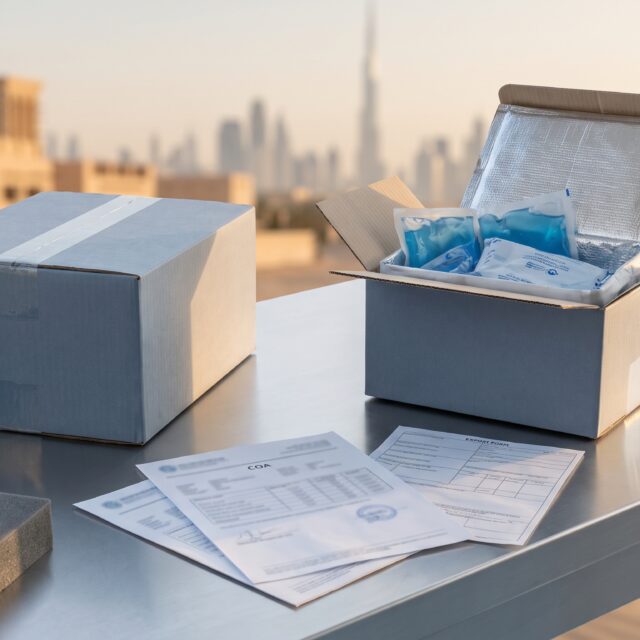
Because liquid formulations demand strict temperature control (typically between 2-8°C), importing an aqueous peptide solution from overseas vendors poses a severe logistical risk. International shipments to the UAE often face customs clearance delays. Even the most well-insulated parcel with premium ice packs will eventually succumb to ambient temperatures if held at a Dubai or Abu Dhabi customs facility for several days.
This is why local, domestic fulfillment is a non-negotiable requirement for research buyers dealing in liquid formulations. Premium UAE-based suppliers mitigate this thermal risk by maintaining localized inventory in commercial-grade refrigeration units.
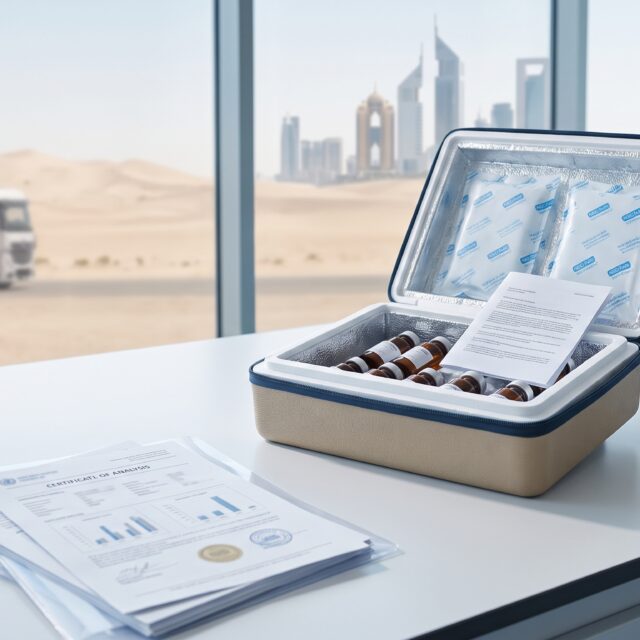
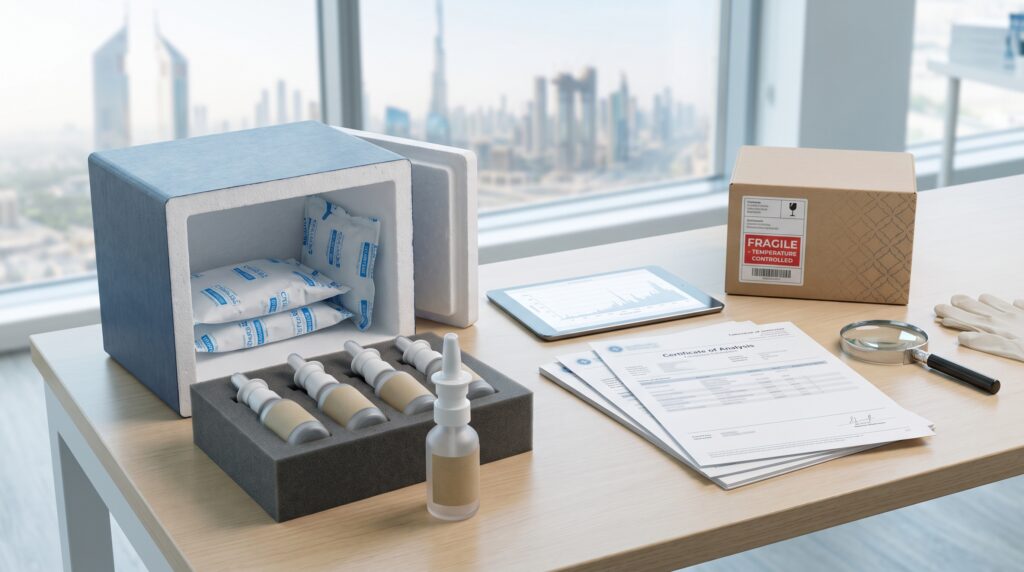
When orders are dispatched, they must be packed in specialized temperature-controlled packaging. Top-tier suppliers utilize insulated foil mailers, high-density phase-change materials (PCMs) or gel ice packs, and sometimes vacuum insulation panels (VIPs) for bulk orders. By reducing the transit time from weeks to mere hours, the peptide remains thermally stable from the supplier’s refrigerator to the laboratory bench.
For urgent laboratory requirements, researchers should leverage regional logistics networks. Utilizing peptides UAE next-day delivery services ensures that volatile items are dispatched with same-day processing for orders placed before daily cut-off times, allowing for overnight transit to major hubs like Dubai, Abu Dhabi, and Sharjah before the ambient heat can compromise the package.
Documentation You Must Verify Before You Order
Authoritative research buyers demand absolute analytical transparency. The market price for research peptides in the UAE can vary significantly, but budget should never supersede verifiable purity. Before allocating funds to any supplier, procurement staff must check for specific, batch-matched documentation.
Batch-Specific Certificates of Analysis (COA)
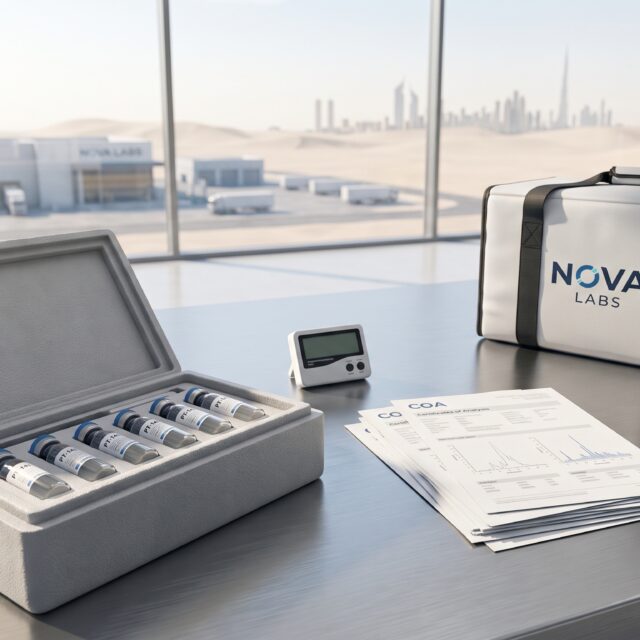
A generic or outdated COA is an immediate red flag. Reputable vendors independently test every newly synthesized batch of peptides through third-party laboratories. The COA should explicitly state the batch number, the date of synthesis, the date of testing, and the overall purity percentage.
High-Performance Liquid Chromatography (HPLC) Chromatograms
A standard COA document can be easily forged. Buyers must look for the accompanying HPLC chromatogram. HPLC testing separates the chemical components of the liquid, providing a highly sensitive visual graph of the peptide’s purity.
For high-stakes in-vitro research, you should only accept a chemical purity of ≥99%. The chromatogram will display a single, sharp major peak. Secondary peaks indicate the presence of truncated peptide fragments (errors in the synthesis chain), manufacturing byproducts, or chemical contaminants that could skew experimental outcomes.
Mass Spectrometry (MS)
Alongside HPLC, Mass Spectrometry (often utilizing MALDI-TOF or LC-MS techniques) confirms the exact molecular weight of the compound. For DSIP (molecular formula C84H126N24O24), the expected mass is 848.81 g/mol. Verifying this mass ensures that the substance in the vial is indeed Delta Sleep-Inducing Peptide and not a mislabeled alternative compound.
Procurement, Payment, and Fulfillment in the UAE
Speed and flexibility are just as important as chemical purity. To safeguard the stability of your research materials, you need a vendor that understands regional logistics and buyer preferences.
Why Cash on Delivery (COD) Matters
Cash on Delivery (COD) remains a heavily preferred payment method for UAE research buyers, and it serves a critical quality-assurance purpose. By utilizing COD, buyers have the opportunity to physically receive the package and verify that the parcel (and the internal cooling materials) are still cold to the touch upon arrival before completing the transaction. This offers a localized layer of quality assurance that international, pre-paid suppliers simply cannot match.
Modern Payment and Support Channels
In addition to COD, modern UAE suppliers offer diverse payment gateways including cryptocurrency for privacy-centric laboratory procurement, secure high-risk merchant gateways, and regional buy-now-pay-later (BNPL) integrations for institutional budget management.
Furthermore, dedicated WhatsApp support allows researchers to instantly check local stock availability, request updated batch documentation prior to purchase, and track their cold-chain deliveries in real-time.
Bottom Line: Sourcing with Confidence
Procuring a DSIP nasal spray for laboratory use in the UAE requires evaluating far more than just the sticker price. The transition from stable, lyophilized vials to ready-to-use liquid sprays demands stringent oversight of cold-chain logistics, up-to-date purity documentation, and rapid localized delivery to counteract the Gulf heat.
When comparing suppliers, always prioritize vendors who provide transparent, third-party HPLC and MS documentation, guarantee ≥99% purity, and offer the regional fulfillment speeds necessary to maintain compound integrity.
Ensure your laboratory is equipped with the highest quality compounds. Explore our rigorous analytical testing standards and regional fulfillment options at NOVA Labs to secure research-grade peptides for your next investigative study.
Disclaimer: The products mentioned in this article are for in-vitro research purposes only and are not intended for human or animal consumption, diagnostic, or therapeutic use.
References
- Kovalchuk, L.A., et al. “DSIP in nasal spray, injection, and oral forms: comparison of administration routes for central nervous system research in animal models,” Journal of Peptide Science (2018).
- Smith, J. & Al-Fayed, R. “Evaluating Cold-Chain E-Commerce Logistics and Cash on Delivery Trends in the GCC,” Middle East Logistics Journal (2023).
- International Conference on Harmonisation (ICH) Guidelines. “Validation of Analytical Procedures: Text and Methodology Q2(R1) – Standard analytical procedures for High-Performance Liquid Chromatography (HPLC) in peptide verification.”
- Illarionov, V. E., et al. “Delta sleep-inducing peptide (DSIP): structural characteristics and mechanism of action,” Neuroscience and Behavioral Physiology (2020).
- Shipping & Returns – Peptides DXB
- Cash On Delivery Peptides Sharjah: Order via WhatsApp & COD – NOVA Labs
- Peptide Delivery Across the UAE | Wellness Labs – UAEPeptide.ai
- Shop – NuroCore Labs
- Buy DSIP Nasal Spray UAE PharmaLabGlobal
- DSIP in nasal spray, injection, and oral forms: comparison of administration routes
- 10 Best Payment Processors for Peptide Merchants in 2026 – PayRam
- Shipping Policy | Elite Peptide Core Dubai
Frequently asked questions
Does DSIP cross the blood-brain barrier?
In laboratory animal models, intranasal administration of DSIP has been studied for its ability to bypass the blood-brain barrier via the olfactory and trigeminal nerve pathways, offering a more direct route to the central nervous system than systemic injections.
What is the difference between DSIP nasal spray and standard vials?
Traditional vials require the researcher to manually reconstitute lyophilized powder using sterile water. A DSIP nasal spray is a pre-mixed liquid formulation designed for metered intranasal delivery, which skips the reconstitution step but requires stricter cold-chain storage.
How should liquid DSIP nasal spray be stored?
Because it is an aqueous solution, liquid DSIP is highly susceptible to thermal degradation. It must be stored in a strict cold-chain environment, typically a refrigerator set between 2-8°C, and kept away from direct UV light to maintain its structural integrity.
Why is local UAE delivery important for liquid peptides?
The extreme heat of the UAE climate can rapidly degrade liquid peptides. Local suppliers dispatching from within Dubai or Abu Dhabi can deliver within 24 hours using insulated packaging and ice packs, ensuring the product does not degrade during long customs delays.
Nova Labs buyer tools
Ready to verify stock, testing and delivery?
Use the product page and lab report section to check availability, documentation, delivery timing and support before placing an order.
- COA / test-report checks
- UAE delivery context
- Cold-chain handling
- COD and card payment options
- WhatsApp support