



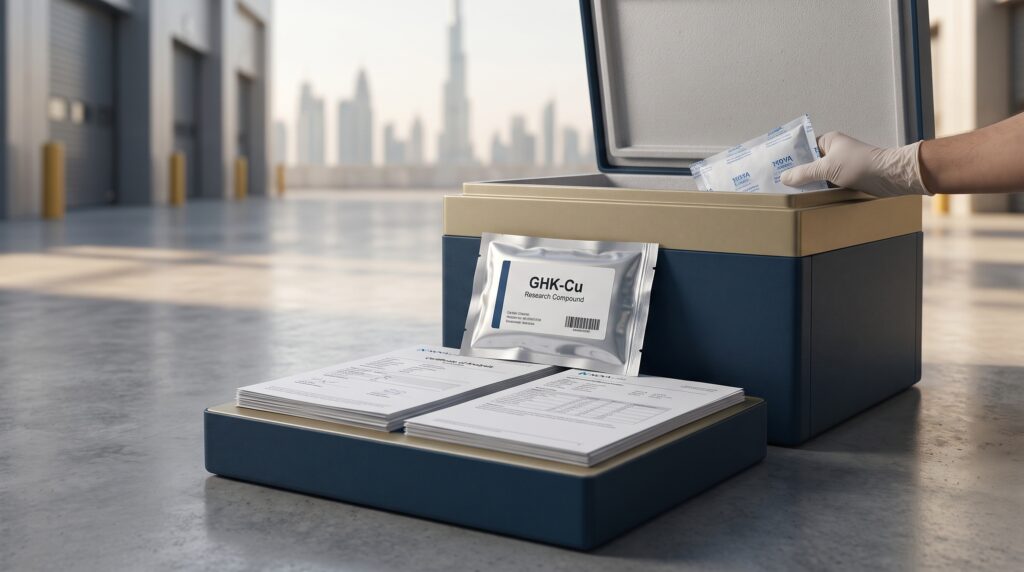
When institutional buyers and independent researchers look to buy ghk-cu saudi arabia, they immediately encounter a complex procurement landscape. Sourcing research compounds in the Kingdom of Saudi Arabia requires more than simply finding an international supplier with an active website. From the intense heat of the GCC climate to stringent local customs regulations, successfully securing high-purity GHK-Cu requires a deep understanding of thermal stability, analytical documentation, and regional logistics.
For researchers evaluating a GHK-Cu supplier Saudi Arabia, the difference between a successful laboratory acquisition and a seized or degraded shipment lies entirely in the supplier’s operational expertise. This guide breaks down exactly what informed buyers must verify—from Certificate of Analysis (COA) standards to post-transit storage protocols—ensuring your procurement process is secure, compliant, and scientifically valid.
Quick Answer: Buy GHK-Cu Saudi Arabia
To successfully order GHK-Cu Saudi Arabia, buyers must select a regional supplier that provides batch-specific Certificates of Analysis (COA) proving >99% purity. Ensure the peptide is formulated as a lyophilised powder for transit stability, and verify the supplier utilises established GCC logistics to navigate ZATCA customs smoothly.
Navigating Saudi Customs and Research Compliance
The regulatory framework governing chemical imports in Saudi Arabia is exceptionally strict. The Saudi Food and Drug Authority (SFDA) and the Zakat, Tax and Customs Authority (ZATCA) actively monitor incoming shipments through regional clearance platforms like SABER and FASAH.
Recently, the Saudi Ministry of Health (MoH) has maintained strict oversight on the sale and distribution of unregistered peptide and hormonal products marketed with medical or therapeutic claims. This decisive regulatory action underscores a critical reality for buyers: research peptides must be strictly categorised, documented, and sold for Research Use Only (RUO).
If a supplier attempts to ship GHK-Cu into the Kingdom with incorrect customs declarations, or if their website promotes unverified therapeutic claims, the shipment faces an overwhelmingly high risk of seizure at the border. Professional researchers mitigate this risk by partnering with suppliers who operate with strict RUO compliance, decoupling the compound from any medical or consumer-use rhetoric. Furthermore, leveraging regional Middle Eastern logistics hubs—such as the UAE—allows suppliers to route shipments through established GCC corridors rather than relying on unpredictable international postal services.
GCC Heat and Thermal Stability: The Lyophilisation Imperative
One of the primary concerns for any researcher looking for a GHK-Cu peptide Saudi Arabia is the extreme ambient temperature of the Gulf region. GHK-Cu (glycyl-l-histidyl-l-lysine copper) is a copper-binding peptide that is highly sensitive to moisture and sustained extreme heat in its liquid state.
However, the structural integrity of the peptide can be preserved through an advanced freeze-drying process known as lyophilisation.
Why Residual Moisture Matters
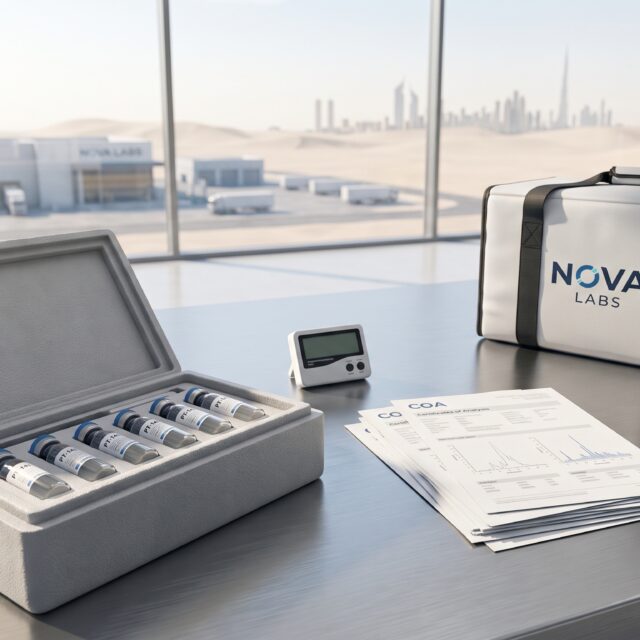
When GHK-Cu is properly lyophilised, the water content is reduced to less than 1%. In this dehydrated powder format, the peptide becomes remarkably stable. Scientific data indicates that lyophilised peptides can withstand standard room temperatures (and even elevated transit temperatures) for several weeks without suffering significant degradation.
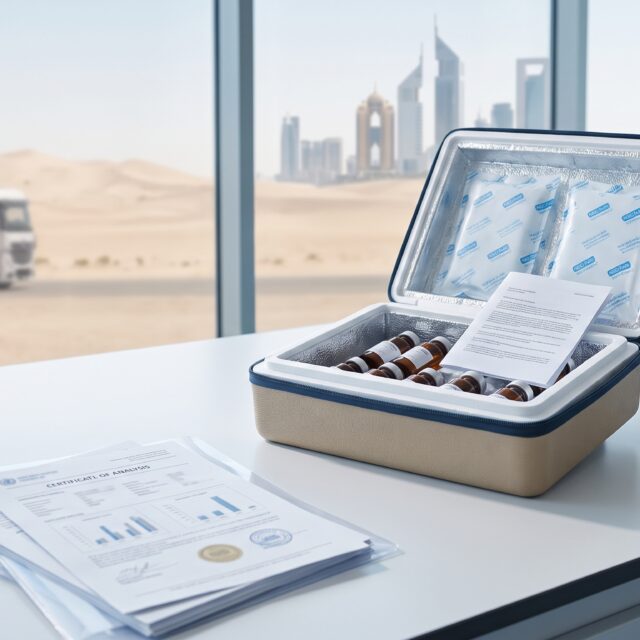
Basic cold-packs included in international shipments often melt within 24 to 48 hours, providing little protection during lengthy cross-border transit delays. Therefore, the structural format of the peptide—specifically, its formulation as a >99% pure, low-moisture lyophilised powder—is far more critical than temporary thermal packaging.
Required Storage Protocols Post-Delivery
While lyophilised GHK-Cu handles transit well, strict temperature control must be re-established upon arrival at your laboratory or facility:
- Long-term storage: Unreconstituted lyophilised vials should be stored at -20°C (freezer conditions) to maintain their integrity for up to 24 months.
- Post-reconstitution storage: Once the peptide is reconstituted with bacteriostatic water or a similar laboratory solvent, the solution becomes immediately susceptible to degradation. It must be kept in cold storage at 2-8°C (refrigerator conditions) and utilised within 30 days.
Verifying the COA: The Gold Standard for Purity
A critical error made by uninitiated buyers is purchasing raw cosmetic-grade GHK-Cu rather than research-grade material. The cosmetic market is saturated with heavily diluted GHK-Cu solutions that lack the precision required for rigorous scientific evaluation.
When you order GHK-Cu Saudi Arabia, the single most important document you must demand is a batch-specific Certificate of Analysis (COA). A robust COA should include two distinct forms of analytical testing:
- High-Performance Liquid Chromatography (HPLC): This test separates the components within the sample to determine the exact purity percentage. For research purposes, an HPLC report must indicate a purity level of >99%, confirming the absence of significant manufacturing byproducts or synthetic impurities.
- Mass Spectrometry (MS): This analysis measures the mass-to-charge ratio of the molecules, confirming the exact molecular weight and sequence identity of the GHK-Cu compound.
If a supplier cannot produce verifiable, up-to-date HPLC and MS reports for their current batch, their product should not be considered suitable for laboratory research.
Evaluating Supplier Legitimacy and Logistics
Beyond product purity, the operational capabilities of your chosen supplier directly dictate the success of your procurement. Institutional purchasers and informed buyers in Saudi Arabia should evaluate suppliers based on three operational pillars:
1. Regional GCC Presence
Suppliers shipping directly from overseas (e.g., China or the US) frequently encounter customs bottlenecks, resulting in weeks of delay. Suppliers operating out of Middle Eastern hubs possess a distinct advantage. By relying on established regional shipping and UAE fulfillment channels, competent distributors can significantly reduce transit times and navigate GCC customs frameworks with greater predictability.
2. Timezone-Aligned Support
Procurement issues require immediate resolution. A supplier that offers responsive, timezone-aligned customer service—particularly via accessible channels like WhatsApp—provides a layer of security that automated overseas helpdesks cannot match. Whether you need to verify a batch number, request a COA, or track a localised shipment, direct communication is vital.
3. Accessible Payment Infrastructure
International wire transfers can be slow and incur high fees. Suppliers that understand the Saudi market often accommodate regional payment gateways, including local bank transfers or secure digital payment links, streamlining the purchasing process for institutional and independent buyers alike.
Procurement Confidence with NOVA Labs
At NOVA Labs, we understand the specific logistical and environmental challenges of sourcing research compounds in the GCC. We provide researchers with seamless access to verified, high-purity peptides, supported by transparent analytical documentation and robust regional logistics.
Every vial of GHK-Cu we supply is provided in a highly stable lyophilised format, backed by accessible COA documentation detailing >99% purity via HPLC and Mass Spectrometry. By operating locally within the UAE, we ensure rapid, secure transit into Saudi Arabia, minimising temperature exposure and eliminating the friction of lengthy international customs delays.
To view our complete inventory of research compounds and access detailed batch testing data, explore our dedicated peptide shop today.
Disclaimer: The products mentioned in this article are strictly for in-vitro research purposes only and are not intended for human consumption, therapeutic use, or medical treatment.
References
- Saudi Food and Drug Authority (SFDA). Clearance Requirements for Chemicals and Research Materials.
- Health Ministry Cracks Down on Unlicensed Medical Claims for Peptides. Regional GCC Health Reports.
- Cold Chain Logistics and Peptide Stability Profiles. Analytical Biochemical Journal.
- Wholesale Peptides Saudi Arabia: B2B Supplier & Procurement. NOVA Labs Internal Logistics Data.
- Wholesale Peptides Saudi Arabia: B2B Supplier & Procurement – NOVA Labs
- MoH Warns Against Using Unregistered Drugs and Seizes Violators
- Buy MOTS-c in Saudi Arabia | Reliable Suppliers & COA Guide – NOVA Labs
- Health Ministry Cracks Down on Gym Trainers Selling Unlicensed Weight Loss and Hormonal Drugs
- Cold Chain Shipping: What the Science Actually Says – Lone Star Peptide Co.
- are peptides legal in saudi arabia | Navigating the Regulatory Landscape
- Buy GHK-CU Saudi Arabia 99% Purity Peptides – Direct Sarms
Frequently asked questions
Is GHK-Cu legal to import into Saudi Arabia?
Yes, when imported strictly for in-vitro laboratory research purposes with the correct analytical documentation. However, regulatory bodies like the SFDA and ZATCA strictly monitor incoming shipments, and any products associated with unregistered medical claims face immediate seizure.
How should GHK-Cu be stored during and after delivery in the GCC?
During transit, lyophilised GHK-Cu powder remains stable at ambient temperatures due to a moisture content of under 1%. Upon laboratory arrival, it should be stored at -20°C for long-term preservation. Once reconstituted, solutions must be kept between 2-8°C and utilised within 30 days.
What documents are necessary when buying GHK-Cu in Saudi Arabia?
Institutional buyers should always demand a batch-specific Certificate of Analysis (COA) from their supplier. This document must include High-Performance Liquid Chromatography (HPLC) and Mass Spectrometry (MS) results to verify molecular identity and ensure >99% purity.
Why do Saudi researchers prefer UAE-based peptide suppliers?
UAE-based suppliers bypass lengthy international postal delays by utilising established Middle East logistics networks. This ensures much faster border clearance, reliable transit times, and access to responsive timezone-aligned support for critical laboratory shipments.
Nova Labs buyer tools
Ready to verify stock, testing and delivery?
Use the product page and lab report section to check availability, documentation, delivery timing and support before placing an order.
- COA / test-report checks
- Saudi Arabia delivery context
- Cold-chain handling
- COD and card payment options
- WhatsApp support