

As Abu Dhabi continues to rapidly expand its biotechnology, academic, and clinical research infrastructure, local laboratory procurement teams face a recurring challenge: sourcing structurally stable, highly pure research materials without border delays. For facilities looking to buy GHK-Cu in Abu Dhabi, the market is sharply divided between low-concentration, unregulated cosmetics and the 99% pure, lyophilised peptides strictly required for rigorous in-vitro studies. Understanding how to navigate this landscape is critical for ensuring experimental accuracy and regulatory compliance.
Quick Answer: How to Buy GHK-Cu in Abu Dhabi
To successfully buy GHK-Cu in Abu Dhabi, researchers must source from domestic UAE suppliers that provide third-party High-Performance Liquid Chromatography (HPLC) testing, verifiable Certificates of Analysis (COAs), and temperature-controlled cold-chain delivery. Purchasing locally bypasses severe customs seizure risks, eliminates lengthy international shipping delays, and ensures immediate chemical stability upon laboratory arrival.
Understanding GHK-Cu in In-Vitro Research Contexts
GHK-Cu (Glycyl-L-histidyl-L-lysine-copper) is a naturally occurring copper complex first isolated from human plasma. In the context of modern laboratory research, this tripeptide is highly valued for its strong affinity for copper(II) ions and its role in cellular signaling pathways.
Before ordering, it is vital to understand what makes research-grade GHK-Cu distinct. In-vitro applications—such as tissue engineering models, fibroblast cell cultures, and cellular regeneration assays—require an isolated, uncontaminated compound. Cosmetic-grade GHK-Cu serums are fundamentally unsuited for this purpose; they are heavily diluted, blended with preservatives, and lack the exact batch-specific molarity testing required for scientific baseline accuracy. Research-grade GHK-Cu is synthesised strictly as a lyophilised (freeze-dried) powder, requiring careful reconstitution with bacteriostatic water or a specific buffer solution prior to experimental application.
The Regulatory Landscape: Domestic Supply vs. International Imports
A primary hurdle researchers face when procuring peptides in the Middle East is the high risk of customs interdiction. Direct international shipments of research compounds into the UAE are frequently seized due to rigorous import guidelines, inconsistent vendor documentation, and strict border controls designed to intercept unlicensed pharmaceuticals.
This operating environment is governed by frameworks like Federal Decree-Law No. 68 of 2023, which established the Emirates Drug Establishment (EDE) to comprehensively regulate pharmaceutical, medical, and biological products in the UAE. Under these regulations, therapeutic peptide administration in Abu Dhabi can only legally occur under a valid prescription from a Department of Health (DOH) licensed physician at regulated clinics.
Consequently, research compounds like GHK-Cu are legally classified and available strictly for in-vitro scientific and laboratory studies. They are entirely unauthorised for human consumption. Because of these strict regulations, choosing a domestic GHK-Cu supplier in Abu Dhabi is a procurement necessity. Sourcing from a local distributor operating within the UAE ensures materials have already cleared customs legally. This dramatically reduces lead times, prevents arbitrary border rejections, and allows researchers to maintain precise project schedules without the looming threat of confiscated international packages.
The Researcher’s Checklist: Verifying Purity and Authenticity
When ordering research compounds, assuming purity based on a label is a dangerous oversight. Research-grade GHK-Cu must demonstrate exceptional purity to prevent variable data, cellular toxicity, or skewed results in experimental protocols. Before confirming any purchase, informed buyers should request and verify the following documentation:
1. High-Performance Liquid Chromatography (HPLC) Reports
HPLC is the gold standard for analysing peptide purity. This testing separates the components of a sample to quantify the exact concentration of the active peptide versus synthesis by-products, truncated sequences, or residual solvents. A reputable supplier will proudly display or provide downloadable HPLC reports for their current stock. For GHK-Cu peptide orders in Abu Dhabi, researchers should demand a minimum purity standard of 98% to 99%.
2. Mass Spectrometry (MS) Data
While HPLC confirms purity, Mass Spectrometry confirms the specific molecular identity of the compound. MS data measures the mass-to-charge ratio of ions. A competent supplier’s MS documentation will verify that the molecular weight of the vial’s contents perfectly matches the expected molecular structure of GHK-Cu, proving you are receiving the exact peptide sequence ordered and not an analogue.
3. Comprehensive Certificates of Analysis (COA)
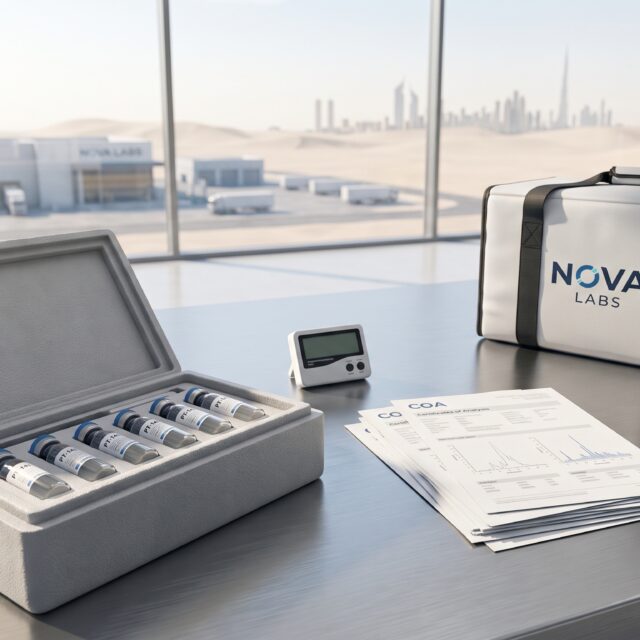
A valid COA binds the HPLC and MS data to a specific, traceable batch number. It should also include the date of manufacture, specific storage recommendations, and visual appearance checks. Interestingly, due to the copper ion, authentic lyophilised GHK-Cu naturally presents as a distinct blue-tinted puck or powder, unlike most peptides which are stark white. Never accept a heavily redacted COA or a generic document lacking a verifiable, independent testing laboratory letterhead.
Beating the Desert Heat: The Necessity of Cold-Chain Logistics
The ambient climate in the UAE introduces a severe, unique risk to peptide structural integrity. Lyophilised peptides are generally stable at room temperature for short periods; however, the ambient heat of the GCC region can easily exceed 40°C in transit vehicles, airport tarmacs, and sorting facilities. Prolonged exposure to extreme temperatures accelerates peptide degradation, rendering the compound inert, denatured, or structurally compromised before it even reaches the laboratory bench.
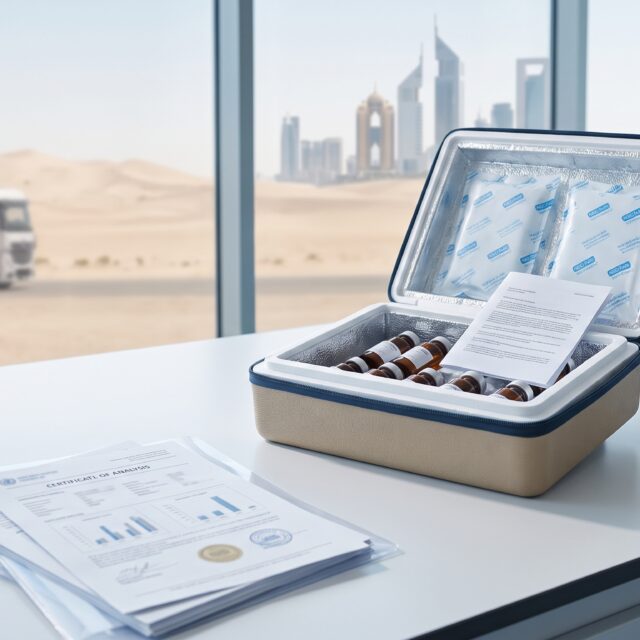
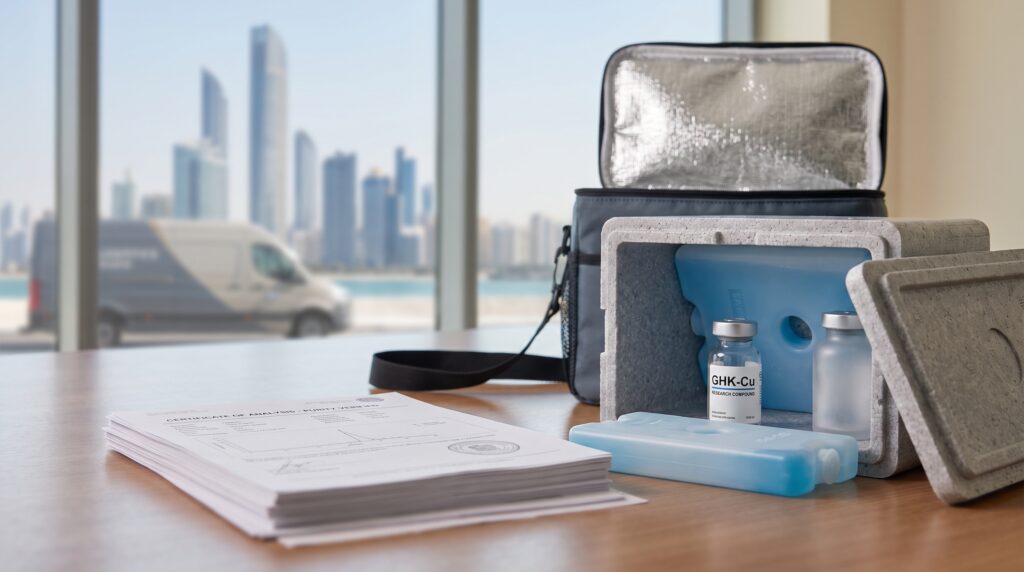
To protect the molecular integrity of GHK-Cu, temperature-controlled transit is absolutely non-negotiable. Leading UAE suppliers utilise specialised insulated packaging paired with medical-grade cold packs to maintain an optimal thermal environment during the ‘last mile’ of transit.
This is why local logistics play such a crucial role. By opting for UAE next day delivery, researchers in Abu Dhabi bypass the prolonged transit times (often 1-3 weeks) of global shipping. Domestic cold-chain dispatch ensures that the peptide transitions from a climate-controlled storage facility directly to the destination laboratory in under 24 hours, completely preserving its chemical stability and research viability.
Evaluating Vendor Support and Operational Transparency
Beyond product purity and logistics, the modern UAE procurement experience is defined by supplier responsiveness, transparency, and operational security. When vetting a GHK-Cu supplier, evaluate their communication infrastructure and payment flexibility.
Customer support expectations in the GCC are strongly centred on immediate, mobile-first communication. The most reliable vendors offer dedicated, hyper-localised WhatsApp support channels. This allows procurement teams to quickly verify batch numbers, request Material Safety Data Sheets (MSDS), or confirm exact delivery windows in real-time, rather than waiting 48 hours for an email reply from an overseas vendor.
Additionally, secure and flexible payment options are a strong indicator of vendor legitimacy and domestic presence. Suppliers offering Cash on Delivery (COD) across Abu Dhabi demonstrate profound confidence in their local stock availability and logistics network. This provides an extra layer of financial security for buyers evaluating a new source, ensuring payment is only exchanged once the physical product is delivered.
Sourcing Your Supply with NOVA Labs
For researchers and laboratory directors evaluating their supply chain, NOVA Labs provides a streamlined, highly transparent procurement solution designed specifically for the rigorous demands of the UAE market. Recognising the strict compliance and quality demands of regional laboratories, NOVA Labs ensures that all research compounds meet uncompromising purity standards, backed by easily accessible third-party documentation.
By holding domestic stock, NOVA Labs eliminates customs delays and leverages robust cold-chain logistics to safeguard product integrity across the Emirates. Researchers can confidently procure high-purity GHK-Cu knowing every vial is dispatched locally, supported by rapid WhatsApp customer service, and eligible for seamless next-day delivery directly to Abu Dhabi facilities.
Conclusion: Secure Your Research Pipeline Today
Securing high-quality research materials in the UAE requires a strategic approach that prioritises local availability, proven chemical integrity, and transparent testing. When setting out to buy GHK-Cu in Abu Dhabi, successful procurement strategies rely on domestic suppliers who guarantee structural integrity through cold-chain logistics, eliminate customs friction, and prove chemical purity through batch-specific HPLC and MS testing. By insisting on unredacted COAs and leveraging local next-day delivery, researchers can ensure their in-vitro projects remain accurate, compliant, and on schedule. Ready to streamline your laboratory procurement? Browse our catalog of fully tested, research-grade peptides today to secure reliable, next-day UAE delivery.
Disclaimer: The products mentioned in this article are for in-vitro research purposes only and are not intended for human consumption, diagnostic, or therapeutic use. Handle all research compounds in compliance with standard laboratory safety protocols.
*
References
- UAE Ministry of Health and Prevention (MOHAP) / Emirates Drug Establishment (EDE). (2023). Federal Decree-Law No. 68 on Pharmaceuticals and Medical Products.
- Pickart, L., & Margolina, A. (2018). Regenerative and Protective Actions of the GHK-Cu Peptide in the Light of the New Gene Data. International Journal of Molecular Sciences, 19(7), 1987.
- Standard Operating Procedures for High-Performance Liquid Chromatography (HPLC) Verification in Scientific Sourcing. Laboratory best practices guide for peptide quantification.
- Guidelines on Peptide Storage, Lyophilization, and Cold-Chain Logistics for Research Compounds in Extreme Climates.
- Are Research Peptides Legal in the UAE? Complete Compliance – NOVA Labs
- GHK-Cu Copper Peptide UAE | Cosmetic Research
- Buy GHK-Cu UAE — Copper Peptide Serum for Skin Research in Dubai
- Peptide Testing Laboratory in UAE | Purity & Safety Testing – METS Lab Abu Dhabi
- Peptide Therapy in Dubai & Abu Dhabi | DNA Health and Wellness
Frequently asked questions
Is GHK-Cu legal to buy for research in Abu Dhabi?
Yes, GHK-Cu is legal to purchase in Abu Dhabi strictly for in-vitro scientific research and laboratory study. Under EDE regulations, it is heavily regulated and entirely unauthorised for human consumption or unprescribed therapeutic use.
Why is local UAE delivery important for GHK-Cu peptides?
Local delivery bypasses international customs seizures and drastically reduces transit time. This allows suppliers to utilise cold-chain logistics (like insulated packaging and ice packs) to protect the peptide from extreme Middle Eastern heat, ensuring structural integrity upon arrival.
What purity percentage should research-grade GHK-Cu have?
Research-grade GHK-Cu should demonstrate a minimum purity of 98% to 99%. This strict purity standard must be verified through third-party High-Performance Liquid Chromatography (HPLC) testing to ensure accurate and uncontaminated in-vitro baseline data.
How can I verify the quality of a peptide supplier in the UAE?
A reliable UAE supplier will proactively provide downloadable Certificates of Analysis (COAs), HPLC test results, and MS data for their current batches. Top local vendors will also offer responsive communication channels like WhatsApp and secure local payment options, such as Cash on Delivery (COD).
What does lyophilised GHK-Cu look like?
Unlike most peptides which present as a white powder, authentic lyophilised GHK-Cu naturally presents as a distinct blue-tinted puck or powder due to the presence of the copper(II) ion in its molecular structure.
Nova Labs buyer tools
Ready to verify stock, testing and delivery?
Use the product page and lab report section to check availability, documentation, delivery timing and support before placing an order.
- COA / test-report checks
- Abu Dhabi delivery context
- Cold-chain handling
- COD and card payment options
- WhatsApp support