
Quick Buyer Checklist:
- Purity: Demand batch-specific HPLC and Mass Spectrometry (MS) testing showing >99% purity.
- Logistics: Ensure the supplier uses insulated mailers and gel packs for regional climate protection.
- Delivery: Prioritize local GCC suppliers to avoid lengthy international customs delays and thermal degradation.
- Support: Look for responsive local customer service and secure payment methods like Cash on Delivery (COD).
Where to Buy TB-500 GCC: Sourcing and Evaluating Suppliers
To safely buy TB-500 in the GCC, researchers must source from local distributors offering third-party HPLC testing, batch-matched Certificates of Analysis, and climate-controlled shipping. Premium regional suppliers use insulated packaging to maintain lyophilized peptide stability, preventing the degradation often caused by international customs delays.
Acquiring high-quality reference materials in the Middle East requires moving past superficial marketing claims and looking directly at procurement logistics. Whether you are a laboratory procurement officer or an informed buyer researching cellular movement, understanding the operational standards of top-tier local suppliers is critical. The regional market for TB-500 (Thymosin Beta-4) is heavily driven by high-performance cellular research, and buyers in the UAE, Saudi Arabia, and the broader Gulf require rapid, high-purity validation.
Historically, GCC laboratories had to rely on overseas suppliers based in the US or Europe. While these international vendors may offer quality products, the shipping logistics present a massive risk. International shipments can sit in unconditioned customs warehouses for weeks, exposing sensitive peptides to extreme heat and effectively destroying the molecular integrity of the compound before it ever reaches the lab bench. Today, informed buyers are increasingly turning to locally stocked suppliers. This strategy ensures that the time from dispatch to the laboratory bench is minimized, protecting your research investment.
The GCC Temperature Shield: Why Cold-Chain Delivery Matters
One of the most significant challenges for the regional peptide market is the extreme local climate. Lyophilized (freeze-dried) peptides are generally stable at room temperature for short durations, but prolonged exposure to the intense heat typical of the Gulf summer can cause accelerated degradation and loss of efficacy.
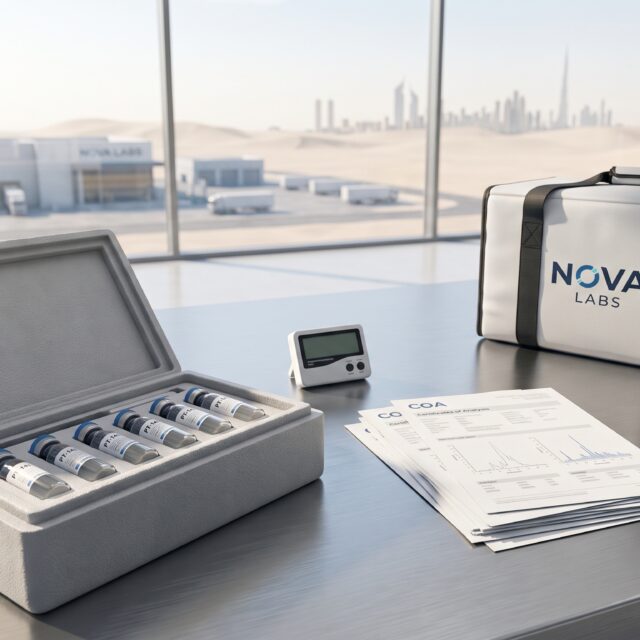
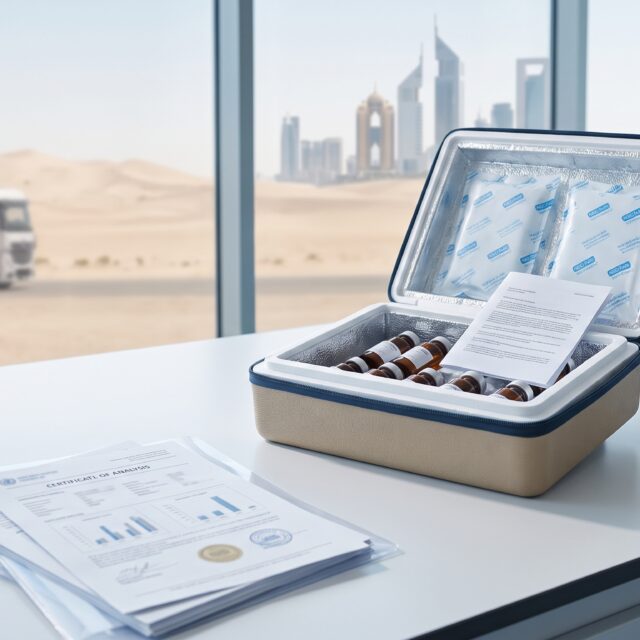
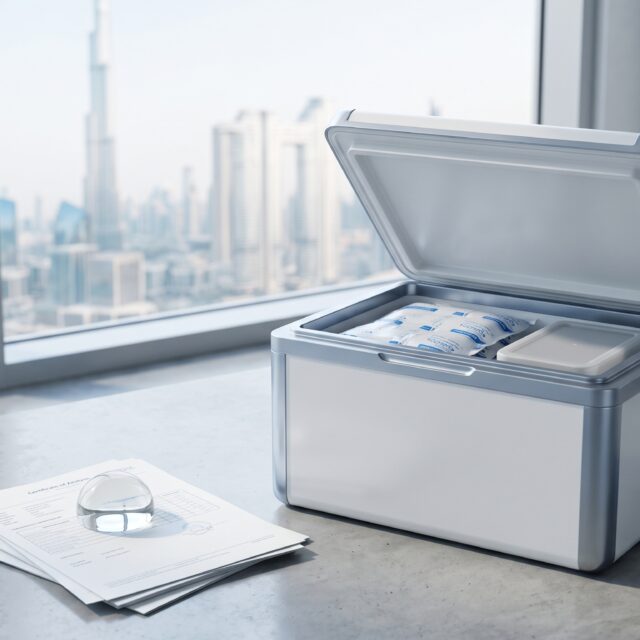
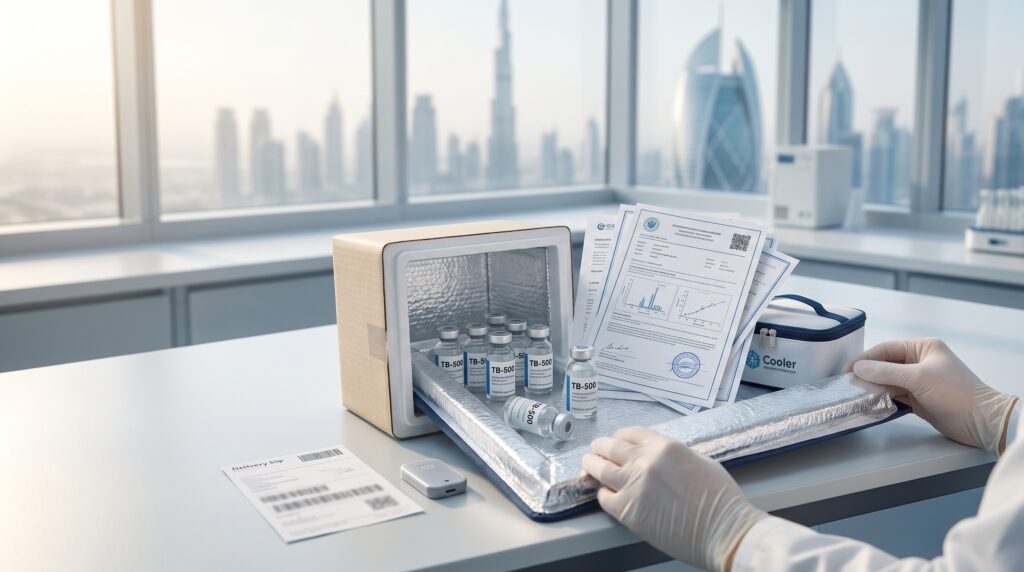
When evaluating where to order research reagents, buyers must inquire about a supplier’s fulfillment infrastructure. Premium distributors do not ship research materials in standard unlined envelopes. Instead, active cold-chain fulfillment is employed. This involves packing vials inside specialized insulated mailers accompanied by gel packs or temperature-stabilizing materials designed to maintain a stable microclimate during transit.
By leveraging localized logistics, top-tier suppliers ensure that the compound spends less than 24 hours in transit within the Emirates. For example, utilizing next-day delivery in the UAE means your reagents bypass the thermal risks associated with prolonged shipping. For the broader GCC, such as Saudi Arabia, Oman, or Qatar, expedited 2 to 5-day shipping windows using temperature-controlled logistics prevent the research reagents from sitting on hot tarmacs. If a vendor cannot confidently explain their climate-adapted shipping protocols, they are not equipped to serve the Middle Eastern market.
Validating Purity: How to Read a Real HPLC Report
The most vital step before procuring reference materials is verifying purity through proper documentation. Authentic suppliers strictly market TB-500 as an in-vitro research reagent, and their primary proof of quality is the Certificate of Analysis (COA).
A valid COA is not a generic, templated document downloaded from a manufacturer’s website; it must be batch-specific. It relies on High-Performance Liquid Chromatography (HPLC) and Mass Spectrometry (MS) testing conducted by an independent, third-party laboratory. When reviewing these reports, buyers should look for a purity level exceeding 99%.
How do you read the report? The HPLC graph should display a single, sharp, dominant peak indicating the isolated presence of Thymosin Beta-4. If you see multiple jagged peaks, a wide base, or a “smudged” graph, this suggests the presence of impurities, residual manufacturing solvents, or cross-contamination from other synthesis processes. Furthermore, diligent procurement staff should cross-reference the batch number on the downloadable COA with the physical batch number printed on the vial itself. This transparency ensures that the testing data provided matches the exact product delivered to your laboratory.
Understanding TB-500 in High-Performance Research
To understand why purity is so heavily scrutinized, it is helpful to look at how TB-500 is utilized in research settings. TB-500 is a synthetic version of Thymosin Beta-4, a naturally occurring peptide consisting of 43 amino acids that plays a critical role in cellular function and tissue architecture.
In laboratory environments, researchers study TB-500 for its unique ability to upregulate actin, a vital cellular protein essential for cell structure, mobility, and movement. Actin comprises up to 10% of the total protein in non-muscle cells, making it a primary target for structural research. In-vitro studies often examine how this compound influences cellular migration pathways, angiogenesis (the formation of new blood vessels), and endothelial cell differentiation.
Because these experiments require precise molecular interactions to track cellular behavior accurately, even minor impurities in a test sample can severely skew research data. A 95% pure peptide might introduce 5% of unknown trifluoroacetic acid (TFA) salts or truncated peptide chains into the petri dish, causing unintended cellular reactions that invalidate the entire study. This makes the procurement of verified, ultra-pure reference materials a foundational requirement for any credible scientific endeavor.
Hyper-Local Logistics, Payment, and Support Expectations
Beyond product quality, the operational reliability of a local supplier network dictates the buyer experience. In the past, researchers had to rely on international wire transfers or cryptocurrency to order from overseas laboratories. This often left buyers with little recourse if a shipment was seized by customs, lost in transit, or arrived damaged.
Today, hyper-local logistics have transformed the landscape. High-ranking local suppliers offer Cash on Delivery (COD) options, which remains one of the most trusted payment methods in the UAE and Saudi Arabia. COD eliminates financial risk for the buyer, ensuring payment is only exchanged when the physical product is safely in hand.
Additionally, the best GCC peptide brands have modernized their customer support. Instead of waiting days for an email reply across different time zones, researchers can now access concierge support via WhatsApp. This allows for near-instantaneous communication regarding technical queries, bulk order discounts, stock checks, batch documentation verification, and real-time shipping status updates.
Storage Protocols Following Delivery
Once logistics deliver the product safely to your facility, the responsibility for maintaining compound stability shifts to the researcher. Proper storage of lyophilized peptides is crucial to extending their shelf life and ensuring consistent research outcomes over time.
Upon receiving the insulated package, the unconstituted vials should be transferred immediately to a cold environment. For short-term storage (several weeks to a few months), a standard laboratory refrigerator at 2°C to 8°C is sufficient and prevents degradation. For long-term preservation (up to 24 months), storing the lyophilized powder in a freezer at -20°C or lower is highly recommended.
When it comes time to utilize the reagent for an assay, researchers must reconstitute the powder using bacteriostatic water or sterile saline, depending on the specific in-vitro protocol requirements. Once reconstituted, the molecular bonds of the peptide become significantly more fragile. The solution must be kept refrigerated at all times and typically degrades if not utilized within 21 to 28 days.
Final Purchasing Checklist & Where to Order
Sourcing high-quality peptides in the Middle East requires a strategic approach to evaluating vendors. Before finalizing any procurement decision, buyers should run through a strict checklist:
- Verify that the vendor provides downloadable, batch-specific HPLC and MS testing reports.
- Ensure the supplier explicitly guarantees a purity level of 99% or higher.
- Confirm the use of insulated mailers and gel packs to combat extreme GCC temperatures.
- Check for fast, hyper-local delivery networks (overnight for UAE, 2-5 days for GCC).
- Look for transparent payment methods like Cash on Delivery (COD) and accessible support.
For researchers and informed buyers ready to secure reliable, laboratory-grade reagents, choose a partner that meets all these criteria. To streamline your procurement process, you can confidently buy TB-500 directly from NOVA Labs. By combining rigorous third-party testing with climate-adapted fulfillment, we guarantee the purity and stability required for high-level cellular research.
Disclaimer: The products mentioned in this article are strictly for in-vitro research and laboratory use only. They are not intended for human consumption, diagnostic, therapeutic, or agricultural purposes.
References
- Philp, D., et al. (2004). “Thymosin beta4 promotes angiogenesis, wound healing, and hair follicle development.” Annals of the New York Academy of Sciences.
- Goldstein, A. L., et al. (2012). “Thymosin β4: actin-sequestering protein moonlights to repair injured tissues.” Trends in Molecular Medicine.
- Huff, T., et al. (2001). “Beta-thymosins, small acidic peptides with multiple functions.” The International Journal of Biochemistry & Cell Biology.
Disclaimer: The products mentioned in this article are for research purposes only and are not intended for human consumption.
- Shipping & Returns – Peptides DXB
- TB-500 – Emirates Peptides
- pipdxb.ae
- TB-500 Research Peptide UAE | COA-Backed
- Peptides Compounding Pharmacy Dubai – CureCell
Frequently asked questions
Where can I safely buy TB-500 in the GCC?
You can purchase TB-500 in the GCC from reputable, locally stocked suppliers like NOVA Labs that provide third-party HPLC testing, batch-specific COAs, and temperature-controlled shipping to ensure compound stability.
Why is cold-chain shipping necessary for peptides in the Middle East?
The extreme ambient heat in the GCC can rapidly degrade lyophilized peptides. Cold-chain shipping using insulated mailers and gel packs preserves the molecular integrity of the compound during transit, which is why local sourcing is preferred over international shipping.
How can I verify the purity of my TB-500 peptide?
Always check the supplier's Certificate of Analysis (COA). A legitimate COA will feature batch-specific High-Performance Liquid Chromatography (HPLC) and Mass Spectrometry (MS) testing demonstrating a purity level greater than 99%.
How long does peptide delivery take in the UAE and GCC?
Top-tier local suppliers offer overnight or next-day delivery within major UAE cities, while shipping to Saudi Arabia, Oman, Qatar, and the broader GCC typically takes 2 to 5 business days using climate-controlled logistics.
How should I store TB-500 once it is delivered?
Lyophilized TB-500 should be stored in a refrigerator (2°C to 8°C) for short-term use, or in a freezer (-20°C) for long-term preservation. Once reconstituted with bacteriostatic water, it must remain refrigerated at all times.
Nova Labs buyer tools
Ready to verify stock, testing and delivery?
Use the product page and lab report section to check availability, documentation, delivery timing and support before placing an order.
- COA / test-report checks
- GCC delivery context
- Cold-chain handling
- COD and card payment options
- WhatsApp support