


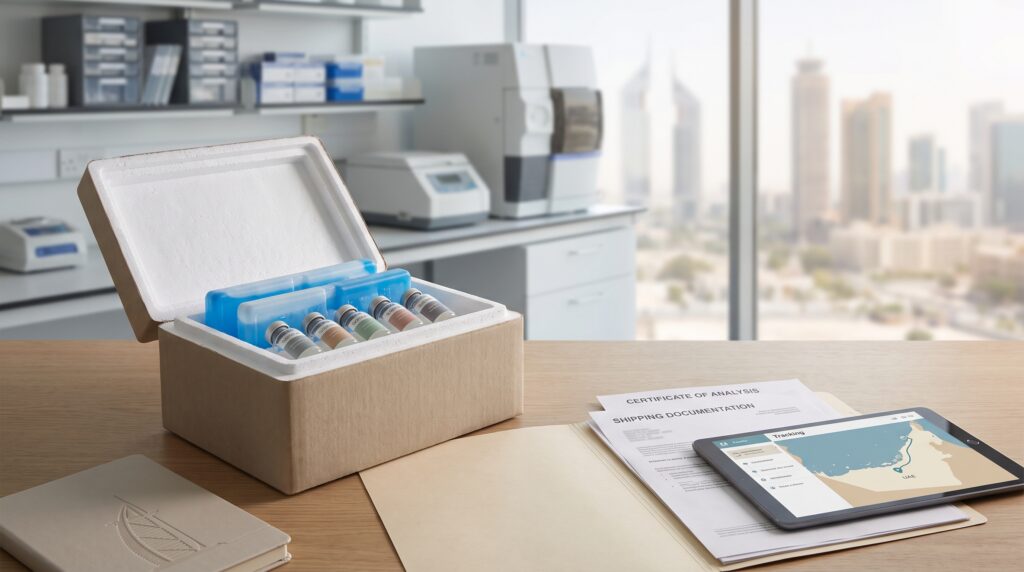
Navigating the procurement of research compounds in the UAE requires a rigorous approach to quality control. With heightened scrutiny on local grey-market vendors and social media sellers, identifying legitimate, properly tested products is essential for maintaining research integrity. For procurement staff and informed buyers, knowing exactly how to spot fake peptides dubai is the first step in avoiding underdosed, contaminated, or completely counterfeit vials.
How To Spot Fake Peptides Dubai: The Complete Buyer Checklist
Quick Answer: To spot fake peptides in Dubai, buyers must demand independent, verifiable Certificates of Analysis (COAs) featuring HPLC and Mass Spectrometry data. Additionally, researchers should verify that vial batch numbers match the documentation, inspect the physical lyophilized puck, and ensure the supplier utilizes local temperature-controlled cold-chain logistics.
The UAE peptide landscape has shifted significantly over recent years. Following the establishment of the Emirates Drug Establishment (EDE) as the centralized regulatory authority for pharmaceutical and chemical oversight, local authorities have launched extensive crackdowns on unapproved peptide sources. These initiatives specifically target unauthorized sellers and local social media influencers who promote unregulated, potentially dangerous products.
This regulatory action highlights a critical reality: the informal market is flooded with substandard products. Metabolic research peptides, growth hormone secretagogues, and other trending compounds are particularly vulnerable to counterfeiting due to high demand and complex manufacturing processes. Authentic sourcing requires looking far past glossy marketing claims and systematically auditing the tangible proof of a compound’s purity, identity, and logistics.
Mastering the Certificate of Analysis (COA) Audit
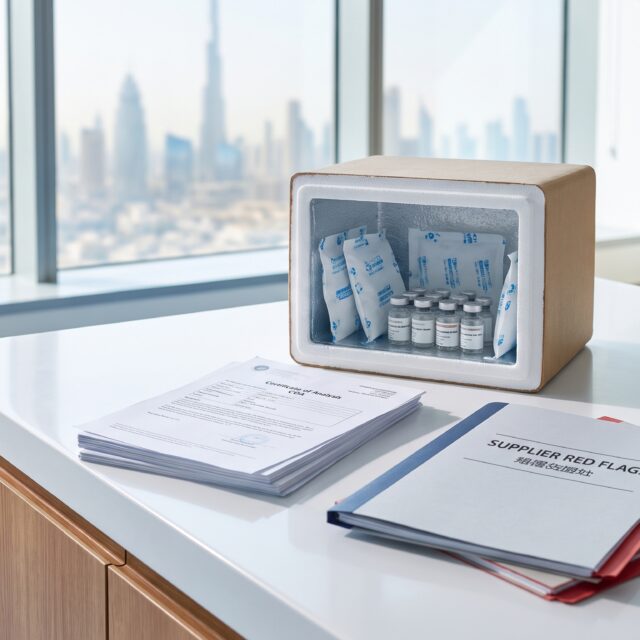
The single most important document a supplier can provide is the Certificate of Analysis (COA). However, counterfeiters frequently forge these documents to mimic legitimate laboratory results. A legitimate COA must be issued by a reputable, independent third-party testing laboratory (such as Janoshik Analytical or an ISO-accredited equivalent). In-house testing reports hold zero objective weight in the research community, as they represent a massive conflict of interest.
When reviewing a COA to authenticate your compounds, buyers should evaluate three distinct aspects of the analysis:
High-Performance Liquid Chromatography (HPLC)
HPLC testing determines the purity of the compound by separating its components. Legitimate research peptides should demonstrate a purity level of 99 percent or higher. The HPLC report will include a chromatogram—a visual graph showing a large main peak corresponding to the target peptide, alongside smaller peaks representing impurities, byproducts, or remaining solvents.
Fake COAs often feature AI-generated or photoshopped graphs with unnaturally smoothed peaks, perfectly flat baselines, or missing solvent peaks, which do not reflect real-world analytical chemistry. Real chromatograms show minor baseline noise and realistic peak asymmetry, reflecting authentic machine readings.
Mass Spectrometry (MS)
While HPLC confirms purity, Mass Spectrometry confirms the exact chemical identity by measuring the precise molecular weight of the compound. A counterfeit vial could theoretically contain 99 percent pure mannitol (a common, cheap filler) and pass an HPLC test if the laboratory is only looking for a single peak. The MS report proves that the molecular structure inside the vial matches the specific sequence of the peptide you ordered.
Spotting Forged Documentation
Counterfeiters frequently recycle old COAs or steal them from legitimate vendors. To verify authenticity, buyers must check for a unique report ID or a scannable QR code that links directly to the testing laboratory’s secure, independent database. If the QR code is missing, blurry, or leads to a generic homepage instead of the specific test report, the document is almost certainly forged. Additionally, the batch or lot number printed on your physical vial must perfectly match the batch number listed on the COA. If it does not, you cannot guarantee the test applies to your product.
Physical Vial Inspection: What Authentic Lyophilized Peptides Look Like
Before initiating any research protocol, a physical inspection of the vial can reveal a lot about the manufacturing standards of the supplier.
Authentic research peptides are typically sold as lyophilized (freeze-dried) powder. A high-quality lyophilization process usually results in a solid, uniform “puck” or a stable, web-like cake at the bottom of the vial. While transit can sometimes break this puck into smaller chunks, it should not look like loose crystalline table salt.
Furthermore, when reconstituting the peptide with bacteriostatic water, a properly sealed, pharmaceutical-grade vial will often have a vacuum inside. When you pierce the rubber stopper with a needle, the negative pressure should naturally draw the diluent into the vial. If there is no vacuum, it may indicate a compromised seal, which can introduce moisture and bacteria, rapidly degrading the peptide. Finally, the reconstituted solution should be completely transparent and free of any floating particulate matter. Cloudiness is a major red flag for contamination or severe degradation.
Dubai’s Heat vs. Peptide Integrity: The Logistics Test
Beyond lab documentation and physical appearance, supply chain logistics serve as a critical indicator of a vendor’s legitimacy. Research peptides are complex amino acid chains held together by fragile peptide bonds. They are highly sensitive to UV light, excessive agitation, and, most importantly, temperature fluctuations.
During the UAE summer, ambient temperatures routinely exceed 35 to 45 degrees Celsius. If a supplier ships internationally using standard postal routes without cold-chain packaging, the compound will almost certainly denature and degrade before it arrives at your laboratory. Grey-market sellers operating out of anonymous overseas warehouses rarely invest in temperature-controlled shipping, prioritizing cheap freight over scientific integrity.
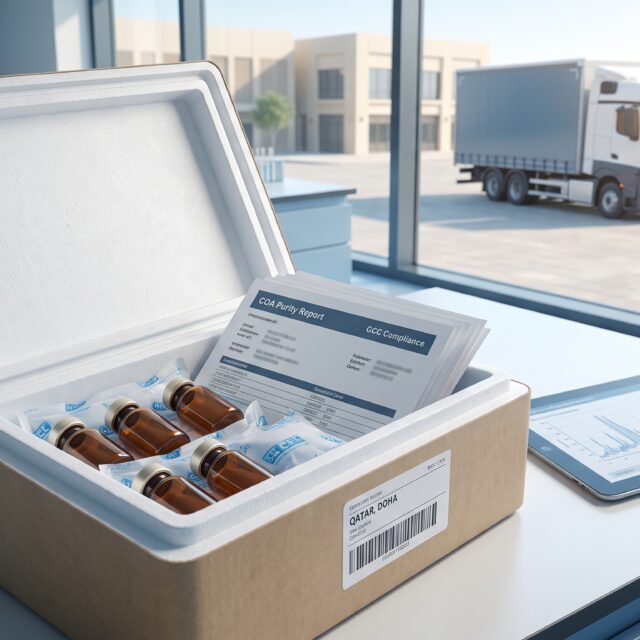
A transparent, legitimate supplier operating in the GCC will explicitly outline their cold-chain logistics. By maintaining local inventory and utilizing insulated packaging combined with clinical-grade ice packs, professional suppliers protect the fragile molecular structure of the peptides from factory to bench.
For time-sensitive research, transit time is a major variable. Utilizing same-day delivery options in Dubai ensures that compounds spend the absolute minimal time in transit, transitioning swiftly from climate-controlled storage facilities directly to your laboratory refrigeration units.
Warning Signs: Payment and Supplier Communication
Operational transparency is a hard dividing line between legitimate chemical suppliers and fraudulent operations. Recent EDE crackdowns emphasize the immense risks of purchasing from unregulated social media accounts and anonymous messaging platforms.
If a vendor mandates communication exclusively through disappearing messages on Telegram, Signal, or WhatsApp, and refuses to provide a centralized, secure website, buyers should immediately step away. Similarly, while cryptocurrency can be a valid alternative payment method in the digital age, a vendor that only accepts crypto, direct peer-to-peer wire transfers, or unstructured cash-on-delivery without providing professional, itemized invoicing is operating outside standard commercial parameters.
Professional peptide suppliers offer clear contact information, responsive technical support, structured merchant checkouts with standard card processing, and visible terms of service. They explicitly sell compounds for laboratory use and do not hide behind anonymous handles or pressure buyers with aggressive, hype-driven sales tactics or illegal human-use dosage guidelines.
Secure Sourcing in the UAE Market
Evaluating a supplier requires looking at their entire operational footprint. A vendor’s ability to supply verifiable, third-party tested compounds is only half the equation; their capacity to deliver those compounds safely within the UAE’s specific environmental constraints is equally important.
When comparing sources in the Middle East, prioritize those that offer:
- Publicly accessible, independently verifiable COAs (HPLC and MS) for every batch.
- Clear, upfront policies on cold-chain packaging and local delivery timelines.
- Secure, standard e-commerce infrastructure rather than informal peer-to-peer messaging deals.
- Properly sealed, professional vials featuring distinct batch numbers and manufacturing dates.
- A comprehensive catalog of research compounds clearly marked for in-vitro laboratory use, completely devoid of unverified medical claims or human dosage recommendations.
By insisting on these non-negotiable standards, researchers can confidently source the materials necessary for their scientific work, avoiding the financial and empirical pitfalls of the counterfeit market.
To explore a catalog of rigorously tested, locally stocked compounds that adhere to the highest standards of quality control, researchers can browse our complete shop to review available inventory and download corresponding batch documentation.
Disclaimer: The products mentioned in this article are for research purposes only and are not intended for human consumption, diagnosis, or treatment. Always adhere to local regulations and institutional safety guidelines when handling laboratory chemicals.
References
- UAE Cracks Down on Unapproved Peptide Weight-Loss Drugs: 71 Sources and 14 Influencers Face Action – Gulf News
- Fake Ozempic warning as UAE patients turn to social media sellers for weight-loss injections
- Federal Decree-Law No. (38) of 2024 Governing Medical Products, Pharmacists and Pharmaceutical Establishments
- How to Spot a Fake Peptide COA: 5 Red Flags | Peptify UK
- How to Read a Peptide COA (Real vs Fake)
Frequently asked questions
How can I verify a peptide COA in the UAE?
To verify a Certificate of Analysis (COA), check for a unique report ID or a scannable QR code that links directly to the independent testing laboratory's secure database. Ensure the batch number on the report perfectly matches the batch number printed on your physical vial.
What does a fake peptide COA look like?
Fake COAs often feature AI-generated or heavily edited HPLC graphs with unnaturally smooth lines or perfectly flat baselines. They may also lack a verifiable QR code, fail to include Mass Spectrometry (MS) data, or be generated 'in-house' rather than by an independent third-party lab.
Why is cold-chain delivery important for peptides in Dubai?
Research peptides are delicate molecular structures sensitive to extreme heat and can degrade rapidly. Due to Dubai's high ambient summer temperatures, professional suppliers must use temperature-controlled cold-chain packaging, such as insulated mailers and ice packs, to protect compound integrity during transit.
What is the difference between HPLC and Mass Spectrometry in peptide testing?
High-Performance Liquid Chromatography (HPLC) measures the purity level of the peptide, checking for impurities or degradation byproducts. Mass Spectrometry (MS) measures the molecular weight of the compound to confirm its exact chemical identity, proving the vial contains the specific peptide sequence ordered.
What are the red flags of a fake peptide supplier?
Major red flags include the inability to provide verifiable third-party COAs, requiring communication exclusively through anonymous apps like Telegram, refusing to use local cold-chain shipping, providing dosage guidelines for humans, and relying solely on untraceable payment methods like cryptocurrency.
Nova Labs buyer tools
Ready to verify stock, testing and delivery?
Use the product page and lab report section to check availability, documentation, delivery timing and support before placing an order.
- COA / test-report checks
- Dubai delivery context
- Cold-chain handling
- COD and card payment options
- WhatsApp support