

The demand for high-quality research compounds across the GCC has grown rapidly, bringing with it an influx of substandard, mishandled, and outright counterfeit products. For laboratory procurement staff and independent researchers evaluating suppliers, understanding how to spot fake peptides UAE vendors distribute is now a critical skill. From cloned lab reports to cross-border extortion scams, the market requires buyers to be highly discerning.
Navigating this landscape means understanding the dual challenges of chemical verification and local logistics. Even a high-purity compound can be rendered useless by the extreme Gulf heat if shipped improperly. This guide breaks down exactly how to verify authenticity, read third-party lab reports, assess manufacturing quality, and avoid the most common supplier scams operating in the region.
Quick Answer: How to Spot Fake Peptides UAE
To spot fake peptides in the UAE, buyers must independently verify third-party Certificates of Analysis (COAs) through secure portals like Janoshik. Avoid international drop-shippers demanding fraudulent customs fees, and reject vendors who ship fragile compounds without verified cold-chain packaging tailored to extreme Gulf temperatures.
The UAE Market Landscape: Regulatory Action and Risks
Operating within the United Arab Emirates requires strict adherence to local laws. Under UAE regulations, peptides sold on the open market are strictly classified for Research Use Only (RUO). Clinical administration is only legal when formally prescribed and supervised within Dubai Health Authority (DHA) or Ministry of Health and Prevention (MOHAP) licensed facilities.
In recent years, the Emirates Drug Establishment (EDE) launched major enforcement actions against unregulated sources and social media influencers marketing unapproved peptide-based compounds online. This regulatory crackdown heavily targeted unregulated consumer-facing sales, pushing the legitimate research market to demand verifiable, independent testing and transparent supplier documentation.
When buying in the UAE, researchers must recognize that professional stockists do not frame their products for human consumption or unauthorized outcomes. Vendors making grand physiological claims, providing dosage instructions, or ignoring RUO classifications are often the exact same vendors cutting corners on product purity and safety.
Chemical Verification: How to Spot Fake Lab Reports
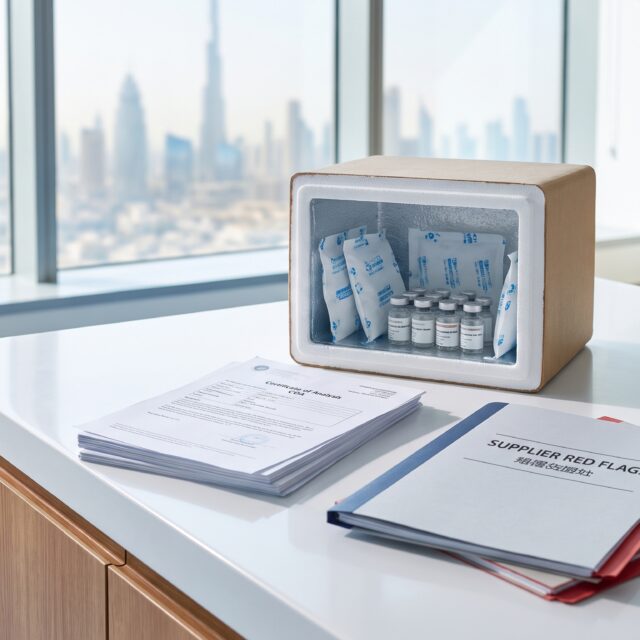
The most reliable way to authenticate a research peptide is through a third-party Certificate of Analysis (COA). However, fraudulent vendors frequently fake lab results using stolen documents, generic templates, or AI-generated chromatograms designed to mimic perfect testing peaks. Without rigorous verification, a piece of paper means very little.
HPLC vs. Mass Spectrometry (LC-MS)
A major red flag in the procurement process is a COA that only displays High-Performance Liquid Chromatography (HPLC) results. HPLC measures sample purity by separating the components of a mixture to see if unwanted byproducts are present. While a 99% purity peak is desirable, HPLC does not confirm the chemical identity of the substance itself.
A complete, trustworthy COA must feature dual-testing: HPLC for purity and Mass Spectrometry (such as LC-MS or MALDI-TOF) to verify the precise molecular weight of the sequence. If a vendor cannot prove both identity and purity, the product cannot be validated. A counterfeiter can easily provide an HPLC graph showing 99% purity of a completely unrelated, cheap filler powder.
Assessing TFA vs. Acetate Salts
Beyond basic purity, the quality of the synthesis process matters. Many cheap peptides are manufactured leaving high levels of Trifluoroacetic acid (TFA), a harsh byproduct of standard solid-phase peptide synthesis. High-quality laboratories perform a counter-ion exchange to replace the TFA with acetate. While this technical detail may not always appear on a basic COA, inquiring about TFA levels is a great way to test a vendor’s technical knowledge. Scammers and low-tier drop-shippers rarely know the difference.
The Janoshik Verification Walkthrough
Janoshik Analytical is a globally recognized standard for independent third-party peptide validation. Reputable vendors use Janoshik because their reports cannot be easily forged, provided buyers know how to check them.
When evaluating a supplier’s Janoshik COA, follow these verification steps:
- Locate the Task Number: Every legitimate Janoshik COA features a unique task or key number at the top of the report.
- Use the Direct Portal: Navigate independently to the official Janoshik verification website. Do not click links provided directly in the vendor’s PDF, as scammers sometimes link to cloned verification sites.
- Input the Code: Enter the task number into the search bar.
- Match the Data: The resulting digital file downloaded directly from Janoshik must match the vendor’s provided COA exactly—including the batch number, product name, date, and purity percentage. Counterfeiters often take a legitimate COA and photoshop the date or batch number. If the system returns no result, or the details differ in any way, the COA is fake.
Navigating Cross-Border Risks: The “Customs Hold” Scam
A prevalent issue facing GCC buyers is the “customs insurance” extortion scam, orchestrated heavily by international drop-shippers. Because importing research peptides directly from international sellers carries a high risk of customs seizure at the UAE border, scammers exploit this friction.
The scam typically operates in three phases:
- The Hook: An international vendor offers research compounds at prices significantly below market value, promising easy delivery to Dubai or Abu Dhabi.
- The Hold: Shortly after “shipping,” the buyer receives a fraudulent email claiming the package has been seized by UAE customs.
- The Extortion: The vendor or fake logistics company demands an immediate payment—often upwards of 800 USD—for a fake “customs clearance fee” or “import insurance,” promising a refund upon delivery.
Once the fee is paid, the vendor disappears. Legitimate customs authorities do not operate this way. Procuring from established local stockists who handle bulk importation and domestic fulfillment entirely bypasses international clearance issues and protects your laboratory budget.
The Impact of Extreme Gulf Heat on Peptide Integrity
Spotting a bad supplier is not just about identifying fake chemistry; it is also about identifying poor logistics. The UAE’s extreme summer climate, where ambient temperatures regularly exceed 45 degrees Celsius, presents a massive hazard to delicate peptide bonds.
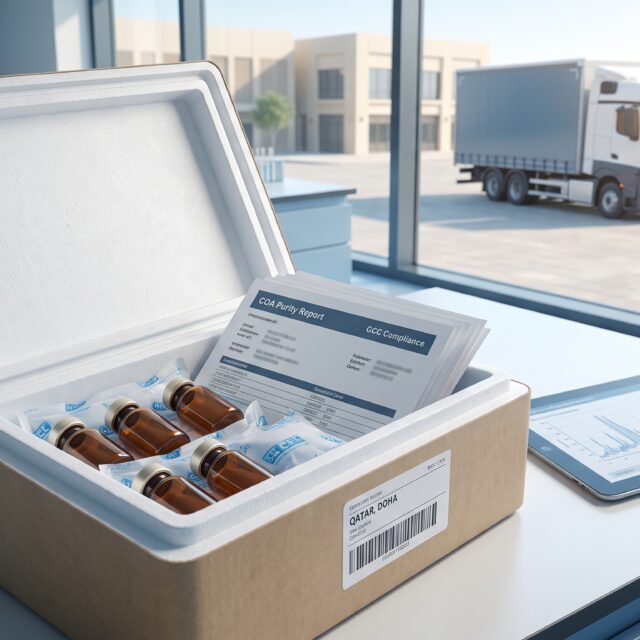
Research indicates that uncooled delivery vehicles in the GCC can reach internal temperatures exceeding 60 degrees Celsius. Even in a lyophilized (freeze-dried) state, prolonged exposure to these thermal extremes rapidly triggers peptide hydrolysis and aggregation, degrading the compound long before it reaches the laboratory. A vendor might start with a 99% pure product, but if they ship it via a standard multi-day postal mailer in August, the delivered product will be highly compromised and unfit for precise cellular assays.
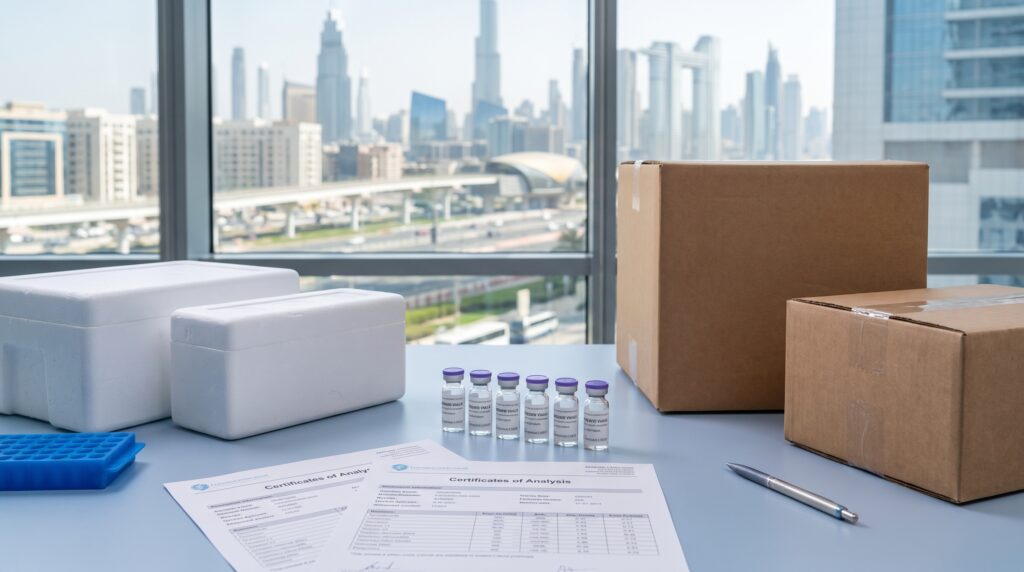
Reputable local suppliers view logistics as a core component of product quality. To maintain molecular stability, utilizing a service offering next-day cold-chain delivery in the UAE is strictly necessary for researchers who need their compounds to arrive intact. This involves insulated packaging, thermal gel packs, and rapid domestic dispatch.
Evaluating Local Support and Payment Infrastructure
Another critical metric for spotting illegitimate operations is the payment and support structure. Fly-by-night scammers typically operate anonymously via platforms like Telegram and demand payment exclusively through untraceable cryptocurrencies or suspicious international wire transfers.
Professional stockists operating legally within the region will offer secure, locally trusted payment gateways. The availability of Cash on Delivery (COD) is a particularly strong indicator of legitimacy, as it proves the vendor has local fulfillment infrastructure and physical inventory inside the UAE. Furthermore, having accessible communication channels, such as a localized WhatsApp support line for rapid logistical coordination, separates genuine businesses from fraudulent drop-shippers.
Practical Buyer Checklist for UAE Researchers
Before placing an order for laboratory supplies in the UAE, use this operational checklist to evaluate the supplier:
- Check for Janoshik COAs: Demand verifiable third-party testing that includes both HPLC and Mass Spectrometry. Cross-reference the batch numbers manually on the independent lab’s website.
- Verify Domestic Fulfillment: Ensure the vendor actually stocks the product inside the UAE to avoid cross-border extortion scams and lengthy customs delays.
- Demand Cold-Chain Logistics: Confirm that the supplier uses temperature-controlled packaging and rapid 1-day delivery to combat the local climate and prevent thermal degradation.
- Assess Support and Payment: Look for localized WhatsApp support and secure, transparent payment methods like Cash on Delivery (COD).
- Review the Framing: Reject vendors making medical claims, providing self-use dosing instructions, or selling heavily restricted retail compounds on the open RUO market.
Sourcing Authentic Research Compounds with NOVA Labs
Knowing how to spot fake peptides UAE suppliers might offer comes down to demanding transparency at every step of the procurement process. From the initial laboratory synthesis and independent testing to the final mile of delivery, quality control must be verifiable.
NOVA Labs provides UAE researchers with locally stocked, high-purity compounds backed by transparent, verifiable Janoshik analytical testing. By combining rigorous dual-testing (HPLC and LC-MS) with specialized cold-chain logistics and immediate domestic dispatch, we eliminate the friction of customs delays and the hazards of extreme heat degradation. When you are ready to secure validated compounds for your next project, explore our fully documented catalog and shop our current inventory with confidence.
Disclaimer: The products mentioned in this article are strictly for in-vitro research purposes only and are not intended for human consumption or medical application.
References
- D’Hondt, M., et al. (2011). “Related impurities in peptide medicines.” Journal of Pharmaceutical and Biomedical Analysis.
- Emirates News Agency (WAM). (2024). Public Health and Regulatory Updates on Medical Compounds and EDE Enforcement.
- Janoshik Analytical. (2024). Certificate of Analysis Verification Protocol.
- UAE Cracks Down on Unapproved Peptide Weight-Loss Drugs – Gulf News
- Peptide Vendor Scams: Red Flags & COA Checklist – NorthPeptide
- Cold-Chain Peptide Delivery and Stability in the UAE
- UAE Peptides: Dubai Buying Guide and Nova Labs Review (2026)
- How To Spot Fake Peptides Bahrain & UAE: COAs & Scam Guide – NOVA Labs
Frequently asked questions
How can I independently verify a peptide COA in the UAE?
You can verify a Certificate of Analysis by locating the unique task number on the document and entering it directly into the independent testing laboratory's official portal, such as the Janoshik Analytical website. The downloaded result must exactly match the vendor's provided batch number and purity percentage.
What is the customs hold scam for research peptides?
The customs hold scam occurs when fraudulent international vendors claim a package has been seized at the UAE border. They then extort the buyer, demanding large payments for fake 'import insurance' or 'clearance fees' which are never refunded.
Why is cold-chain shipping important for peptides in Dubai?
Extreme GCC summer temperatures, which can exceed 60 degrees Celsius inside uncooled delivery vehicles, rapidly degrade fragile peptide bonds through hydrolysis and aggregation. Cold-chain shipping with insulated packaging is mandatory to maintain the structural integrity of the compounds during transit.
Are research peptides legal to buy in the UAE?
Research peptides are legally permitted to be sold strictly for Research Use Only (RUO) and are not approved for human consumption on the open market. Clinical administration is only legal when explicitly prescribed and supervised by professionals in DHA or MOHAP-licensed medical facilities.
Nova Labs buyer tools
Ready to verify stock, testing and delivery?
Use the product page and lab report section to check availability, documentation, delivery timing and support before placing an order.
- COA / test-report checks
- UAE delivery context
- Cold-chain handling
- COD and card payment options
- WhatsApp support