
The Core Challenge: How to Store Peptides in Summer Heat
To store peptides in summer heat, keep unopened lyophilised vials in a manual-defrost freezer at -20°C for long-term archival. Before opening in high UAE humidity, allow vials to equilibrate at room temperature for 30 minutes to prevent condensation. Once reconstituted, store strictly refrigerated between 2°C and 8°C.
Operating a research facility or managing an independent laboratory in the United Arab Emirates comes with a unique set of logistical hurdles. Between June and September, ambient temperatures across the GCC routinely exceed 45°C (113°F). For researchers working with highly sensitive biomolecules, this intense climate presents a constant threat to compound integrity. Precise temperature management is not merely a best practice—it is an operational necessity to ensure that laboratory results are precise, accurate, and reproducible.
Understanding how to store peptides in summer heat requires looking beyond the thermostat setting. It involves understanding the physical vulnerabilities of the compounds themselves, managing the hidden threat of coastal humidity in cities like Dubai and Abu Dhabi, and utilizing strict handling protocols that prevent microscopic degradation before your experiments even begin.
Key Takeaways: UAE Buyer & Storage Checklist
- Cold Chain Focus: Always source from vendors using Phase Change Materials (PCMs) rather than basic dry ice for GCC transit.
- Verify Baseline Purity: Inspect HPLC and MS Certificates of Analysis (COAs) prior to storage to guarantee the compound wasn’t degraded in transit.
- The 30-Minute Rule: Never open a deeply frozen vial in a humid lab. Allow 30 minutes of room-temperature equilibration.
- Equipment Needs: Utilize manual-defrost freezers (-20°C) for long-term powder storage to avoid freeze-thaw cycles.
- Liquid Parameters: Reconstituted vials must remain in a stable refrigerator (2°C to 8°C) and should never be frozen.
The Physics of Degradation: What Heat Does to Peptides
Peptides are precisely sequenced chains of amino acids. Their biological functionality in in vitro research depends entirely on their structural shape remaining intact. When exposed to excessive heat, ultraviolet light, or unwanted moisture, these delicate molecular bonds begin to break down rapidly.
In the extreme climate of the Middle East, researchers must vigilantly guard against three specific molecular threats:
- Hydrolysis: The cleavage of chemical bonds by water. This is the single fastest way to destroy a peptide, often caused by invisible airborne moisture or premature exposure to humid air.
- Oxidation: A chemical reaction that alters specific amino acids (such as methionine or tryptophan), changing the molecule’s shape and rendering the compound biologically inactive.
- Deamidation: The removal of an amide group, a degradative pathway often accelerated by elevated temperatures and improper pH balances.
To mitigate these risks before shipping, professional suppliers stabilize peptides by freeze-drying them into a solid powder—a highly technical process known as lyophilisation. In this dormant state, the compounds are remarkably resilient. However, the moment that state is altered by temperature fluctuations or moisture absorption, the clock on their structural viability begins ticking.
The Condensation Trap: Navigating UAE Coastal Humidity
One of the most frequent mistakes made by buyers researching how to store peptides in summer heat is ignoring relative humidity. Coastal research hubs like Dubai, Sharjah, and Abu Dhabi experience intense summer humidity. When combined with intensely air-conditioned laboratories, this creates an invisible hazard known as the “condensation trap.”
Lyophilised peptide powder is incredibly hygroscopic, meaning it actively attracts and absorbs moisture from the surrounding environment. When you remove a vial from a -20°C freezer and immediately break the seal in a 24°C laboratory with 60% ambient humidity, airborne moisture instantly condenses on both the cold glass and the powder itself.
This microscopic moisture triggers instant hydrolysis, effectively destroying the molecular integrity of the batch before official reconstitution has even begun.
To prevent this, procurement staff and researchers must enforce the “30-Minute Warm-Up Rule.” When removing a vial from a deep freeze, it must be placed in a sealed desiccator—or left in its closed, temperature-resistant container on the benchtop—for a minimum of 30 minutes. The vial must fully equilibrate to room temperature before the airtight seal is broken. This ensures no condensation forms when the vial is finally exposed to the ambient air.
Lyophilised vs. Reconstituted: Two Distinct Storage Phases
The rules for handling these compounds change entirely depending on their physical state. A thorough storage protocol must clearly delineate the handling of dry powder from liquid solutions.
Storing Unopened, Lyophilised Vials
Unopened lyophilised vials should be catalogued and stored at -20°C for any long-term archival purposes. Under these precise conditions, powder stability can typically be extended for 24 to 36 months, depending on the complexity of the amino acid chain.
Crucially, these vials must be stored in a manual-defrost freezer. Standard laboratory or commercial auto-defrost freezers routinely cycle their temperatures above freezing to melt ambient ice buildup. This invisible cycle subjects the delicate biomolecules to constant, damaging freeze-thaw events, rapidly fracturing the chains. Always designate a static, manual-defrost unit exclusively for sensitive biochemicals.
Storing Reconstituted (Liquid) Peptides
Once a diluent—such as bacteriostatic water or sterile lab-grade solvent—is introduced, the peptide becomes highly fragile. Reconstituted liquid must never be frozen. Freezing liquid peptides creates microscopic ice crystals that physically shear the molecular bonds, rendering the compound completely useless for in vitro research.
Liquid solutions must be kept strictly refrigerated between 2°C and 8°C. In this state, most compounds will maintain baseline stability for approximately 14 to 28 days, though specific degradation curves vary by specific compound sequence. Keep the vials upright, store them away from the refrigerator door (which fluctuates wildly in temperature upon opening), and ensure they are thoroughly shielded from direct light.
Surviving UAE Transit: The Reality of Cold-Chain Logistics
A paramount concern among local researchers is the transit period itself. If extreme heat destroys biomolecules, how can they safely arrive at a laboratory in Dubai or Riyadh during August?
The answer lies in the resilience of the lyophilised state combined with highly advanced cold-chain logistics. While prolonged exposure to heat is detrimental, freeze-dried powder can withstand short transit durations (up to 40°C for a few days) without meaningful degradation. However, professional suppliers do not rely on this baseline resilience alone to cross the GCC.
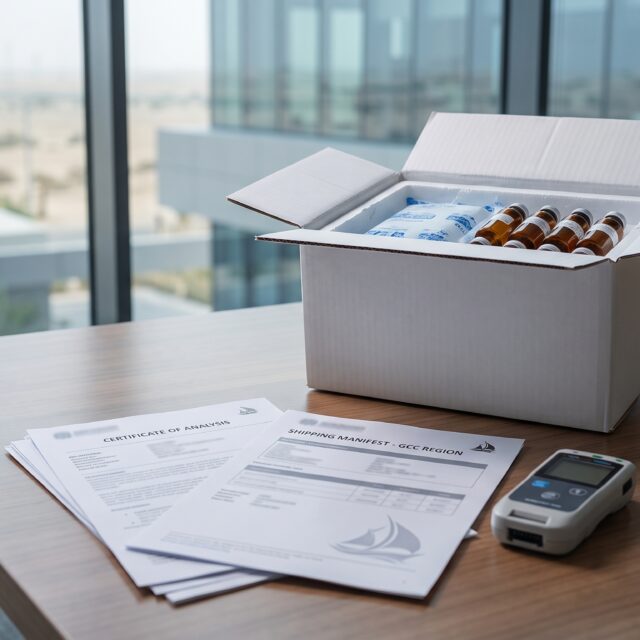
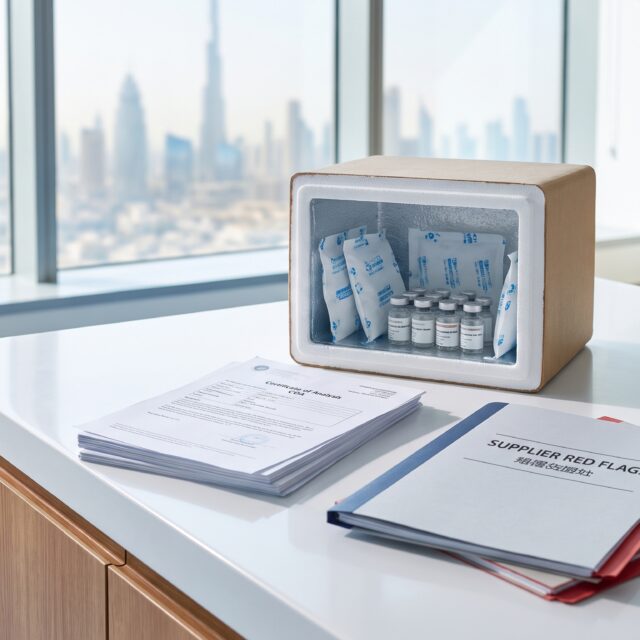
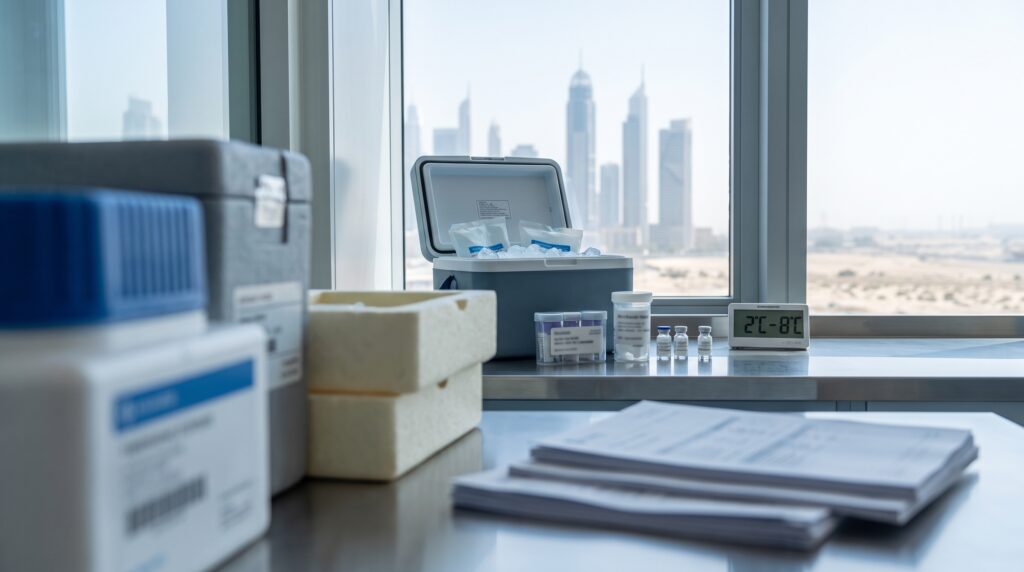
When importing compounds internationally, customs delays at Dubai International Airport (DXB) or King Khalid International Airport (RUH) can leave packages sitting on hot tarmacs for days. To survive the harsh Middle Eastern climate, specialized logistics are required. This involves the use of Phase Change Materials (PCMs) rather than standard dry ice. PCMs are engineered thermal panels designed to hold an exact internal temperature range (usually 2°C to 8°C) for extended periods without freezing the product.
When evaluating a supplier, it is vital to secure domestic, locally stocked biomolecules from suppliers offering immediate GCC dispatch. Local stock eliminates international customs delays and ensures your cold-chain remains unbroken.
Verifying Baseline Purity Before Storing
No flawless storage protocol can save a compound that arrives at your laboratory already degraded. Before implementing a strict cooling regimen, careful researchers must first establish the unquestionable baseline purity of the batch they are cataloguing.
This is where transparent documentation becomes the buyer’s strongest tool. Sourcing materials from suppliers who provide independent, batch-specific Certificates of Analysis (COAs) is critical. Leading analytical laboratories perform High-Performance Liquid Chromatography (HPLC) and Mass Spectrometry (MS) to verify the exact purity percentage and molecular weight of the vial’s contents.
By carefully checking these documents, you confirm that the compound has not suffered thermal degradation prior to arriving at your facility. We strongly encourage all procurement teams to verify baseline purity through our lab results page to understand the uncompromising standard of transparency required in this industry.
Secure Sourcing and Conclusion
Understanding how to store peptides in summer heat is a critical competency for any laboratory operating in the UAE. The unique combination of intense ambient temperatures and high coastal humidity requires a strict adherence to cold-chain logistics, proper manual-defrost freezer selection, and patient handling protocols like the 30-minute warm-up rule.
By ensuring your compounds remain stable from the moment of dispatch to the moment of reconstitution, you protect the structural integrity of your samples and the validity of your research data.
A credible regional partner is essential for maintaining this chain of quality. Look for suppliers who offer transparent HPLC testing, reliable local delivery insulated from extreme conditions, and modern B2B purchasing options.
For researchers seeking locally supported, strictly verified compounds capable of meeting these rigorous demands, we invite you to explore our full catalogue of research compounds in the shop. Our commitment to quality ensures that the unique challenges of the GCC climate never compromise your research outcomes.
Disclaimer: The products and compounds mentioned in this article are explicitly for in vitro research purposes only and are strictly not intended for human or animal consumption, diagnostic, or therapeutic use.
References
- Bachem AG. “Handling and Storage Guidelines for Peptides.”
- Sigma-Aldrich / Merck. “Peptide Stability and Handling Guide for Laboratory Environments.”
- D’Hondt, M., et al. “Related impurities in peptide medicines and analytical considerations.” Journal of Pharmaceutical and Biomedical Analysis, vol. 101, 2014, pp. 2-30.
- USP (United States Pharmacopeia) General Chapters on Cold Chain Management and Biologics Storage.
- Peptide Storage Temperature Qatar: Complete Handling & – NOVA Labs
- Peptide Storage Temperature Bahrain: Practical Buyer Guide – NOVA Labs
- How to Store Research Peptides: Complete UK Guide to Stability and Shelf Life (2026)
- How to Store Peptides: Complete Guide (Fridge, Freezer & Shelf Life)
- Handling and Storage Guidelines for Peptides – Bachem
Frequently asked questions
How do I prevent condensation on peptide vials in humid UAE weather?
To prevent condensation, always use the 30-minute warm-up rule. Keep the sealed vial in a closed container or desiccator at room temperature for at least 30 minutes after removing it from the freezer. Allow it to fully equilibrate before opening the seal in a humid lab.
Can I store lyophilised peptides in a standard frost-free freezer?
No. Standard frost-free (auto-defrost) freezers regularly warm up to melt ambient ice, creating a continuous freeze-thaw cycle that fractures delicate molecular chains. Always use a dedicated manual-defrost freezer set to -20°C for long-term storage.
Can I refreeze liquid reconstituted peptides?
No. Freezing a liquid peptide causes microscopic ice crystals to form, which physically shear the amino acid bonds and destroy the compound's biological activity. Liquid solutions must be kept strictly refrigerated between 2°C and 8°C.
How long do peptides last in the fridge once reconstituted?
Once mixed with a solvent like bacteriostatic water, liquid solutions typically remain stable for 14 to 28 days when stored continuously at 2°C to 8°C, kept upright, and protected from light and temperature fluctuations.
Does shipping in UAE summer heat destroy peptide powder?
Lyophilised (freeze-dried) powder is highly resilient and can withstand short transits in warm temperatures. However, reputable local suppliers mitigate extreme UAE summer heat by using specialized Phase Change Materials (PCMs) and domestic dispatch to maintain cold-chain integrity.
Nova Labs buyer tools
Ready to verify stock, testing and delivery?
Use the product page and lab report section to check availability, documentation, delivery timing and support before placing an order.
- COA / test-report checks
- UAE delivery context
- Cold-chain handling
- COD and card payment options
- WhatsApp support