



Evaluating synthetic peptide compounds for laboratory study requires strict attention to molecular structure, receptor pathways, and degradation risks. For procurement staff and principal investigators in the UAE, the primary keyword driving technical inquiries is often ipamorelin vs cjc-1295 no dac. While both are growth hormone secretagogues utilized in scientific studies, they represent entirely distinct classifications of peptides that trigger different intracellular mechanisms.
Understanding the exact difference between Ipamorelin and CJC-1295 No DAC is essential for designing accurate in vitro models. Researchers must differentiate these compounds not only by their pharmacokinetic properties—such as half-life and enzymatic stability—but also by how they handle the extreme thermal challenges of the GCC environment prior to reconstitution.
Quick Answer: Ipamorelin vs CJC-1295 No DAC
When comparing ipamorelin vs cjc-1295 no dac, the core difference lies in their receptor pathways. CJC-1295 No DAC is a GHRH analog that mimics endogenous somatocrinin, while Ipamorelin is a selective GHS-R1a agonist. Both are utilized in laboratory environments to observe short, pulsatile cellular secretions rather than continuous elevations.
Structural and Pharmacological Distinctions
To determine whether an experimental protocol requires ipamorelin or cjc-1295 no dac, it is vital to outline their exact chemical profiles. Although frequently researched together to observe pharmacological convergence, their baseline properties vary significantly.
CJC-1295 No DAC (Modified GRF 1-29) Profile
CJC-1295 No DAC—often chemically denoted as Modified GRF 1-29—is a synthetic, 29-amino-acid peptide analog of naturally occurring growth hormone-releasing hormone (GHRH). It binds directly to the growth hormone-releasing hormone receptor (GHRHR).
The defining characteristic of the “No DAC” variant is the absence of a Drug Affinity Complex. Without this complex to bind to blood proteins like albumin, the compound maintains a relatively brief half-life of approximately 30 minutes in laboratory models. This short pharmacokinetic window makes it highly valuable for research designed around brief, pulsatile surges. Because it mimics endogenous somatocrinin, researchers utilize it to trigger the cyclic AMP (cAMP) signaling cascade within somatotroph cells.
Ipamorelin Profile
Ipamorelin is classified as a synthetic pentapeptide. Unlike CJC-1295 No DAC, it operates as a highly selective agonist of the ghrelin/growth hormone secretagogue receptor (GHS-R1a). It does not bind to GHRHR.
Historically, earlier generations of ghrelin-mimetics (such as GHRP-2 and GHRP-6) caused widespread non-target activity in research settings. Ipamorelin is distinguished in the literature by its extreme selectivity; even at supraphysiologic research concentrations, it does not induce significant elevations in cortisol, ACTH, prolactin, or aldosterone. With a half-life extending to roughly 2 hours, it offers a slightly longer window of pulsatile activity than modified GRF 1-29. Its primary mechanism involves triggering the protein kinase C (PKC) intracellular cascade.
Pharmacological Convergence in Research
When reviewing ipamorelin vs cjc-1295 no dac research, literature frequently explores the synergy between GHRH analogs and GHS-R1a agonists. Because they activate parallel but distinct intracellular pathways—cAMP and PKC respectively—their combined application in in vitro laboratory settings yields a complementary reaction.
Scientific studies note that the convergence of these two pathways prompts a larger, more robust cellular release from somatotrophs than either peptide could produce in isolation. However, this synergy is strictly a phenomenon observed in controlled scientific modeling. It underscores the importance of precise structural identification and purity verification when procuring these compounds for institutional laboratories.
Evaluating Peptide Stability in the UAE Climate
For laboratories operating in Dubai, Abu Dhabi, and the wider GCC region, assessing the difference between ipamorelin and cjc-1295 no dac extends beyond molecular biology into supply chain logistics.
Ambient summer temperatures in the Gulf frequently exceed 50 degrees Celsius outdoors and can peak above 60 degrees Celsius on uncooled airport tarmacs. Lyophilized peptides are highly susceptible to thermal degradation. Prolonged heat exposure promotes accelerated peptide bond hydrolysis, oxidation, and molecular aggregation. If a shipment of CJC-1295 No DAC or Ipamorelin is subjected to these conditions during import, the structural integrity of the compounds is neutralized before laboratory reconstitution ever begins.
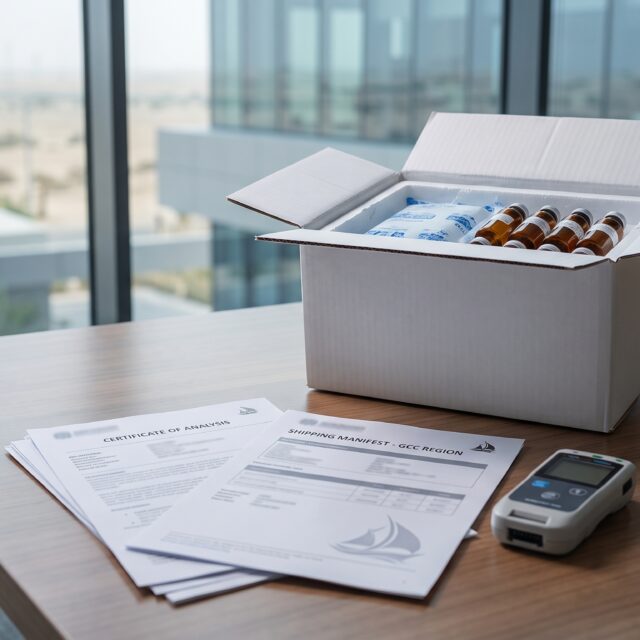
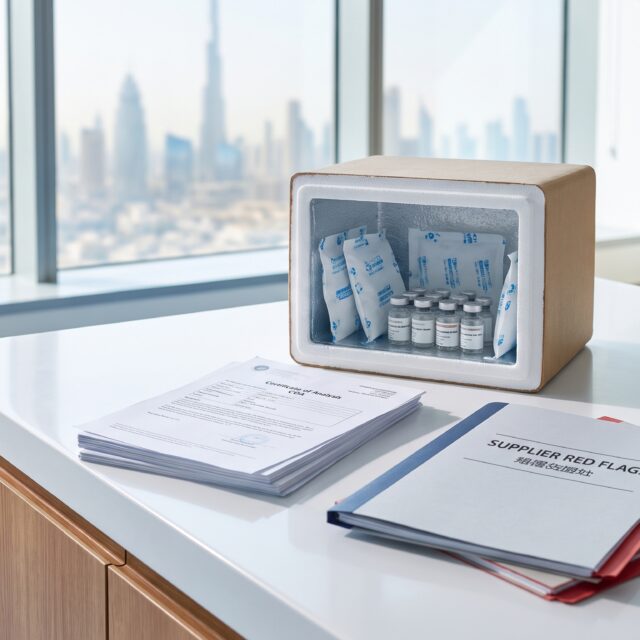
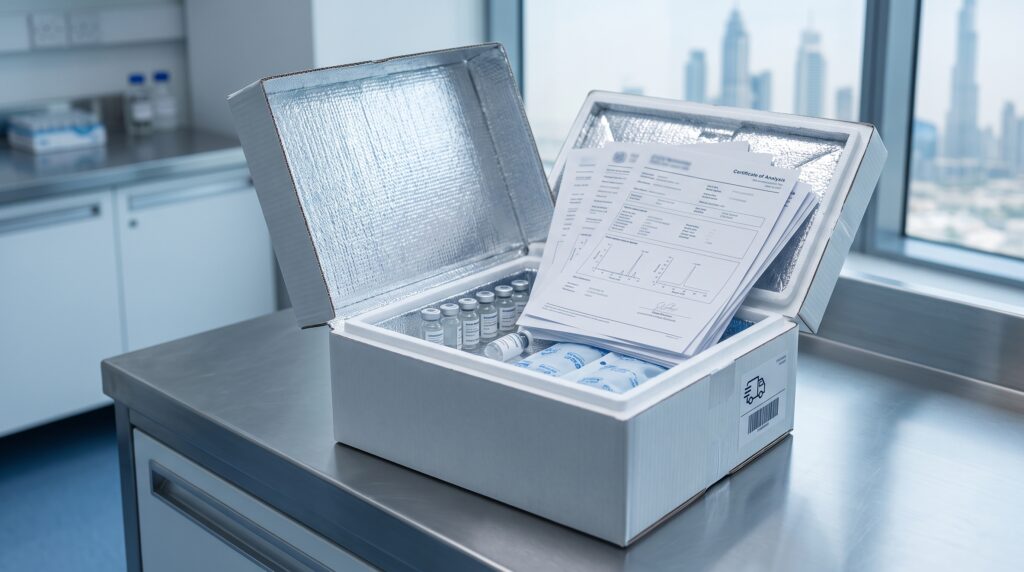
To preserve chemical identity and purity profiles, researchers demand strictly managed cold-chain logistics. This includes specialized insulated packaging, transit temperature loggers, and expedited local distribution to bypass prolonged customs delays. Working with a domestic supplier that manages this infrastructure internally eliminates the friction and risk of importing sensitive research materials from overseas.
Documentation Checklist: How to Verify Research Purity
Whether an institution requires ipamorelin or cjc-1295 no dac, procuring research-grade materials mandates rigorous verification. Informed buyers and procurement specialists must demand transparency through independent analytical documentation.
Before authorizing a purchase, evaluate the supplier based on the following criteria:
- Batch-Specific COAs: The Certificate of Analysis must reflect the current available batch, not a generic, years-old document.
- Purity Thresholds: High-quality research demands a minimum purity of ≥99%. This prevents unknown contaminants from skewing sensitive cellular assays.
- HPLC and MS Reports: High-Performance Liquid Chromatography guarantees the purity percentage, while Mass Spectrometry confirms the precise molecular weight and identity of the sequence.
- Third-Party Verification: Testing should be conducted by accredited, objective laboratories rather than internally generated certificates.
At NOVA Labs, we maintain complete transparency regarding product integrity. Researchers can verify the analytical data for all our chemical compounds by reviewing our third-party lab results directly on our platform.
Securing Supply at NOVA Labs UAE
Navigating the procurement of highly sensitive research peptides in the UAE requires a supplier that understands both the scientific literature and local logistical challenges. NOVA Labs bridges this gap by offering verifiable purity, reliable cold-chain logistics, and responsive local support.
We provide domestic UAE delivery within 1 to 3 business days, drastically reducing the thermal risks associated with international freight. For institutional and independent buyers, we offer flexible, secure payment gateways including Cash on Delivery (COD), alongside direct WhatsApp support to verify stock and coordinate specific delivery windows.
Whether your protocol models GHRH activation or selective ghrelin mimicry, you can evaluate the precise chemical specifications for both compounds through our catalog:
- Review the analytical profile for Ipamorelin.
- Review the analytical profile for CJC-1295 No DAC.
By prioritizing strictly verified purity, domestic temperature control, and transparent testing documentation, NOVA Labs ensures your laboratory research is built on a foundation of chemical integrity.
Disclaimer: The products mentioned in this article are strictly for in vitro laboratory research purposes only and are not intended for human consumption, diagnostic, or therapeutic use.
References
- Raun, K., et al. (1998). Ipamorelin, the first selective growth hormone secretagogue. European Journal of Endocrinology, 139(5), 552-561. Demonstrates selective action without cortisol or ACTH elevation.
- Teichman, S. L., et al. (2006). Prolonged stimulation of growth hormone (GH) and insulin-like growth factor I secretion by CJC-1295. The Journal of Clinical Endocrinology & Metabolism. Establishes baseline pharmacokinetic distinctions for Modified GRF 1-29 compounds.
- Jaffe, C. A., et al. (1993). Synergistic effects of GHRH and GHRP in human subjects (adapted for foundational in vitro principles). Demonstrates the mechanistic convergence of cAMP and PKC signaling pathways.
- CJC-1295 and Ipamorelin: A GHRH-Plus-Ghrelin-Mimetic Combination
- CJC-1295 vs Ipamorelin: Differences, Dosing, and Stacking (2026) | Peptidepedia
- CJC-1295 With DAC vs CJC-1295 No DAC: Key Differences in Laboratory Research Applications
- Ipamorelin, the first selective growth hormone secretagogue
- Cold-Chain Shipping and Import Documentation for Research Peptides in the UAE
Frequently asked questions
What is the difference between CJC-1295 No DAC and Ipamorelin?
The primary difference lies in their structural mechanisms. CJC-1295 No DAC is a GHRH analog that binds to the GHRH receptor, while Ipamorelin is a synthetic pentapeptide that acts as a highly selective agonist of the ghrelin (GHS-R1a) receptor.
Does Ipamorelin affect cortisol levels during laboratory research?
In laboratory research models, Ipamorelin is recognized for its extreme selectivity. Even at high concentrations, scientific literature shows it does not induce significant elevations in cortisol, ACTH, or aldosterone.
Why do researchers compare Ipamorelin vs CJC-1295 No DAC?
Researchers compare them because they stimulate different cellular pathways—protein kinase C (PKC) versus cyclic AMP (cAMP). When utilized together in vitro, they demonstrate a synergistic, pulsatile release larger than either compound alone.
How long is the half-life of CJC-1295 No DAC?
Because it lacks the Drug Affinity Complex (DAC) designed to bind to blood proteins, CJC-1295 No DAC (Modified GRF 1-29) has a short laboratory half-life of approximately 30 minutes, ideal for pulsatile research models.
How should lyophilized research peptides be stored in the UAE?
Due to extreme local temperatures that risk hydrolysis and oxidation, peptides must be shipped via cold-chain logistics. Upon arrival, lyophilized vials should be stored strictly in freezers or refrigerators away from light and moisture.
Nova Labs buyer tools
Ready to verify stock, testing and delivery?
Use the product page and lab report section to check availability, documentation, delivery timing and support before placing an order.
- COA / test-report checks
- UAE delivery context
- Cold-chain handling
- COD and card payment options
- WhatsApp support