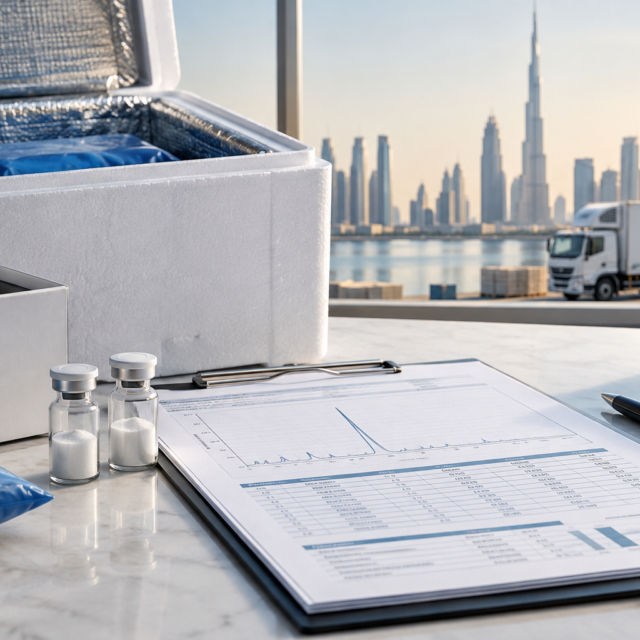

A supplier lists a research peptide in both dry and prepared-liquid formats. For a buyer in Dubai or elsewhere in the UAE, the useful question is not simply which format is “better.” It is which offered product matches the research specification—and whether the supplier can document its contents and deliver it under its stated conditions.
Lyophilised vs liquid peptides: the short answer
Lyophilised vs liquid peptides differ in presentation and formulation, but neither format has a universal shelf life or shipping temperature. Freeze-drying may improve stability for a particular formulation; it does not validate every dry vial. Compare the offered lot’s content, identity and purity results, storage statement, expiry or retest date, and UAE delivery plan.
Buyer checklist — check these before payment
- Product fit: Does your approved research specification call for a dry material or a particular finished solution?
- Batch evidence: Does the certificate of analysis (COA) identify the lot that will be supplied?
- Labelled amount: Is the claim for peptide content, total dry mass, concentration or fill volume—and is it supported by an appropriate test?
- Delivery: Do the packaging and handover arrangements match the product’s written transport conditions?
- Order details: Are stock, payment options and the contact for documentation questions confirmed for your actual UAE address?
What changes when a peptide is supplied dry or in liquid?
A lyophilised peptide has undergone freeze-drying and is supplied as a dry material. A liquid product is supplied in a stated solution formulation. Those descriptions tell a buyer how the product is presented, not how long a particular lot will remain within specification. Published work on freeze-dried pharmaceuticals describes why stability depends on factors including formulation and process conditions [1]. It should not be read as a shelf-life guarantee for a research peptide.
| Buyer question | Lyophilised product | Liquid product |
| — | — | — |
| What does the label quantify? | Confirm whether the amount is net peptide content or total dry material, which may include other components. | Confirm peptide amount, stated concentration, fill volume and formulation components. |
| What supports the dating? | Check the expiry or retest date against the specified storage conditions and available supporting information. | Check the dating and storage information for the finished liquid, not only its starting material. |
| What must happen in transit? | Follow the supplier’s product-specific transport statement; dry does not automatically mean heat-tolerant. | Check whether any stated temperature requirement can be maintained through delivery and handover. |
A format change may also mean a change in labelled quantity, formulation or testing scope. If an offer describes the dry and liquid versions as interchangeable, ask the supplier which specifications each version meets. Neither presentation alone establishes sterility or suitability for a purpose outside the stated research specification.
How do you verify the COA and the amount in the vial?
First, connect the paperwork to the item being offered. A useful COA identifies the product and lot, names the issuing laboratory, and reports test dates, methods, specifications and results. Compare its lot identifier with the supplier’s listing or order confirmation. If a listing says “third-party tested,” the report should make it possible to identify the testing party and the relevant lot; the phrase itself is not a test result.
Next, separate three claims that are often presented together:
- Identity: Evidence such as mass spectrometry can support whether the tested material matches an expected molecular mass. The scope depends on the method and does not, by itself, establish every structural detail.
- Purity: An HPLC result reports what a specified chromatographic method measured. A high peak-area percentage is not the same as a measurement of how much peptide the vial contains.
- Content: An assay or other documented content determination addresses the amount of peptide under its stated calculation basis. Check whether the reported amount applies to the supplied vial or finished liquid.
For a dry product, ask whether the labelled mass includes residual water, counter-ions or formulation components, or instead represents net peptide content. For a liquid, check the relationship between the reported concentration, fill volume and peptide amount. If the COA tests only a starting material, it may not answer a question about the finished, filled solution. Published peptide-measurement guidance also underscores the need to specify how quantities are determined and interpreted [2].
NOVA Labs provides a lab-results page as a starting point for reviewing available documents. A posted report is useful only when its product and lot can be matched to the one you intend to order; request clarification if that connection is missing.
Which storage and delivery questions matter in Dubai and the UAE?
Use the offered product’s written storage and transport instructions as the starting point. Ask whether the same limits apply before dispatch, during transit and after receipt. If a supplier permits a temperature excursion, ask what duration and range it covers and what supports that allowance. Do not replace those details with a blanket rule that dry peptides always ship at ambient temperature or that every liquid requires the same cooling arrangement.
For a Dubai office, a university receiving desk or a laboratory elsewhere in the Emirates, the final handover can be as relevant as the courier journey. A parcel may spend time in a vehicle, a dispatch queue or an unattended reception area. That does not prove a short delay damages the product; it makes the planned handover and any product-specific limits worth checking before purchase.
Confirm the dispatch window for your address, the packaging proposed for the actual order and whether temperature monitoring is available if required by the product specification. Ask who handles a missed delivery, a delayed parcel or a package that arrives outside its stated conditions. If your receiving team needs a lot number or documents before accepting a parcel, establish when those details will be provided.
For deliveries elsewhere in the GCC, check destination-specific import, customs and documentation requirements separately from UAE delivery arrangements. A “research use only” label does not establish that an item may be imported or supplied in every jurisdiction. The Emirates Drug Establishment is a UAE regulatory starting point; the applicable requirements depend on the product and transaction [3].
What should be settled before checkout?
A listing is not a substitute for an order-specific confirmation. The NOVA Labs shop can help a buyer identify currently listed formats, but the decisive details are the offered lot, its documentation and the delivery terms available for the buyer’s location. If a required format is not shown, do not assume the alternative is equivalent to the project specification.
Before paying, confirm whether the required lot is in stock, which payment methods are offered for that order and when dispatch is expected. Do not assume cash on delivery or a particular courier service is available. Identify a support contact who can answer a lot-specific question before dispatch, and keep the written answer with your procurement records. This is especially useful when a COA, listing and invoice describe the amount using different terms.
The practical format decision
Choose the format specified by the research project, then compare the actual offers: labelled peptide content, formulation, lot-matched identity and purity results, content evidence, dating, storage instructions and a workable delivery plan. If two products appear equivalent but one lacks a lot-matched report or clear transport conditions, that is a documentation gap to resolve—not a reason to assume the dry or liquid format is inherently superior.
For a NOVA Labs order, review the relevant listing and lab results, then contact NOVA Labs to confirm the offered lot, documentation and UAE delivery conditions before checkout.
Research purposes only: Products discussed here are not intended for human consumption. This guide does not provide preparation, administration, dosage or treatment instructions.
References
- Wang W. “Lyophilization and development of solid protein pharmaceuticals”. Background on formulation-dependent freeze-drying; not evidence of a universal peptide shelf life.
- “Recommendations for the generation, quantification, storage and handling of peptides used for mass spectrometry-based assays”. Research context for peptide measurement and handling; not a specification for a supplier’s finished product.
- Emirates Drug Establishment. UAE regulatory starting point; buyers must determine which current requirements apply to their product and shipment.
- Emirates Drug Establishment — Circular No. 46/2026, Guideline for Handling Peptide Products and Molecules
- EMA — Guideline on the Development and Manufacture of Synthetic Peptides
Frequently asked questions
Is lyophilised the same as freeze-dried?
Yes. Lyophilisation is freeze-drying. The resulting dry presentation does not, by itself, establish a product’s shelf life or permissible shipping temperature.
Which lasts longer, lyophilised or liquid research peptides?
Neither format has a universal shelf life. Compare the specific products’ expiry or retest dates, stated storage conditions and supporting product information rather than relying on format alone.
Does 98% HPLC purity mean a vial contains 98% of its labelled amount?
No. An HPLC purity percentage and the amount of peptide in a vial are different measurements. Request a separate assay or content result and check how the amount was calculated.
What should I check on a liquid peptide COA?
Check that the lot matches the offered product and review the stated identity, purity and content methods and results. Confirm whether testing covers the finished liquid, and check its concentration, fill volume, formulation and storage statement.
Can lyophilised research peptides ship without cooling in the UAE?
Do not assume so. Check the specific product’s written transport conditions and ask how the supplier’s packaging, dispatch and handover plan will meet them.
Nova Labs buyer tools
Ready to verify stock, testing and delivery?
Use the product page and lab report section to check availability, documentation, delivery timing and support before placing an order.
- COA / test-report checks
- UAE delivery context
- Cold-chain handling
- COD and card payment options
- WhatsApp support