
Procuring high-quality research materials in the Middle East introduces unique logistical challenges. For laboratories and informed buyers in the UAE, understanding the exact parameters of lyophilized peptide shelf life is critical for maintaining compound integrity and ensuring repeatable research outcomes. Freeze-drying, or lyophilization, is the industry standard for stabilizing delicate amino acid chains, removing the moisture that ordinarily accelerates degradation. But exactly how long do these compounds remain viable, and how does the extreme GCC climate impact their stability during transit and storage?
This comprehensive lyophilized peptide shelf life guide breaks down the storage timeline, the chemical mechanisms of degradation, and the local procurement checks researchers must implement to protect their investments.
The Bottom Line: Lyophilized Peptide Shelf Life
When kept unopened in a dry, dark environment at -20°C, lyophilized peptides have a shelf life of three to five years. At standard refrigeration (2°C to 8°C), they remain stable for several months to a year. Once reconstituted with a solvent, the safe usable shelf life drops strictly to 28 days.
To maximize the viability of your research compounds, you must understand the stark difference in stability between the dry, powdered state and the liquid, reconstituted state.
Unopened (Lyophilized) Storage
The primary advantage of lyophilization is that it strips the peptide of its water content, effectively halting hydrolysis—one of the main chemical processes that breaks down peptide bonds. In this dormant powder form, stability is highly dependent on temperature:
- Deep Freeze (-80°C): For long-term archiving, ultra-low temperatures can preserve structural integrity for a decade or more. This is standard practice for reference materials.
- Standard Freezer (-20°C): This is the most practical long-term storage method for working laboratories. At this temperature, lyophilized peptide shelf life is easily maintained for three to five years.
- Standard Refrigerator (2°C to 8°C): For compounds slated for use within the current academic or fiscal year, standard refrigeration offers stability for several months up to one full year without significant degradation.
- Room Temperature (20°C to 25°C): While lyophilized powders are stable at room temperature for several days to a few weeks, long-term ambient storage is highly discouraged as it slowly degrades the peptide’s structural integrity.
After Reconstitution (Liquid Storage)
The moment a lyophilized peptide is reconstituted with a solvent—typically bacteriostatic water—the protective benefits of freeze-drying vanish. The introduction of moisture makes the amino acid bonds highly vulnerable to hydrolysis, oxidation, and bacterial contamination.
Once reconstituted, the compound must be kept continuously refrigerated (2°C to 8°C) and utilized within a strict 28-day window. This timeline is not arbitrary; it aligns with the effective life of the antimicrobial preservative (benzyl alcohol) found in bacteriostatic water. Beyond 28 days, the risk of bacterial proliferation and structural degradation renders the solution unsuitable for precise research applications.
The UAE Climate Imperative: Why Cold-Chain Logistics Matter
For buyers in the GCC, the textbook definitions of lyophilized peptide shelf life often collide with the harsh reality of local logistics. While freeze-dried peptides can survive mild ambient temperatures in European or North American supply chains, the UAE presents an entirely different risk profile.
During the summer months, ambient temperatures in Dubai and Abu Dhabi regularly exceed 45°C. Inside standard, non-refrigerated delivery vans, temperatures can spike even higher. If a delicate peptide formulation sits in these conditions for hours or days during customs clearance or last-mile delivery, the thermal stress can rapidly shatter the amino acid bonds, ruining the compound before it ever reaches your laboratory.
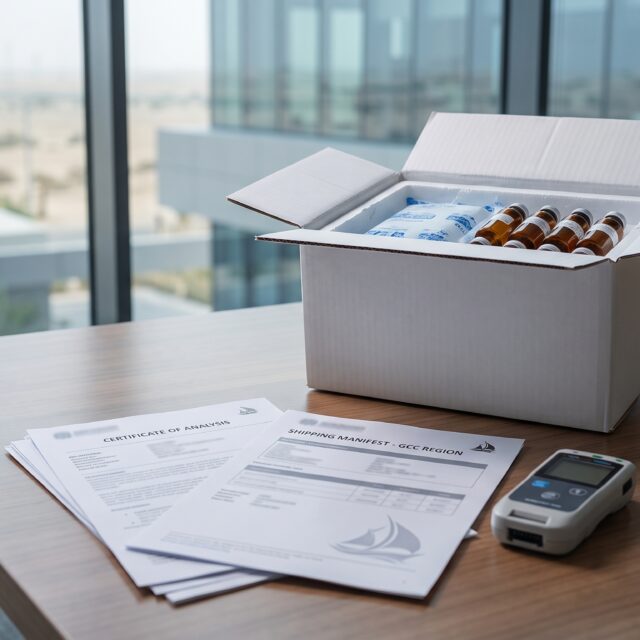
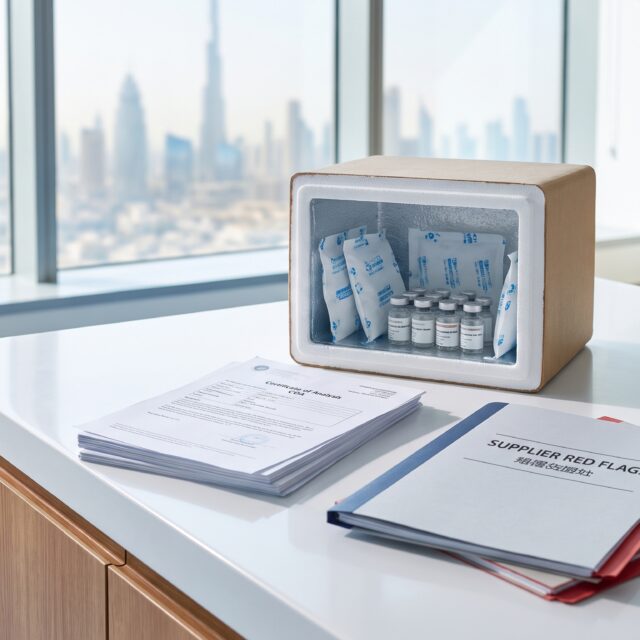
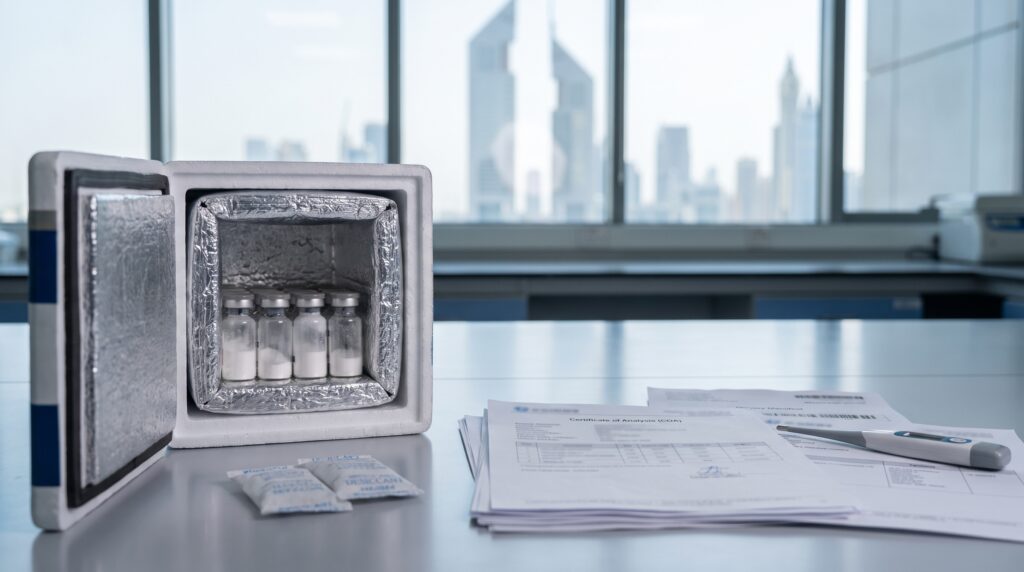
This climate reality makes local procurement and specialized logistics non-negotiable. Reputable suppliers operating within the UAE, such as NOVA Labs, utilize dedicated temperature-controlled packaging and cold-chain shipping networks. By minimizing thermal exposure during the critical “last mile” of delivery, proper logistics ensure that the peptide arrives with its maximum shelf life entirely intact. When comparing suppliers, researchers should always verify if cold-chain shipping protocols and local stock availability are guaranteed.
Chemical Degradation: What Causes Peptides to Break Down?
Understanding why a lyophilized peptide shelf life protocol requires strict temperature and handling controls requires a brief look at peptide chemistry. Peptides are not uniform; their stability is dictated by their specific amino acid sequences. Several chemical pathways lead to degradation if storage protocols are ignored:
1. Oxidation
Certain amino acid residues are highly susceptible to oxidation when exposed to air and light. Cysteine (Cys), Methionine (Met), and Tryptophan (Trp) are particularly vulnerable. When oxygen interacts with these residues, it alters the compound’s molecular weight and binding affinity, skewing research data. This is why high-quality vials are sealed under inert gas (like nitrogen or argon) and should be stored away from direct UV light.
2. Moisture Absorption (Hygroscopicity)
Many peptide residues—such as Aspartic acid (Asp), Glutamic acid (Glu), Lysine (Lys), Arginine (Arg), and Histidine (His)—are exceptionally hygroscopic. This means they act like molecular sponges, rapidly absorbing moisture from the surrounding air.
Critical Handling Tip: When removing a vial from the freezer (-20°C), you must allow it to equilibrate to room temperature before opening the seal. If you open a freezing-cold vial in a humid UAE laboratory, ambient moisture will instantly condense onto the powder, triggering premature hydrolysis and severely compromising the compound.
3. Deamidation and Hydrolysis
Over time, especially under elevated temperatures, the amide groups in Asparagine (Asn) and Glutamine (Gln) residues can undergo deamidation. Furthermore, in liquid states, water molecules cleave the peptide bonds (hydrolysis). These processes occur at accelerated rates if the compound is exposed to the extreme ambient temperatures common in Middle Eastern transit.
Verifying Baseline Purity Before You Store
An often-overlooked aspect of long-term storage is the baseline quality of the compound. The stated lyophilized peptide shelf life assumes you are starting with a highly pure, stable product. If a peptide is heavily contaminated with synthesis byproducts, truncation sequences, or heavy metals from the manufacturing process, it will degrade much faster than a pure sample, regardless of how well you store it.
Discerning UAE researchers must insist on independent verification. Before committing to a supplier, ensure they provide transparent, batch-specific documentation. Third-party High-Performance Liquid Chromatography (HPLC) and Mass Spectrometry (MS) test reports—commonly referred to as Certificates of Analysis (COAs)—are the only reliable proof of purity.
For example, you can verify independent batch COAs directly through NOVA Labs to confirm that your compound meets a strict purity threshold (typically >99%) before it enters your freezer inventory. A transparent COA acts as a trust anchor, proving that the chemical you are placing into long-term storage is precisely what you paid for.
Best Practices for GCC Laboratory Storage
To ensure your research compounds achieve their maximum potential lifespan, implement this straightforward handling checklist:
- Minimize Freeze-Thaw Cycles: Repeatedly freezing and thawing a reconstituted peptide damages the molecular structure. If you require smaller volumes over a long period, consider aliquoting the reconstituted solution into smaller sterile vials before freezing, though it is generally safer to utilize the batch within 28 days refrigerated.
- Equilibrate Before Opening: Always let sealed vials reach room temperature prior to opening to prevent hygroscopic moisture condensation.
- Shield from UV Light: Store vials in dark, opaque containers or designated dark freezer drawers. UV exposure accelerates oxidation.
- Use Proper Solvents: Only reconstitute with high-quality bacteriostatic water containing 0.9% benzyl alcohol. Sterile water lacks the preservative necessary to prevent bacterial growth and will reduce the usable liquid lifespan to just a few days.
- Document Everything: Maintain a strict inventory log detailing the exact date of receipt, the batch COA, and the date of reconstitution on every vial.
Securing Reliable Supplies in the UAE
Maximizing lyophilized peptide shelf life requires a combination of perfect manufacturing, secure cold-chain transit, and strict laboratory storage protocols. By understanding the vulnerabilities of specific amino acid chains and the severe risks posed by the local climate, researchers can protect the integrity of their materials and the accuracy of their downstream data.
For laboratories operating in Dubai, Abu Dhabi, and across the GCC, partnering with a supplier that understands local logistical hurdles is paramount. NOVA Labs bridges this gap by providing cold-chain handling, local UAE dispatch, and completely transparent third-party HPLC testing on every single batch.
Ready to source securely handled, verifiable research materials for your laboratory? Shop Premium Peptides today to experience the NOVA Labs standard of quality and logistical care.
*
Disclaimer: The products mentioned in this article are strictly for laboratory research purposes only and are not intended for human consumption, treatment, or diagnostic use.
References
- GenScript. (n.d.). Peptide Storage and Handling Guidelines.
- AAPPTEC. (n.d.). Storage and Handling of Peptides.
- Sigma-Aldrich / Merck. (n.d.). Handling and Storage of Peptides.
- Benoiton, N. L. (2006). Chemistry of Peptide Synthesis. CRC Press.
- D’Hondt, M., et al. (2011). “Related impurities in peptide medicines.” Journal of Pharmaceutical and Biomedical Analysis.
- How to Store Peptides: Complete Guide (Fridge, Freezer & Shelf Life)
- Cold-Chain Peptide Delivery and Stability in the UAE
- How Long Do Lyophilized Peptides Last? Shelf Life Explained
- NOVA Labs UAE Review (2026): COAs, Prices & Delivery – PeptideStat
- Peptide Storage and Handling Guidelines – GenScript
- Peptide Storage and Handling Guide: How Long Do They Last? – Jay Campbell
- Storage and Handling of Peptides – AAPPTEC
Frequently asked questions
How long do lyophilized peptides last at room temperature?
Lyophilized (freeze-dried) peptides can remain stable at room temperature for several days to a few weeks. However, long-term storage at ambient temperature is highly discouraged, especially in hot climates, as it slowly degrades the peptide bonds.
Why is cold-chain shipping important for peptides in the UAE?
During UAE summers, ambient temperatures can exceed 45°C, causing extreme heat inside standard delivery vans. Cold-chain shipping protects delicate lyophilized peptides from thermal stress, ensuring they arrive at your laboratory without premature degradation.
How long are peptides good for after being reconstituted?
Once reconstituted with bacteriostatic water, peptides must be stored in a refrigerator (2°C to 8°C) and used within a strict 28-day window. After 28 days, the antimicrobial preservative loses effectiveness, increasing the risk of contamination and structural breakdown.
Why must I let a peptide vial reach room temperature before opening?
Many peptide sequences are highly hygroscopic, meaning they easily absorb moisture. If you open a freezing-cold vial, ambient humidity will instantly condense on the powder, causing moisture damage and early degradation.
How do I verify the starting quality of my peptide before storage?
You should always demand a batch-specific Certificate of Analysis (COA) from a third-party laboratory. HPLC and Mass Spectrometry reports verify the baseline purity of the compound, ensuring you are not storing degraded or contaminated materials.
Nova Labs buyer tools
Ready to verify stock, testing and delivery?
Use the product page and lab report section to check availability, documentation, delivery timing and support before placing an order.
- COA / test-report checks
- UAE delivery context
- Cold-chain handling
- COD and card payment options
- WhatsApp support