



The Definitive Peptide Purity Guide Abu Dhabi Researchers Trust
Quick Answer:
A reliable peptide purity guide for Abu Dhabi emphasizes verifying independent HPLC reports for 99% purity and confirming mass spectrometry data. Researchers must also prioritize suppliers offering localized, temperature-controlled delivery to prevent chemical degradation in extreme Gulf temperatures.
Buyer Checklist & Key Takeaways:
- Verify HPLC & MS Data: Always demand batch-specific testing to confirm ≥98% purity.
- Mandate Cold-Chain Transit: Ensure lyophilized vials ship with thermal packaging and cooling gel packs.
- Leverage Local Stock: Avoid international customs delays by sourcing from domestic UAE warehouses.
- Secure Payment Networks: Utilize vendors providing direct local bank transfers or secure, region-friendly checkout options.
- Responsive Support: Choose suppliers that offer localized support (like WhatsApp) for real-time logistics tracking.
Sourcing high-grade research materials in the Gulf region presents a unique set of logistical and quality-control challenges. For laboratories, independent researchers, and procurement teams evaluating regional suppliers in Abu Dhabi, simply finding a vendor with stock is not enough. The harsh climate, strict customs procedures, and varying standards of chemical manufacturing mean that rigorous verification is essential before any order is placed.
This comprehensive guide breaks down the critical elements of evaluating peptide suppliers in the UAE. From decoding laboratory purity reports to understanding the physical impact of ambient heat on compound degradation, we will explore exactly what you should check to ensure your research materials arrive intact, stable, and chemically accurate.
Decoding COAs: HPLC and Mass Spectrometry Explained
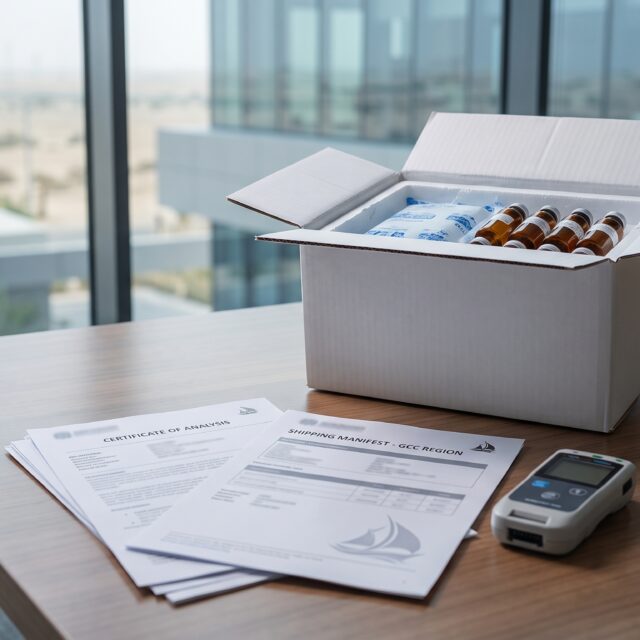
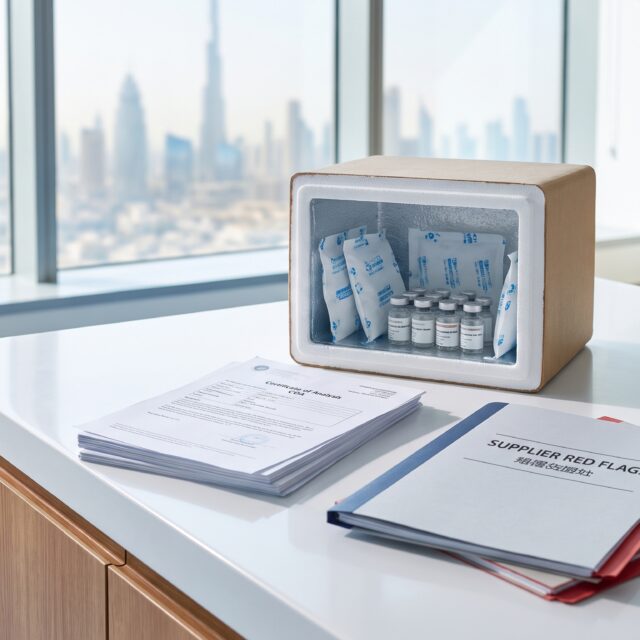
The foundation of any reputable procurement strategy begins with the Certificate of Analysis (COA). A COA is a comprehensive laboratory document that proves the chemical composition and purity of a specific batch of peptides. Without batch-specific documentation, buyers have no way of knowing whether their materials contain unwanted synthesis byproducts, residual solvents, or degraded fragments.
Top-tier peptide suppliers in the UAE set a strict quality baseline of 98% to 99% purity. To verify this, buyers must look for two primary testing methodologies on the COA:
High-Performance Liquid Chromatography (HPLC)
HPLC is the gold standard for measuring the purity of a peptide. The test involves pushing a sample through a pressurized column filled with an adsorbent material. Different chemical components in the sample travel at different speeds, separating the primary compound from any impurities. The resulting HPLC graph displays peaks; the primary peak represents the target peptide, and the area under this peak (relative to the total area) dictates the purity percentage. If an HPLC report shows an area of 99.2%, you are observing highly refined, research-grade material.
Mass Spectrometry (MS)
While HPLC confirms how pure a sample is, Mass Spectrometry (MS) confirms its exact identity. MS analyzes the mass-to-charge ratio of the ions in a sample, verifying the precise molecular weight. Because a peptide’s sequence of amino acids dictates its molecular weight down to the decimal, MS ensures that the sequence is structurally correct. A missing or swapped amino acid during synthesis would immediately be flagged by a mismatch in the expected molecular mass.
When evaluating a supplier’s documentation, ensure both tests are present and clearly tied to the batch number of the product you are purchasing. Beware of generic or heavily redacted COAs that do not align with current inventory.
Understanding Net Peptide Content (NPC) and TFA Removal
In addition to HPLC and MS, advanced researchers in Abu Dhabi should understand Net Peptide Content (NPC). During the chemical synthesis process, trifluoroacetic acid (TFA) is frequently used. As a result, the final lyophilized powder contains both the peptide and TFA salts. A highly pure peptide (e.g., 99% on HPLC) might have an NPC of 80%, meaning 20% of the lyophilized powder’s weight consists of these binding salts. This is entirely normal for standard research peptides, but knowing the NPC is vital for researchers calculating precise molar concentrations for their laboratory assays.
Beating the 45°C Gulf Heat: Why Cold-Chain Logistics Matter
For procurement teams, prioritizing temperature control is crucial. The extreme heat of the UAE, where ambient summer temperatures in Abu Dhabi routinely exceed 45°C, poses a severe threat to peptide stability.
Peptides are complex chains of amino acids held together by peptide bonds. When exposed to extreme heat, these bonds become highly vulnerable to degradation processes such as hydrolysis (the cleavage of chemical bonds by water), oxidation, and deamidation. Even a few hours sitting in a hot, uninsulated delivery van can compromise a 99% pure batch, rapidly degrading the structural integrity of the compound and rendering the research material useless.
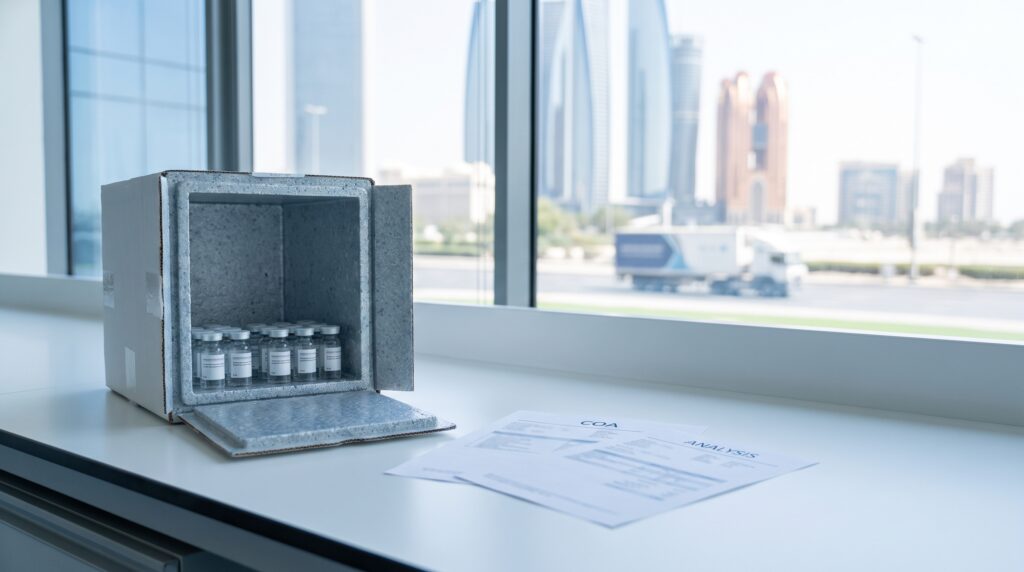
To prevent this, true cold-chain logistics are non-negotiable. Reputable suppliers manage this by packaging lyophilized (freeze-dried) vials in specialized thermal insulation equipped with cooling gel packs. This packaging is designed to maintain a stable environment—ideally between 2°C and 8°C—during transit.
For researchers operating in the UAE, utilizing local dispatch hubs that guarantee rapid transit is essential. Partnering with vendors that understand the exact requirements of Gulf climate logistics, such as those providing peptides in the UAE with next-day delivery, ensures chain of custody and thermal stability from the warehouse to your laboratory door.
Customs, Compliance, and Local Payment Options
Navigating the regulatory and financial landscape in the UAE requires specific local knowledge. Unregistered research-grade peptides are typically regulated as general-trade chemical substances rather than controlled pharmaceuticals.
When imported or traded locally, these compounds move under standard Harmonized System (HS) customs codes. For example, lyophilized peptide powders often fall under HS 3504.00.10, while other miscellaneous chemical research compounds use HS 3824.99.99. Working with a domestic supplier who accurately categorizes and clears these compounds prevents administrative friction, ensuring materials bypass international customs delays entirely.
Payment processing is another common hurdle for researchers. Global payment gateways frequently block peptide merchants due to strict card brand regulations regarding research chemicals. Consequently, relying solely on international credit card processing can lead to cancelled orders and procurement delays. Leading local suppliers in Abu Dhabi and Dubai have adapted to this reality by offering secure, regionally friendly payment alternatives. These often include direct UAE bank transfers in AED, secure payment links, and localized network options that streamline institutional purchasing.
Laboratory Storage and Handling Best Practices
Once a highly pure, properly transported order arrives, the responsibility for maintaining its integrity shifts to the researcher. Even the highest quality materials will degrade rapidly if handled incorrectly post-delivery in a laboratory environment.
Most research peptides arrive in a lyophilized (freeze-dried) state. In this stable powder form, they can endure brief periods at ambient room temperature, though long-term storage (months to years) should always be in a laboratory freezer at or below -20°C. However, once the peptide is reconstituted, its vulnerability increases exponentially.
Reconstitution must be performed using sterile bacteriostatic water, which contains a small percentage (0.9%) of benzyl alcohol to prevent bacterial growth. Key rules for handling reconstituted materials include:
- Strict Refrigeration: Once liquid is added, the vial must be kept consistently refrigerated at 2°C to 8°C. Never freeze reconstituted peptides, as the expansion of ice crystals can sheer the amino acid bonds.
- Limited Shelf Life: Reconstituted liquid peptides generally remain stable for 3 to 4 weeks, depending on the specific compound and its susceptibility to oxidation.
- Gentle Handling: Never shake a reconstituted vial aggressively. Swirl it gently to dissolve the powder, as vigorous shaking can damage the delicate molecular chains.
- Sterile Technique: Always swab the vial stopper with isopropyl alcohol before inserting a needle to maintain the sterile environment created by the bacteriostatic water.
Conclusion: Making Informed Procurement Decisions
Evaluating peptide suppliers in the UAE demands a precise, evidence-based approach. The unique combination of the Gulf’s intense heat, the strict scientific requirements for 99% purity, and the need for localized infrastructure means Abu Dhabi researchers cannot rely on generic global suppliers who ship without thermal protection.
By demanding batch-specific HPLC and MS testing, prioritizing cold-chain insulated transit, and understanding proper post-delivery storage protocols, buyers can protect their research investments and ensure the validity of their experimental data.
To access laboratory-tested research materials with verified purity and reliable cold-chain logistics, explore the comprehensive inventory available at the NOVA Labs shop, designed to meet the rigorous demands of UAE laboratories.
Disclaimer: The products mentioned in this article are strictly for in-vitro research and laboratory experimentation only. They are not intended for human consumption, clinical use, self-administration, or therapeutic application.
References
- Gulf Logistics Review (2023). Cold-Chain Pharmaceutical Delivery and Stability in the UAE.
- International Journal of Peptide Research (2022). Thermal Degradation of Lyophilized Peptides and Amino Acid Chains.
- UAE Federal Customs Authority (2024). HS Code Classifications for Chemical Compounds and Research Reagents.
- Journal of Chemical Analysis (2021). Validating HPLC and Mass Spectrometry for Polypeptide Purity Determination.
Disclaimer: The products mentioned in this article are for research purposes only and are not intended for human consumption.
- Buying Research Peptides UAE — the 2026 buyer-evaluation guide – Wellness Labs
- Cold-Chain Peptide Delivery and Stability in the UAE
- LAB REPORTS – peptidetechuae.com
- Research Peptide FAQ | UAE Core Peptides
- Shipping & Returns – Peptides DXB
Frequently asked questions
What is the acceptable purity level for research peptides in Abu Dhabi?
Most premium suppliers and academic institutions require a minimum of 98% to 99% purity. This must be verified by batch-specific High-Performance Liquid Chromatography (HPLC) testing.
How does the UAE summer heat affect peptide shipments?
Ambient temperatures in Abu Dhabi can exceed 45°C, which rapidly degrades peptides through hydrolysis and oxidation. Reliable suppliers mandate insulated cold-chain delivery with gel packs to maintain a stable 2°C to 8°C environment during transit.
Are research peptides restricted by UAE customs?
Unregistered research-grade peptides are typically classified as general-trade chemical compounds under specific HS codes (like 3504.00.10). Sourcing from domestic UAE warehouses is recommended to bypass international customs delays entirely.
What should I look for in a peptide Certificate of Analysis (COA)?
A comprehensive COA should include an HPLC graph confirming the purity percentage (ideally over 98%) and a Mass Spectrometry (MS) report verifying the exact molecular weight and amino acid sequence of the specific batch.
How long do peptides last once mixed with bacteriostatic water?
Once reconstituted from their lyophilized powder form into liquid using bacteriostatic water, peptides must be stored in a refrigerator at 2°C to 8°C. Under these conditions, they generally remain chemically stable for 3 to 4 weeks.
Nova Labs buyer tools
Ready to verify stock, testing and delivery?
Use the product page and lab report section to check availability, documentation, delivery timing and support before placing an order.
- COA / test-report checks
- Abu Dhabi delivery context
- Cold-chain handling
- COD and card payment options
- WhatsApp support