




Key Takeaways
- Documentation: Rigorous third-party Certificates of Analysis (COA) containing both HPLC and Mass Spectrometry are non-negotiable for bulk orders.
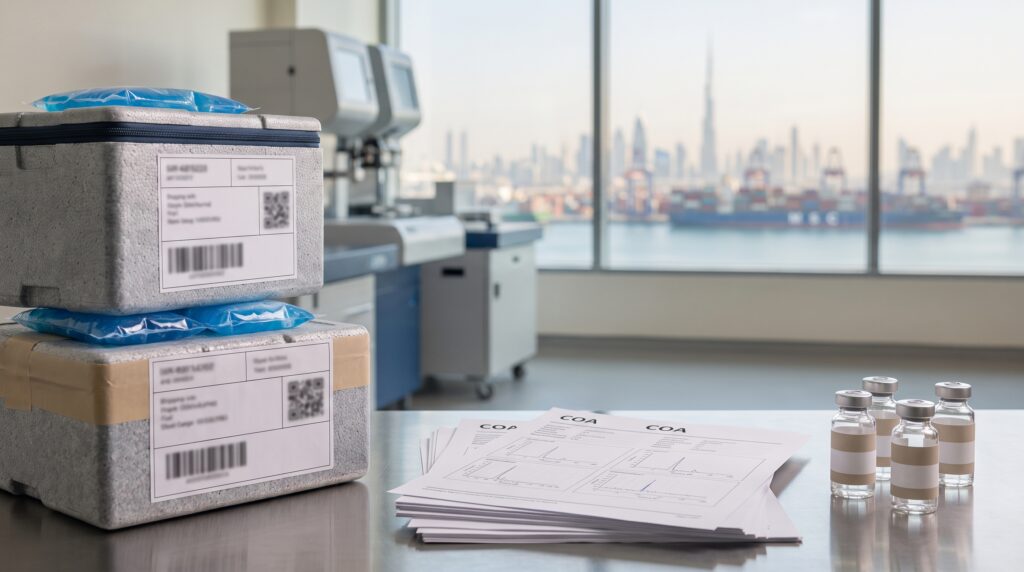
- Cold-Chain Logistics: Distributors must utilize Phase Change Materials (PCMs) and temperature data loggers to survive the extreme GCC climate.
- Local Compliance: UAE Federal Law requires strict operational models to demarcate research-grade compounds from consumer pharmaceuticals.
- Customs Friction: Partnering with local suppliers eliminates the high risk of international customs seizures and multi-week cold-chain failures.
The landscape for securing research compounds in the Middle East is rapidly maturing into a highly structured B2B market. For procurement managers, research institutions, and informed buyers, sourcing wholesale peptides requires moving beyond simple web searches and prioritizing rigorous supplier verification. With shifting local regulations and extreme regional climates, bulk procurement demands specialized knowledge of logistics, analytical testing, and commercial compliance.
Historically, acquiring research compounds in bulk involved navigating opaque international supply chains, risking customs delays, and hoping temperature-sensitive shipments survived the journey. Today, the regional market demands a more sophisticated approach. Establishing a relationship with a reliable supplier hinges on evaluating their cold-chain infrastructure, demanding transparent documentation, and understanding local operational constraints.
Whether you are stocking a laboratory, managing procurement for an institution, or organizing a large-scale research initiative, this guide outlines the operational and compliance benchmarks you must verify before committing to a bulk purchase.
Sourcing Wholesale Peptides GCC: What to Look For
When sourcing wholesale peptides in the GCC, procurement teams must verify third-party analytical documentation including HPLC and Mass Spectrometry, ensure GDP-compliant cold-chain logistics to survive extreme 45°C regional heat, and confirm strict regulatory compliance for research-only compounds to avoid customs delays and supply chain disruptions.
The regulatory environment in the United Arab Emirates and the broader GCC has tightened significantly to ensure market safety and operational transparency. A landmark shift occurred with UAE Federal Law No. 38 of 2024, which centralized and reinforced medical and pharmaceutical approvals under the Emirates Drug Establishment (EDE).
Recently, regional health authorities have demonstrated a strict commitment to this framework by launching major enforcement campaigns that cracked down on unapproved consumer sources operating outside compliance standards. For B2B buyers, this regulatory tightening means that partnering with a legitimate, compliant supplier is no longer just about pricing—it is about supply chain security.
Legitimate suppliers operate strict commercial-only models for bulk transactions. They clearly demarcate research-grade compounds from consumer pharmaceuticals, ensuring that their supply chain does not fall foul of regional enforcement actions targeting unapproved medical sales. They explicitly restrict their products to laboratory and research applications.
Analytical Documentation: The Foundation of Bulk Peptides
When purchasing bulk research compounds, verbal assurances of purity are insufficient. Wholesale transactions require definitive proof of compound stability, identity, and purity via third-party analytical documentation. The cornerstone of this verification is the Certificate of Analysis (COA). For an informed procurement officer, a COA must feature distinct, verifiable testing parameters.
HPLC (High-Performance Liquid Chromatography)
HPLC testing determines the purity of the compound by separating the mixture into its individual components. Because peptides are synthesized using complex amino acid chains, incomplete synthesis can leave behind truncated sequences or impurities. A stringent supplier will provide HPLC reports demonstrating a purity level—typically 98% or higher—for research applications. Anything lower introduces variables that could compromise your research data.
Mass Spectrometry (MS)
While HPLC confirms how pure a sample is, Mass Spectrometry confirms the identity of the compound by measuring its exact molecular weight. If a supplier provides an HPLC report without a corresponding Mass Spec graph, the buyer cannot definitively prove that the highly pure powder in the vial is actually the correct peptide sequence.
Endotoxin Limits and Lyophilization Quality
For specific in-vitro testing applications, bulk procurement may also necessitate checking endotoxin levels. High-quality wholesale suppliers utilize advanced lyophilization (freeze-drying) processes that yield stable, highly pure structural powder, minimizing moisture content and preventing rapid degradation in storage.
Batch Traceability
In B2B purchasing, consistency across large volumes is vital. Documentation must correspond to the specific batch number printed on your vials. Reputable regional suppliers ensure that lot numbers on the physical products match the lot numbers on the testing reports, allowing procurement teams to maintain accurate internal logs and quality control standards.
The Cold-Chain Challenge in the Middle East
One of the most significant barriers to importing and distributing bulk peptides in the region is the climate. GCC summer temperatures routinely exceed 45°C. Without proper handling, extreme heat can rapidly degrade the delicate molecular bonds of lyophilized peptides, rendering bulk shipments useless before they even arrive at the laboratory.
GDP-compliant (Good Distribution Practice) cold-chain logistics are mandatory for wholesale transactions. A professional supplier understands that protecting these assets requires specialized infrastructure, far beyond standard courier shipping.
- Temperature Controlled Packaging: Bulk orders must be packed using phase-change materials (PCMs) or medical-grade insulated shippers designed to maintain an internal temperature of 2°C to 8°C for the duration of the transit window.
- Direct Routing: The more layovers and facility transfers a shipment endures, the higher the risk of temperature excursions. Sourcing from a supplier with local UAE stock significantly minimizes transit time compared to ordering from overseas manufacturers.
- Real-Time Monitoring: Advanced B2B logistics often incorporate temperature data loggers within the shipment. This allows the receiving facility to verify that the core temperature never breached the safe threshold during transport.
If a supplier cannot clearly articulate their cold-chain protocols for UAE summer deliveries, they are not equipped to handle wholesale volumes.
Overcoming Customs Friction with Local Procurement
For many years, GCC researchers relied on direct importation from overseas manufacturers in Asia or North America. While this sometimes appeared cost-effective on paper, the hidden costs often destroyed the value proposition.
International bulk shipments routinely face customs friction. When a large consignment of specialized compounds arrives at Dubai Customs or other GCC ports without perfectly aligned commercial documentation, it is highly likely to be flagged for inspection. If the shipment lacks precise regulatory paperwork matching local guidelines, it can be held for weeks or destroyed. During this delay, the cold-chain inevitably fails, and the product degrades.
By partnering with a local UAE-based supplier, B2B buyers effectively outsource this customs friction. A local distributor has already managed the complex importation, quality control, and regulatory compliance. The transaction becomes a simple domestic transfer, often completed via same-day or next-day secure courier services.
This operational advantage means procurement teams can rely on exact delivery windows rather than estimated, multi-week international freight timelines. If you need to test the quality of specific compounds before committing to a larger wholesale arrangement, your team can evaluate individual vials by browsing the NOVA Labs online store for immediate, locally stocked dispatch.
Structuring Bulk Orders and Payment Cycles
Established regional B2B distributors rarely list bulk pricing publicly. Instead, they operate on an inquiry-driven model. Pricing is dynamic, scaling according to the expected volume of the order, the frequency of purchases, and the complexity of the compound synthesis.
For medical suppliers, SMEs, and research institutions in the UAE, managing working capital is a critical operational factor. The regional B2B landscape frequently operates on tight credit payment cycles. However, the specialized nature of high-purity peptides often requires structured payment terms, deposits, or Cash on Delivery (COD) models for initial wholesale transactions to establish trust and confirm logistical reliability. Over time, recurring buyers can often negotiate favorable terms based on consistent order volumes.
Stock Availability and Post-Sale Support
Beyond the initial transaction, ongoing operational support is a major differentiator in the wholesale market. The ability to verify real-time stock levels prevents research downtime. A professional supplier provides direct communication channels—such as a dedicated B2B account manager or responsive local WhatsApp support—to handle urgent stock checks, provide updated COAs for new batches, and coordinate complex delivery schedules across different emirates or neighboring GCC countries.
Agility is critical in research procurement; partnering with a supplier that maintains a deep inventory of locally warehoused stock ensures that sudden increases in your research demands can be met within 24 to 48 hours, rather than weeks.
Conclusion: Securing Your B2B Supply Chain
Procuring wholesale peptides in the GCC requires a strategic approach to compliance, logistics, and analytical documentation. The maturing regulatory landscape in the UAE means that buyers must prioritize transparency, verifiable purity, and operational capability over the lowest possible price point.
By demanding strict HPLC and Mass Spectrometry documentation, ensuring robust cold-chain delivery protocols, and leveraging the speed of local distribution, procurement teams can protect their capital and maintain consistent, high-quality research operations. Focus on building relationships with suppliers who understand regional compliance and possess the infrastructure to deliver on their promises.
If you represent a laboratory, institution, or procurement department looking to secure a reliable supply chain with structured pricing, you can submit your exact requirements through the NOVA Labs wholesale portal to initiate a secure commercial discussion with our B2B team.
Disclaimer: The products mentioned in this article are for research purposes only and are not intended for human consumption, therapeutic use, or medical treatment.
*
References
- Gulf News. (2024). UAE Cracks Down on Unapproved Peptide Weight-Loss Drugs: Sources and Influencers Face Action. Gulf News Local Reporting.
- UAE Government Portal. (2024). Federal Law No. 38 of 2024 on Medical and Pharmaceutical Regulations. UAE Ministry of Health and Prevention.
- Al Barrak Group. (2023). Cold Chain Logistics for GCC’s Food and Pharma Supply Chains. Logistics and Supply Chain Insights.
- Comfi. (2023). Optimize Your Suppliers Payment Terms UAE. B2B Financial Insights.
- UAE Cracks Down on Unapproved Peptide Weight-Loss Drugs: 71 Sources and 14 Influencers Face Action – Gulf News
- The New Era of Pharmaceutical Regulation in the UAE: Key Changes Under Federal Law No. 38 of 2024 (UAE)
- Cold Chain Logistics for GCC’s Food and Pharma Supply Chains – Al Barrak Group
- Optimize Your Hospital Suppliers Payment Terms UAE – Comfi
Frequently asked questions
What documentation is required when buying wholesale peptides in the GCC?
Buyers must request third-party Certificates of Analysis (COA) that include both HPLC for purity verification and Mass Spectrometry for molecular identity. These documents should match the exact batch numbers on the delivered vials.
How are bulk research peptides shipped during UAE summers?
Wholesale orders should be transported using GDP-compliant cold-chain logistics. Professional suppliers use insulated medical shippers and Phase Change Materials (PCMs) to maintain a stable 2°C to 8°C environment during transit.
Are B2B peptide purchases regulated in the UAE?
Yes. Under UAE Federal Law No. 38 of 2024, legitimate wholesale suppliers must operate strictly within B2B, research-only frameworks to maintain compliance and avoid confusing laboratory compounds with consumer pharmaceuticals.
How does pricing work for wholesale research compounds?
B2B suppliers generally offer dynamic, volume-based pricing rather than fixed retail rates. Procurement teams must submit a formal inquiry detailing their required quantities to receive a structured wholesale quote.
Why is local GCC sourcing better than international importing for peptides?
Local sourcing bypasses international customs friction, prevents extended port delays that ruin temperature-sensitive shipments, and allows for rapid, next-day domestic delivery to your laboratory facility.
Nova Labs buyer tools
Ready to verify stock, testing and delivery?
Use the product page and lab report section to check availability, documentation, delivery timing and support before placing an order.
- COA / test-report checks
- GCC delivery context
- Cold-chain handling
- COD and card payment options
- WhatsApp support