



Peptide Purity Guide Kuwait: Verifying Quality and Avoiding Degradation
Securing high-quality research materials in the Gulf region requires more than just finding a supplier online. For procurement staff and informed buyers in the GCC, extreme local temperatures and stringent import regulations mean that evaluating a vendor is a multi-step process. If you need a definitive peptide purity guide Kuwait researchers can rely on, understanding the intersection of laboratory analytics, cold-chain logistics, and local customs compliance is the foundation of successful procurement.
Quick answer: To guarantee research viability when sourcing peptides in Kuwait, buyers must verify a batch-specific Certificate of Analysis (COA) showing HPLC and Mass Spectrometry results with purity exceeding 98%. Additionally, suppliers must utilize cold-chain logistics to prevent heat degradation in Kuwait’s summer climate and meet local PAI packaging regulations.
Whether you are managing an institutional laboratory or conducting private independent research, the structural fragility of peptide compounds demands rigorous vetting before you place an order.
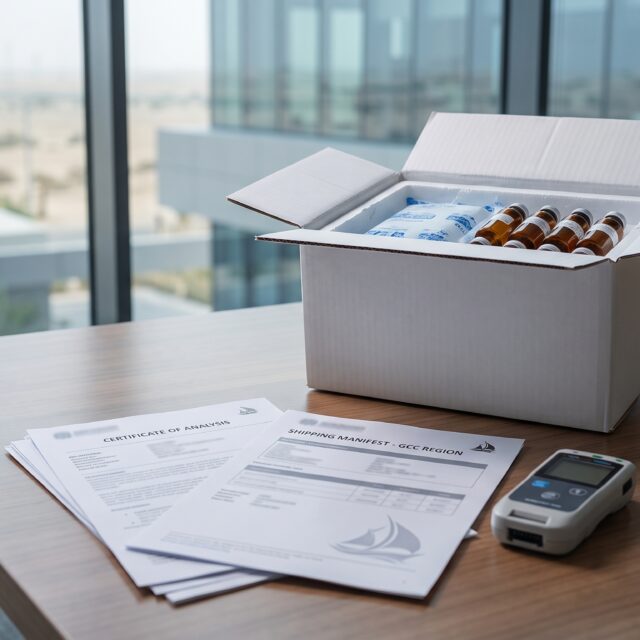
Why the Certificate of Analysis (COA) is Your Primary Safety Net
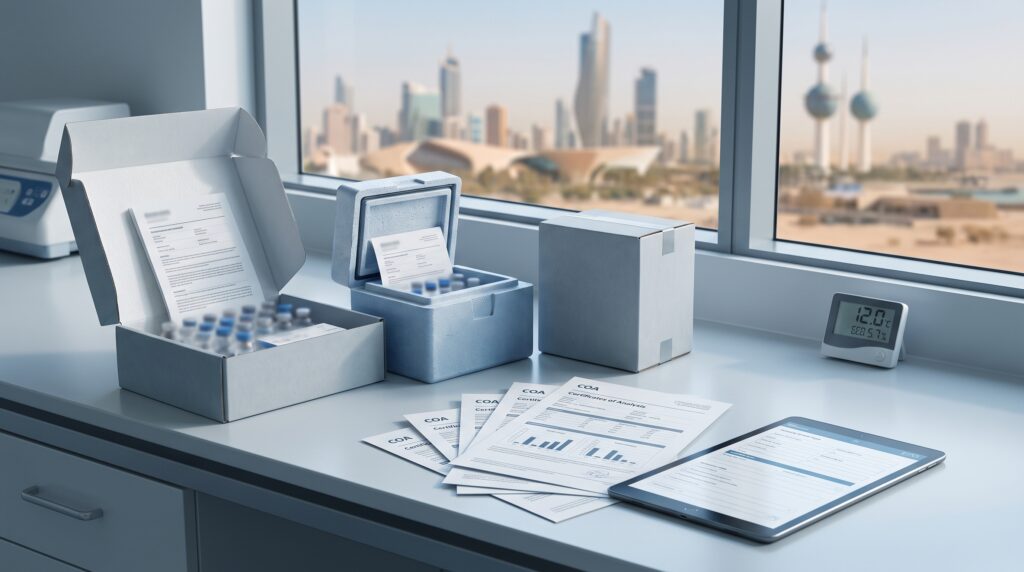
A professional supplier will always provide transparent documentation. The most critical document you must review before placing any order is the Certificate of Analysis (COA). Many online vendors claim they have the “highest quality” products, but without a third-party verified COA, these claims are entirely meaningless.
A comprehensive peptide purity guide in Kuwait must begin with the two primary analytical techniques detailed on a legitimate COA: HPLC and Mass Spectrometry.
High-Performance Liquid Chromatography (HPLC)
HPLC is the scientific standard used to separate, identify, and quantify each component within a mixture. When you look at an HPLC trace on a COA, you are looking for a single, sharp, primary peak. This peak represents your target peptide.
If the graph shows multiple smaller peaks clustered around the main one, these represent impurities. In peptide synthesis, these impurities are typically deletion sequences (where an amino acid was missed) or truncated sequences (where the chain stopped growing too early). For sensitive biochemical research and standardisation, you should look for an HPLC purity rating of 98% or higher. Using sub-98% purity compounds introduces unknown variables that can compromise assay results and lead to costly experimental failures.
Mass Spectrometry (MS)
While HPLC confirms how pure the compound is, Mass Spectrometry (MS) confirms that the compound is actually what it claims to be. MS measures the mass-to-charge ratio of ions to establish the precise molecular weight of the peptide.
The COA should list an “Expected Mass” and an “Observed Mass”. These two figures must align closely (usually within a margin of ±1 Dalton). If the MS data is missing or the observed mass does not match the theoretical molecular weight, the supplier may be selling a mislabeled, degraded, or entirely different compound.
Beating the 50°C Heat: Cold-Chain Logistics in the GCC
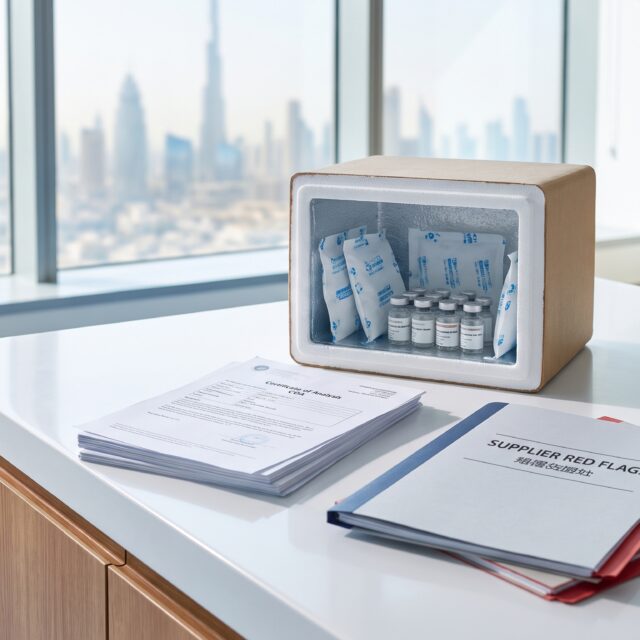
Verifying a COA is only the first step. The second, and arguably most critical challenge for Gulf-based researchers, is the climate. Kuwait’s hyper-arid environment regularly sees summer temperatures surpassing 50 degrees Celsius. Peptides are highly sensitive to heat, light, and moisture, and prolonged exposure to high temperatures will cause rapid structural degradation.
When evaluating a supplier, you must scrutinise their packaging and shipping protocols. Regional presence is a massive advantage here. Ordering from overseas suppliers can result in packages sitting in sweltering customs warehouses for weeks.
Storage and Handling Protocols
To safeguard against heat-induced degradation, premium suppliers implement strict handling protocols:
- Lyophilised (Freeze-Dried) Peptides: In their powder form, lyophilised peptides are relatively stable during short transits if packaged securely. However, for long-term storage, they must be kept in desiccated, airtight containers at temperatures between -20°C and -80°C.
- Reconstituted Peptides: Once a peptide is reconstituted with bacteriostatic water or another solvent, its shelf-life decreases dramatically. Reconstituted solutions must be kept refrigerated at 2°C to 8°C and handled under sterile conditions to prevent bacterial contamination.
For a definitive peptide purity guide Kuwait laboratories can trust, procurement teams must prioritise suppliers that offer regional, climate-controlled shipping. For example, buyers relying on our infrastructure at NOVA Labs benefit from our deep understanding of the region. You can learn more about how we manage temperature-sensitive transits via our secure GCC shipping and UAE next-day delivery network.
Navigating Kuwaiti Customs: PAI, KUCAS, and Labeling
Beyond heat, administrative friction at the border is a major hurdle for importing research chemicals into Kuwait. All chemical imports must comply with the regulations set forth by the Public Authority for Industry (PAI).
Specifically, laboratory reagents and chemical imports fall under the Kuwait Conformity Assessment Scheme (KUCAS). To successfully clear customs without delays that could compromise temperature-sensitive materials, documentation must be flawless. This often involves obtaining a Technical Evaluation Report (TER) and a Technical Inspection Certificate (TIR) for large institutional orders.
Additionally, Kuwait’s import regulations mandate comprehensive labeling on all imported chemicals. A reputable supplier will ensure that vials and packaging clearly display:
- The precise product name and molecular formula.
- Active ingredient percentages and purity claims.
- United Nations CAS (Chemical Abstracts Service) numbers where applicable.
- Clear, unambiguous storage and handling instructions.
If a supplier tries to ship unlabelled “stealth” packages, they risk having the shipment seized by Kuwaiti customs, resulting in a total loss of your procurement budget.
Evaluating Your Supplier: A Buyer Checklist
To ensure your laboratory or research setup receives exactly what was ordered, use this checklist before engaging with a new supplier:
- Demand Batch-Specific Documentation: Never accept a generic COA. The COA must match the exact batch number printed on the vial you receive.
- Verify Independent Testing: Ensure the testing was conducted by a reputable, independent third-party laboratory rather than an in-house, unverified machine.
- Check Local Logistics Capabilities: Ask the supplier how they handle GCC transit. Do they offer cold-chain shipping? Do they have a regional hub that shortens transit time to Kuwait?
- Test Their Support Responsiveness: A trustworthy supplier will offer rapid, professional support. Evaluate whether they have active support channels that understand local GCC challenges.
- Review Payment and Delivery Security: Look for flexible, secure payment options that protect institutional and independent buyers alike.
To view a catalogue of compounds that meet rigorous analytical standards with fully transparent documentation, you can explore our complete catalogue at NOVA Labs.
Conclusion and Next Steps
Successfully sourcing research materials in the Gulf requires diligence. By demanding batch-specific HPLC and MS data, ensuring purities of 98% or higher, and working with suppliers who understand the severe logistical challenges of Kuwait’s 50°C+ climate, you protect the integrity of your research.
Never compromise on documentation, always factor in cold-chain transit, and ensure your supplier complies with KUCAS labeling requirements to avoid costly customs delays.
Disclaimer: The products mentioned in this article are intended strictly for in vitro laboratory research purposes only and are not approved for human or animal consumption, diagnostic, or therapeutic use.
*
References
- High-Performance Liquid Chromatography (HPLC) and Mass Spectrometry in Peptide Quality Control | Journal of Chromatography
- Peptide Storage Best Practices for Stability and Safety | AAPPTEC
- Kuwait Tightens Import Regulations to Enhance Product Safety and Compliance | Watheeq
- Kuwait Conformity Assessment Scheme (KUCAS) Guidelines | Public Authority for Industry (PAI)
- Kuwait – Labeling/Marking Requirements | International Trade Administration
- How to Read a Peptide Purity Test: HPLC, Mass Spectrometry and COA Interpretation for UK Researchers (2026)
- Peptide Storage Best Practices for Stability and Safety
- Kuwait Tightens Import Regulations to Enhance Product Safety and Compliance (October 2024) | Watheeq
- Kuwait – Labeling/Marking Requirements | Privacy Shield
- Peptide Quality – FAQ | AAPPTEC
Frequently asked questions
What is a good purity percentage for research peptides in Kuwait?
For sensitive biochemical research and reliable assay reproducibility, peptide purity should be 98% or higher, as verified by independent HPLC testing.
How should peptides be stored to survive the GCC summer heat?
Lyophilised (freeze-dried) peptides should be stored in desiccated, airtight containers between -20°C and -80°C. Once reconstituted, peptides must be kept refrigerated at 2°C to 8°C.
What is the difference between HPLC and Mass Spectrometry on a COA?
HPLC measures the purity level by separating the compound from impurities like deletion sequences, while Mass Spectrometry (MS) verifies the precise molecular weight to confirm the compound's true identity.
Do peptide imports into Kuwait require specific customs documentation?
Yes, laboratory chemical imports into Kuwait must comply with PAI and KUCAS regulations. This requires accurate chemical labeling, including CAS numbers, and sometimes a Technical Evaluation Report (TER) to avoid customs seizures.
Why is batch-specific COA verification important?
A generic COA does not guarantee the quality of current inventory. A batch-specific COA ensures that the exact manufactured lot you are purchasing has been recently tested for purity and identity.
Nova Labs buyer tools
Ready to verify stock, testing and delivery?
Use the product page and lab report section to check availability, documentation, delivery timing and support before placing an order.
- COA / test-report checks
- Kuwait delivery context
- Cold-chain handling
- COD and card payment options
- WhatsApp support