
Sourcing and maintaining research compounds in the Gulf climate requires strict attention to environmental factors. For laboratories and independent research buyers, managing peptide storage temperature in dubai represents a unique operational challenge. Summer ambient temperatures frequently soar between 40°C and 48°C, and coastal relative humidity spikes above 70%. Standard temperate-climate handling protocols are not enough here. Preserving the structural integrity of these delicate amino acid sequences demands a comprehensive understanding of thermal degradation, cold-chain logistics, and proper local laboratory storage procedures.
Whether you are assessing a new supplier’s operational infrastructure or upgrading your own facility’s storage protocols, understanding how environmental stressors impact chemical bonds is critical for accurate research outcomes.
Key Takeaways: Dubai Peptide Handling
- Dry (Lyophilized) Peptides: Store at -20°C to -80°C for maximum long-term stability and protection against ambient heat.
- Liquid (Reconstituted) Peptides: Must remain refrigerated between 2°C and 8°C; never freeze them to prevent crystal shearing.
- Humidity Risk: Acclimatize frozen vials to room temperature before opening to prevent internal condensation and rapid degradation.
- Logistics: Utilize local suppliers offering advanced Phase Change Material (PCM) packaging to avoid customs delays and tarmac exposure.
What is the Proper Peptide Storage Temperature in Dubai?
The proper peptide storage temperature in Dubai is strictly dictated by the compound’s format. Unreconstituted, lyophilized peptide powder must be kept frozen at -20°C for long-term preservation. Once reconstituted into a liquid solution, peptides require continuous refrigeration between 2°C and 8°C and must be utilized within 14 to 30 days.
The Impact of the Gulf Climate on Peptide Stability
Peptides are complex chains of amino acids connected by fragile peptide bonds, making them highly susceptible to physical and chemical degradation. When exposed to uncontrolled thermal environments, these intricate structures can undergo rapid hydrolysis (cleavage of bonds by water), oxidation, and aggregation, rendering the compound useless for precise laboratory assays.
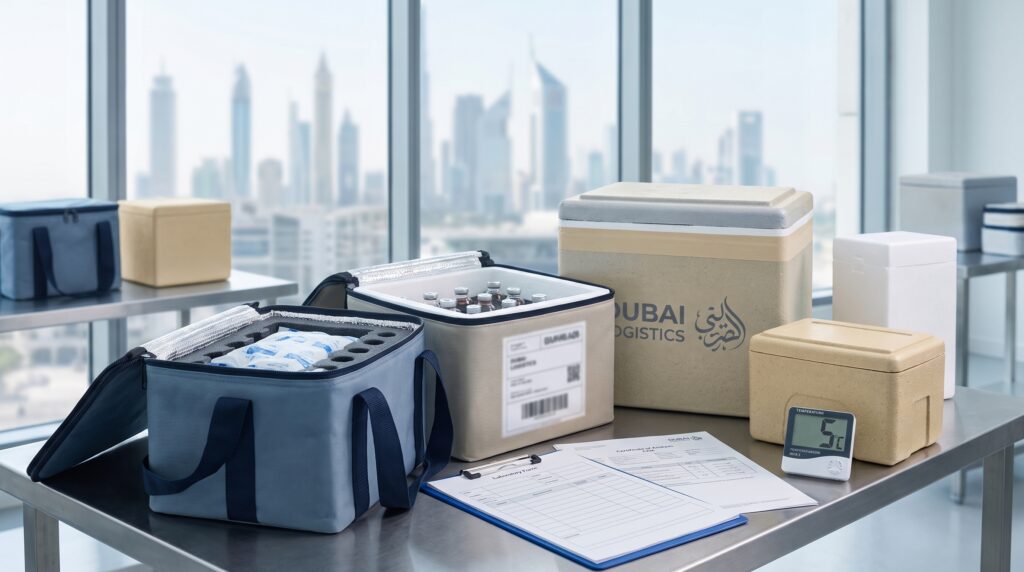
In the UAE, the primary threat to peptide purity is often not the laboratory freezer itself, but unmonitored transition windows during shipping and delivery. Standard international shipping routes frequently expose parcels to the “airport tarmac threat.” When unairconditioned delivery vans, customs holding areas, or cargo pallets sit in 45°C ambient heat for even a few hours, the internal temperature of standard packaging rapidly exceeds safe thresholds. Thermal mass from standard gel ice packs quickly depletes under these conditions.
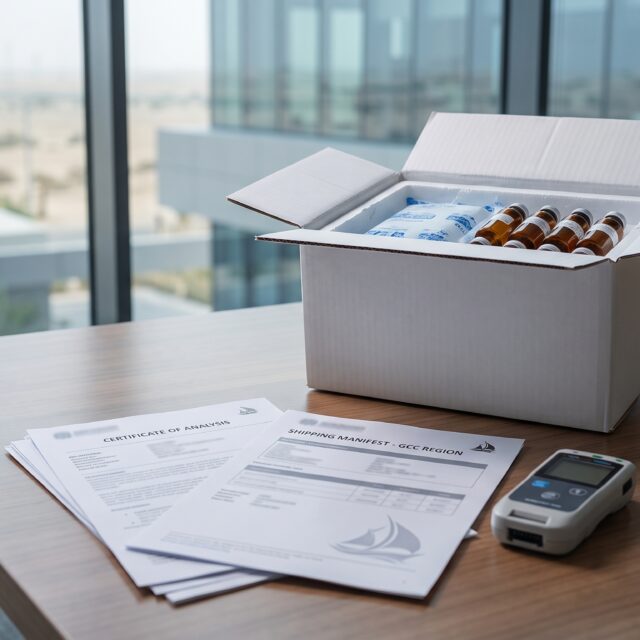
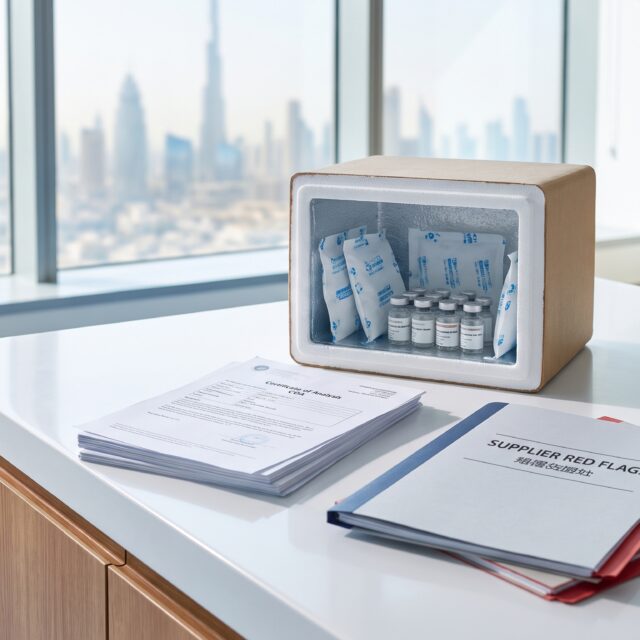
Reliable local vendors mitigate this by utilizing Phase Change Materials (PCMs) rather than standard water-based ice packs. PCMs are engineered to absorb massive amounts of latent heat, ensuring that the internal packaging remains securely within the safe 2°C to 8°C range for up to 72 hours during transit across the Emirates.
Lyophilized vs. Reconstituted: A Complete Laboratory Storage Guide
Distinguishing between dry powder and liquid solution is the absolute foundation of any effective local peptide storage protocol. The state of the compound dictates its thermal resilience.
Storing Lyophilized Peptide Powder
Lyophilization (freeze-drying) actively removes moisture from the peptide while it is frozen under a vacuum, effectively suspending its degradation and ensuring long-term stability. When preserved in this state, peptides are remarkably resilient, provided they are kept away from heat and light.
- Long-term laboratory reserves (6 to 36+ months): Lyophilized vials should be stored in deep freezers at -20°C to -80°C. At these sub-zero temperatures, chemical degradation is virtually halted, allowing researchers to stock up on single batches for long-term studies.
- Short-term storage (1 to 3 months): Standard refrigeration at 2°C to 8°C is generally sufficient for lyophilized powder intended for near-term reconstitution.
- Transit stability: While lyophilized powder is highly stable and can tolerate brief periods at room temperature (around 20°C to 24°C), prolonged exposure to extreme UAE summer temperatures must be actively minimized to prevent premature peptide bond breakdown.
Handling Reconstituted Liquid Peptides
The moment a peptide is reconstituted with bacteriostatic water or sterile laboratory water, its chemical fragility increases exponentially. Aqueous solvents provide the necessary medium for rapid bacterial growth, hydrolysis, and chemical breakdown if temperatures fluctuate even slightly.
- Strict refrigeration required: All liquid peptides must be stored continuously at 2°C to 8°C. They should never be left on a room-temperature lab bench longer than necessary to draw a measurement.
- Operational shelf life: Once reconstituted, the standard operational shelf life is 14 to 30 days. This timeline depends heavily on the specific amino acid sequence and the purity of the solvent used.
- No freeze-thaw cycles: Never freeze a liquid peptide. The expansion of water crystals during freezing physically shears the delicate peptide chains, permanently destroying the compound’s structure. If a reconstituted peptide accidentally freezes, it must be discarded.
Condensation Control: Managing Dubai’s 70% Humidity
Extreme heat is an obvious logistical hurdle in the GCC, but high coastal humidity presents an equally severe threat to research materials. In Dubai, Abu Dhabi, and Sharjah, ambient humidity levels can easily exceed 70% for much of the year, creating severe condensation risks for cold-stored laboratory materials.
When a vial of lyophilized peptide is removed from a -20°C freezer and immediately opened in a humid, air-conditioned laboratory environment, ambient moisture rapidly condenses inside the cold vial. This immediate introduction of water compromises the dry powder, accelerating degradation before the researcher even introduces a calculated solvent.
To prevent irreversible moisture damage, laboratories must follow strict acclimatization protocols. Cold vials should be placed in a closed desiccator (or left in their sealed, moisture-proof transit container) for at least 30 to 60 minutes until they reach ambient room temperature. Only after the vial has naturally warmed to the surrounding temperature should the protective cap be removed. Additionally, premium laboratories ensure their vials are originally filled under an inert nitrogen or argon atmosphere to completely displace reactive atmospheric oxygen during storage.
Evaluating Local Logistics and GCC Suppliers
For UAE researchers, managing the logistical constraints of international procurement often leads to delayed shipments, aggressive customs friction, and thermally compromised compounds. Relying on cross-border shipments during the peak of summer is a significant gamble with research funding.
Bypassing international bottlenecks by partnering with specialized regional suppliers is the most effective way to protect your research investments. By utilizing localized services like same-day delivery in Dubai, researchers completely bypass international shipping hurdles, ensuring the cold chain is maintained from the warehouse directly to the laboratory bench.
When evaluating a local supplier’s operational competence, verify these critical checkpoints:
- Localized Cold-Chain Operations: Does the supplier dispatch directly from regional GCC hubs? Localized sourcing collapses transit windows from several weeks to just a few hours.
- Advanced Packaging Integration: Standard ice packs fail quickly in the Gulf heat. Premium suppliers utilize vacuum-insulated containers and dedicated PCMs to guarantee thermal stability throughout the final delivery mile.
- Flexible Commerce and Support: Trustworthy local operators accommodate regional purchasing habits by offering Cash on Delivery (COD), flexible secure payment plans, and rapid local support via WhatsApp for immediate logistical troubleshooting.
- Transparent Inventory: The ability to check live local stock prevents researchers from accidentally pre-ordering items that will end up back-ordered and stuck in international transit.
Verifying Purity Before Committing to Storage
Proper laboratory storage is only effective if the compound is pure to begin with. The most stringent thermal controls cannot save a heavily degraded or cross-contaminated batch.
Before adding any new compound to your laboratory freezer, strictly verify the supplier’s testing documentation. A legitimate research supplier will provide batch-specific, lot-matched Certificates of Analysis (COAs) conducted by an independent, verifiable third-party laboratory.
These analytical reports should clearly display High-Performance Liquid Chromatography (HPLC) results to confirm purity percentages (aiming for >99%), alongside Mass Spectrometry (MS) data to definitively verify the correct molecular weight of the sequence. If a supplier refuses to provide up-to-date, third-party analytical testing, the compounds are not suitable for controlled research environments.
To explore a catalog of fully documented, locally warehoused compounds that ship using optimized GCC cold-chain protocols, view the NOVA Labs shop.
Conclusion
Protecting the structural integrity of research compounds in the UAE requires proactive, uncompromising management of both extreme heat and high humidity. By strictly adhering to documented temperature protocols—freezing lyophilized powder for the long term and refrigerating fragile reconstituted liquids without exception—researchers ensure their materials remain viable, stable, and accurate for precise analytical work.
Equally important is securing a resilient, localized supply chain. Bypassing international transit delays in favor of Dubai-based suppliers utilizing specialized cold-chain packaging guarantees that your compounds arrive intact. For UAE researchers ready to upgrade their procurement process, browse our complete inventory today and experience the reliability of optimized GCC cold-chain delivery.
Disclaimer: The products and information mentioned in this article are intended for laboratory, analytical, and in-vitro research purposes only. They are not for human or animal consumption, diagnostic, therapeutic, or clinical use.
References
- Thermo Fisher Scientific. (2023). “Peptide Storage and Handling Guidelines.”
- Sigma-Aldrich / Merck Millipore. (2022). “Handling and Storage of Synthetic Peptides.”
- Current Protocols in Protein Science. (2001). “Storage and Handling of Peptides.”
- Genosphere Biotechnologies. (2021). “Best Practices for Peptide Storage and Handling.”
- American Peptide Company. (n.d.). “A Guide to Peptide Handling and Storage.”
- Thermal Stability of Lyophilized Peptides in the Gulf Climate | VaultLabs Technical Whitepaper
- Peptide Storage Guide – UAE Core Peptides
- About UAE Core Peptides | Laboratory Research Supply
- Storage & Handling Guide — Reviva® Research Peptides
- Peptide Storage Temperature Oman: Cold-Chain & Handling – NOVA Labs
- Peptide Storage Temperature Bahrain: Practical Buyer Guide – NOVA Labs
- How to Store Peptides: Complete Guide (Fridge, Freezer & Shelf Life)
- Best Practices for Peptide Storage and Handling – Genosphere Biotechnologies
Frequently asked questions
What is the proper peptide storage temperature in Dubai for dry powder?
Lyophilized (dry) peptide powder should be stored in a freezer at -20°C to -80°C for long-term stability, completely protecting it from Dubai's extreme ambient heat.
How long do liquid peptides last in the fridge?
Once reconstituted with an appropriate solvent, liquid peptides must be stored continuously at 2°C to 8°C and typically maintain a usable laboratory shelf life of 14 to 30 days.
Can I freeze a reconstituted liquid peptide?
No. Freezing a liquid peptide causes water crystals to form and expand, which physically shears and permanently destroys the delicate amino acid structures.
How does Dubai humidity affect peptide storage?
High humidity can ruin dry peptide powder if condensation forms inside a cold vial. To prevent this, always let refrigerated or frozen vials sit in a desiccator for 30 to 60 minutes to reach room temperature before opening.
Why is local UAE peptide delivery better than international shipping?
Local delivery bypasses international customs delays and dangerous airport tarmac exposure, reducing transit times to hours and ensuring temperature-sensitive cold-chain packaging remains intact.
Nova Labs buyer tools
Ready to verify stock, testing and delivery?
Use the product page and lab report section to check availability, documentation, delivery timing and support before placing an order.
- COA / test-report checks
- Dubai delivery context
- Cold-chain handling
- COD and card payment options
- WhatsApp support