
Peptide Storage Temperature UAE: The Short Version
For proper peptide storage temperature in the UAE, unopened lyophilised vials should be refrigerated at 2°C to 8°C for up to 36 months or frozen at -20°C for long-term preservation. Once reconstituted with bacteriostatic water, solutions must remain refrigerated between 2°C and 8°C and used within 28 days.
Securing research-grade compounds requires understanding their molecular fragility. When operating a laboratory or procuring materials in the GCC, local environmental factors dictate entirely different handling protocols than those used in cooler climates. Here is how to evaluate supplier handling practices, protect your investment from transit heat, and maintain peak stability.
Why the UAE Climate Demands Strict Cold-Chain Logistics
A high-purity peptide is useless if it degrades during last-mile delivery. In the United Arab Emirates, where summer outdoor and tarmac temperatures regularly exceed 45°C, transit environments quickly become hostile to delicate amino acid sequences.
Some international suppliers claim that shipping temperatures are irrelevant as long as vials avoid direct sunlight. This is a false and costly assumption. While lyophilised (freeze-dried) compounds are far more stable than liquid solutions, sustained exposure to extreme heat—such as sitting in a hot delivery van or customs warehouse in Dubai—accelerates molecular degradation and denaturation.
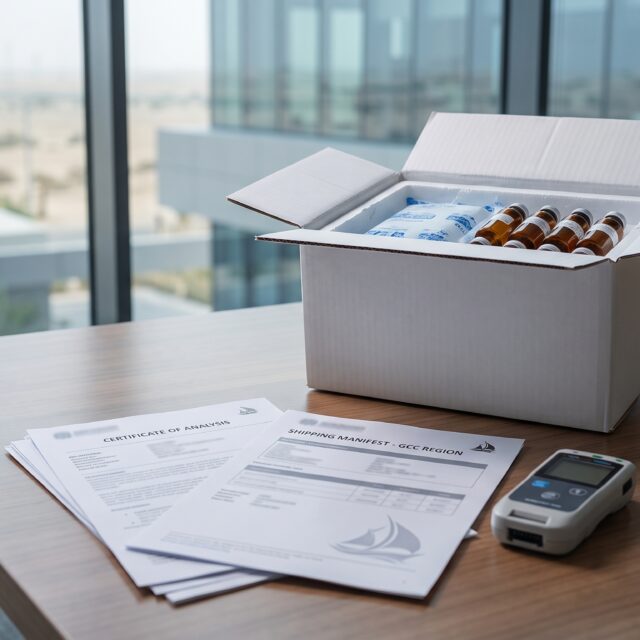
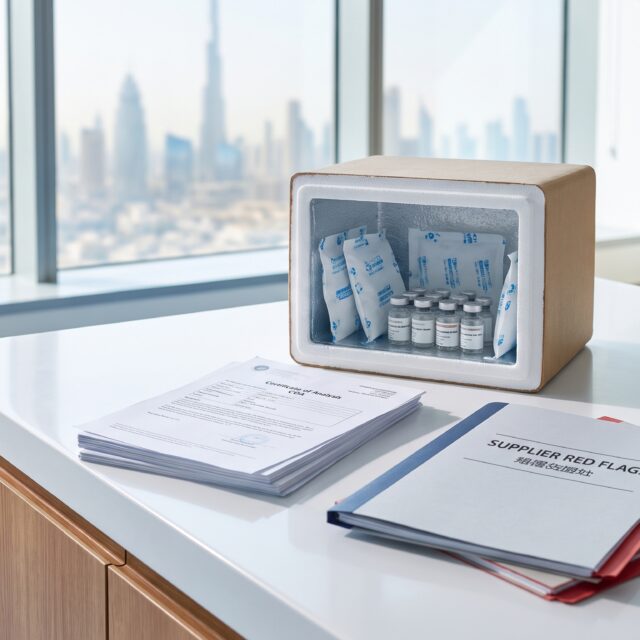
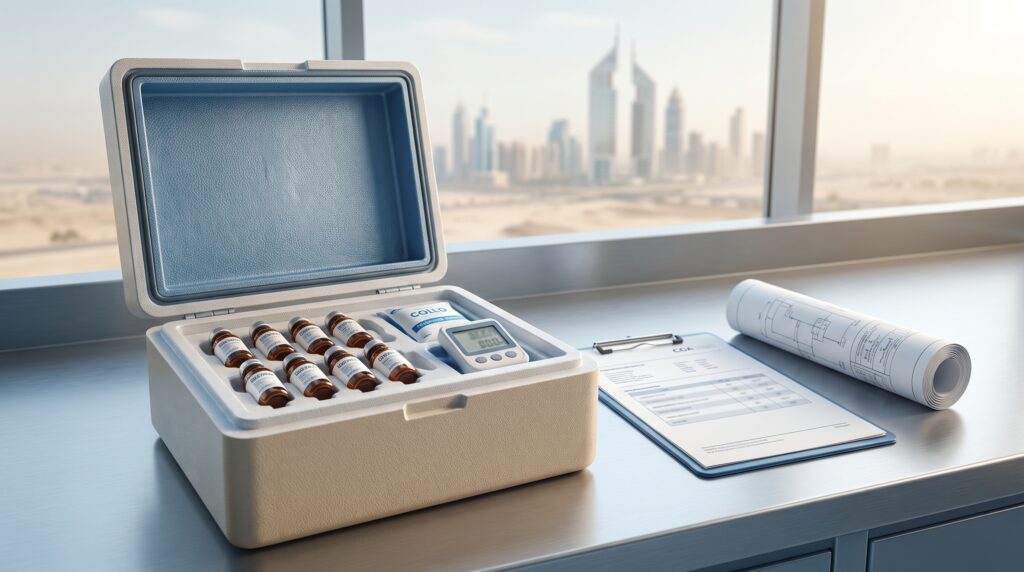
Reputable research suppliers counteract this by utilising passive temperature-controlled packaging. This involves insulated mailers combined with phase-change materials designed to maintain a stable, cool environment throughout transit. When evaluating a supplier, ask about their local dispatch protocols. Ensuring your supplier provides next-day delivery in the UAE is the most effective way to minimise the duration your compounds spend outside a controlled climate.
Lyophilised vs. Reconstituted Storage Rules
Understanding proper peptide storage temperature in the UAE means differentiating between the dry powder (lyophilised) and the liquid mixture (reconstituted).
Storing Unopened Lyophilised Vials
In their freeze-dried state, these compounds are robust but still require strict temperature management. For short- to medium-term storage, placing unopened vials in a laboratory refrigerator at 2°C to 8°C preserves stability for up to 36 months, depending on the sequence.
For long-term reserves, unopened vials should be frozen. Standard freezer temperatures of -20°C maintain stability for up to 60 months, while ultra-low temperature freezers (-80°C) offer even greater longevity. Always document the date of freezing and maintain a comprehensive inventory log.
Handling Reconstituted Solutions
Once mixed with a diluent, molecular structures become significantly more vulnerable to degradation, bacterial contamination, and temperature fluctuations.
Reconstituted solutions must be placed immediately in a refrigerator at 2°C to 8°C. Never keep them at room temperature. The lifespan of a liquid compound depends heavily on the diluent:
- Bacteriostatic Water (BAC): Containing 0.9% benzyl alcohol to inhibit bacterial growth, BAC water allows reconstituted peptides to remain stable for up to 28 days when properly refrigerated.
- Sterile Water: Lacking antimicrobial properties, sterile water provides a much shorter stability window. Compounds reconstituted with sterile water typically risk contamination within 5 to 7 days.
The Dubai Condensation Trap: Managing Humidity Risks
While high temperatures are an obvious threat, the extreme humidity found in coastal UAE cities like Dubai presents a less understood risk to peptide integrity: condensation.
When you remove a frozen or refrigerated vial of lyophilised powder and immediately unseal it in a humid room, ambient moisture rapidly condenses on the cold surfaces inside the vial. This sudden moisture causes premature hydrolysis, fundamentally altering the compound before you have even begun your protocols.
To avoid this condensation trap, implement an equilibration protocol. Before opening a cold vial, place it inside an airtight desiccator at room temperature. Allow the vial to gradually adjust to the ambient temperature of the laboratory. The desiccant material absorbs any stray moisture, ensuring the fragile powder remains entirely dry until you introduce your diluent.
Avoiding the Frost-Free Freezer Hazard
When opting for deep-freeze storage (-20°C to -80°C), the type of freezer used is critical. A common laboratory error is storing valuable research compounds in standard commercial or domestic “frost-free” freezers.
Frost-free appliances prevent ice build-up by running automatic defrost cycles. These cycles periodically raise the internal temperature, creating microscopic freeze-thaw events. Repeated freeze-thaw cycles physically stress and ultimately destroy the fragile bonds holding sequences together.
If you must freeze reconstituted liquids—a practice generally avoided unless strictly necessary—industry standard protocol dictates aliquoting the solution into single-use micro-vials before the initial freeze. This ensures you only thaw the exact amount required, protecting the remaining reserve.
Procuring Peptides in the UAE: What to Check
Establishing a reliable storage framework is only useful if the compounds you purchase are pure and properly handled before they reach you. When evaluating suppliers in the GCC, look for specific operational signals that indicate professional quality control.
First, verify independent third-party testing. A Certificate of Analysis (COA) supported by High-Performance Liquid Chromatography (HPLC) and Mass Spectrometry (MS) is the only objective proof of purity and identity.
Second, assess logistical infrastructure. Customs friction can delay international shipments for weeks, exposing packages to fluctuating warehouse temperatures. Suppliers who hold physical stock within the UAE and clear products under correct laboratory reagent classifications (such as HS Code 38229000) bypass these delays. Local stock paired with cash-on-delivery (COD) options and responsive support demonstrates a commitment to the local research community.
At NOVA Labs, we focus on mitigating these exact regional challenges by maintaining local UAE inventory, enforcing rigorous cold-chain protocols, and publishing verifiable testing data for our entire catalogue.
Bottom Line on UAE Peptide Stability
Maintaining the correct peptide storage temperature in the UAE is an ongoing process that begins the moment a vial is dispatched. By demanding cold-chain shipping, understanding the distinct requirements of lyophilised versus liquid states, and protecting your materials from humidity and freeze-thaw cycles, researchers can ensure the integrity of their data.
Whether you are evaluating metabolic research compounds or structural proteins, verifiable purity and professional logistics are non-negotiable. To review our latest HPLC/MS testing reports, confirm local stock availability, and secure temperature-controlled delivery for your laboratory, browse our peptide shop today.
References
- Manning, M. C., Chou, D. K., Murphy, B. M., Payne, R. W., & Ruth, A. S. (2010). Stability of protein pharmaceuticals: an update. Pharmaceutical Research, 27(4), 544-575.
- Patel, S. M., Doen, T., & Pikal, M. J. (2010). Lyophilization and development of solid protein pharmaceuticals. International Journal of Pharmaceutics, 390(1), 2-11.
- United States Pharmacopeia (USP). General Chapter <1044> Cryopreservation of Cells and Peptides.
Disclaimer: The products mentioned in this article are for in-vitro research purposes only and are not intended for human consumption or therapeutic use.
- Peptide Storage Guide | UAE Core Peptides
- Peptide Therapy in Dubai & Abu Dhabi | DNA Health and Wellness
- FAQs For Peptides And Shipping – PharmaLab Global UAE
- Shipping Policy – UAEPeptide.ai
- Peptides Compounding Pharmacy Dubai – CureCell
- Peptide Storage Temperature Bahrain: Practical Buyer Guide – NOVA Labs
- Peptide Storage Temperature Saudi Arabia: Stability & Cold – NOVA Labs
Frequently asked questions
How long do lyophilised peptides last in the fridge?
When kept at standard refrigeration temperatures (2°C to 8°C), unopened lyophilised peptides remain stable for up to 36 months, depending on the specific sequence.
Can I freeze reconstituted peptides?
Yes, but it is not recommended for bulk vials. Repeated freeze-thaw cycles destroy molecular bonds. Instead, aliquot the liquid into single-use micro-vials before the initial freeze to protect the remaining reserve.
Does shipping temperature matter for peptides in the UAE?
Absolutely. Extreme UAE summer temperatures, often exceeding 45°C on shipping tarmacs, rapidly denature uninsulated peptides. Always request passive temperature-controlled packaging and next-day local delivery.
What happens if my peptide vial gets condensation?
Moisture causes premature hydrolysis, degrading the compound before research begins. In high-humidity areas like Dubai, allow frozen vials to equilibrate to room temperature inside an airtight desiccator before opening.
Nova Labs buyer tools
Ready to verify stock, testing and delivery?
Use the product page and lab report section to check availability, documentation, delivery timing and support before placing an order.
- COA / test-report checks
- UAE delivery context
- Cold-chain handling
- COD and card payment options
- WhatsApp support