




How to Buy BPC-157 GCC: Sourcing and Supply Complexities
To safely buy BPC-157 in the GCC, researchers must source from domestic suppliers who maintain local stock. This eliminates international customs seizures and guarantees that delicate peptide structures survive extreme summer heat via cold-chain delivery, all verified through independent, batch-specific HPLC purity testing.
Buyer Checklist for the GCC Market
- Local Inventory: Verify that the supplier holds physical stock in the UAE or KSA to prevent extended customs delays.
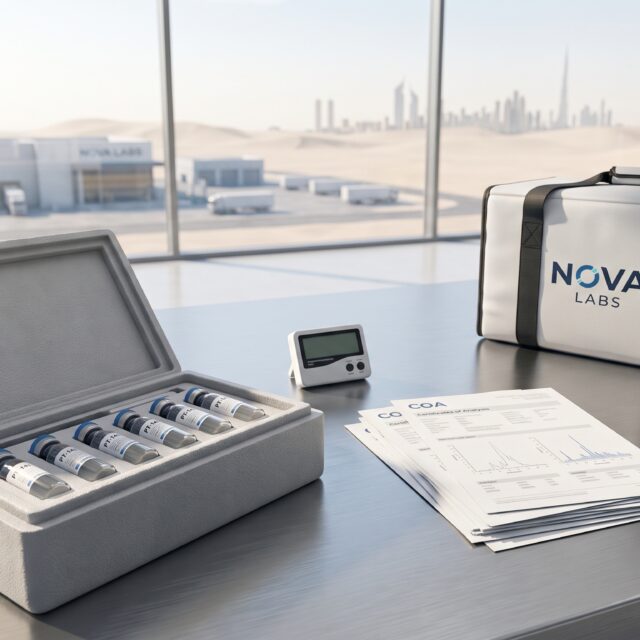
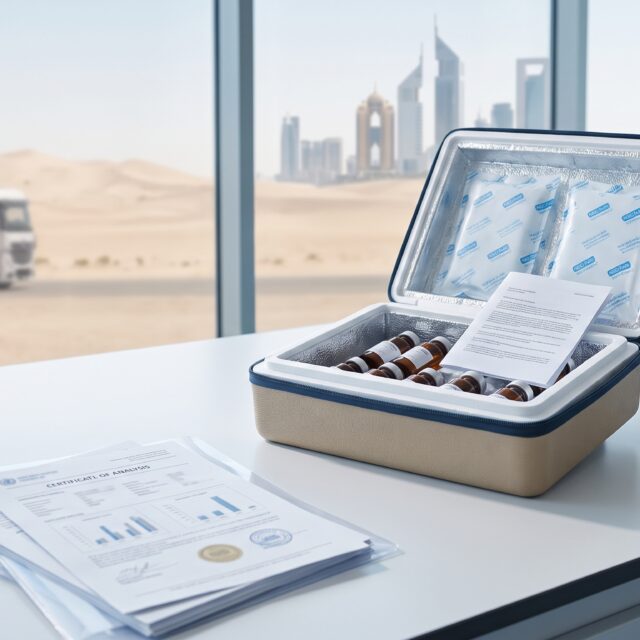
- Cold-Chain Logistics: Ensure deliveries use expanded polystyrene (EPS) packaging and phase-change gel packs.
- Batch-Specific COAs: Demand up-to-date HPLC and Mass Spectrometry reports proving 99% or higher purity.
- Secure Payment Infrastructure: Look for reputable domestic payment options like COD, Tabby, or Tamara.
For procurement officers, independent researchers, and analytical buyers evaluating the local market, the decision to order research materials requires navigating a highly specific set of regional challenges. The Middle Eastern peptide landscape is rapidly evolving, bridging the gap between premium international manufacturers and the localized demands of laboratories across the United Arab Emirates, Saudi Arabia, and neighboring nations.
To successfully secure high-quality BPC-157 for in-vitro assays or molecular stability profiling, researchers must account for the GCC’s extreme summer climate, complex customs regulations regarding imported laboratory materials, and the absolute necessity of verifiable purity documentation. This guide details how to confidently evaluate a domestic BPC-157 supplier, verify independent analytical testing, and ensure your research compounds arrive with their structural integrity completely preserved.
Avoiding Customs Friction: Why Local GCC Stock is Critical
Historically, purchasing research peptides meant importing them directly from synthesis laboratories in the United States, Europe, or Asia. However, when you attempt to buy BPC-157 GCC directly from overseas, you expose your procurement process to severe logistical friction.
Direct peptide imports are highly prone to customs delays and administrative holds in the UAE, KSA, Qatar, Kuwait, Bahrain, and Oman. Regional customs authorities heavily scrutinize imported chemical compounds, often requiring specialized import permits and extensive documentation that can take weeks to process. Furthermore, when international shipments are held up in regional customs facilities—such as airport cargo terminals—they are frequently exposed to unconditioned storage environments.
Extended delays at border checkpoints dramatically increase the risk of compound degradation. By choosing a verified domestic BPC-157 supplier in the GCC, researchers bypass these importation hurdles entirely. Reputable domestic suppliers have already navigated the complex import compliance landscape, paid the necessary duties, and hold inventory locally. This localized model allows for rapid, secure, and legally compliant dispatch directly to your laboratory facility without the risk of seizure or protracted delays.
The Threat of the Climate: The Science of Cold-Chain Delivery
BPC-157 is a synthetic 15-amino acid sequence. Like all delicate molecular structures, it is highly sensitive to environmental extremes, specifically heat and ultraviolet radiation. In the Middle East, where ambient summer temperatures regularly exceed 40°C (104°F), traditional postal networks and standard courier services pose a severe threat to peptide integrity.
The primary risks to peptides in high-heat environments are hydrolysis and oxidation. If a vial sits in the back of an un-air-conditioned delivery van in Dubai or Riyadh for even a few hours, the lyophilized (freeze-dried) powder can begin to denature, compromising the compound’s viability and yielding inaccurate data for subsequent research.
When evaluating a BPC-157 peptide GCC supplier, their logistics framework is just as critical as the quality of the product itself. Top-tier suppliers utilize specialized cold-chain packaging protocols. A compliant cold-chain infrastructure includes:
- Thermally Insulated Packaging: EPS (Expanded Polystyrene) or high-density polyurethane foam coolers that resist external ambient temperatures.
- Phase Change Materials (Gel Packs): Refrigerant blocks specifically engineered to maintain a stable, cool internal environment (typically 2°C to 8°C) for up to 48 hours in transit.
- Expedited Courier Networks: The capability to dispatch and deliver within tightly controlled 24- to 48-hour windows, ensuring the package arrives before the thermal insulation is compromised.
Maintaining the cold chain from the warehouse to your laboratory bench is a paramount operational priority. To understand the rigorous protocols required to achieve this across the region, you can review our comprehensive guide on peptides UAE next day delivery.
Verifying Purity: Deconstructing BPC-157 Peptide Documentation
The cornerstone of any reliable research chemical transaction is absolute transparency in analytical testing. The visual appearance of a lyophilized cake provides zero indication of its molecular purity or identity. Therefore, buyers must rely on a comprehensive Certificate of Analysis (COA).
When reviewing a BPC-157 COA, informed buyers should look for specific, verifiable data points rather than accepting a generic or templated document:
High-Performance Liquid Chromatography (HPLC)
HPLC is the analytical gold standard for separating, identifying, and quantifying each component in a mixture. A reputable COA will display a high-resolution chromatogram charting the results. For BPC-157 intended for rigorous research, the industry benchmark is a purity level of 99% or greater. Any supplier unable to provide a clear, legible HPLC report showing >99% purity should be immediately disqualified.
Mass Spectrometry (MS)
While HPLC confirms the purity of the sample, Mass Spectrometry (MS) confirms the exact molecular weight and structural identity of the peptide sequence. BPC-157 has a highly specific molecular mass. The MS chart provided by the supplier must perfectly align with this established theoretical mass to rule out cross-contamination, synthesis errors, or mislabeling.
Batch-Specific Reporting and TFA Removal
A massive red flag when trying to order BPC-157 in the GCC is the presence of an outdated or static COA. Testing must be batch-specific. If a supplier displays a COA dated three years ago, it offers zero assurance regarding the specific vial you are purchasing today. Always verify that the batch number on the physical vial corresponds directly to the provided analytical report. Additionally, advanced suppliers will ensure excess Trifluoroacetic acid (TFA)—a toxic byproduct of the synthesis process—has been properly removed, preventing interference in cellular assays.
Evaluating Supplier Legitimacy: Payment Gateways and Support
Beyond purity verification and shipping logistics, the transactional mechanics of a supplier dictate their long-term reliability. The GCC peptide market has adapted to the unique purchasing preferences of regional researchers, placing a heavy emphasis on seamless communication and flexible, secure payment structures.
Secure Payments: COD and BNPL Integrations
Trust is hard-won in the research chemical sector. To mitigate buyer apprehension and prove domestic capability, many premium GCC suppliers offer Cash on Delivery (COD) services. This allows researchers to physically receive their cold-chain package before relinquishing funds. Furthermore, the integration of Buy Now, Pay Later (BNPL) platforms, such as Tabby and Tamara, has become a strong indicator of a supplier’s domestic legitimacy. These regional financial institutions stringently vet the merchants they partner with, requiring commercial licenses and proven operational histories.
Responsive Local Support
In the UAE, KSA, and broader GCC, traditional email communication is frequently secondary to direct, instant messaging. A reliable supplier will maintain a dedicated, highly responsive WhatsApp support channel. This provides researchers with immediate, human-led assistance for stock checks, delivery window coordination, urgent COA requests, and rapid resolution of any logistical queries.
Conclusion: Sourcing Safely and Confidently
The decision to procure BPC-157 in the GCC requires an analytical, cautious approach. By prioritizing domestic suppliers who hold local stock, demanding rigorous independent HPLC and MS testing, and utilizing strict cold-chain logistics, researchers can entirely bypass the logistical nightmares of international importation and ensure their materials yield accurate, uncompromised data.
Focus on verified, batch-specific documentation and demand logistical excellence. At NOVA Labs, we have meticulously engineered our procurement and local logistics infrastructure to solve these exact challenges for researchers across the Middle East. We provide guaranteed local warehousing, uncompromising cold-chain dispatch, and accessible, batch-verified analytical data for every compound.
To review our analytical documentation and secure reliable, premium-grade stock for your laboratory, explore our dedicated BPC-157 product page.
Disclaimer: All products discussed in this guide are strictly for laboratory, in-vitro, and analytical research purposes only. They are not intended for, nor approved for, human consumption, clinical treatment, or therapeutic use. Handle all research chemicals according to standard laboratory safety protocols.
*
References
- Market Analysis of Local Stock Availability and Cold-Chain Compliance in the GCC Region, Independent Logistics Data (2023).
- Standards for High-Purity Research Peptides and Laboratory Supply, Middle East Analytical Guidelines.
- Guidelines on the Preservation of Lyophilized Research Compounds in Extreme Climates (UAE & KSA Transport Studies).
- National Center for Biotechnology Information (NCBI). Stability of Synthetic Peptides Under Environmental Stress. Analytical Chemistry Protocols.
- Buy BPC-157 UAE – Emirates Peptides
- Peptide Therapy In Dubai | Peptide Injection | AED1300 – Enfield Royal Clinic Dubai
- Peptides Lab GCC – High-Purity Research Peptides | GCC Supply for Laboratories
- Peptide Storage & Handling — Lyophilized & Reconstituted | UAEPeptide.ai
Frequently asked questions
Is BPC-157 legal to buy in the UAE and GCC?
Yes, BPC-157 is legally available to purchase in the UAE and GCC specifically as a research chemical. It must be bought strictly for laboratory, in-vitro, or analytical research purposes and is strictly not sold or approved for human consumption.
Why is cold-chain delivery critical for peptides in the GCC?
The GCC region experiences extreme summer temperatures that regularly exceed 40°C. If delicate peptide structures are exposed to this heat, they rapidly degrade. Cold-chain delivery uses insulated packaging and phase-change gel packs to maintain a cool environment, ensuring the compound's purity is preserved.
What must I verify on a BPC-157 Certificate of Analysis (COA)?
A reliable COA for BPC-157 must be batch-specific. It should include High-Performance Liquid Chromatography (HPLC) results demonstrating a purity of 99% or greater, alongside Mass Spectrometry (MS) data verifying the exact molecular weight and identity of the peptide sequence.
What are the advantages of using a local GCC supplier?
Sourcing from a domestic GCC supplier prevents international customs seizures, eliminates extended border delays, and guarantees that sensitive compounds are not left in un-air-conditioned airport warehouses, drastically improving the safety and speed of delivery.
How should researchers store BPC-157 upon delivery?
Lyophilized (freeze-dried) BPC-157 should be stored in a laboratory freezer at -20°C for long-term molecular stability. Once reconstituted with bacteriostatic water for immediate research, it must be kept refrigerated between 2°C and 8°C and protected from direct ultraviolet light.
Nova Labs buyer tools
Ready to verify stock, testing and delivery?
Use the product page and lab report section to check availability, documentation, delivery timing and support before placing an order.
- COA / test-report checks
- GCC delivery context
- Cold-chain handling
- COD and card payment options
- WhatsApp support