




Navigating Peptide Sourcing in the Middle East
When establishing procurement protocols for synthetic peptides in the Gulf Cooperation Council (GCC), procurement teams and laboratory heads face a unique set of environmental and regulatory hurdles. Extreme summer temperatures can rapidly degrade fragile lyophilized compounds in transit, while complex regulatory landscapes at international borders frequently create unpredictable delays.
For researchers focused on growth hormone-releasing hormone (GHRH) analogues, the structural integrity of the compound upon arrival is just as critical as its initial synthesis. Evaluating a supplier in the region requires more than simply comparing baseline prices. Informed buyers must demand highly specific documentation, strict adherence to cold-chain logistics, and compliance with local Research Use Only (RUO) guidelines.
Quick Answer: How to Buy CJC-1295 No DAC GCC
To safely buy cjc-1295 no dac gcc laboratories must source from vendors providing verifiable third-party Certificates of Analysis (COAs) from reputable labs like Janoshik. Prioritize local UAE dispatch to bypass cross-border customs seizures, and mandate strict 2-8°C cold-chain logistics to protect lyophilized peptides from extreme regional heat during transit.
Understanding CJC-1295 No DAC (Modified GRF 1-29) in Research
CJC-1295 No DAC, frequently referred to in scientific literature as Modified GRF 1-29, is a synthetic peptide analogue of endogenous Growth Hormone-Releasing Hormone (GHRH). In highly controlled research settings, it is studied extensively for its ability to stimulate a pulsatile release of growth hormone in cellular and animal models, without inducing a constant, artificially elevated baseline level.
Unlike its counterpart that includes a Drug Affinity Complex (DAC)—which binds to blood albumin to significantly extend the compound’s half-life for continuous activation—CJC-1295 No DAC has a much shorter half-life of approximately 30 minutes. This makes the ‘No DAC’ variant particularly valuable for in-vitro and in-vivo models requiring controlled, episodic stimulation that closely mimics natural biological rhythms and secretory pulses.
Because this specific molecular structure is highly sensitive to environmental stressors, minor variations in batch purity, or degradation due to unauthorized heat exposure, can dramatically skew experimental data. Therefore, securing the highest quality material available is the foundational step of any viable research protocol.
Verifying Purity: The Critical Role of COAs and HPLC Testing
A reputable regional peptide supplier will never ask a laboratory to take their word for product quality. Scientific integrity demands verifiable, quantitative proof. Unfortunately, many international vendors provide static, unvouched PDF reports that are easily manipulated, outdated, or completely fabricated.
When you intend to source research chemicals for a GCC-based facility, you must request a batch-specific Certificate of Analysis (COA). This document should be generated by an independent, third-party laboratory utilizing High-Performance Liquid Chromatography (HPLC) and Mass Spectrometry (MS).
What to Look for on a Peptide COA
When reviewing a testing document, procurement officers should check for three essential metrics:
- Peptide Purity (HPLC): This measures the percentage of the target peptide relative to impurities (such as truncated sequences or synthesis byproducts). Premium research demands a purity level exceeding 98%.
- Net Peptide Content (Mass Spec): Because lyophilized peptides contain counter-ions (like TFA salts) and residual moisture, a 2mg vial will not contain 2mg of active peptide unless it accounts for these factors. A good COA verifies the exact active mass inside the vial.
- Independent Verification: The most trusted reports in the industry feature a unique verification key or barcode that allows the buyer to authenticate the results directly on the testing laboratory’s secure portal.
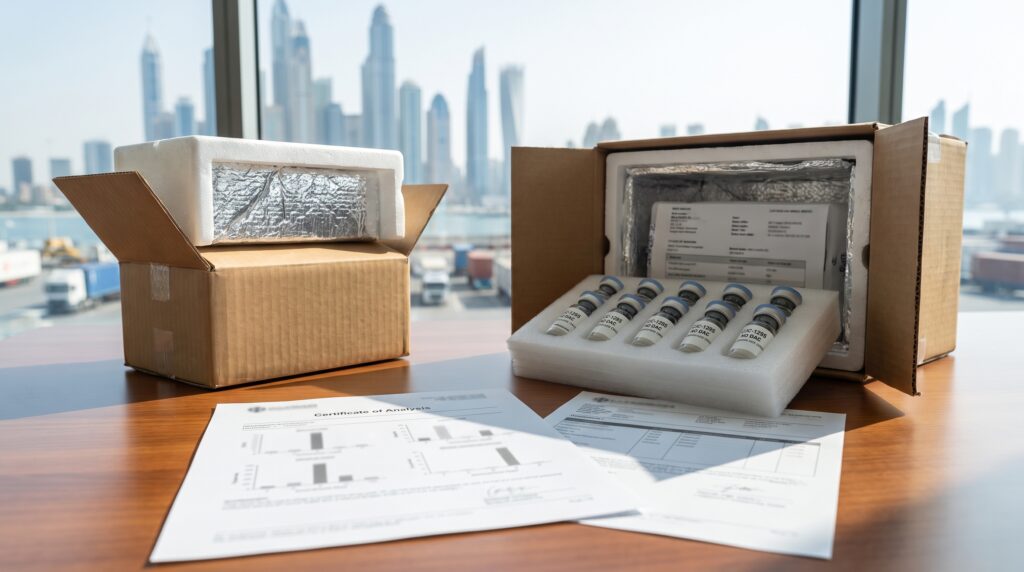
For example, NOVA Labs ensures total transparency for their research compounds. A recent analyzed batch of CJC-1295 No DAC (Batch Number: NVCJND10-01042026) was tested via Janoshik Analytical, verifying an exceptional 99.87% purity level with a precise net content of 10.56mg per vial. This level of precise documentation allows researchers to accurately calculate their experimental reconstitution protocols without the risk of under-dosed or contaminated materials.
Surviving the Desert Heat: The Necessity of Cold-Chain Logistics
The climate in the GCC presents a profound logistical challenge for biochemical suppliers. In the summer heat of the UAE, Saudi Arabia, or Qatar, standard parcel delivery can easily expose lyophilized compounds to temperatures well above 40°C. Prolonged heat exposure accelerates the degradation of the peptide bonds, reducing the compound’s efficacy and rendering it useless for precise scientific research.
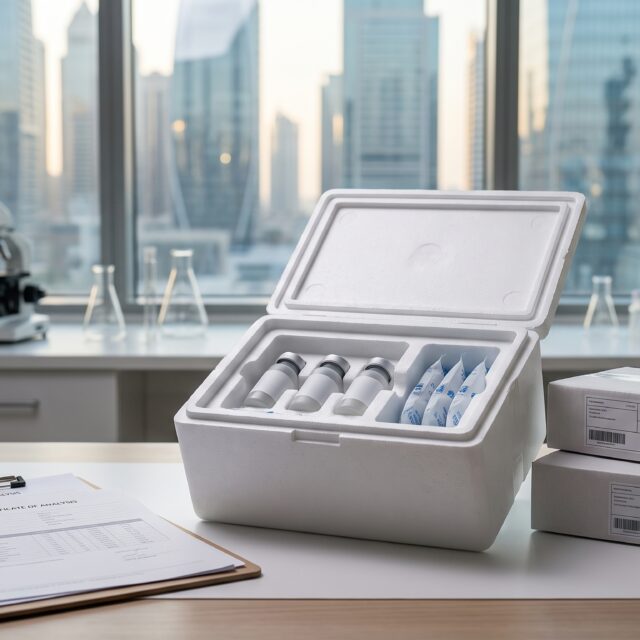
Proper thermal logistics are non-negotiable in this region. To preserve molecular stability, shipments must be handled using specialized cold-chain protocols. This involves packing the vials in vacuum-insulated Expanded Polystyrene (EPS) containers alongside specialized gel cool packs designed to maintain an optimal 2-8°C window throughout the courier network.
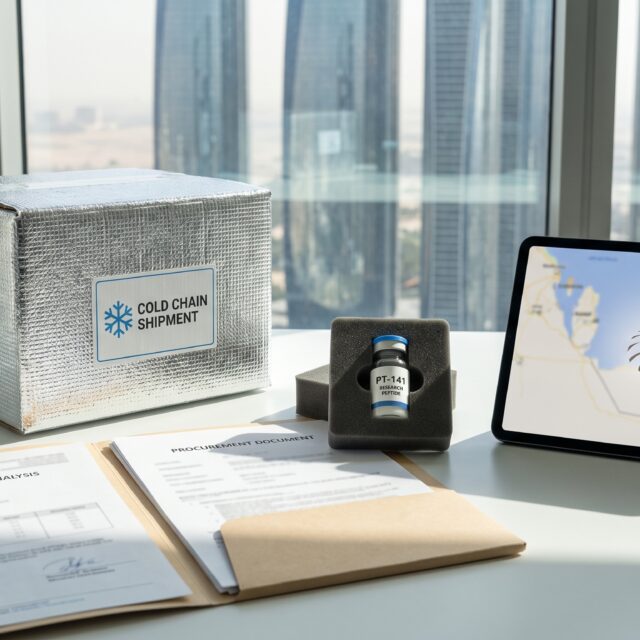
Buyers should look for suppliers who guarantee temperature-controlled transit, particularly during the critical last-mile delivery phase where parcels are most vulnerable. For researchers operating within the United Arab Emirates, utilizing next-day delivery logistics ensures the compound spends the absolute minimum time in transit, drastically reducing the window for thermal degradation.
Bypassing Customs Friction: The Strategic Advantage of Local Hubs
Importing research chemicals internationally into the Gulf region carries inherent and costly risks. Shipments routed through major checkpoints like Zayed International Airport in Abu Dhabi, Dubai International Airport (DXB), or Doha Customs frequently face long hold times. Regulatory scrutiny is intense, and potential seizure is highly likely if documentation is deemed insufficient or misinterpreted by local authorities.
Under recent legislation, such as the UAE’s Federal Decree-Law No. 38 of 2024, the Emirates Drug Establishment (EDE) strictly regulates all pharmaceutical and chemical imports. To maintain legal compliance and clear customs smoothly, peptides must be explicitly designated and correctly invoiced for Research Use Only (RUO).
Suppliers operating localized dispatch hubs within the UAE provide a massive strategic advantage to GCC buyers. By holding inventory domestically, they entirely bypass international customs friction for local UAE buyers, and they significantly streamline cross-border shipping to neighboring GCC countries (like Oman, Bahrain, and Saudi Arabia). This localized positioning not only accelerates delivery times but also eliminates the unpredictable thermal exposure associated with parcels sitting for days in non-climate-controlled customs warehouses.
Payment Protocols and Customer Support Expectations
Commercial transparency extends beyond laboratory testing; it includes how a supplier handles financial transactions and ongoing customer support. Payment infrastructure in the GCC varies depending on local banking regulations, and informed buyers should understand their options before attempting to finalize a procurement order.
Most premium suppliers accept secure, local credit card processing and modern digital wallets such as Apple Pay. While Cash on Delivery (COD) is highly sought after for security and convenience, it is typically restricted to domestic shipments strictly within the UAE. This restriction is due to the complexities of cross-border courier collections and currency conversions. If you are ordering from outside the UAE, expect to use standard secure digital payment gateways.
Furthermore, high-quality vendors offer responsive, locally relevant customer support. The ability to verify real-time stock availability, confirm upcoming batch numbers, request bulk pricing for long-term studies, or resolve delivery inquiries via direct WhatsApp support is a strong indicator of a supplier’s operational maturity and reliability in the region.
The GCC Buyer’s Checklist for CJC-1295 No DAC
Before finalizing an order with any supplier claiming to service the GCC, ensure their operational standards align with this laboratory checklist:
- Third-Party Verification: Does the supplier provide a batch-specific COA from a recognized independent laboratory (such as Janoshik) with a working verification link?
- Thermal Logistics: Do they utilize vacuum-insulated packaging and cool packs to maintain a stable 2-8°C environment during shipping?
- Local Dispatch: Are shipments dispatched from within the UAE or a local GCC hub to prevent unpredictable delays at international customs checkpoints?
- Regulatory Compliance: Are the vials strictly labeled and invoiced for Research Use Only (RUO) to align with regional chemical frameworks?
- Secure Payment Channels: Are domestic payment options available, and are the limitations of Cash on Delivery clearly defined for cross-border shipments?
Conclusion and Next Steps
Sourcing high-purity research peptides in the Middle East requires rigorous evaluation of vendor capabilities. When your laboratory needs to secure CJC-1295 No DAC, researchers must look past generic marketing claims and focus squarely on verifiable analytical data and robust logistics.
By demanding independent Janoshik COAs, ensuring strict cold-chain delivery protocols, and leveraging the speed of localized GCC dispatch hubs, procurement teams can protect their budgets and guarantee experimental integrity.
If you are ready to secure verifiable, laboratory-grade compounds with guaranteed next-day regional delivery, review our latest third-party testing documents and explore our complete catalog at NOVA Labs.
Disclaimer: The products mentioned in this article are strictly for in-vitro and in-vivo laboratory research purposes only. They are not intended for human consumption, therapeutic use, or medical treatment.
References
- Federal Decree-Law No. 38 of 2024, Emirates Drug Establishment (EDE) Regulations.
- Janoshik Analytical: Standard Testing Protocols for Synthetic Peptide Purity and Net Content Verification.
- NOVA Labs Internal Batch Analysis Reports (Batch: NVCJND10-01042026).
- Journal of Clinical Endocrinology & Metabolism: Growth Hormone-Releasing Hormone Analogues in Experimental Models.
- Buy CJC-1295 No DAC UAE: Purity, Delivery & Buyer’s Guide – NOVA Labs
- United Arab Emirates Peptide Laws & Regulations – PeptideLaws.com
- NOVA Labs UAE Review 2026: COA Audit, Prices and Delivery – PeptideStat
- Nova Labs Review 2026: UAE Peptide Supplier COA and Cold-Chain Audit
- Why Cold-Chain Matters for Peptide Stability, Especially in UAE Heat – Swiss Pharma
- Buy CJC-1295 No DAC Qatar: COAs, Customs & Delivery Guide – NOVA Labs
- Buy CJC-1295 No DAC in Oman | Verifiable Purity & Delivery – NOVA Labs
Frequently asked questions
Is Cash on Delivery available for CJC-1295 No DAC orders in the GCC?
Cash on Delivery (COD) is generally restricted to domestic shipments within the UAE due to logistics constraints. For cross-border GCC orders (such as Saudi Arabia or Qatar), standard payment methods like secure credit card processing or Apple Pay are required.
How do I verify the purity of CJC-1295 No DAC before buying?
Always require a batch-specific Certificate of Analysis (COA) from an independent third-party testing facility, such as Janoshik. Ensure the document includes a live verification link to confirm the peptide's purity and net mass directly on the testing laboratory's portal.
Why is local UAE dispatch important for GCC peptide shipments?
Sourcing from a supplier with local dispatch hubs bypasses international customs at major checkpoints. This drastically reduces transit times, minimizes the risk of regulatory seizure, and ensures the peptide remains thermally protected during the last-mile delivery.
What temperature should CJC-1295 No DAC be stored at during transit?
Lyophilized peptides like CJC-1295 No DAC require strict cold-chain logistics. They should be shipped in vacuum-insulated packaging with cool packs to maintain a stable 2-8°C environment, preventing molecular degradation during the extreme summer heat in the GCC.
Nova Labs buyer tools
Ready to verify stock, testing and delivery?
Use the product page and lab report section to check availability, documentation, delivery timing and support before placing an order.
- COA / test-report checks
- GCC delivery context
- Cold-chain handling
- COD and card payment options
- WhatsApp support