


Institutional procurement officers and independent laboratories studying the hypothalamic-pituitary-gonadal (HPG) axis often face distinct logistical hurdles when sourcing specialised compounds in the GCC. For those looking to buy Kisspeptin, Oman presents a unique regulatory environment that requires strict attention to customs documentation, independent testing verification, and climate-resilient transport.
Because local peptide synthesis is generally absent in Oman, high-purity research materials must be imported from established regional hubs like Dubai. This means buyers must navigate cross-border shipping, local regulations, and extreme heat that can quickly degrade fragile biological compounds if improperly handled.
Buyer Checklist: Sourcing Peptides in Oman
- Customs Protocol: Oman utilizes the Bayan single-window system; imports are processed directly through your facility’s Commercial Registration (CR) number.
- Quality Verification: Never procure without a batch-specific Certificate of Analysis (COA) and third-party HPLC/MS reports proving ≥99% purity.
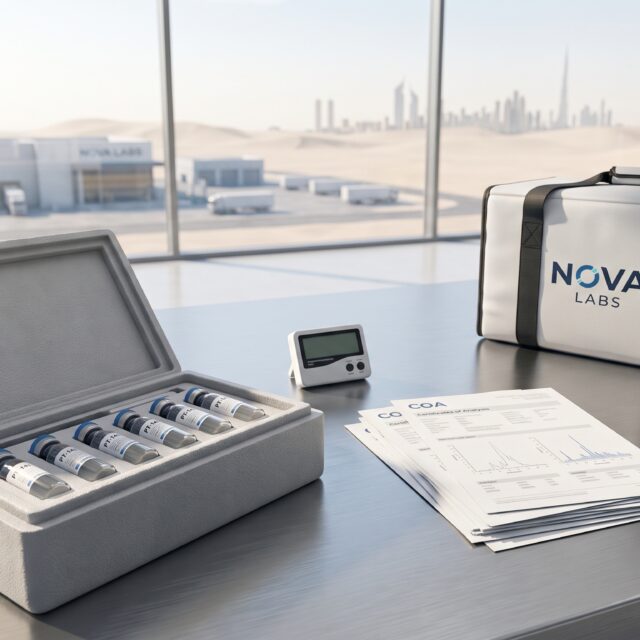
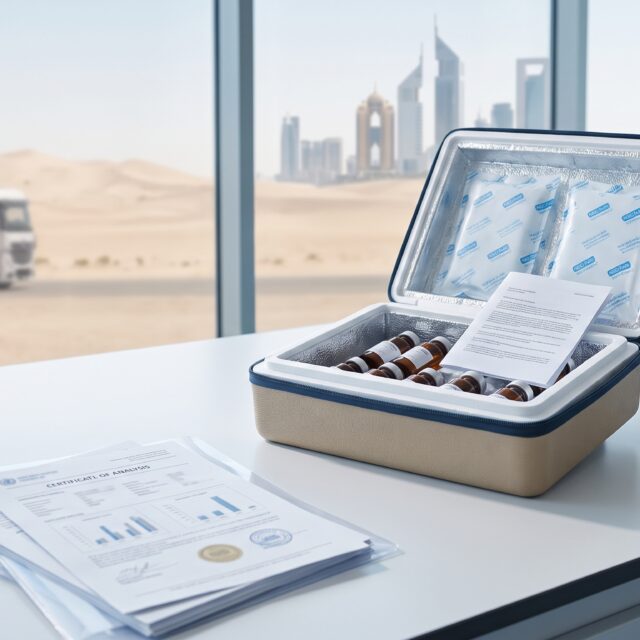
- Logistics: Due to the severe GCC climate, Kisspeptin must be shipped as a lyophilised powder via cold-chain transit.
- Regional Hubs: Sourcing from Dubai-based facilities prevents prolonged delays in un-air-conditioned international customs warehouses.
How to Buy Kisspeptin in Oman
To successfully buy Kisspeptin in Oman, researchers must source from regional GCC suppliers providing batch-specific COAs and third-party HPLC testing. Ensure shipments are dispatched as lyophilised powder via expedited cold-chain logistics, complete with accurate Safety Data Sheets to clear the Bayan customs system without delay.
Navigating the Bayan Single-Window System
Unlike some neighbouring GCC countries that utilise dedicated, item-specific customs codes for individual importers, Oman’s Directorate General of Customs operates via the unified Bayan system. This digital single-window system identifies institutional buyers and independent laboratories directly by their Commercial Registration (CR) number. When importing research chemicals, your clearing agent will link the airway bill and commercial invoice directly to your CR, meaning institutional compliance must be flawless prior to the shipment arriving at Muscat International Airport or local land borders.
Required Customs Documentation
When importing research materials, Oman’s Ministry of Health and Drug Safety Center maintain strict oversight. To prevent friction, delays, or confiscation at the border, a reliable supplier must furnish the following documentation alongside the shipment:
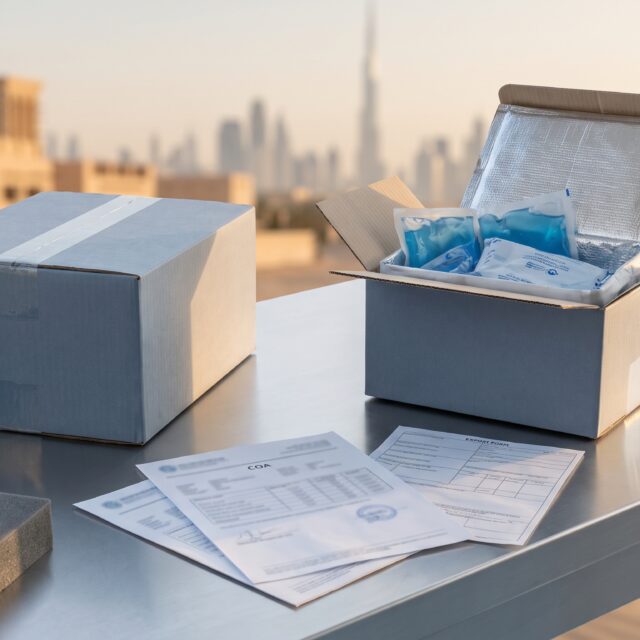
- Certificate of Analysis (COA): This document must be batch-specific and confirm the exact purity of the peptide (typically ≥99%). It is essential for proving the molecular identity of the material matches the commercial invoice.
- Safety Data Sheet (SDS): Outlines the chemical properties, handling risks, and safety precautions required for safe transit. Customs officials rely on the SDS to verify the compound is not hazardous and is intended strictly for in-vitro use.
- Commercial Invoice: Must accurately describe the product as a research chemical, completely devoid of any therapeutic, medical, or dietary claims. Incorrectly labelling research peptides as supplements is a primary cause of customs seizure.
Verifying Quality: COAs, HPLC, and Mass Spectrometry
Before evaluating a supplier’s logistics, it is essential to verify the specifications of the compound being procured. The primary variant utilised in laboratory environments is Kisspeptin-10 (KP-10, CAS 374675-21-5).
KP-10 acts as a crucial upstream regulator of the HPG axis. Researchers study its mechanisms in triggering the release of Gonadotropin-Releasing Hormone (GnRH), which subsequently influences Luteinising Hormone (LH) and Follicle-Stimulating Hormone (FSH) secretion in animal models and cellular assays. Because KP-10 is a delicate neuropeptide, its structural stability is the most critical factor for any in-vitro study.
When reviewing a supplier, an independent testing report is non-negotiable.
- High-Performance Liquid Chromatography (HPLC): This test confirms the purity of the peptide. For research applications, purity should be no less than 99%. HPLC identifies the presence of truncated peptide sequences or impurities left over from the synthesis process.
- Mass Spectrometry (MS): This verifies the molecular weight of the compound, ensuring you have actually received Kisspeptin-10 and not a generic substitute.
- TFA Removal: Inquire if the supplier performs Trifluoroacetic acid (TFA) removal. High residual TFA from the synthesis process can cause cellular toxicity in delicate in-vitro cultures.
Climate Resilience: Cold-Chain Logistics and Storage
The extreme GCC climate poses one of the most significant threats to peptide integrity. Transporting biological materials into Oman without proper thermal safeguards almost guarantees molecular degradation, rendering the compound useless for precise research.
The Importance of Lyophilisation
To combat heat exposure, research-grade Kisspeptin must be supplied strictly as a lyophilised (freeze-dried) powder. Lyophilisation removes the water content from the peptide, drastically improving its thermal stability during transit. If a supplier attempts to ship pre-reconstituted liquid peptides internationally, it demonstrates a severe lack of handling expertise.
Regional Dispatch vs. International Shipping
Procuring peptides from overseas suppliers (such as those in the US or China) often means the package will sit in un-air-conditioned customs warehouses for days during clearance. This is why Omani laboratories increasingly rely on regional hubs.
By operating out of Dubai, premier suppliers bypass the lengthy international transit phase. Leveraging robust local networks—such as the infrastructure that allows for peptides UAE next-day delivery—regional suppliers can rapidly process cross-border shipments to Oman. This ensures the timeline from laboratory dispatch to the researcher’s bench is kept as short as possible, preserving the peptide’s efficacy.
Laboratory Storage Protocols
Once the shipment arrives at your facility in Oman, strict storage protocols must be followed:
- Long-term Storage: Unopened, lyophilised vials should immediately be stored in a laboratory freezer at -20°C. Under these conditions, they can remain stable for up to 24 months.
- Reconstitution: When researchers are ready to begin their assays, the compound must be reconstituted using bacteriostatic water or sterile saline, depending on the assay requirements.
- Short-term Storage: Once reconstituted, the peptide becomes highly fragile. It must be kept continuously refrigerated at 2°C to 8°C and utilised within a few weeks to prevent degradation.
Payment, Support, and Procurement Checks
For institutional buyers in Oman, sourcing complex compounds often requires more than just adding an item to a cart. Professional laboratory suppliers differentiate themselves through dedicated procurement support.
- Dedicated Support Channels: Look for suppliers that offer direct communication (such as WhatsApp or a dedicated institutional email) to coordinate with your local customs clearance agents.
- Flexible Invoicing: Institutional procurement often requires formal Proforma Invoices (PI) and specific line-item descriptions to satisfy internal accounting and commercial banking requirements.
- Secure Payment Gateways: Reliable suppliers offer standard, secure payment methods, including institutional wire transfers and encrypted credit card processing, rather than relying solely on peer-to-peer applications.
Procuring Reliable Peptides for Your Lab
At NOVA Labs, we understand the distinct regulatory and climatic requirements of Middle Eastern researchers. We bridge the gap between global synthesis standards and local logistics, ensuring that when researchers source Kisspeptin in Oman, they receive stable, verified, and high-purity compounds without the traditional friction of international procurement.
Our Kisspeptin-10 is synthesised under rigorous quality controls, and we proudly publish our independent batch testing data so buyers can proceed with total confidence. By operating our primary logistics hub in Dubai, we guarantee that our cold-chain practices are calibrated specifically for the GCC climate.
To view current batch data, review pricing, and secure stock for your next project, explore our research-grade Kisspeptin today.
Disclaimer: All products mentioned in this article, including Kisspeptin-10, are intended strictly for laboratory research and development purposes only. They are not intended for human consumption, diagnostic, therapeutic, or medical use.
*
References
- Oman Directorate General of Customs. “Bayan System Guidelines and Importation Controls.” Royal Oman Police.
- Ministry of Health, Sultanate of Oman. “Guidelines for the Importation of Chemicals and Biological Materials for Laboratory Use.”
- Plant, T. M. (2015). “The role of KiSS-1 in the regulation of puberty and reproduction in the male.” Journal of Endocrinology, 226(2), T17-T28.
- Roa, J., Aguilar, E., Dieguez, C., Pinilla, L., & Tena-Sempere, M. (2008). “New frontiers in kisspeptin/GPR54 physiology as fundamental gatekeepers of reproductive function.” Frontiers in Neuroendocrinology, 29(1), 48-69.
Disclaimer: The products mentioned in this article are for research purposes only and are not intended for human consumption.
- Buy Kisspeptin Oman: Sourcing, Purity & Cold-Chain Delivery – NOVA Labs
- Importing into Oman: Bayan, customs duty and clearing agents
- Customs release and drug release to markets
- Buy GHK-Cu Oman: Purity, COAs & Fast Delivery Guide – NOVA Labs
- Kisspeptin-10 5mg UAE – Buy Research-Grade Peptide, HPLC-Tested – UAEPeptide.ai
Frequently asked questions
Is a special customs code required to import peptides into Oman?
No, unlike some GCC nations, Oman utilises the single-window Bayan system. Importations of research chemicals are processed directly through the purchasing entity's Commercial Registration (CR) number.
How is Kisspeptin shipped to prevent degradation in GCC heat?
Premium suppliers provide the compound strictly as a lyophilised (freeze-dried) powder and utilise expedited, cold-aware logistics from regional hubs like Dubai to ensure thermal stability during transit to Oman.
What documentation is required to clear research peptides in Oman?
Buyers typically need a batch-specific Certificate of Analysis (COA), a comprehensive Safety Data Sheet (SDS), and an accurate commercial invoice stating the product is for research purposes only to satisfy local customs.
What is the standard purity for research-grade Kisspeptin?
High-quality research peptides should demonstrate a purity of 99% or higher. This specification must always be verified by independent, third-party High-Performance Liquid Chromatography (HPLC) and Mass Spectrometry (MS) testing.
Nova Labs buyer tools
Ready to verify stock, testing and delivery?
Use the product page and lab report section to check availability, documentation, delivery timing and support before placing an order.
- COA / test-report checks
- Oman delivery context
- Cold-chain handling
- COD and card payment options
- WhatsApp support