



The Local Challenge: How to Safely Buy KPV in Sharjah
To safely buy KPV in Sharjah, researchers must prioritize local suppliers providing batch-specific Certificates of Analysis (COAs) with HPLC testing. Domestic sourcing ensures sensitive peptides avoid international customs holds and arrive intact via strictly controlled cold-chain logistics, maintaining optimal molecular stability.
Buyer Checklist & Key Takeaways:
- Documentation: Always demand batch-matched High-Performance Liquid Chromatography (HPLC) and Mass Spectrometry (MS) documentation.
- Logistics: Prioritize domestic UAE suppliers to eliminate international customs friction and transit delays.
- Transit Integrity: Ensure the vendor utilizes insulated cold-chain packaging tailored for the Middle East climate.
- Product Format: Select lyophilized powder presentations for maximum chemical stability during transport and storage.
- Support: Look for accessible local communication, such as WhatsApp support, for immediate stock and COA verifications.
For researchers and procurement specialists operating in the UAE, sourcing laboratory-grade compounds requires navigating a highly specific set of logistical and regulatory hurdles. The primary challenge lies in ensuring that sensitive compounds maintain their structural stability during transit, clear local customs regulations without friction, and arrive with irrefutable proof of molecular identity. Historically, buyers in the Gulf relied on overseas vendors, waiting weeks for international shipments and risking degradation. Today, leading regional distributors have established local inventory, dramatically reducing transit times while solving the critical issue of temperature control.
Verification Over Trust: Reading the Analytical COA
The research peptide market is notorious for generalized quality claims. Practically every vendor advertises ‘99% purity’, but for laboratory consistency, marketing statements are meaningless without documentation. When you evaluate suppliers to procure KPV, your primary metric for evaluation should always be the analytical documentation provided.
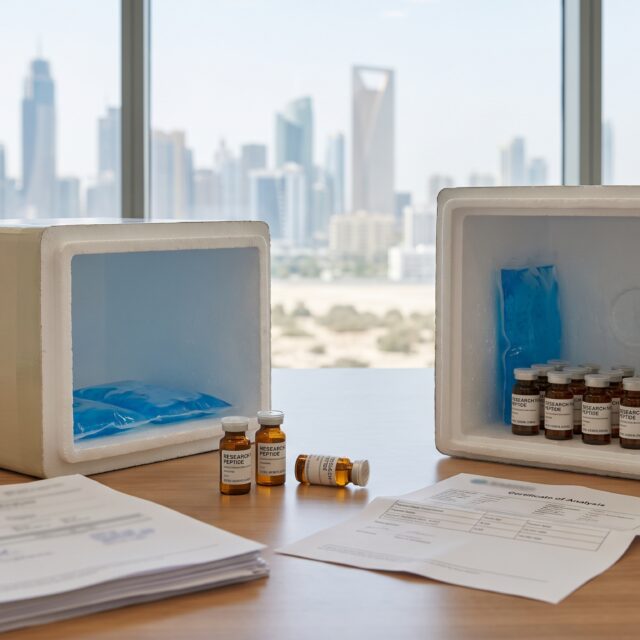
Advanced buyers demand batch-specific Certificates of Analysis (COAs). A legitimate COA must include several critical data points:
- High-Performance Liquid Chromatography (HPLC): Raw chromatogram data visually represents the compound’s purity. Evaluators should look for a singular, distinct peak that clearly separates the primary KPV peptide (Lysine-Proline-Valine) from any synthesis byproducts. Baseline noise should be minimal.
- Mass Spectrometry (MS): This confirms the exact molecular weight of the peptide. The mass-to-charge (m/z) ratio must verify that the sequence weight matches the structural label claim of the KPV molecule perfectly.
- Batch Alignment: The lot number printed on the physical vial upon delivery must correspond perfectly to the batch number on the published COA. If these numbers do not match, the test results do not apply to your specific compound.
- Testing Dates: Peptides degrade over time if stored improperly. Ensure the analytical testing was conducted recently by an independent third-party facility.
If a supplier cannot provide verifiable, third-party HPLC and MS data, the raw material is simply not suitable for rigorous in-vitro applications.
Beating the UAE Heat: Logistics and Cold-Chain Protocols
The climate in the United Arab Emirates poses a significant threat to peptide stability. With summer temperatures in Sharjah routinely exceeding 40°C, a standard cardboard box shipped via regular mail will almost certainly result in degraded compounds. Peptides are fragile amino acid chains; when exposed to excessive heat, chemical bonds break down and denature, leading to compromised and unreliable research outcomes.
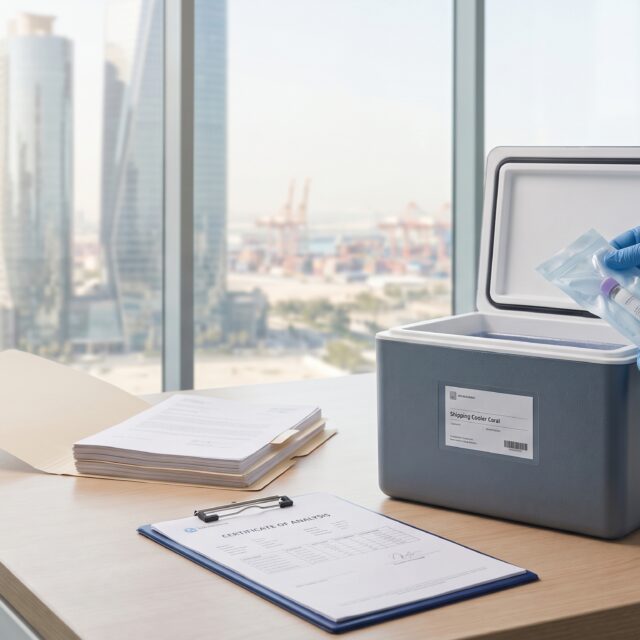
Reputable suppliers handle logistics as a core component of their quality assurance process. Professional thermal-insulated packaging is non-negotiable in the GCC. Procurement teams should look for vendors who utilize specialized insulated mailers equipped with phase-change materials or frozen gel packs to maintain a stable microclimate during transit.
Speed is equally critical. By choosing a domestic supplier over an international one, laboratories bypass lengthy customs holds and unpredictable global freight variables. Top-tier suppliers like NOVA Labs emphasize specialized dispatch routes. Dedicated local stock enables secure, next-day UAE shipping directly to facilities in Sharjah, ensuring the cold chain remains intact from the distributor’s warehouse to your laboratory bench.
Regulatory Reality: Research-Grade Guidelines in the GCC
Understanding the regulatory framework surrounding peptides in the UAE is essential for compliant institutional procurement. The Ministry of Health and Prevention (MOHAP) and local health authorities closely monitor the importation of biological and chemical materials.
There is a strict operational distinction between clinical distribution and research-grade procurement:
- Research-Grade Compounds: Non-prescription peptides intended purely for in-vitro laboratory study, mass spectrometry calibration, or cellular assay research are handled under general commercial trade regulations. They are typically categorized under specific Harmonized System (HS) codes, such as 3504.00 for peptones and their derivatives, or 3824.99 for chemical research compounds.
- Clinical Products: Conversely, any peptide intended for clinical application must pass through strict pharmaceutical registration channels.
Compliant research suppliers will explicitly state their products are restricted solely to in-vitro laboratory research. They will maintain professional boundaries and refuse to provide reconstitution formulas for human application or therapeutic claims.
Evaluating KPV Form Factors for UAE Laboratories
KPV is available in several form factors, and selecting the optimal format depends entirely on the nature of your laboratory work and local storage capabilities.
- Lyophilized Vials: This is the undisputed industry standard for research. Lyophilization (freeze-drying) removes moisture and maximizes the shelf life of the peptide chain. Researchers reconstitute the dry powder using laboratory-grade bacteriostatic water immediately prior to the study, offering the highest degree of control over molar concentration. You can explore standard KPV vials to review typical laboratory presentations designed for maximum shelf life.
- Pre-mixed Liquids: While convenient in highly repetitive testing environments, pre-mixed liquid solutions require significantly stricter cold storage parameters since the compound is already actively suspended in a liquid state, accelerating potential degradation.
- Nasal Sprays and Experimental Suspensions: These formats introduce numerous variables like differing degradation rates and suspension barriers that must be accounted for in experimental design and are generally avoided for baseline analytical studies.
For the highest stability in the Sharjah climate, lyophilized vials remain the most robust and highly recommended option, provided they are properly stored upon delivery.
Post-Delivery Storage Best Practices
Securing safe delivery is only half the battle; maintaining stability post-delivery is critical. Once KPV arrives at a Sharjah facility, immediate transfer to appropriate storage is required to halt degradation.
- Unreconstituted (Lyophilized) State: Vials should remain sealed and stored in a laboratory freezer at -20°C. In this state, lyophilized KPV can maintain its molecular integrity for up to 24 months.
- Reconstituted State: Once bacteriostatic water is introduced, the peptide becomes highly susceptible to bacterial contamination and rapid degradation. Reconstituted KPV must be kept refrigerated between 2°C and 8°C and should typically be utilized within 14 to 21 days for accurate assay results.
- Handling: Always allow vials to reach room temperature before opening to prevent condensation from forming inside the vial, which can rapidly degrade the peptide.
Payments, Security, and Institutional Support
The final hurdle in sourcing research materials often occurs during the checkout process. Many international research peptide suppliers struggle significantly with reliable payment processing. Unregistered research compounds are frequently classified as high-risk by major credit card networks under compliance programs like the Mastercard BRAM (Business Risk Assessment and Mitigation) guidelines. Consequently, standard credit card portals on overseas websites frequently crash, freeze funds, or drop transactions unexpectedly.
Stable financial settlement is a strong indicator of a supplier’s operational maturity. Domestic UAE suppliers bypass international banking frictions by offering localized, secure alternatives. Procurement teams should look for vendors that provide direct, secure bank transfers or Cash on Delivery (COD) options within the UAE.
Additionally, direct local communication is invaluable. Suppliers that offer dedicated WhatsApp business support for real-time stock checks, COA requests, and delivery coordination provide a much higher level of reliability than overseas vendors relying on automated, anonymous contact forms.
Conclusion: Making an Informed Procurement Decision
Whether you are conducting institutional studies, cellular assays, or private laboratory analysis in Sharjah, the decision to source KPV locally should be grounded in verifiable analytical data and logistical reliability. Demand batch-specific HPLC and MS documentation to confirm purity. Insist on specialized cold-chain logistics that account for the extreme GCC climate, and partner with suppliers who maintain strictly compliant, non-medical operations.
By focusing on purity verification, secure transit, and reliable local support, procurement teams can ensure the integrity of their research materials. Explore our full range of rigorously tested compounds at NOVA Labs to secure reliable, locally stocked peptides for your next laboratory study.
*
Disclaimer: The products mentioned in this article are strictly for in-vitro laboratory research purposes only. They are not intended for human consumption, animal consumption, or clinical application. Always follow proper laboratory safety protocols when handling research compounds.
*
References
- United States Pharmacopeia (USP). (2023). Guidelines on High-Performance Liquid Chromatography (HPLC) for Peptide Purity Verification and Baseline Analysis.
- Journal of Peptide Science. (2022). Temperature Stability, Moisture Content, and Degradation Kinetics of Lyophilized Peptides in Extreme Climates.
- Dubai Customs & UAE Federal Customs Authority. (2024). Harmonized System (HS) Codes for Chemical and Laboratory Compounds (Section VI, Chapters 28-38).
- Mastercard. (2024). Business Risk Assessment and Mitigation (BRAM) Program Compliance Standards for High-Risk E-commerce Categories.
- Buying Research Peptides UAE — the 2026 buyer-evaluation guide – Wellness Labs
- About PepcoLab — Research-Grade Peptide Supplier, UAE
- KPV 10mg Pre-filled Pen – NOVA Biolabs – PeptidesSouq
- Shipping & Returns – Peptides DXB
- Peptides Compounding Pharmacy Dubai – CureCell
- New UAE Peptide Regulations: What You Need to Know
Frequently asked questions
Is KPV peptide legally available in Sharjah?
Yes, KPV is available in Sharjah strictly for in-vitro laboratory research. It is imported and distributed under specific commercial HS codes for chemical research compounds and is explicitly not authorized for human consumption.
How is KPV shipped to survive the UAE heat?
Reputable UAE suppliers use specialized thermal-insulated mailers equipped with phase-change materials or cold gel packs to maintain product stability. Domestic next-day delivery routes to Sharjah minimize transit time and protect fragile chemical bonds from extreme ambient temperatures.
What is the best format for KPV stability in a laboratory?
Lyophilized (freeze-dried) vials offer the highest stability and longest shelf life in warm climates. The peptide remains protected from rapid degradation until it is reconstituted with bacteriostatic water immediately before the study.
How can I verify the purity of a KPV supplier in Sharjah?
Buyers should demand batch-specific Certificates of Analysis (COAs) that include raw High-Performance Liquid Chromatography (HPLC) and Mass Spectrometry (MS) data to definitively prove chemical identity, sequence weight, and purity.
Why do international peptide sites struggle with credit card payments?
Research compounds are often flagged as high-risk under global credit card network guidelines (such as BRAM), causing payment gateways to fail or drop transactions. Local UAE suppliers circumvent this by offering stable options like direct bank transfers or Cash on Delivery (COD).
Nova Labs buyer tools
Ready to verify stock, testing and delivery?
Use the product page and lab report section to check availability, documentation, delivery timing and support before placing an order.
- COA / test-report checks
- Sharjah delivery context
- Cold-chain handling
- COD and card payment options
- WhatsApp support