



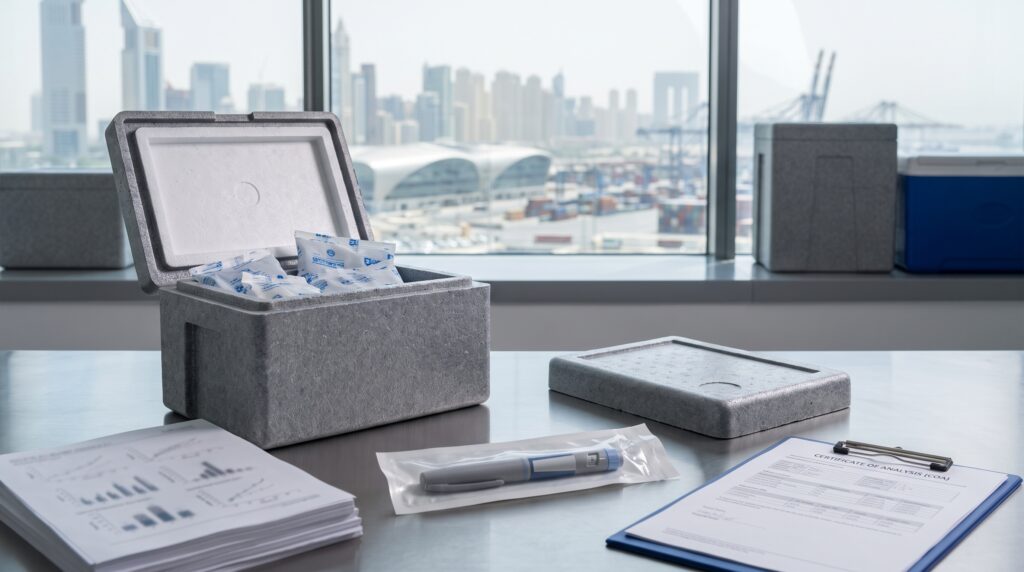
Procuring laboratory reference materials in the Gulf region requires navigating a unique set of logistical and environmental challenges. For procurement staff and informed researchers evaluating the CJC-1295 Ipamorelin blend, the stakes are particularly high when dealing with pre-mixed liquid formats. In a climate like the UAE, where extreme ambient heat poses an immediate threat to compound stability, understanding the differences between lyophilised powders and pre-mixed liquid delivery systems is an operational necessity.
Selecting a reliable supplier goes far beyond comparing baseline prices on international vendor sites. It involves auditing their local cold-chain logistics infrastructure, demanding verifiable High-Performance Liquid Chromatography (HPLC) reports, and ensuring their shipping protocols prevent structural degradation during transit. This guide outlines exactly what you must verify before committing laboratory budgets to CJC-1295 Ipamorelin blend formats in Dubai, Abu Dhabi, or the wider GCC.
What is the CJC-1295 Ipamorelin Blend?
The CJC-1295 Ipamorelin blend is a pre-mixed liquid research material combining a synthetic GHRH analogue (Mod GRF 1-29) and a selective ghrelin receptor agonist. For UAE researchers, pre-mixed pens offer precise volumetric dispensing, eliminating manual reconstitution errors while requiring strict 2-8°C cold-chain storage.
Quick Answer / Buyer Checklist
Before procuring liquid peptide blends in the GCC, researchers should verify the following parameters:
- Format Identification: Confirm the blend utilises CJC-1295 ‘No DAC’ (Mod GRF 1-29) for pulsatile in-vitro research.
- Purity Verification: Demand batch-specific HPLC and Mass Spectrometry (MS) documentation proving >99% purity.
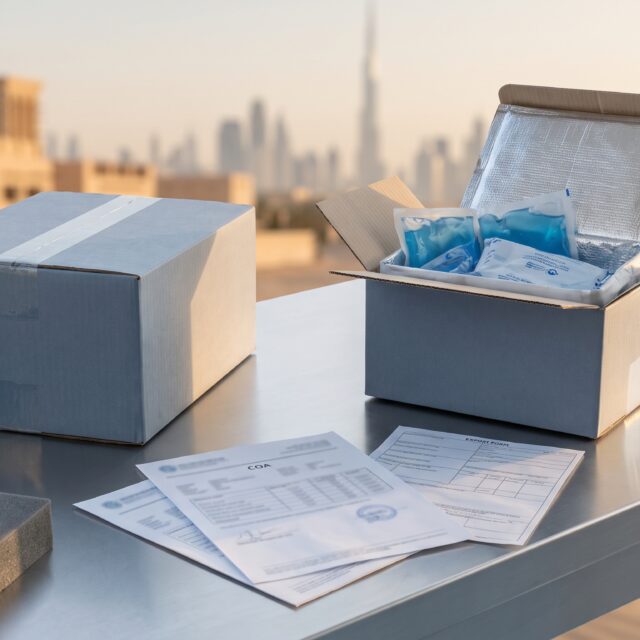
- Thermal Logistics: Ensure the vendor utilises active cold-chain shipping (insulated packaging and refrigerant packs).
- Local Inventory: Choose local suppliers to avoid protracted customs delays that compromise temperature-sensitive liquids.
In contemporary laboratory environments, studying the growth hormone axis often involves dual-pathway activation. These two distinct compounds are frequently paired because they operate through independent, non-overlapping intracellular cascades, providing a synergistic mechanism of action ideal for isolated cellular assays.
CJC-1295 acts upon the anterior pituitary cell models to initiate the cAMP (cyclic adenosine monophosphate) pathway. It is vital to note that research-grade CJC-1295 is most commonly sourced as the ‘No DAC’ variant. This specific variant has a short half-life of approximately 30 minutes, which closely mimics natural physiological pulses in test subjects. Conversely, the ‘With DAC’ variant involves an added Drug Affinity Complex that binds to blood proteins, resulting in a sustained, multi-day release model. The specific pairing of ‘No DAC’ with Ipamorelin—which triggers the separate Protein Kinase C (PKC) pathway—allows researchers to observe amplified, targeted, pulsatile release mechanisms without prolonged baseline elevation.
Pre-Mixed Pens vs. Lyophilised Vials: Eliminating Volumetric Variables
Historically, synthetic peptides have been predominantly supplied in lyophilised (freeze-dried) glass vials. While lyophilised powder is highly stable at ambient room temperatures during short international transits, it inherently demands manual reconstitution upon arrival at the laboratory. This involves introducing a highly precise volume of bacteriostatic water or sterile saline into the vial.
For stringent, high-throughput laboratory research, the manual reconstitution process introduces several disruptive variables:
- Volumetric Margin of Error: Calculating exact molar concentrations relies entirely on the precise volume of diluent added. Minor miscalculations during manual pipetting or mixing can compromise standardization across large experimental cohorts, leading to skewed data sets.
- Contamination Risks: Every time a syringe needle punctures a vial’s rubber septum to introduce diluent or draw out the solution, the risk of particulate, bacterial, or cross-compound contamination increases exponentially.
- Degradation from Agitation: Improper reconstitution techniques, such as aggressive shaking of the vial rather than gentle swirling, can mechanically shear the delicate molecular bonds of the peptides.
The CJC-1295 + Ipamorelin blend pen research format systematically resolves these issues. The material arrives pre-mixed in a medically sealed, sterile cartridge. The automated dispenser mechanism provides highly precise, micro-dosed, repeatable volume delivery without ever requiring external diluents. This ensures the chemical concentration remains uniformly standardized from the first dispensing click to the last.
The GCC Climate Challenge: Cold-Chain Logistics for Liquid Peptides
The most significant and unavoidable consideration when sourcing a pre-mixed liquid pen in the UAE is thermal stability. The physical chemistry of peptide degradation dictates that once a synthetic compound is suspended in an aqueous solution, its molecular structure becomes highly vulnerable to hydrolysis, oxidation, and temperature-induced denaturing.
Unlike resilient freeze-dried vials, pre-mixed peptide pens must be continuously maintained at a strict storage temperature of 2°C to 8°C. Exposure to the ambient summer temperatures of Dubai or Abu Dhabi—which frequently exceed 40°C—even for a few hours in a standard courier’s unconditioned sorting facility, can rapidly degrade the material. Denatured peptides will yield null or erratic results in cellular assays, rendering the research material completely unviable and wasting laboratory budgets.
When evaluating a supplier in the region, researchers must vigorously audit the provider’s logistics framework. A credible local supplier will utilise:
- High-Grade Insulated Packaging: Expanded polystyrene (EPS) or specialized thermal bubble liners that actively prevent ambient heat penetration.
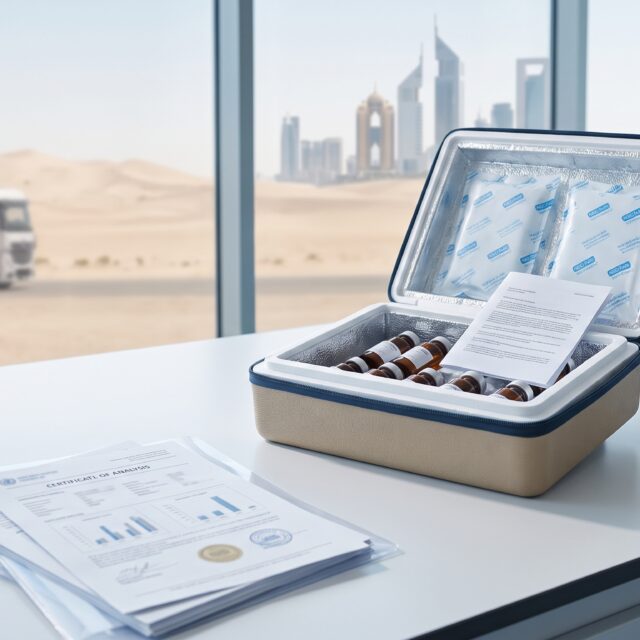
- Phase Change Materials (Cold-Packs): Commercial gel packs or dry ice protocols designed to securely maintain the 2-8°C thermal window for a minimum of 48 to 72 hours.
- Expedited Regional Dispatch: Utilising specialized next-day courier networks that strictly limit the total transit time from the supplier’s climate-controlled facility directly to your laboratory refrigerator.
To mitigate these severe local climate risks, partnering with a local supplier that offers dedicated UAE next-day cold-chain delivery is not an optional premium—it is an absolute scientific necessity.
How to Audit COA Documentation in the UAE
Trust in the biochemical supply industry is established exclusively through independent, third-party laboratory verification. A supplier’s marketing claims regarding purity, yield, or concentration are entirely meaningless without a verifiable Certificate of Analysis (COA). Unfortunately, the market is saturated with vendors using generic, outdated, or fabricated documentation.
When assessing a supplier for the CJC-1295 Ipamorelin blend, procurement officers should demand batch-specific testing data. The documentation packet should meticulously detail:
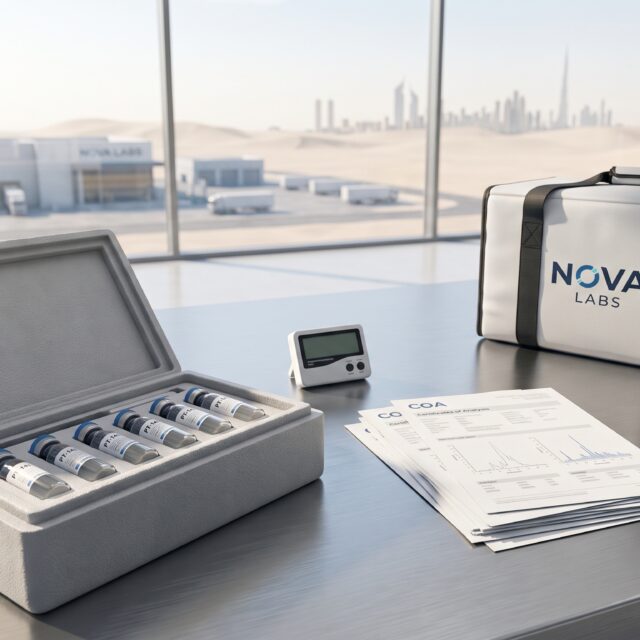
- High-Performance Liquid Chromatography (HPLC): This analytical technique separates, identifies, and quantifies each component in the liquid mixture. For a dual-blend product, you should look for distinct, sharp peaks correlating to both CJC-1295 and Ipamorelin, indicating an absence of unwanted synthesis by-products, truncated sequences, or heavy metal impurities. The absolute minimum benchmark for research-grade peptides is 99% purity.
- Mass Spectrometry (MS): This verifies the precise molecular weight of the isolated compounds. It confirms structural identity by measuring the mass-to-charge ratio (m/z) of the ions against established biochemical databases, proving the compound is exactly what the label claims.
- TFA Content Analysis: Trifluoroacetic acid (TFA) is frequently used during peptide synthesis. High residual TFA levels can be cytotoxic in sensitive cellular assays, so verifying low TFA salt content is a hallmark of premium manufacturing.
- Batch Matching: Always ensure the batch or lot number printed directly on your delivered pen cartridge matches the alphanumeric batch number explicitly stated on the provided COA.
If a vendor obscures the name of their independent testing facility, refuses to provide batch-specific documents upon request, or presents heavily redacted reports, procurement teams should immediately source their materials elsewhere.
Procuring the CJC-1295 + Ipamorelin Blend Pen at NOVA Labs
For UAE-based institutions, private research clinics, and informed independent buyers, navigating international customs with temperature-sensitive liquid peptides often results in extensive delays. When a shipment sits in a customs warehouse lacking refrigeration, product stability is compromised before it ever reaches your desk. Sourcing from a locally operating, quality-assured provider completely eliminates border friction and transit delays.
NOVA Labs explicitly addresses these operational hurdles for the GCC market. When sourcing a CJC-1295 + Ipamorelin Blend Pen through NOVA Labs, researchers benefit from distinct assurances:
- Uncompromising Cold-Chain Integrity: All liquid blend pens are stored in continuously monitored refrigeration units. Upon order, they are dispatched using robust insulated packaging, guaranteeing biological viability upon arrival anywhere in Dubai, Abu Dhabi, or the wider Emirates.
- Local Inventory & Direct Support: Stock is physically held locally, avoiding opaque international customs delays. Dedicated WhatsApp support enables buyers to easily check current inventory availability, confirm specific delivery windows, and request up-to-date COAs prior to placing an order.
- Transparent Verification: Comprehensive, batch-specific HPLC and Mass Spectrometry reports are readily available to validate the 99%+ purity of the synergistic blend.
- Flexible GCC Payment Options: Providing secure, encrypted checkout gateways alongside Cash on Delivery (COD) options to build regional trust and procurement confidence.
Conclusion: Upgrading Your Research Materials
Evaluating a pre-mixed liquid peptide system requires strict attention to logistical realities and environmental constraints. The CJC-1295 Ipamorelin blend offers unparalleled dispensing precision by removing the volumetric variability of manual reconstitution. However, this clinical convenience is entirely dependent on rigid temperature control and verifiable manufacturing quality.
Before finalizing any procurement order, ensure your vendor checks all the core boxes: batch-specific HPLC reports proving >99% purity, confirmation of the ‘No DAC’ formulation for optimal pulsatile research, and a guaranteed 2-8°C cold-chain delivery framework designed explicitly to survive the UAE climate.
If your laboratory is ready to upgrade its reference materials with confidence, explore the locally stocked, third-party verified CJC-1295 Ipamorelin Blend Pen at NOVA Labs today.
Disclaimer: The products, blends, and compounds mentioned in this article are strictly for laboratory research and in-vitro diagnostic purposes only. They are not intended for human consumption, therapeutic use, or medical treatment of any kind.
*
References
- Bowers, C. Y. (1998). “Growth hormone-releasing peptide and its analogues.” Biochemical and Biophysical Research Communications, 250(3), 573-581.
- International Journal of Pharmaceutics. (2015). “Stability of therapeutic peptides in aqueous solutions: A review of the thermal and chemical degradation pathways.”
- World Health Organization (WHO). (2015). “Guidelines on the international packaging and shipping of vaccines and biologicals.” (Relevant to cold-chain infrastructure).
- D’Alessio, D. A., et al. (2004). “Mechanism of action of GH secretagogues: Activation of distinct intracellular signalling pathways.” Endocrinology.
Disclaimer: The products mentioned in this article are for research purposes only and are not intended for human consumption.
- CJC-1295 and Ipamorelin: Mechanism & Research
- Buy Ipamorelin CJC-1295 No DAC Pre-Mixed Pen Singapore – Pharma Lab Global
- CJC-1295 & Ipamorelin (CJC-IPA) Blend Pen — UAE & GCC – NOVA Labs
- Buy CJC-1295 + Ipamorelin Pen in UAE | GH Secretagogue | Body Labs
- Nova Labs Review 2026: UAE Peptide Supplier COA and Cold-Chain Audit
Frequently asked questions
What is the correct storage temperature for a CJC-1295 Ipamorelin blend pen?
A pre-mixed liquid CJC-1295 and Ipamorelin blend pen must be stored in a refrigerator at a strictly controlled temperature between 2°C and 8°C. Unlike lyophilised powders, liquid peptides are highly susceptible to thermal degradation and should never be left at ambient room temperature or exposed to freezing.
Does the CJC-1295 in this blend use the No DAC or With DAC format?
Research-grade pre-mixed pens typically utilise the 'No DAC' version of CJC-1295, also known as Mod GRF 1-29. This variant has a short half-life that mimics natural physiological pulses, as opposed to the 'With DAC' variant which provides a sustained release over several days.
How is a pre-mixed peptide pen different from a standard vial?
Standard vials contain lyophilised (freeze-dried) powder that requires manual reconstitution with bacteriostatic water prior to use, which can introduce volumetric errors and contamination risks. A pre-mixed pen contains the peptides already suspended in liquid within a medically sealed cartridge, allowing for exact, repeatable volume dispensing.
Why is cold-chain delivery essential when ordering peptide pens in the UAE?
Due to the extreme ambient temperatures in the UAE and wider GCC, liquid peptides will rapidly undergo hydrolysis and degrade if shipped via standard freight. Cold-chain logistics, incorporating insulated packaging and ice packs via next-day delivery, ensure the structural integrity of the compound is preserved.
What documentation should I request before buying a CJC-1295 Ipamorelin blend?
Researchers should always demand batch-specific High-Performance Liquid Chromatography (HPLC) and Mass Spectrometry (MS) documentation. These third-party lab reports verify the exact molecular weight and confirm the blend meets the benchmark of >99% purity without unwanted synthesis by-products.
Nova Labs buyer tools
Ready to verify stock, testing and delivery?
Use the product page and lab report section to check availability, documentation, delivery timing and support before placing an order.
- COA / test-report checks
- UAE delivery context
- Cold-chain handling
- COD and card payment options
- WhatsApp support