



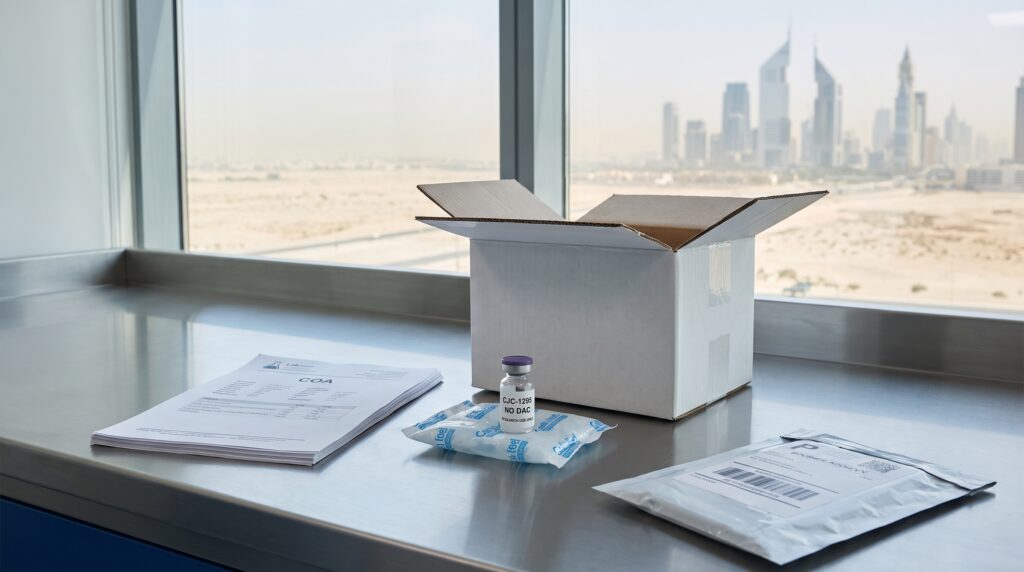
Sourcing reliable, high-purity laboratory reagents in the GCC presents a unique set of regional hurdles. For researchers, institutional laboratories, and procurement specialists looking to buy CJC-1295 No DAC in Kuwait, the challenges are immediate: extreme desert climates that threaten compound stability, stringent customs protocols, and a fragmented market of international suppliers with varying documentation standards.
Securing research-grade peptides requires a structured, critical approach to verifying supplier credentials, evaluating analytical testing transparency, and ensuring that logistics networks are properly equipped for local environments. This guide breaks down the essential criteria every buyer in Kuwait should evaluate before placing an order.
Quick Answer: What to Know Before You Buy CJC-1295 No DAC Kuwait
When looking to buy CJC-1295 No DAC Kuwait, prioritize regional GCC suppliers providing batch-specific, third-party HPLC and MS certificates verifying at least 99% purity. Ensure the vendor utilizes validated 2-8°C cold-chain shipping, offers secure local payment portals, and strictly complies with customs declarations for in-vitro research chemicals.
The Role of CJC-1295 No DAC (Modified GRF 1-29) in Research
CJC-1295 No DAC, frequently referred to in scientific literature as Modified GRF 1-29, is a synthetic, 29-amino-acid analog of Growth Hormone-Releasing Hormone (GHRH). In laboratory environments, it is extensively utilized for in-vitro experimentation to model GH-axis pulsatility, study biochemical clearance rates, and observe cellular signaling pathways.
Short Half-Life vs. Extended Binding
Unlike its counterpart that includes a Drug Affinity Complex (DAC), the “No DAC” variant features a significantly shorter half-life (typically measured in minutes rather than days). This characteristic makes it highly valuable for researchers aiming to observe episodic, pulsatile interactions at the cellular receptor level, rather than prolonged, continuous receptor binding.
Because the structural integrity of this peptide sequence is critical for accurate modeling, even minor impurities or environmental degradation can severely compromise experimental data. Consequently, procuring high-purity, accurately synthesized material is the first and most vital step for any research programme utilizing this compound.
Sourcing CJC-1295 No DAC in Kuwait: The Quality Checklist
Identifying a reliable CJC-1295 No DAC supplier requires looking past basic marketing claims and focusing strictly on verifiable, technical documentation. A credible vendor will operate with complete transparency regarding their quality assurance protocols, specifically regarding analytical testing.
1. High-Performance Liquid Chromatography (HPLC)
HPLC is the industry standard for determining the purity of a synthesized peptide sequence. This analytical technique separates the components in a mixture, allowing scientists to quantify the exact concentration of the desired peptide versus any synthetic byproducts (such as truncated sequences) or impurities. When you evaluate a supplier, their HPLC data should demonstrably prove a purity level of 99% or higher.
2. Mass Spectrometry (MS)
While HPLC confirms purity, Mass Spectrometry is absolutely necessary to confirm the identity of the compound. MS measures the mass-to-charge ratio of ions, verifying that the molecular weight of the vial’s contents matches the precise theoretical molecular weight of CJC-1295 No DAC. If a supplier provides an HPLC report without an accompanying MS report, the testing documentation is fundamentally incomplete.
3. Trifluroacetic Acid (TFA) Removal
During standard peptide synthesis, TFA is used to cleave the peptide from its resin. High levels of residual TFA can be cytotoxic in cell culture experiments, skewing in-vitro results. Premium suppliers will employ counter-ion exchange processes to replace TFA with acetate or chloride, minimizing toxicity. Always inquire about a supplier’s TFA removal protocols if your research involves live cell cultures.
4. Batch-Specific Certificates of Analysis (COA)
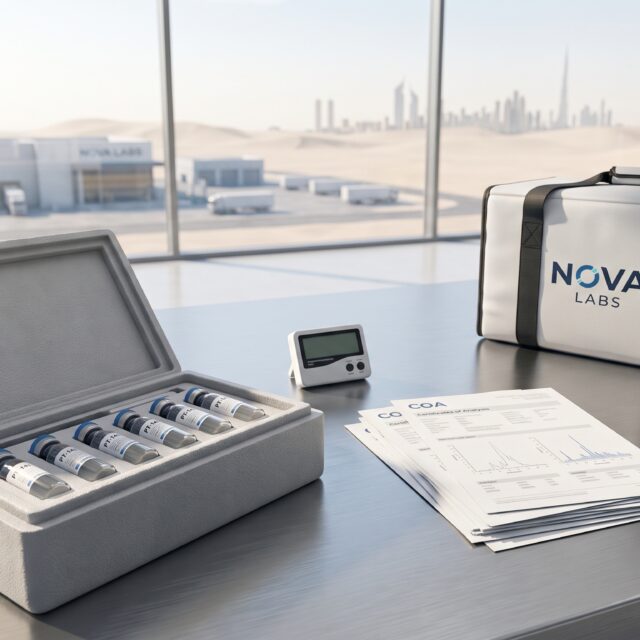
General, stock, or outdated testing reports are insufficient for rigorous laboratory procurement. A legitimate supplier will provide a batch-specific COA that correlates directly with the current inventory being sold. Buyers should check the date on the COA, verify the name and accreditation of the independent testing laboratory, and ensure that the batch number printed on the vial matches the provided documentation.
Navigating Cold-Chain Logistics and Kuwait Customs
Procuring sensitive biological materials in the GCC is heavily dictated by climate and regulation. Kuwait’s summer temperatures easily exceed limits that would rapidly degrade unprotected lyophilized peptides, rendering them completely inert before they even reach the laboratory bench.
Furthermore, regulatory frameworks under Kuwait’s Ministry of Health (MOH) and the Pharmaceutical and Herbal Medicines Registration and Control Administration (PHMRCA) dictate strict import conditions that must be navigated with precision.
Surviving the Desert Heat
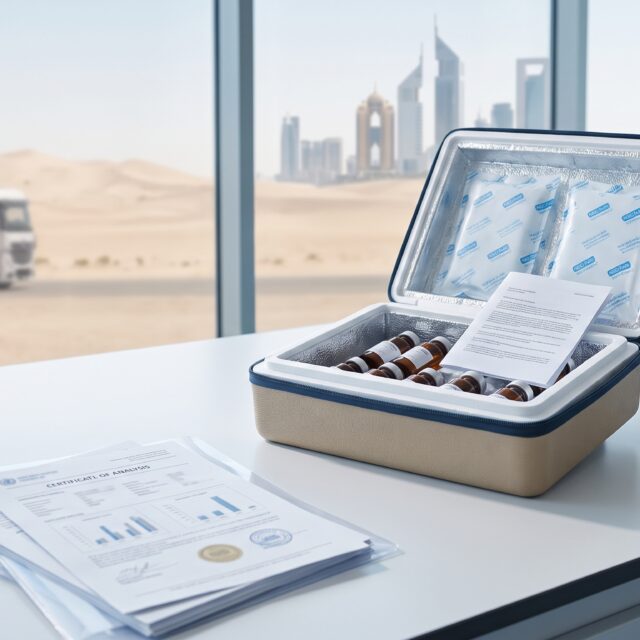
Standard courier shipping in a cardboard box is highly inadequate for peptides. Sourcing research peptides in Kuwait necessitates robust cold-chain infrastructure. Reliable suppliers utilize validated insulated packaging equipped with phase-change materials (such as specialized industrial ice packs or dry ice cooling systems) designed to maintain an internal temperature of 2-8°C throughout a 48 to 72-hour transit window.
This thermal protection ensures that the compound arrives in its fully stable, lyophilized state, ready for proper laboratory reconstitution with bacteriostatic water or acetic acid, and subsequent ultra-low temperature storage.
Customs Compliance and Documentation
Under Kuwait’s Law No. 28 of 1996 regulating medical and pharmaceutical products, biological imports are heavily scrutinized. Peptides occupy a strict regulatory lane; they are permitted strictly for laboratory and academic research.
To bypass unnecessary delays at Kuwait International Airport or Shuwaikh port, shipping documentation must be exceptionally precise. Invoices, commercial declarations, and airway bills must explicitly label the contents as “research chemicals” or “in-vitro reagents.” Any supplier attempting to market or label these compounds with therapeutic, diagnostic, or cosmetic claims risks having the shipment seized by the MOH Drug Control authorities. Working with a regional supplier familiar with GCC customs nuances significantly reduces this friction.
Local GCC Support, Payment, and Stock Visibility
One of the primary advantages of utilizing a GCC-based hub rather than ordering from overseas is the localization of operational support. When you order research peptides through a regional distributor, the friction of international procurement is minimized.
Expedited Transit Times via Regional Hubs
Sourcing from a regional base drastically condenses the shipping timeline. Instead of a package spending a week in international transit, regional dispatches often reach Kuwait within 48 to 72 hours. By leveraging a localized GCC and UAE delivery network, researchers can ensure the cold-chain packaging is never pushed past its validated thermal limits.
Secure and Localized Payment
International wire transfers or obscure offshore payment gateways can complicate procurement for private laboratories and universities. Premium regional suppliers offer localized, secure B2B checkouts, accommodating standard credit card payments and facilitating transactions in familiar regional currencies, thereby reducing conversion fees and administrative overhead.
Dedicated Procurement Support
Direct communication is vital when coordinating the delivery of temperature-sensitive reagents. Reputable suppliers provide dedicated account managers or direct support channels (such as WhatsApp) to coordinate shipping times, provide real-time tracking, and supply digital copies of all COAs prior to dispatch.
Buyer’s Verification Checklist
Whether you are a university lab manager or an independent researcher outfitting a private facility, the burden of verification rests on the buyer. Before authorizing a purchase, cross-reference the following:
- Documentation: Does the supplier prominently display their third-party testing?
- Relevancy: Are the COAs recent, independent, and batch-matched to the inventory?
- Logistics: Does the shipping policy explicitly detail 2-8°C temperature-controlled packaging for GCC transit?
- Compliance: Is the product explicitly framed, invoiced, and sold for in-vitro research and laboratory use only?
- Support: Is there a clear channel for resolving delivery delays or documentation requests?
Conclusion
Successfully buying CJC-1295 No DAC in Kuwait requires navigating a gauntlet of climate threats, stringent customs regulations, and varying supplier quality. By demanding batch-specific HPLC and MS documentation and partnering with suppliers who deeply understand GCC cold-chain requirements, researchers can ensure the integrity of their experimental materials.
For GCC laboratories seeking reliable, high-purity reagents without the anxiety of degraded compounds or customs seizures, NOVA Labs provides highly purified CJC-1295 No DAC backed by transparent, independent testing and dedicated regional cold-chain shipping logistics. Always ensure your procurement aligns with best practices for stability and regional compliance to secure the most accurate data for your research.
Disclaimer: The products mentioned in this article are strictly for in-vitro research and laboratory experimentation purposes only. They are not intended for human consumption, diagnostic, or therapeutic use.
References
- International Trade Administration. “Kuwait – Import Requirements and Documentation.” Trade.gov.
- Ministry of Health, State of Kuwait. “Law No. 28 of 1996 In Regard to the Organization of the Pharmacy Profession and the Handling of Medicines.”
- National Center for Biotechnology Information. “Growth Hormone-Releasing Hormone (GHRH) Analogs in Research.” PubChem Database.
Disclaimer: The products mentioned in this article are for research purposes only and are not intended for human consumption.
- Buy CJC-1295 No DAC Kuwait: Supplier, Purity, & Delivery Guide – NOVA Labs
- Peptide Laws in Kuwait — Can You Buy, Travel & Import? (2026)
- CJC-1295 & Ipamorelin (CJC-IPA) Blend Pen — UAE & GCC – NOVA Labs
- Kuwait – Import Requirements and Documentation – International Trade Administration
- CJC-1295 no DAC 5mg – Buy Online from XL Peptides UK
Frequently asked questions
Is CJC-1295 No DAC legal to import into Kuwait?
Yes, provided it is strictly imported and documented as an in-vitro research chemical or laboratory reagent. Any labeling implying human, therapeutic, or medical use will likely result in seizure by Ministry of Health (MOH) customs authorities.
How is CJC-1295 No DAC protected from extreme heat during delivery to Kuwait?
Reliable regional suppliers utilize validated cold-chain logistics. They package the lyophilized vials in specialized insulated containers with phase-change materials (like dry ice or industrial gel packs) designed to maintain a stable 2-8°C internal temperature during the 48-72 hour transit.
What is the difference between CJC-1295 No DAC and the DAC version?
The primary difference in a research context is the biological half-life. CJC-1295 No DAC (Modified GRF 1-29) features a short half-life ideal for modeling episodic, pulsatile release, whereas the DAC (Drug Affinity Complex) modification significantly extends the half-life for continuous binding observations.
How can I verify the purity of CJC-1295 No DAC before buying?
Buyers should always request a recent, batch-specific Certificate of Analysis (COA) from an independent, accredited laboratory. This documentation must include both High-Performance Liquid Chromatography (HPLC) and Mass Spectrometry (MS) testing results that confirm at least 99% peptide purity.
Nova Labs buyer tools
Ready to verify stock, testing and delivery?
Use the product page and lab report section to check availability, documentation, delivery timing and support before placing an order.
- COA / test-report checks
- Kuwait delivery context
- Cold-chain handling
- COD and card payment options
- WhatsApp support