



Procurement officers, clinical researchers, and informed buyers across Dubai, Abu Dhabi, and the broader Middle East face unique challenges when sourcing research compounds. Securing high-quality material requires more than trusting a supplier’s marketing claims or checking a box on an order form. If you want to know how to read peptide coa gcc, you must understand both the analytical chemistry detailed on the report and the physical realities of local Gulf logistics.
In a region where ambient summer temperatures routinely exceed 45°C, verifying chemical purity on paper is only half the battle. A flawless Certificate of Analysis (COA) from an overseas supplier means very little if the compound degrades in a cross-border customs warehouse. This comprehensive guide details exactly what to look for on a laboratory report, how to interpret complex chromatograms, why dual-method testing is non-negotiable, and how localized cold-chain logistics protect your research materials from thermal degradation.
Quick Answer: How to Read Peptide COA GCC
To read a peptide COA in the GCC, first verify that the batch number precisely matches your physical vial. Next, check the High-Performance Liquid Chromatography (HPLC) graph for a relative purity percentage above 98%. Finally, review the Mass Spectrometry (MS) data to confirm the molecular weight exactly matches the theoretical sequence.
The Anatomy of a Legitimate Certificate of Analysis
Understanding how to read a peptide COA in GCC markets starts with differentiating between the two primary analytical methods used to verify compounds: High-Performance Liquid Chromatography (HPLC) and Mass Spectrometry (MS). A legitimate lab report will always include both. If a supplier only provides one, it is a significant procurement red flag, as one test cannot replace the other.
High-Performance Liquid Chromatography (HPLC) for Purity
HPLC testing determines the relative purity of a sample. During this process, the peptide is dissolved in a solvent and pushed through a highly pressurized column. Different molecules travel through this column at varying speeds—a metric known as ‘retention time’. As these molecules exit the column, a UV detector measures their absorbance, creating distinct ‘peaks’ on a chromatogram graph.
When evaluating the HPLC section of a COA, pay attention to the following details:
- The Main Peak: There should be one dominant, sharp peak on the graph representing the target peptide. If the peak is broad, split, or accompanied by numerous smaller peaks, the sample contains significant impurities or synthesis byproducts.
- Relative Purity Percentage: This is calculated by measuring the area of the main peptide peak against the combined area of all other peaks. A standard benchmark for high-grade research material is a purity of 98% or higher.
- Baseline Noise: Look at the flat line (baseline) between peaks. A highly jagged baseline can indicate poor testing methodology, contamination in the testing equipment, or degraded material.
Crucial Clarification: Purity vs. Net Peptide Content
It is vital to understand that HPLC purity does not equate to the net active powder weight. Lyophilized (freeze-dried) samples inherently contain residual moisture and counter-ion salts—such as trifluoroacetic acid (TFA) or acetate—which are necessary to keep the peptide stable during the freeze-drying process. A vial labeled “10mg” with 99% purity means that 99% of the protein content is the target sequence, but the total mass inside the vial will include those necessary binding salts and moisture.
Mass Spectrometry (MS) for Sequence Identity
While HPLC confirms that the vial contains a pure substance, it cannot tell you what that substance actually is. A sample could test at 99.8% purity but be an entirely different compound than the one you ordered. This is why Mass Spectrometry—often Electrospray Ionization (ESI) or MALDI-TOF—is absolutely mandatory.
Mass Spectrometry measures the mass-to-charge ratio (m/z) of the eluting ions to determine the exact molecular weight of the compound. Every specific peptide sequence has a precise, theoretical molecular weight based on its amino acid chain.
When reading the MS data:
- Match Theoretical vs. Observed: The COA will list a “Theoretical Mass” and an “Observed Mass.” These numbers should match almost identically.
- Acceptable Variance: Because of natural isotopic variations and equipment calibration limits, an acceptable variance is typically ±0.5 Daltons (Da). If the observed mass is off by several Daltons, the sequence is incorrect, missing an amino acid, or has degraded.
Spotting Fake or Outdated COAs in the Market
Knowing how to interpret the scientific data is essential, but verifying the authenticity of the document itself is equally important. Unfortunately, photoshopped or recycled COAs are a known issue in international procurement. When reviewing a COA, laboratory managers and buyers should run through the following checklist:
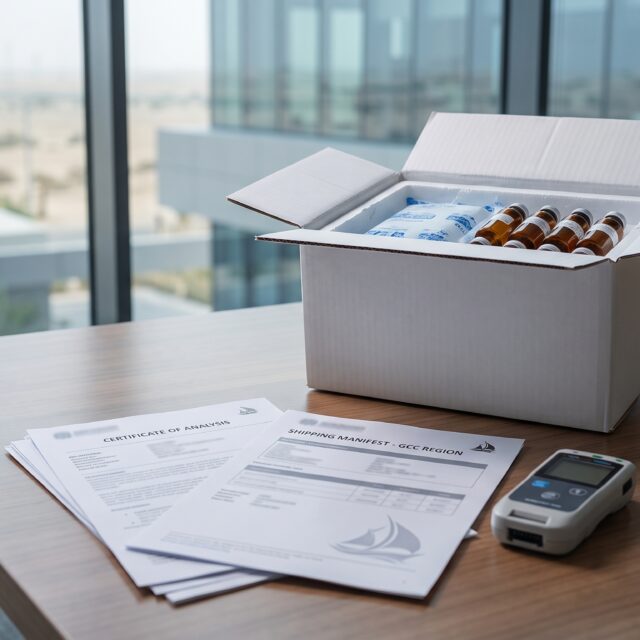
- Matching Batch and Lot Numbers: The lot or batch number printed on the COA must match the alphanumeric code printed on your physical vial character-for-character. Generic, unlinked COAs with no batch references are essentially meaningless.
- Independent Third-Party Accreditation: The most credible COAs are generated by independent laboratories rather than the manufacturer’s in-house team. Look for ISO/IEC 17025 compliance and verifiable report numbers. Many modern analytical labs now include QR codes that link directly back to the testing facility’s secure database for real-time verification.
- Date of Testing vs. Manufacture: Peptides have a finite shelf life, even when lyophilized and stored correctly. Check the testing date on the COA. If the test was conducted two years ago, the current stability of the compound may be heavily compromised, especially if it was stored improperly in the interim.
Why GCC Logistics Make or Break Peptide Integrity
A common mistake among buyers is focusing entirely on the chemical data on the COA while completely ignoring the physical journey the compound takes to reach the laboratory bench. The extreme climate of the Middle East poses a severe threat to peptide stability.
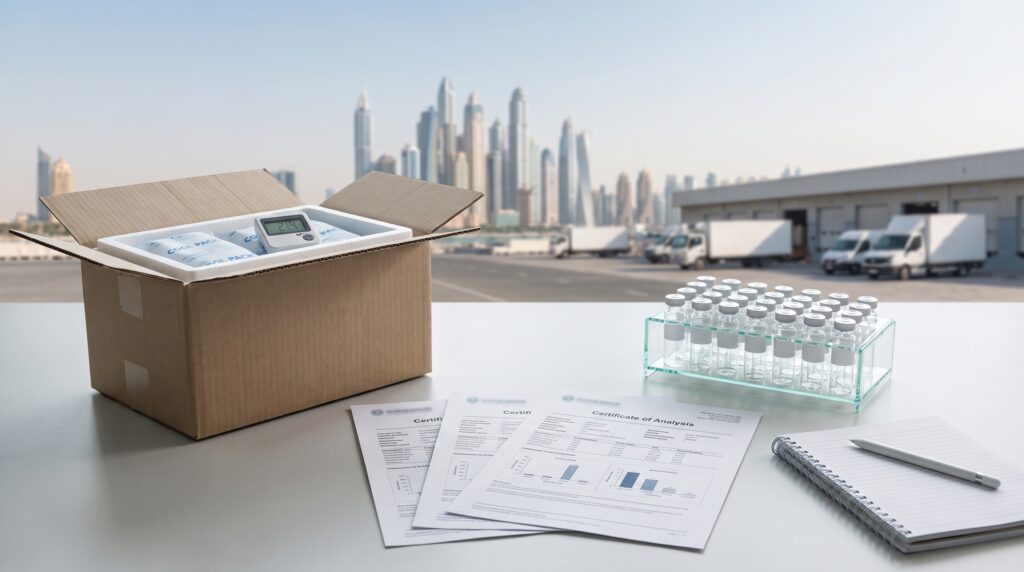
Research peptides are highly susceptible to thermal degradation. Exposing lyophilized powder to temperatures above 40°C—even for brief periods during transit—can break down the delicate amino acid bonds, causing the sequence to fragment. International shipments frequently face friction when passing through mainland customs or Free Zone declaration pathways in the UAE. These customs delays often result in parcels sitting in ambient-temperature warehouses for days, rendering a perfect 99% pure COA completely obsolete before the package even arrives at your facility.
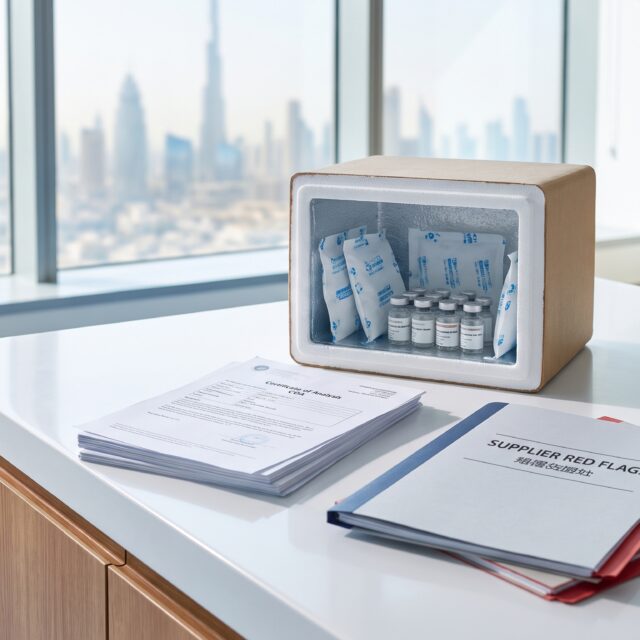
To bypass these severe logistical risks, forward-thinking buyers prioritize regional suppliers. Ensuring that your supplier utilizes continuous insulated cold-chain shipping is just as critical as checking the laboratory report. For researchers who cannot afford transit degradation and require absolute certainty, securing local UAE next-day delivery ensures that materials remain strictly temperature-controlled (2–8°C) from the local storage facility directly to your laboratory.
How to Evaluate Suppliers and Purchase with Confidence
When you integrate COA literacy with local logistical knowledge, evaluating research suppliers becomes a straightforward, empirical process. Transparency and communication are your best indicators of reliability.
Before placing an order, ensure the supplier allows you to view batch-specific documentation or is willing to provide it rapidly via direct support channels, such as WhatsApp or dedicated email. Furthermore, flexibility in payment gateways and clear local stock availability are strong markers of a well-established operation. Local options within the UAE demonstrate that the supplier actually holds regional inventory and can dispatch immediately, entirely removing the risk of long-haul international shipping and subsequent customs thermal exposure.
Bottom Line on Verifying Quality in the Middle East
Mastering this how to read peptide coa guide gcc is ultimately about combining rigorous scientific verification with regional common sense. Always demand dual-method testing to confirm both purity (HPLC) and identity (MS). Ensure the batch numbers on the documentation precisely align with your physical inventory, and verify the recency of the test date.
Above all, never underestimate the destructive power of a Gulf summer on unprotected international shipments. By sourcing locally from partners who prioritize rigorous third-party testing alongside strict cold-chain logistics, you protect the integrity of your research from the lab report all the way to the laboratory bench.
To explore a catalog of verifiably tested, locally stocked research materials that prioritize cold-chain stability, browse the full NOVA Labs shop.
Disclaimer: The products mentioned in this article are strictly for in-vitro research purposes only and are not intended for human consumption, diagnostic, or therapeutic use.
References
- American Society for Mass Spectrometry (ASMS). Guidelines for Peptide Identification and Purity Verification.
- United States Pharmacopeia (USP). Chromatographic Purity and Mass Spectrometry Standards for Peptides.
- National Center for Biotechnology Information (NCBI). Stability of Lyophilized Peptides in Varying Thermal Conditions.
- Dubai Municipality. Cold Chain Logistics and Storage Guidelines for Temperature-Sensitive Compounds.
- How to Read a Peptide Certificate of Analysis (COA) – Rite Aid
- How to Read a Peptide Certificate of Analysis (CoA) [2026]
- HPLC vs LC-MS for Peptide Purity Testing: Why Identity Confirmation Matters
- Incoterms for Research Peptide Imports into the UAE – Peak Labs
- Free Zone vs Mainland Import Pathways for Research Peptide Shipments – Peak Labs
Frequently asked questions
Why is a single-method peptide COA considered a red flag?
A single-method COA usually only shows HPLC data, which measures purity but cannot confirm the sequence identity. A sample could be 99% pure but contain entirely the wrong compound, making Mass Spectrometry (MS) necessary to verify the exact molecular weight.
Does a 99% peptide purity percentage equal the net active weight?
No. The purity percentage reflects the ratio of the target peptide to impurities in the protein mass. Lyophilized powder inherently contains moisture and necessary counter-ion salts (like TFA or acetate) for stability, which account for a portion of the total mass in the vial.
How does the UAE summer heat affect peptide quality after testing?
Peptides are highly sensitive to thermal degradation. If a shipment sits in ambient customs warehouses during a Gulf summer (often exceeding 40°C), the amino acid bonds can break down, rendering the original COA purity data entirely irrelevant.
What details should I match on the COA and the physical vial?
Always verify that the exact alphanumeric lot or batch number printed on the laboratory Certificate of Analysis matches the batch number printed on the label of your physical vial to ensure the test applies to your specific material.
What is an acceptable Dalton variance on a Mass Spectrometry report?
When comparing the theoretical mass of a peptide sequence to the observed mass on a Mass Spectrometry (MS) report, an acceptable variance is typically ±0.5 Daltons (Da). Larger discrepancies indicate an incorrect or degraded sequence.
Nova Labs buyer tools
Ready to verify stock, testing and delivery?
Use the product page and lab report section to check availability, documentation, delivery timing and support before placing an order.
- COA / test-report checks
- GCC delivery context
- Cold-chain handling
- COD and card payment options
- WhatsApp support