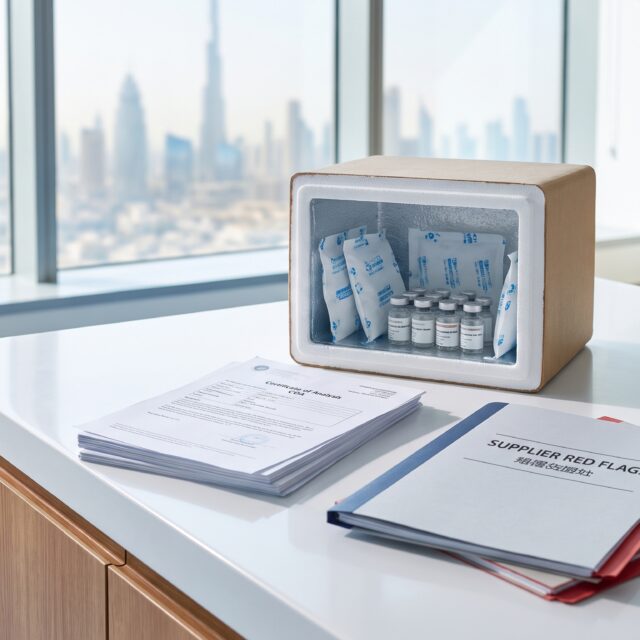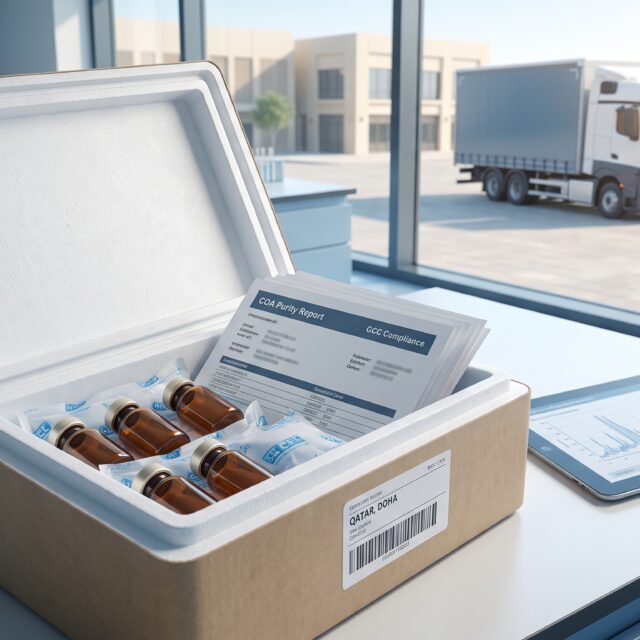



Sourcing high-grade biochemicals in the GCC presents a unique set of challenges, from stringent import documentation to extreme logistics temperatures. For institutional researchers, procurement staff, and informed buyers evaluating suppliers, understanding exactly how to read a peptide COA is the primary defense against acquiring substandard compounds. A document alone does not guarantee quality unless you know how to interpret the analytical data and match it to the physical product arriving at your facility in Kuwait.
Quick Answer: How to Read Peptide COA Kuwait Documents
To know how to read peptide COA Kuwait documentation, first locate the high-performance liquid chromatography (HPLC) results showing at least 98% purity. Next, check the mass spectrometry (MS) graph to confirm the exact molecular weight. Finally, ensure the lot number on the certificate perfectly matches your physical research vial.
While reading the documentation is essential, buyers in Kuwait must also consider local logistics. A pristine COA means little if the product sits in a hot customs warehouse for weeks. This guide covers how to perform a rigorous analytical audit on supplier documents, how to navigate the GCC supply chain, and why secure regional dispatch is vital to maintaining verified purity.
The Analytical Audit: HPLC and Mass Spectrometry Demystified
A legitimate Certificate of Analysis goes far beyond a simple “Pass/Fail” statement. It relies on advanced analytical chemistry to verify both how pure the substance is and whether it is the correct substance at all. When evaluating how to read a peptide COA in Kuwait, you must focus on two primary testing methodologies: HPLC and MS.
High-Performance Liquid Chromatography (HPLC) Step-by-Step
HPLC is utilized to determine the chemical purity of the compound. The test separates the components of a sample and measures them based on area percentage.
When you examine the HPLC chromatogram on a COA, you should actively evaluate the following:
- A Single, Sharp Peak: The graph, which plots retention time on the X-axis against absorbance on the Y-axis, should display one dominant, vertical peak. This represents the target peptide. Wide or “shouldered” peaks can indicate co-eluting impurities.
- Minimal Baseline Noise: A jagged baseline or multiple smaller peaks before or after the main elution indicate impurities, synthesis byproducts (like truncated sequences), or degradation fragments.
- Target Purity (≥98%): The area percentage of the primary peak should mathematically calculate to 98% or higher for rigorous in vitro research. Anything lower suggests incomplete synthesis or poor purification processes.
- Testing Conditions: Professional COAs will list the solvent gradients used (often Water/TFA and Acetonitrile/TFA) and the wavelength of the UV detector (commonly 214 nm or 220 nm, which detects the peptide bond).
Mass Spectrometry (MS) and Sequence Identity
While HPLC confirms that a vial contains a pure substance, it does not confirm what that substance is. This is where Mass Spectrometry (MS) becomes non-negotiable. MS verifies the sequence identity by measuring the mass-to-charge (m/z) ratio of the molecules.
Synthesis errors can result in a peptide that is 99% pure but has the wrong amino acid sequence (missing an amino acid, for example, known as a deletion sequence). To prevent this, researchers must cross-reference the target theoretical molecular weight of the specific peptide with the observed weight on the MS report.
In Electrospray Ionization (ESI) mass spec—the most common method for peptides—you will often see multiple peaks corresponding to different charge states (e.g., [M+H]+, [M+2H]2+). By doing a simple calculation, you can verify that these fractions add up to the correct theoretical mass. If a supplier provides an HPLC report but no MS report, the molecular identity remains entirely unverified.
Beyond Purity: TFA, Moisture, and Net Peptide Content
Advanced buyers auditing a COA should also look for secondary metrics that affect research calculations.
Trifluoroacetic Acid (TFA) Content
During solid-phase peptide synthesis (SPPS) and subsequent HPLC purification, TFA is heavily used. Most research-grade lyophilized peptides exist as TFA salts. While standard, excessive TFA can be cytotoxic to certain cell lines in vitro. High-quality COAs will sometimes note the TFA content or indicate if the peptide has been converted to an acetate or hydrochloride (HCl) salt, which is preferable for specific biological assays.
Moisture Content and Net Peptide Weight
Lyophilized peptides are highly hygroscopic, meaning they absorb moisture from the air. A COA may include a Karl Fischer titration result to show moisture content. It is important to understand that if a vial contains 10mg of lyophilized powder, that weight includes the peptide, the counter-ion (like TFA), and residual moisture. This is why strict adherence to COA metrics is vital for calculating exact molarity for your experiments.
Red Flags: Spotting Fake or Outdated COAs
Unfortunately, the biochemical supply chain contains unreliable vendors who use generic documentation to create an illusion of compliance. When vetting suppliers, strict attention to administrative details is crucial.
Generic Spec Sheets vs. Batch-Specific Data
A “specification sheet” outlines what the product should be. A Certificate of Analysis outlines what a specific batch actually is. If a supplier hands you a document without an HPLC chromatogram or mass spectrum graph attached, you are likely looking at a generic template, not verifiable test results.
Matching Lot Numbers
The most common method unreliable suppliers use to mask untested stock is recycling an old, legitimate COA for new, untested batches. The lot or batch number printed clearly on the top of the COA must match the lot number on your physical vial exactly. If a vendor cannot provide batch-matching documentation before you finalize your order, it is a significant procurement red flag.
Outdated Testing Dates and Lab Credentials
Pay attention to the date the analysis was performed. Peptides are sensitive biological molecules subject to hydrolysis and oxidation. If the COA is several years old, the product has likely degraded, particularly if it has not been stored in strict, temperature-controlled environments during its lifespan. Furthermore, ensure the COA features a legitimate signature from a Quality Control manager or references a verifiable third-party testing facility.
Beating the Heat: Kuwait Customs and Regional Logistics
Analytical verification is only half the battle. In the GCC, the intersection of bureaucratic import regulations and extreme weather dictates whether a compound retains its original, COA-verified purity by the time it reaches your laboratory.
The MOH Health Release Hurdle
Importing research peptides directly into Kuwait from overseas often invites rigorous scrutiny from the Directorate General of Customs. Standard local pharmacies cater primarily to over-the-counter beauty and oral collagen markets, creating a severe supply gap for specialized research compounds. Consequently, customs officials frequently demand a Ministry of Health (MOH) Health Release for unapproved or unregistered chemical compounds imported internationally.
The Ardeya Warehouse Bottleneck
If a shipment lacks properly formatted Research Use Only (RUO) documentation or gets flagged for an MOH release, it is placed on hold. These shipments frequently sit in local customs facilities, such as the major sorting centers in Ardeya, which are not always comprehensively temperature-controlled for biologicals. During the Kuwaiti summer, ambient temperatures in these logistics chains can easily soar between 40°C and 50°C+.
While lyophilized (freeze-dried) peptides possess short-term stability at elevated temperatures compared to reconstituted solutions, prolonged exposure to this extreme heat rapidly degrades the active compound’s concentration and purity through deamidation and oxidation. The 99% HPLC purity documented on the original COA is effectively destroyed by the time the shipment clears.
Sourcing Safely: The Advantage of GCC Dispatch
To bypass these logistical bottlenecks, reputable suppliers utilize regional GCC hubs rather than relying on direct international imports for every single Kuwaiti order.
Dispatching from a regional center allows suppliers to tightly control the transit environment. For instance, leveraging regional hubs that offer peptides UAE next-day delivery means Kuwait-bound shipments spend significantly less time in transit and customs clearance when crossing GCC borders. By utilizing insulated packaging, cold-chain handling protocols, and highly tailored RUO documentation designed specifically for intra-GCC movement, the risk of extended customs holds is vastly reduced. This ensures the chemical purity verified on the COA remains intact upon delivery.
Reliable Payment and Dedicated Support
Beyond logistics, evaluate how the supplier operates commercially. Authentic research chemical suppliers provide secure, conventional payment methods (such as major credit cards through corporate gateways) rather than demanding irreversible cryptocurrency transfers. Furthermore, they should offer accessible regional support—often via WhatsApp or dedicated email channels—to assist with documentation requests, batch verification, and shipping updates before you commit your laboratory’s budget.
The Kuwait Buyer’s Verification Checklist
Before finalizing any procurement order in Kuwait, use this practical checklist to protect your budget and project timeline:
- Request the Batch-Specific COA: Do this before paying. Confirm the supplier has the document readily available via email.
- Verify HPLC Purity: Ensure the chromatogram shows a sharp, single peak with an area percentage of ≥98% and minimal baseline noise.
- Confirm MS Identity: Check that the observed molecular weight (m/z) on the Mass Spectrometry graph mathematically matches the target compound’s theoretical weight.
- Check the Lot Number: Once delivered, cross-reference the vial’s label with the provided documentation.
- Evaluate Logistics & Support: Ask the supplier where the product ships from. Ensure they use regional GCC dispatch, provide secure payment options, and utilize insulated packaging to avoid heat degradation during customs transit.
Bottom Line
Mastering how to read a peptide COA in Kuwait is a fundamental skill for researchers and informed buyers navigating a complex supply landscape. By demanding batch-specific HPLC and MS data, and pairing that vigilance with smart, regional logistics that bypass customs bottlenecks, you can secure compounds that truly match their documentation.
Whether you are auditing your current supplier’s transparency or initiating a new laboratory project, reliable sourcing starts with verified data and secure transit. Explore the NOVA Labs research collection for verifiable, accurately documented compounds backed by rapid, secure regional GCC delivery.
Disclaimer: The products mentioned in this article are strictly for laboratory research and development purposes. They are not intended for human consumption, diagnostic, or therapeutic use.
References
- United States Pharmacopeia (USP). Guidelines on the Analytical Validation of Synthetic Peptides.
- ICH Harmonised Tripartite Guideline: Impurities in New Drug Substances Q3A(R2).
- A. G. Beck-Sickinger et al. “Quality standards for peptide synthesis.” Journal of Peptide Science.
- General requirements for high-performance liquid chromatography (HPLC) in biochemical analysis.
- World Health Organization (WHO) Good Distribution Practices (GDP) for Pharmaceutical and Biological Products.
Disclaimer: The products mentioned in this article are for research purposes only and are not intended for human consumption.
- How To Read Peptide COA Kuwait: Practical Buyer Guide – NOVA Labs
- Best Peptide Shop Kuwait: Supplier Guide & Customs Tips – NOVA Labs
- Peptide Purity Guide Kuwait | Check COAs & GCC Logistics – NOVA Labs
- Peptide Certificates of Analysis: How to Read and Verify a COA (2026 Guide) | Peptidepedia
- How to Read a Peptide COA: Identity, Purity & Content – Prism Labs
- Do Peptides Degrade During Shipping Without Refrigeration? Facts vs. Myths
Frequently asked questions
What does HPLC measure on a peptide Certificate of Analysis?
High-Performance Liquid Chromatography (HPLC) measures the chemical purity of a peptide. A reliable COA should display a chromatogram with a single sharp peak, confirming a purity level of 98% or higher without major baseline noise or secondary peaks.
Why is Mass Spectrometry (MS) required alongside HPLC?
While HPLC confirms that a substance is pure, Mass Spectrometry (MS) confirms its specific molecular identity. MS verifies that the observed mass-to-charge ratio matches the target peptide's theoretical weight, ensuring there are no missing amino acids or synthesis errors.
How can I verify if a supplier's peptide COA is genuine?
To verify a COA, ensure it includes both full HPLC and MS data graphs rather than a generic text specification sheet. Crucially, confirm that the specific batch or lot number printed on the certificate exactly matches the physical label on your research vial.
Why do peptide shipments face customs delays in Kuwait?
Kuwait Customs closely inspects biochemical imports, often demanding a Ministry of Health (MOH) Health Release for unregistered compounds coming directly from outside the GCC. Without highly accurate Research Use Only (RUO) documentation, shipments get delayed in holding facilities.
Does extreme heat in Kuwait customs warehouses ruin peptide purity?
Yes. If shipments are held in non-temperature-controlled warehouses during the GCC summer, prolonged exposure to heat exceeding 40°C can rapidly degrade lyophilized compounds via oxidation and hydrolysis, effectively lowering the purity originally verified on the supplier's COA.
Nova Labs buyer tools
Ready to verify stock, testing and delivery?
Use the product page and lab report section to check availability, documentation, delivery timing and support before placing an order.
- COA / test-report checks
- Kuwait delivery context
- Cold-chain handling
- COD and card payment options
- WhatsApp support