
Sourcing research peptides in the Gulf requires navigating specific logistical and regulatory hurdles. For laboratories and independent researchers looking to buy TB-500 in Kuwait, procurement goes far beyond a simple price comparison. Kuwait’s extreme climate, strict border regulations, and the prevalence of forged analytical reports make an informed purchasing strategy vital. When laboratories receive degraded or incorrectly documented compounds, costly research protocols are immediately compromised.
Quick Answer: Where to Buy TB-500 in Kuwait
To successfully buy TB-500 in Kuwait, researchers must prioritise suppliers offering independent HPLC/MS testing, strict research-only documentation, and rapid regional shipping. Sourcing from a UAE-based fulfilment centre prevents thermal degradation by compressing international delivery times down to just 3 to 5 days.
Understanding TB-500 in Laboratory Research
Before initiating procurement, it is crucial to understand the exact compound being sourced. TB-500 is a synthetic version of the naturally occurring peptide Thymosin Beta-4. In cellular biology, it is primarily studied for its role in upregulating actin binding, a process critical for cell migration, tissue architecture, and cellular proliferation in in-vitro models.
Because structural and functional assays rely on exact molecular interactions, introducing compromised reagents into these studies yields false data. If a vial contains excessive synthesis impurities, heavy metals, or degraded peptide chains, the subsequent cellular response will be skewed. This makes rigorous vetting of your supplier’s analytical standards a non-negotiable step in the procurement process.
The Heat-Sensitive Sourcing Audit: Combating Thermal Degradation
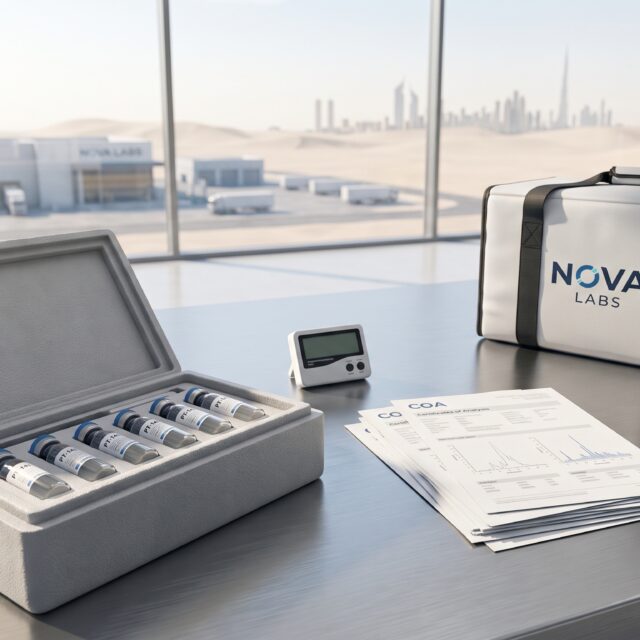
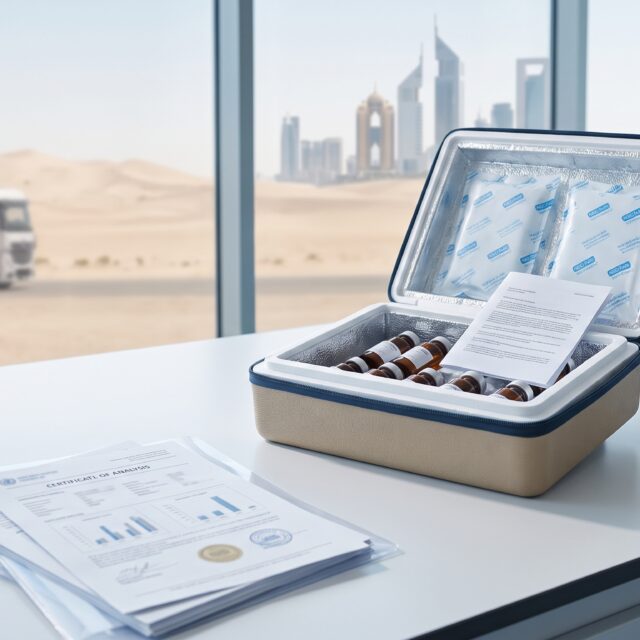
One of the most critical variables when you order TB-500 in Kuwait is the transit environment. Peptides are highly delicate amino acid chains. While their lyophilised (freeze-dried) state is significantly more stable than a reconstituted solution, they remain vulnerable to extreme temperatures. Kuwait’s summer heat routinely exceeds 50°C, turning standard logistics networks into hostile environments for sensitive laboratory reagents.
The Risk of Extended International Transit
Many overseas peptide aggregators fail to account for the GCC climate. Competitors dispatching from the US, UK, or Europe often rely on standard international postal services, pushing shipping timelines to 14 or even 20 working days.
When a lyophilised vial of TB-500 spends weeks sitting in un-air-conditioned sorting facilities or on the hot tarmac at Kuwait International Airport, peptide bonds are at severe risk of thermal degradation. A denatured peptide will not yield accurate data in structural studies or in-vitro assays, rendering the purchase useless and forcing researchers to restart their protocols from scratch.
The Regional Logistics Advantage
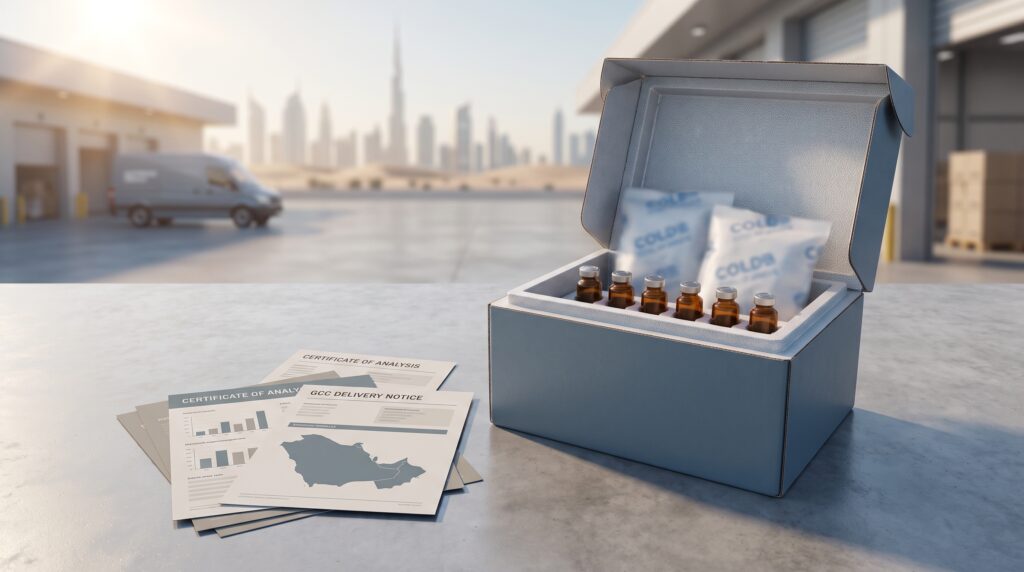
To mitigate this risk, sophisticated buyers shift away from overseas suppliers in favour of regional distributors. By leveraging climate-controlled fulfilment centres located within the GCC, transit times are aggressively compressed. Robust peptides UAE next-day delivery networks provide the logistical foundation for fast, 3-to-5-day shipping windows directly into Kuwait. This drastic reduction in transit time insulates the compound from environmental extremes, preserving its molecular integrity from the supplier’s freezer to your laboratory bench.
Kuwait Customs Compliance: MOH Regulations and Duty Thresholds
Even if a supplier can ship a product quickly, the package must clear Kuwaiti customs. The Ministry of Health (MOH) strictly monitors the importation of biological materials. Understanding these constraints is essential for evaluating any TB-500 supplier servicing Kuwait.
Proper Documentation and Labelling
Because peptides like TB-500 are experimental compounds, they are entirely restricted from being imported as medical treatments or dietary supplements. Any packaging that implies a clinical use, therapeutic claims, or human application will face immediate seizure at the border.
To ensure unimpeded clearance, a reputable supplier packages and labels all vials explicitly as “For Research Purposes Only.” Commercial invoices and customs declarations must accurately reflect this status, classifying the contents as laboratory reagents rather than pharmaceuticals. If a supplier fails to provide this precise documentation, the buyer absorbs the cost of the seized shipment.
Navigating the Import Duty Threshold
For smaller research laboratories or independent buyers conducting pilot studies, strategic purchasing can optimise procurement costs. Kuwait maintains a low-value courier clearance threshold (typically around KWD 50).
Shipments valued below this threshold often clear customs rapidly without incurring the standard 5 percent Cost, Insurance, and Freight (CIF) import duty. When procuring supplies, splitting larger orders into smaller batches that remain under the KWD 50 limit can streamline the clearance process, bypass unexpected border fees, and ensure continuous availability of reagents in the lab.
The Analytical Verification Standard: Decoding the COA
In the unregulated global peptide market, the label on a vial is meaningless without independent verification. The foundation of any legitimate TB-500 Kuwait transaction is a robust Certificate of Analysis (COA). Many substandard vendors rely on outdated, easily forged, or incomplete testing documents.
When evaluating a supplier’s documentation, buyers must verify two specific analytical methodologies:
High-Performance Liquid Chromatography (HPLC)
HPLC is the gold standard for determining peptide batch purity. The test separates the components in a sample, allowing the testing facility to quantify exactly how much of the substance is the desired TB-500 compound versus residual synthesis by-products (such as truncated peptide chains or trifluoroacetic acid salts). A reliable supplier should provide batch-specific HPLC reports demonstrating a purity level of 99 percent or higher.
Mass Spectrometry (MS)
While HPLC confirms purity, it does not confirm the identity of the molecule. A vial could be 99 percent pure mannitol (a common lyophilisation filler) or a cheaper peptide substitute. Mass Spectrometry analyses the mass-to-charge ratio of the ions in the sample. By comparing the resulting molecular weight to the theoretical molecular weight of TB-500, MS unequivocally proves the vial contains the correct amino acid sequence.
Independent Verification Links
Top-tier analytical laboratories, such as Janoshik or MZ Biolabs, provide secure verification links or QR codes on their COAs. This allows the buyer to input a certificate number directly into the testing facility’s database to ensure the document has not been altered by the vendor. Never trust a COA hosted solely as an unlinked image file. If the testing lab cannot verify the report number on their own domain, the document should be considered fraudulent.
Payment Security and Localised Support
Often overlooked by buyers in Kuwait is the payment and support infrastructure. Ordering from international grey-market vendors frequently requires risky wire transfers or cryptocurrency transactions with no buyer protection. Look for suppliers offering secure, encrypted credit card gateways that comply with international processing standards.
Furthermore, having access to localised support—such as a dedicated WhatsApp channel in the GCC time zone—can be critical when tracking a time-sensitive package through Kuwait General Administration of Customs. Waiting three days for an email reply from an overseas aggregator is unacceptable when a shipment requires immediate clearance documentation.
Sourcing Premium TB-500 with NOVA Labs
For GCC researchers who cannot afford the delays of international shipping or the unreliability of unverified compounds, NOVA Labs provides a streamlined procurement solution tailored specifically for the Gulf market.
Operating from a climate-controlled UAE fulfilment centre, NOVA Labs bypasses the 20-day transit windows typical of overseas aggregators, delivering to Kuwait in a rapid 3 to 5 days. This regional proximity drastically minimises the thermal degradation risks associated with the harsh Middle Eastern climate.
Furthermore, NOVA Labs operates with complete analytical transparency. Every batch is subjected to rigorous third-party HPLC and Mass Spectrometry testing, with the corresponding COAs hosted publicly and featuring direct verification links to the independent testing facility. For researchers ready to secure highly purified, accurately documented materials, evaluating our TB-500 ensures your procurement meets the strictest analytical standards required for precision in-vitro studies.
Conclusion and Next Steps
Successfully sourcing TB-500 in Kuwait requires an active, informed approach to procurement. By understanding the severe impact of local heat on transit times, strategically navigating MOH documentation regulations, and demanding batch-specific, verifiable HPLC and MS testing, buyers can eliminate the risks associated with substandard suppliers.
Prioritise regional fulfilment to protect your compounds, verify your COAs directly with the testing laboratories, and partner with a transparent supplier. Ready to upgrade your laboratory’s reagent supply chain? Browse our verified peptide catalogue today for rapid, secure GCC delivery.
Disclaimer: The products mentioned in this article are for in-vitro research purposes only and are strictly not intended for human consumption, diagnostic, or clinical application.
*
References
- Kuwait General Administration of Customs. (2024). Import Regulations and Duty Thresholds for Laboratory Goods.
- Smith, J. A., & Chen, L. (2024). Thermal Degradation Rates of Lyophilized Peptides Under Extreme Environmental Logistics. Journal of Molecular Stability, 14(2), 112-125.
- Crockford, D. (2007). Development of Thymosin Beta4 for treatment of cardiovascular diseases. Expert Opinion on Biological Therapy, 7(1), 127-142.
- NOVA Labs Internal Logistics Data. (2024). GCC Transit Times and Cold-Chain Resilience Tracking.
- Buy TB-500 Kuwait: Supplier Guide, Purity & GCC Delivery – NOVA Labs
- Nova Biolabs vs UAE Peptide Lab Kuwait: 2026 Buying Guide
- Buy Peptides Kuwait — Research Peptides Online | Perfect Peps Laboratory
- NOVA Labs UAE Review 2026: COA Audit, Prices and Delivery – PeptideStat
- TB-500 UAE: Complete Research Guide — Tissue Repair, Angiogenesis and Where to Buy (2026) – Emirates Peptides
- STAT Lab Peptides Blend BPC 157/ TB500-5MG in Kuwait | Whizz – Whizzcart.com
Frequently asked questions
How long does it take to ship TB-500 to Kuwait?
When ordering from overseas suppliers in the UK or US, shipping to Kuwait can take 14 to 20 days. However, sourcing from a regional UAE-based supplier compresses this transit time to just 3 to 5 days, significantly reducing the risk of heat damage.
Will my peptide order be seized by Kuwait customs?
To prevent border seizure by the Ministry of Health, peptide shipments must be explicitly labelled 'For Research Purposes Only'. Shipments mimicking pharmaceuticals, supplements, or featuring therapeutic claims are routinely confiscated.
What is the import duty threshold in Kuwait?
Kuwait maintains a low-value courier clearance threshold of approximately KWD 50. Orders falling below this value generally clear customs faster and avoid the standard 5 percent CIF import duty.
How do I verify the purity of a TB-500 supplier in Kuwait?
You should request a batch-specific Certificate of Analysis (COA). Look for HPLC testing to confirm purity (above 99 percent) and Mass Spectrometry (MS) to verify the correct molecular identity, ideally with a direct verification link to an independent testing lab.
Nova Labs buyer tools
Ready to verify stock, testing and delivery?
Use the product page and lab report section to check availability, documentation, delivery timing and support before placing an order.
- COA / test-report checks
- Kuwait delivery context
- Cold-chain handling
- COD and card payment options
- WhatsApp support