




Procuring high-purity research compounds in Saudi Arabia presents unique structural and logistical challenges. Laboratory managers, principal investigators, and independent researchers must navigate strict ZATCA customs regulations, extreme regional thermal transit conditions, and stringent corporate onboarding processes. When evaluating specialised suppliers based in the neighbouring United Arab Emirates to circumvent long-haul overseas delays, the market comparison almost invariably focuses on nova biolabs vs peptides lab uae.
While both of these suppliers operate out of modern UAE logistics hubs to accelerate GCC transit times, they serve fundamentally different buyer profiles and utilize drastically different operational models. Peptides Lab UAE functions as a closed, highly restricted corporate B2B portal. In contrast, NOVA Labs operates on an agile, open-access model reinforced by verifiable third-party analytical testing and localised Saudi payment infrastructure.
This comprehensive guide explores the operational realities of sourcing from both providers, allowing Saudi Arabian buyers to make an informed, structurally appropriate decision for their laboratory’s needs.
Quick Answer: Nova Biolabs vs Peptides Lab UAE
When comparing Nova Biolabs vs Peptides Lab UAE, the key differentiator is procurement accessibility. Peptides Lab UAE strictly requires a corporate trade licence for closed B2B institutional purchasing. Conversely, NOVA Labs utilizes an open-access model featuring independent Janoshik HPLC testing, pre-cleared ZATCA documentation, and localized GCC payment options, ensuring frictionless fulfillment for both institutional and independent KSA researchers.
Evaluation Methodology and Criteria
As of 2026-09-03, this comparison is based on an evaluation of the prevailing market conditions for importing biochemicals into the Kingdom of Saudi Arabia. The core criteria assessed include:
- Administrative Friction: The bureaucratic requirements necessary to view pricing, place orders, and finalize a purchase.
- Logistics and Thermal Protection: The methods used to ensure delicate amino acid sequences survive the intense heat of GCC land and air transit.
- ZATCA and SFDA Compliance: The proactive steps taken by the supplier to minimize border confiscation risks.
- Analytical Verification: The availability, independence, and transparency of Certificates of Analysis (COAs), High-Performance Liquid Chromatography (HPLC), and Mass Spectrometry (MS) data.
- Payment Infrastructure: The flexibility and economic viability of payment gateways for GCC-based buyers.
Procurement Models: Open Access vs Corporate B2B
The most immediate and tangible distinction between these two UAE-based suppliers is the administrative framework required simply to initiate a transaction.
Peptides Lab UAE operates under a strict, closed B2B system aligned with Dubai DED Trade Licence regulations. To view catalogue pricing, access analytical reports, or place a preliminary order, prospective buyers must submit a valid corporate trade licence, a Tax Registration Number (TRN), and complete institutional onboarding. This model caters exclusively to heavily funded universities, registered clinics, and corporate entities with dedicated procurement departments. For independent researchers, principal investigators operating private in-vitro lab setups, or rapidly scaling biotech startups, this creates a significant, often insurmountable barrier to entry.
NOVA Labs deliberately utilises an open-retail procurement model designed to serve both large institutional departments and agile independent researchers. There are no corporate vetting delays or mandatory TRN registrations required to browse the catalogue, review purity metrics, or complete a purchase. This frictionless approach frequently saves KSA buyers weeks of lead time otherwise lost to administrative onboarding, allowing researchers to rapidly acquire necessary biochemicals for immediate laboratory assay and evaluation without bureaucratic entanglement.
Surviving the Heat: Lyophilised Compounds and Logistics
The GCC climate presents a severe logistical challenge for the transport of biochemicals. With regional summer temperatures routinely exceeding 40°C (104°F), the molecular stability of research compounds during the cross-border transit from Dubai to cities like Riyadh, Jeddah, Dammam, and Dhahran is a paramount concern.
Thermal degradation is a primary threat to amino acid chains. Pre-mixed liquid solutions degrade rapidly when exposed to heat, fracturing the delicate molecular sequences and rendering the compounds analytically useless by the time they clear Saudi customs.
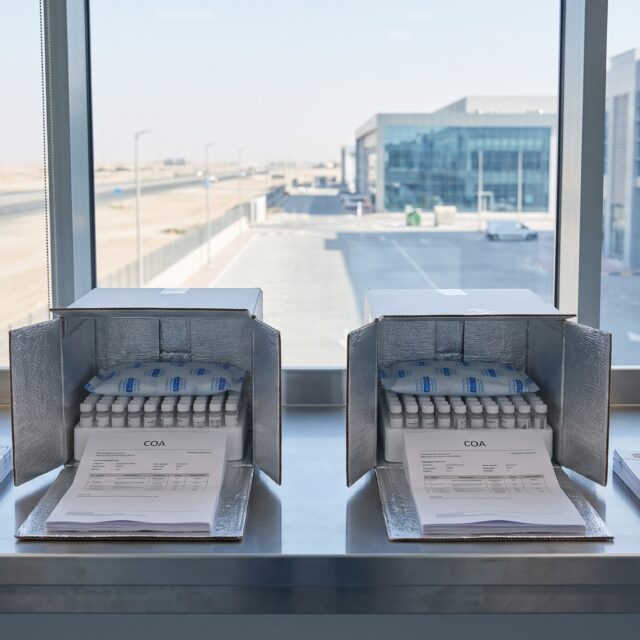
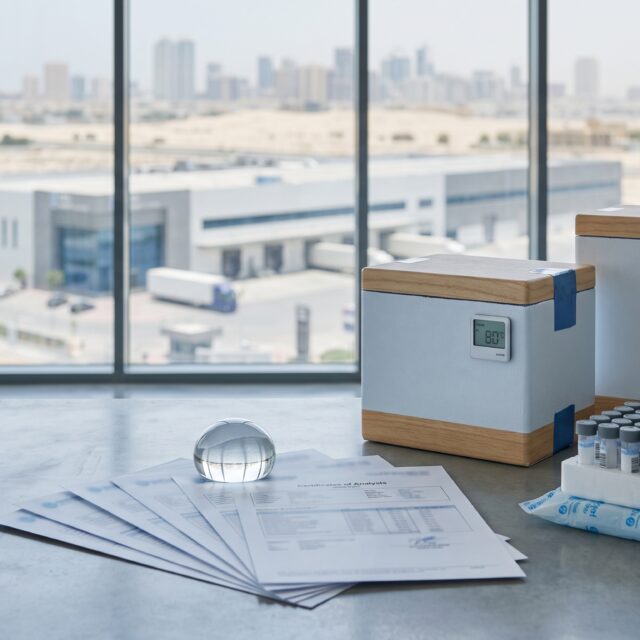
To mitigate this, both NOVA Labs and Peptides Lab UAE supply their research peptides exclusively as lyophilised (freeze-dried) powders. Lyophilisation removes the moisture from the compound under a strict vacuum, putting the peptide into a dormant, highly stable state. In this desiccated powdered form, the compounds can comfortably survive the elevated temperatures of regional transit. Researchers are instructed to reconstitute the peptide with bacteriostatic water only once the vial is safely stored in a temperature-controlled laboratory setting (typically 2°C to 8°C).
Because both suppliers operate out of local distribution hubs, they dramatically reduce the prolonged thermal exposure associated with importing from North America or China. While domestic buyers frequently take advantage of peptides UAE next day delivery, KSA buyers rely on this same rapid UAE dispatch to ensure their cross-border transit times are kept to an absolute minimum, usually arriving within 4 to 5 business days.
Navigating ZATCA Clearances and Border Friction
Importing biological supplies into the Kingdom requires navigating the rigorous regulations set by the Zakat, Tax and Customs Authority (ZATCA) and the Saudi Food and Drug Authority (SFDA). Confiscation, extreme delays, or unexpected tariffs frequently occur when documentation is incomplete.
Peptides Lab UAE expects its B2B buyers to handle much of the import compliance autonomously. Because they require a trade licence upfront, the operational assumption is that the purchasing entity has a dedicated import broker managing ZATCA compliance, TRN verification, and corporate customs clearance on the Saudi side.
NOVA Labs recognises that many independent and private researchers do not retain full-time import brokers. To minimise border confiscation risks and bureaucratic friction, packages are dispatched under strict, compliant Research Use Only (RUO) labelling. All necessary customs documentation is pre-cleared and included directly with the shipping manifest, explicitly detailing that the lyophilised powders are non-hazardous, non-infectious, and intended solely for in-vitro laboratory analysis. This proactive, hands-on approach significantly reduces friction at the Saudi border, maintaining consistent delivery windows to major KSA cities.
Verifying Purity: COA Transparency and Analytical Testing
For any valid in-vitro research application, chemical purity is the most critical metric. Researchers must be able to definitively verify that a compound matches its expected molecular weight and contains no synthesis byproducts, TFA (trifluoroacetic acid) residue, or heavy metal contaminants.
Peptides Lab UAE handles their analytics privately. They provide Certificates of Analysis (COAs) upon B2B request or during the final stages of institutional onboarding. However, because their portal is closed, prospective buyers cannot independently verify batch testing records prior to initiating the corporate registration process.
NOVA Labs has established a distinctly higher standard for transparency by hosting cryptographically verifiable testing reports publicly for every batch. They partner exclusively with Janoshik, a highly respected independent analytical laboratory, to perform High-Performance Liquid Chromatography (HPLC) and Mass Spectrometry (MS). Every product page features the relevant Janoshik report, and researchers can enter the unique verification key directly into the public Janoshik database to confirm its authenticity. This guarantees that all synthesised sequences consistently meet strict ≥98%-99% purity thresholds before the buyer ever allocates research capital.
Payment Infrastructure and Fulfillment Economics
Cross-border B2B transactions often involve high minimum order quantities (MOQs), costly international wire transfers, and disadvantageous currency conversion fees. When evaluating the economic efficiency of sourcing in KSA, the payment infrastructure dictates the accessibility of the supplier.
Peptides Lab UAE relies on traditional B2B payment methods, such as corporate bank wires and net-30 credit terms, which are standard for their institutional client base. They also maintain a relatively high free-delivery threshold, which can prove prohibitive for small-scale pilot studies or researchers requiring only a few vials for preliminary testing.
NOVA Labs has integrated modern, localised GCC payment solutions designed explicitly for flexibility and cash-flow management:
- Tamara and Tabby (BNPL): Saudi buyers can split their laboratory supply costs into interest-free installments, a significant advantage for privately funded or grant-pending research.
- Cash on Delivery (COD): Available for added buyer confidence within specific GCC zones.
- Cryptocurrency Gateways: Providing a secure, borderless, and immediate payment alternative.
- Favorable Shipping Economics: NOVA Labs provides highly competitive shipping thresholds to GCC destinations, including KSA, dramatically lowering the cost of entry for researchers conducting early-phase assays.
Conclusion and Next Steps
When conducting a nova biolabs vs peptides lab uae comparison for Saudi Arabian procurement, the optimal choice hinges on your laboratory’s administrative structure.
If you represent a large-scale university or corporate clinic with established import brokers, an active TRN, and mandatory B2B purchasing protocols, Peptides Lab UAE is equipped to handle those institutional needs.
However, if you are an independent researcher, a private facility manager, or an agile biotech buyer seeking to bypass administrative friction, NOVA Labs provides a distinctly superior procurement experience. By combining an open-access catalogue, cryptographically verifiable Janoshik testing, pre-cleared ZATCA documentation, and localised KSA payment options like Tamara, they remove the traditional hurdles of regional peptide sourcing.
To view current batch purity reports, Janoshik certifications, and secure your compounds for seamless Saudi fulfillment, explore the product catalogue.
*
Disclaimer: The products and compounds mentioned in this article are strictly for laboratory, in-vitro, and research purposes only. They are not intended for human consumption, therapeutic use, or medical treatment.
References
- Zakat, Tax and Customs Authority (ZATCA): Official Import Guidelines for Laboratory and Chemical Reagents into the Kingdom of Saudi Arabia. zatca.gov.sa
- Saudi Food and Drug Authority (SFDA): Regulations for the Importation of Non-Medical and Research Use Only (RUO) Substances. sfda.gov.sa
- Janoshik Analytical: Mass Spectrometry and High-Performance Liquid Chromatography (HPLC) verification protocols for synthetic peptides. janoshik.com
- World Health Organization (WHO): Guidelines on the Safe Transport of Infectious Substances and Diagnostic Specimens (Adapted for RUO thermal stability and logistics). who.int
- Nova Biolabs vs Peptides Lab UAE: 2026 KSA Sourcing Guide
- Peptides Lab UAE
Frequently asked questions
Does Nova Biolabs ship research compounds to Saudi Arabia?
Yes, NOVA Labs ships research compounds directly to major Saudi Arabian cities, including Riyadh, Jeddah, Dammam, and Dhahran, with typical delivery times ranging from 4 to 5 days once customs clearance is approved.
Do I need a trade licence to buy from Peptides Lab UAE?
Yes, Peptides Lab UAE operates a strictly closed B2B platform and requires buyers to submit a valid corporate trade licence and complete institutional onboarding to access their pricing and catalogue.
Can I use Tamara or Tabby to pay for research peptides in KSA?
Yes, NOVA Labs supports localised Saudi payment infrastructure, allowing researchers to split their purchases using Buy Now, Pay Later (BNPL) services like Tamara and Tabby.
How are research compounds protected from the GCC heat during transit?
High-tier suppliers ship peptides exclusively as lyophilised (freeze-dried) powders. This vacuum-sealed state removes moisture and stabilizes the compound, preventing thermal degradation even in temperatures exceeding 40°C during GCC land transit.
What is Janoshik HPLC testing?
Janoshik is an independent analytical laboratory that uses High-Performance Liquid Chromatography (HPLC) and Mass Spectrometry (MS) to verify the purity and molecular weight of a chemical compound. NOVA Labs provides these verifiable reports publicly for every product batch.
Nova Labs buyer tools
Ready to verify stock, testing and delivery?
Use the product page and lab report section to check availability, documentation, delivery timing and support before placing an order.
- COA / test-report checks
- Saudi Arabia delivery context
- Cold-chain handling
- COD and card payment options
- WhatsApp support