




Procuring temperature-sensitive research compounds in the Gulf Cooperation Council (GCC) requires navigating one of the harshest logistical environments on earth. During the height of summer, ambient temperatures routinely exceed 45°C. For procurement staff and informed research buyers in the Kingdom of Saudi Arabia, the challenge is clear: maintaining the structural integrity of fragile amino acid sequences from the supplier’s laboratory to the local testing facility.
Without specialised infrastructure, standard international shipping methods frequently fail, leaving researchers with degraded compounds and compromised experimental data. Navigating these environmental extremes requires a comprehensive understanding of regional supply chains, advanced packaging technologies, customs bottlenecks, and documentation requirements.
Quick Answer: Why Cold Chain Peptide Delivery in Saudi Arabia is Crucial
Cold chain peptide delivery in Saudi Arabia prevents temperature-sensitive research compounds from degrading. Since local temperatures frequently exceed 45°C, secure delivery requires vacuum-insulated packaging, digital data loggers, and expedited UAE-to-KSA logistics to maintain a 2°C to 8°C environment before customs delays exhaust the cooling buffer.
The Threat of 45°C Heat on Molecular Integrity
Lyophilised (freeze-dried) peptides possess a degree of ambient temperature stability, but they are not impervious to extreme heat. Prolonged exposure to temperatures exceeding 25°C accelerates the cleavage of delicate peptide bonds, irreversibly altering the compound’s structure. By the time a package endures the radiant heat of an airport tarmac in Riyadh or Jeddah, the internal temperature of a standard cardboard box can soar well above the danger zone.
This is why securing reliable cold chain peptide delivery in Saudi Arabia is non-negotiable. Whether you are evaluating metabolic compounds, structural proteins, or standard analytical reference materials, heat exposure invalidates the supplier’s Certificate of Analysis (COA). A compound that tested at 99% purity in a North American or European laboratory may arrive at a fraction of that purity if its transit packaging fails to shield it from the intense Saudi climate.
Evaluating Local Regulations and Logistical Realities
In the broader pharmaceutical and biotechnology sectors, the Saudi Food and Drug Authority (SFDA) enforces strict Good Distribution Practice (GDP) standards. These regulations mandate precise temperature monitoring—typically requiring biologicals and sensitive materials to remain between 2°C and 8°C. Furthermore, commercial temperature-controlled logistics in the Kingdom require transport vehicles to be digitally linked to the Saudi government’s electronic tracking platforms to audit real-time transit temperatures.
While independent research peptide shipments do not automatically fall under commercial pharmaceutical GDP mandates, these stringent national standards set the benchmark for what successful regional logistics look like. If commercial entities require satellite-tracked refrigerated vehicles to move sensitive compounds across the desert, informed research buyers should expect a comparable level of thermal defence from their independent suppliers.
If your supplier handles shipping to Saudi Arabia the same way they handle shipping to Northern Europe, the delivery is already compromised.
Navigating Saudi Customs and Documentation
The hidden cost of international shipping into the GCC is not just the freight charge; it is the time spent in customs clearance. When a package arrives at King Khalid International Airport (RUH) or King Abdulaziz International Airport (JED), it enters a complex queue. Standard international postal options, and even some commercial couriers, may hold packages in non-temperature-controlled facilities while waiting for clearance.
Every passive cold-chain system has a thermal buffer—the maximum number of hours the packaging can maintain its target temperature before the internal cooling elements melt and ambient heat breaches the insulation. A high-quality thermal buffer might last 72 hours. If transit takes 48 hours, but the package sits in a customs holding warehouse for an additional 72 hours due to missing paperwork, the buffer fails. The ice melts, the insulation saturates, and the research peptides degrade.
Preventing these delays requires meticulous documentation. Shipments must include precise commercial invoices, Material Safety Data Sheets (MSDS), and clear declarations that the compounds are intended for in-vitro laboratory research purposes only. Regional suppliers are typically more adept at generating this precise paperwork to ensure swift border processing.
The Riyadh-Dubai Corridor: The Regional Fulfilment Advantage
To circumvent the lethal combination of long international flight times and unpredictable customs holds, experienced GCC researchers leverage regional supply lines. Sourcing from a highly resourced hub in the United Arab Emirates drastically alters the logistics equation.
The UAE-to-KSA distribution channel reduces total shipping transit time to a highly reliable 24 to 48 hours. By crossing borders regionally via established GCC trade corridors, packages spend significantly less time in transit, ensuring the cold chain’s thermal buffer is never exhausted.
Suppliers that operate locally understand the unique pressures of the environment. Because NOVA Labs handles regional distribution from a dedicated GCC hub, buyers can leverage this geographical proximity. When compounds are dispatched via our UAE-to-GCC delivery network, the initial leg of the journey is highly controlled, and cross-border transit into Saudi Arabia is expedited. This regional proximity is the single most effective way to eliminate the lengthy customs lag that destroys international shipments.
What Real Cold Chain Packaging Looks Like
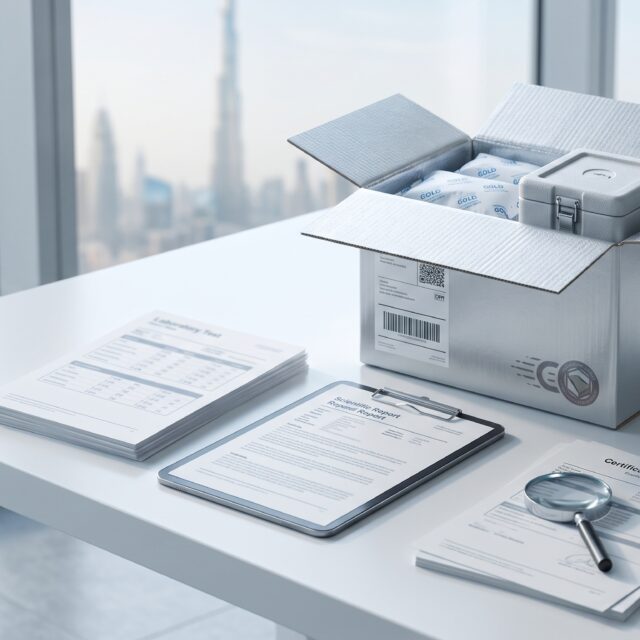
When evaluating cold chain peptide delivery in Saudi Arabia, buyers must ask their suppliers exactly how the materials are packed. Not all cold shipping is created equal. The industry generally relies on two tiers of passive thermal systems:
1. The Standard Tier (Cardboard and Loose Gel)
Basic suppliers rely on standard EPS (expanded polystyrene or styrofoam) coolers packed with loose water-based gel packs. While inexpensive, EPS has relatively poor thermal resistance. Water-based gel packs melt quickly when exposed to high external heat. This setup typically yields a thermal buffer of just 24 to 36 hours. In a Saudi summer, relying on EPS and water ice is a dangerous gamble.
2. Advanced Passive Thermal Systems (Vacuum Insulation)
Premium suppliers utilise high-density Phase Change Materials (PCMs) rather than standard ice. PCMs are engineered chemicals that absorb massive amounts of ambient heat as they change from solid to liquid, maintaining a precise internal temperature for much longer.
These PCMs are enclosed within Vacuum Insulated Panels (VIPs). Because a vacuum contains no air, it cannot conduct heat. A box lined with VIPs can maintain a 2°C to 8°C environment for up to 96 hours, even when the external temperature exceeds 40°C. This is the gold standard for desert logistics.
3. The Heat-Exposure Audit Trail (Data Loggers)
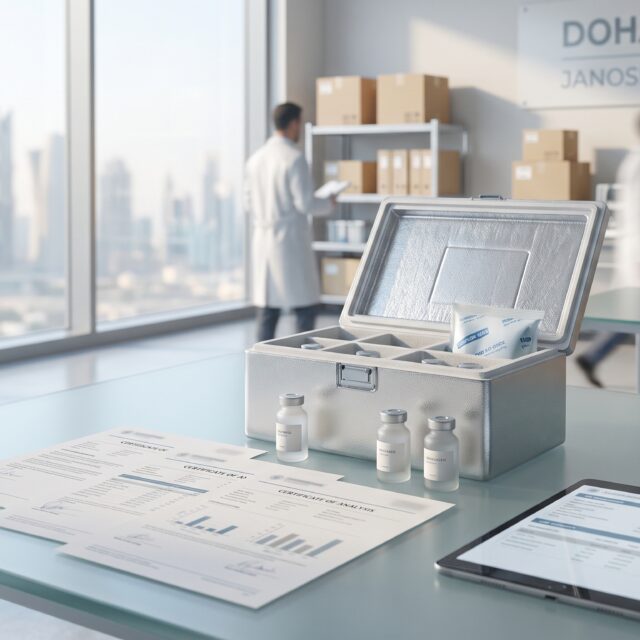
Top-tier logistics do not just promise cold temperatures; they prove it. Reliable cold chain shipments integrate a calibrated USB or Bluetooth temperature data logger inside the primary insulation chamber. When the buyer opens the package in their lab in Jeddah or Dhahran, they can plug the logger into their computer and download a complete minute-by-minute temperature graph spanning the entire journey. If the temperature spiked during a customs hold, the logger provides the exact data needed to verify whether the compound’s integrity was maintained.
The Importance of Analytical Transparency Before Transit
There is no point in paying for premium cold chain logistics if the original compound was impure before it left the facility. The cold chain only preserves the baseline quality of the material; it cannot fix a poorly synthesised sequence.
Prior to transit, all research compounds should be verified via High-Performance Liquid Chromatography (HPLC) and Mass Spectrometry (MS). A rigorous Certificate of Analysis (COA) confirms that the compound meets strict baseline purities (typically >99%). To ensure your experimental materials are backed by verified third-party testing prior to dispatch, you can browse rigorously tested compounds via our comprehensive research shop. Starting with analytically verified material ensures that your logistics investment is protecting a pristine compound.
A Buyer’s Checklist for Saudi Logistics Procurement
Before you procure your next batch of research compounds, ensure your supplier meets the following operational benchmarks:
- Regional Fulfilment Origin: Is the package physically dispatching from a GCC hub? Prioritise UAE/GCC hubs over North American or Asian origins to cut transit times and cross-border friction.
- Packaging Technology: Does the supplier use Vacuum Insulated Panels (VIPs) and Phase Change Materials (PCMs), or standard styrofoam and ice packs?
- Thermal Buffer Rating: What is the maximum guaranteed thermal buffer of the packaging in 40°C+ ambient heat? (Look for a minimum 72-hour rating).
- Data Logging Integration: Will the shipment include a digital temperature logger for transit audit purposes upon receipt?
- Payment and Support Infrastructure: Does the supplier offer secure local payment gateways or cryptocurrency options for privacy? Do they provide direct customer support via WhatsApp for real-time tracking updates during the customs clearance process?
- Analytical Transparency: Are the compounds backed by accessible, batch-specific HPLC and MS testing prior to shipping?
Secure Your Research Supply Chain
For researchers operating in Saudi Arabia, the local climate is the ultimate stress test for any supplier’s operational competence. While extreme heat poses a genuine threat to fragile molecular structures, these environmental risks are entirely manageable with the right infrastructural approach.
By moving away from slow, unpredictable intercontinental freight and embracing dedicated regional UAE-to-KSA distribution channels, you eliminate the primary cause of thermal failure: transit time. When combined with advanced vacuum insulation, strict documentation, and transparent data logging, cold chain peptide delivery in Saudi Arabia becomes a reliable, verifiable process rather than a logistical gamble. Protect your research data by demanding logistics that are explicitly built for the operational reality of the GCC.
*
Disclaimer: The products mentioned in this article are strictly for in-vitro laboratory research purposes only and are not intended for human consumption, therapeutic use, or clinical application. Always handle research compounds strictly according to standard laboratory safety protocols and regional regulations.
References
- Saudi Food and Drug Authority (SFDA). (2021). Guidelines on Good Distribution Practice (GDP) for Pharmaceutical Products.
- Parenteral Drug Association (PDA). (2020). Technical Report No. 39: Guidance for Temperature-Controlled Medicinal Products.
- World Health Organization (WHO). (2015). Temperature and route mapping for transport of time- and temperature-sensitive pharmaceutical products.
- Saudi Logistics Hub. (2023). Cold Chain Infrastructure and Logistics Expansion in the GCC.
- The Future of SFDA-Compliant Cold Chain Logistics in Saudi Arabia
- How Can Pharmaceutical Logistics Meet Strict SFDA Compliance in Saudi Arabia? – CoolGo
- Pharmaceutical Temperature-Controlled Transport in KSA – Inqlha
- Cold Chain Packing & Logistics – Leading Cold Chain Solutions Provider
- Retatrutide Saudi Arabia: Buying, Purity, COA and Delivery Guide – NOVA Labs
Frequently asked questions
How long does cold chain peptide delivery to Saudi Arabia take?
When fulfilled from a regional hub like the UAE, delivery to major Saudi cities such as Riyadh, Jeddah, and Dammam typically takes 24 to 48 hours. This regional proximity significantly reduces the risk of customs delays that often plague intercontinental shipments.
Are standard ice packs enough to protect peptides in the Saudi summer?
No. Standard water-based gel packs melt too quickly in ambient temperatures exceeding 45°C. Reliable GCC cold chain logistics require Phase Change Materials (PCMs) and Vacuum Insulated Panels (VIPs) to maintain a secure 72 to 96-hour cooling buffer.
How can I verify that my research peptides stayed cold during transit?
High-quality scientific suppliers include calibrated USB or Bluetooth temperature data loggers inside the insulation chamber. This provides the buyer with a complete minute-by-minute temperature audit trail upon receipt to ensure the thermal buffer remained intact.
What temperature range is required for safe peptide transit?
Most temperature-sensitive biological and research compounds, including lyophilised peptides, require a maintained internal environment of 2°C to 8°C to prevent rapid structural degradation and preserve bond integrity during transit.
Why do international peptide shipments often fail at Saudi customs?
International shipments often fail because they lack precise documentation, such as targeted Material Safety Data Sheets (MSDS) and specific laboratory use declarations. If paperwork is incomplete, the package sits in a customs queue until the cold chain thermal buffer is exhausted.
Nova Labs buyer tools
Ready to verify stock, testing and delivery?
Use the product page and lab report section to check availability, documentation, delivery timing and support before placing an order.
- COA / test-report checks
- Saudi Arabia delivery context
- Cold-chain handling
- COD and card payment options
- WhatsApp support