
Peptide Purity Guide GCC: The Core Essentials
For GCC buyers, verifying peptide purity requires checking independent High-Performance Liquid Chromatography (HPLC) reports showing >=99% purity and LC-MS data for exact molecular identity. Procurement managers must also demand temperature-controlled local logistics to prevent rapid compound degradation from the extreme Middle Eastern climate during transit.
Procuring high-grade research materials in the Gulf Cooperation Council (GCC) presents a unique set of regional challenges. Between extreme summer heat that routinely surpasses 40 degrees Celsius, complex regional customs regulations, and widely varying supplier standards, laboratory managers and informed buyers must be rigorous in their vendor evaluation process.
This peptide purity guide GCC laboratories and researchers rely on breaks down exactly how to vet suppliers, accurately read batch documentation, and ensure fragile compounds remain stable from the warehouse dispatch point all the way to your workbench.
Key Takeaways for GCC Laboratory Procurement
- Demand Independent Testing: Only accept Certificates of Analysis (COAs) from accredited third-party laboratories, not self-generated supplier documents.
- Verify the Documentation: Look for HPLC purity of >=98% (ideally 99%+) and LC-MS reports confirming the exact molecular weight and sequence identity.
- Mitigate Transit Risks: International shipping into the UAE and GCC often faces severe customs delays; prioritize suppliers with local cold-chain infrastructure.
- Check Support Channels: Legitimate regional suppliers offer responsive client support (e.g., WhatsApp or direct lines) for instant batch verifications.
Why Sourcing in the Gulf Demands Extra Vigilance
The climate and logistical landscape of the United Arab Emirates, Saudi Arabia, Qatar, and the wider GCC region are notoriously tough on biological materials. Research peptides are composed of fragile chains of amino acids that are held together by delicate peptide bonds. When exposed to prolonged high temperatures, ambient humidity, or ultraviolet light, these bonds can undergo hydrolysis or oxidation, essentially rendering the compound useless for precise scientific research.
Many overseas suppliers will ship to the GCC using standard international couriers. However, what often goes unmentioned is the transit reality: packages frequently sit in unconditioned airport warehouses or ambient-temperature sorting facilities during customs clearances, which can take anywhere from three days to two weeks. A beautifully designed supplier website does not guarantee compound stability if the logistics network is fundamentally flawed for the region.
The Ultimate Buyer Checklist: Validating Research Peptides in the UAE
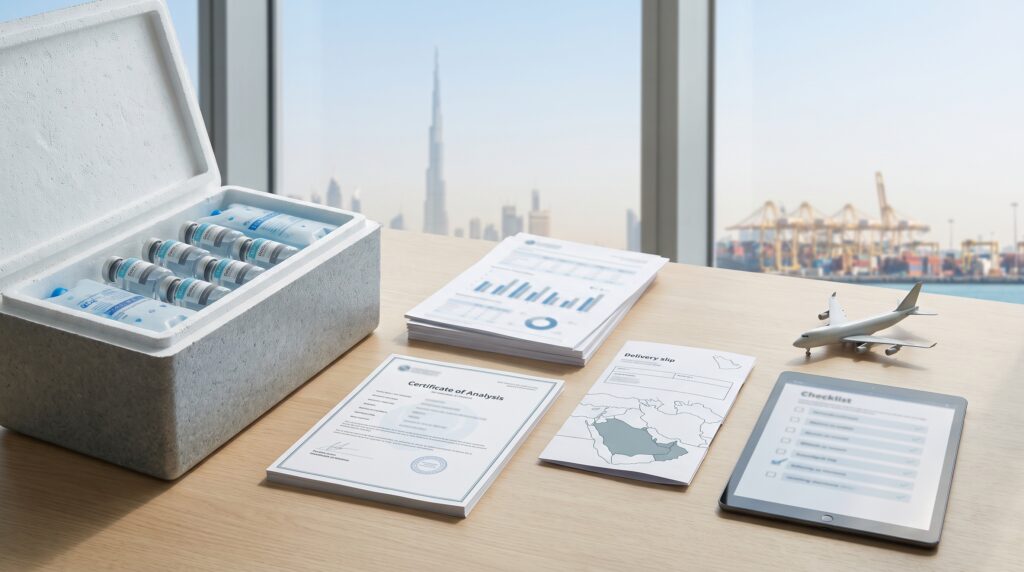
Before placing an order for an upcoming laboratory project or clinical assay, evaluating the supplier’s transparency and local infrastructure is non-negotiable. Use this advanced evaluation checklist to separate reputable scientific suppliers from high-risk, drop-shipping vendors:
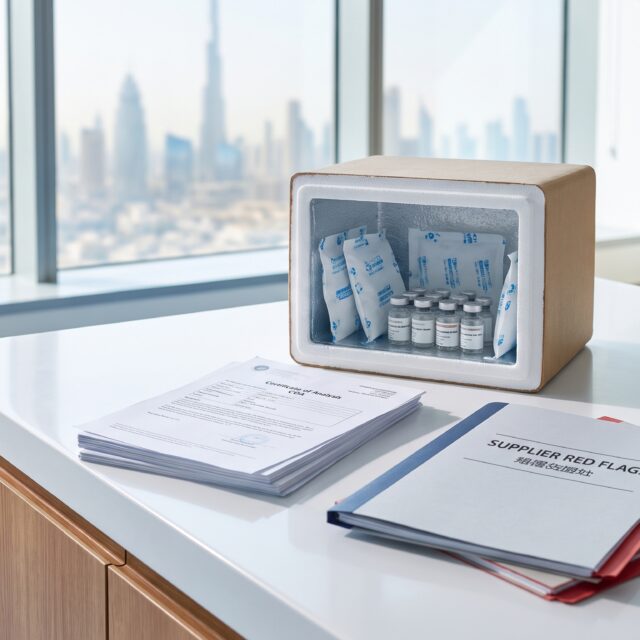
- Traceable Batch Numbers: Every vial should correspond directly to a specific batch number on the COA. If the COA is generic and does not clearly state the current batch, it is likely outdated.
- Testing Dates: A reliable COA should ideally be dated within the last 6 to 12 months. Older tests may not accurately reflect the current inventory being shipped.
- Accredited Laboratory Sources: The testing must be conducted by an ISO-accredited external analytical laboratory (e.g., MZ Biolabs or similar recognized entities) to completely eliminate internal bias and conflict of interest.
- Chromatography Verification: The product must show an HPLC purity of >=98% alongside a clear LC-MS report.
- Local Inventory vs. Drop-Shipping: Ensure the vendor holds stock locally in Dubai or Abu Dhabi. Localized inventory drastically cuts down transit times and avoids customs delays.
Decoding the COA: HPLC, LC-MS, and TFA Explained
Understanding the specific analytical documentation provided by a supplier is the most critical step in verifying research integrity. Merely glancing at a “99% pure” badge on a website is insufficient. You need to know how to read the actual lab data. Two primary analytical methods are used in tandem to validate research compounds.
High-Performance Liquid Chromatography (HPLC)
HPLC remains the absolute gold standard for verifying the quantitative purity of a peptide sample. The resulting output graph, known as a chromatogram, plots peaks that represent the various components within the tested sample.
When reading an HPLC chromatogram, the massive primary peak represents your target peptide. Any smaller, secondary peaks trailing or leading the main peak indicate impurities, which are typically truncated sequences or by-products from the synthesis process. For rigorous in-vitro applications and reliable data generation, the industry standard requires a minimum purity of >=98%. Using compounds that fall below this threshold introduces uncontrollable biological confounding variables, potentially rendering an entire experiment’s dataset invalid.
Liquid Chromatography-Mass Spectrometry (LC-MS)
While HPLC confirms how pure a sample is, it cannot tell you what the sample actually is. A vial could theoretically be 99% pure baking soda and pass an HPLC test. This is where LC-MS testing becomes crucial.
Mass spectrometry measures the mass-to-charge ratio of ions. It confirms the exact molecular identity and molecular weight of the compound against its theoretical weight. If a supplier provides an HPLC report showing high purity but fails to provide mass spectrometry data, there is absolutely no verified scientific proof that the vial contains the correct peptide sequence.
The Role of TFA (Trifluoroacetic Acid) Content
During solid-phase peptide synthesis, Trifluoroacetic Acid (TFA) is commonly used to cleave the peptide from the resin. While standard synthesis leaves residual TFA salts, specialized laboratories sometimes require TFA-removal processes (exchanging TFA for acetate salts) for specific cell-culture experiments where high TFA levels might cause cellular toxicity. High-quality COAs will often note the salt form or the percentage of net peptide content.
The GCC Cold-Chain Survival Guide: Heat, Humidity, and Transit
One of the most frequent points of failure in regional peptide procurement is the final logistical leg. As established, the extreme climate of the GCC can rapidly degrade sensitive research materials if mishandled in transit.
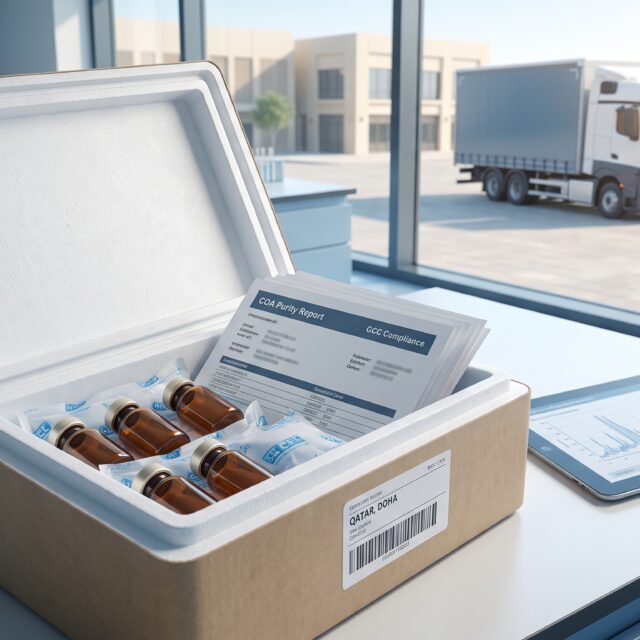
To bypass severe transit risks associated with international borders, research facilities must rely on domestic distribution networks. Specialized suppliers understand that maintaining the cold chain is just as important as the initial synthesis. By utilizing temperature-controlled, next-day delivery protocols in the UAE, NOVA Labs ensures that sensitive compounds are never subjected to the prolonged heat exposure common with cross-border shipping.
Premium delivery protocols typically include:
- Thermally insulated, light-proof packaging.
- Temperature stabilizing ice packs to maintain ambient cooling without freezing the lyophilized cake.
- Expedited last-mile couriers who understand handling protocols for fragile laboratory materials.
Local Storage Protocols for UAE Laboratories
Even with flawless cold-chain delivery, the end-user must implement rigorous Standard Operating Procedures (SOPs) for storage to maintain stability. Ambient regional humidity can also play a detrimental role during the reconstitution phase, making deeply climate-controlled laboratory environments absolutely essential.
Handling Lyophilized Peptides
When research peptides are delivered, they arrive in a lyophilized (freeze-dried) state. In this powdered form, they are remarkably resilient provided they are kept completely away from direct sunlight, UV radiation, and severe heat. Standard laboratory protocols dictate that lyophilized peptides remain highly stable in a sealed, dark vial at 2 to 8 degrees Celsius (standard refrigeration) for up to 36 months, or at -20 degrees Celsius (frozen) for up to 60 months.
Handling Reconstituted Compounds
Once a peptide is reconstituted with sterile bacteriostatic water or a specific buffer solution, the molecular structure becomes highly fragile. It must be stored immediately at 2 to 8 degrees Celsius. Under these strict conditions, it will remain stable for a maximum of 4 to 8 weeks depending on the specific peptide sequence.
Crucially, UAE laboratories must adhere to the temperature excursion rule: if a reconstituted peptide experiences a temperature excursion of more than 4 hours above 15 degrees Celsius (for example, during a prolonged AC or generator failure), immediate disposal is required to prevent biological contamination and data degradation. Furthermore, repeated freeze-thaw cycles of liquid peptides are strictly prohibited as the expanding ice crystals will mechanically shear the delicate molecular bonds.
Procurement Support, Payments, and Verification
Operating within the regulatory framework of the UAE requires clarity on product designation. Products supplied by specialist domestic distributors are strictly designated as research-grade peptides, intended exclusively for laboratory use, in-vitro testing, and analytical research.
Modern regional suppliers have adapted to the needs of GCC laboratory managers by offering streamlined procurement processes. This includes secure local payment gateways, corporate invoicing, and direct communication lines such as WhatsApp for immediate procurement support and stock verification. Before committing laboratory budgets to a new supplier, ensure they provide transparent batch documentation that you can verify independently.
Conclusion
Securing high-quality compounds in the Gulf requires far more than just looking for the lowest price tag on an overseas website. It demands a firm understanding of chromatography, an awareness of regional supply chain vulnerabilities, and the implementation of strict in-house storage SOPs. By demanding third-party HPLC and LC-MS documentation, and by insisting on local cold-chain logistics, researchers can effectively protect their budgets and ensure the absolute validity of their assay data.
To view fully verified independent testing reports, check stock availability, and explore research compounds backed by local UAE cold-chain delivery, you can browse our complete catalog at the NOVA Labs shop.
Disclaimer: NOVA Labs products are strictly for laboratory research and in-vitro use only. They are not intended for human consumption, therapeutic use, or diagnostic purposes.
References
- D’Hondt, M., et al. (2014). “Related impurities in peptide medicines.” Journal of Pharmaceutical and Biomedical Analysis, 101, 2-30.
- Vlieghe, P., et al. (2010). “Synthetic therapeutic peptides: science and market.” Drug Discovery Today, 15(1-2), 40-56.
- United States Pharmacopeia (USP). General Chapter <1503> Quality Attributes of Synthetic Peptides.
- Kuhlmann, J., et al. (2020). “Impact of Temperature Excursions on Peptide Stability.” International Journal of Pharmaceutics, 587, 119630.
Disclaimer: The products and guidelines mentioned in this article are specifically intended for in-vitro research purposes only and are strictly not for human or animal consumption.
- Peptide Storage in UAE Labs: Best Practices
- Peptide Storage Guide | UAE Core Peptides
- Primero Peptides UAE: Research-Grade Peptides
- Elysium Peptides: Premium Peptides In UAE For Research Use
- Peptides Compounding Pharmacy Dubai – CureCell
- Peptide Purity: Proven Guide to Reading a COA 2026 – PSPeptides
Frequently asked questions
What is an acceptable HPLC purity percentage for research peptides?
The industry standard for quantitative research peptides is a minimum purity of 98%, with premium grades exceeding 99%. This must be verified by independent High-Performance Liquid Chromatography (HPLC) to ensure reproducible experimental results and eliminate confounding variables.
Why is LC-MS testing necessary alongside HPLC for peptides?
While HPLC measures the quantitative purity percentage by highlighting impurities, LC-MS (Liquid Chromatography-Mass Spectrometry) confirms the precise molecular identity and molecular weight. It proves the sample contains the exact peptide sequence expected, rather than just a pure unknown substance.
How does extreme heat affect peptide deliveries in the UAE and GCC?
Prolonged exposure to GCC summer temperatures during international shipping delays can permanently degrade the fragile molecular bonds of peptides. Utilizing local suppliers with cold-chain packaging and next-day delivery prevents transit temperature excursions and maintains stability.
How long do lyophilized research peptides last in a laboratory fridge?
When stored properly in a sealed vial away from direct ultraviolet light at 2 to 8 degrees Celsius, lyophilized (freeze-dried) peptides remain highly stable for up to 36 months without significant degradation.
What happens if a reconstituted peptide is left at ambient temperature?
If a reconstituted peptide experiences a temperature excursion of more than 4 hours above 15 degrees Celsius, standard laboratory protocols dictate immediate disposal. The peptide structure degrades rapidly in liquid form when exposed to heat, risking research contamination.
Nova Labs buyer tools
Ready to verify stock, testing and delivery?
Use the product page and lab report section to check availability, documentation, delivery timing and support before placing an order.
- COA / test-report checks
- GCC delivery context
- Cold-chain handling
- COD and card payment options
- WhatsApp support