
Navigating the Exact Peptide Storage Temperature Saudi Arabia Requires
Quick Answer
The optimal peptide storage temperature Saudi Arabia labs require is -20°C to -80°C for unopened lyophilized vials. Once reconstituted, liquid compounds must remain strictly refrigerated between 2°C and 8°C. Always protect vials from extreme GCC tarmac heat during customs clearance and avoid damaging freeze-thaw cycles.
For research laboratories, procurement staff, and independent investigators in the Kingdom of Saudi Arabia (KSA), the local climate poses a severe logistical challenge. With summer temperatures frequently exceeding 45°C in cities like Riyadh and Jeddah, sensitive chemical compounds are at constant risk. When delicate amino acid chains are exposed to excessive thermal stress, they undergo rapid chemical degradation—specifically through structural unraveling and processes like hydrolysis, oxidation, and deamidation.
Understanding the precise temperature thresholds for these compounds is only half the battle. Buyers must also navigate the logistical realities of importing sensitive research materials into the GCC. Dealing with stringent customs procedures, avoiding multi-day clearance delays, and ensuring continuous cold-chain integrity from the supplier’s laboratory directly to the researcher’s bench requires meticulous planning and reliable regional partnerships.
Lyophilized vs. Reconstituted: Core Temperature Rules
The physical state of a research peptide drastically alters its thermal stability and required handling protocols. Recognizing the difference between lyophilized (freeze-dried) powder and reconstituted (liquid) solutions is the foundation of any local laboratory protocol.
Handling Lyophilized (Powdered) Peptides
When high-grade peptides are manufactured, they are typically subjected to lyophilization—a sophisticated freeze-drying process that extracts moisture under a vacuum while maintaining the structural integrity of the compound. In this powdered state, peptides are highly stable, provided they are kept away from heat, light, and ambient moisture.
- Long-Term Storage (Months to Years): Unopened lyophilized vials should be kept in a dedicated biomedical laboratory freezer at temperatures ranging from -20°C to -80°C. Under these strict, ultra-low conditions, most compounds can remain viable and retain their tested purity for 3 to 5 years.
- Medium-Term Storage (Weeks to Months): If a deep freezer is unavailable or the compound is slated for imminent laboratory use, storing the unopened powder in a standard, temperature-monitored refrigerator at 2°C to 8°C is acceptable for medium-term stability.
- Transit Tolerances: High-quality lyophilized peptides can briefly withstand ambient temperatures during short transit windows (typically up to a few days) without catastrophic degradation, provided they are shielded from direct sunlight and extreme localized heat. However, in the KSA summer, “ambient” transit is rarely safe without active or passive thermal packaging.
Managing Reconstituted (Liquid) Peptides
Once a researcher introduces a solvent—such as bacteriostatic water or sterile saline—the peptide transitions into a liquid state. The covalent bonds become immediately susceptible to environmental stressors, drastically reducing the compound’s stability and shelf life. Strict temperature control becomes non-negotiable.
- Mandatory Refrigeration: Reconstituted peptides must be stored strictly in a refrigerator at 2°C to 8°C. They should never be left at room temperature in the Saudi climate for any extended period, as biological degradation will accelerate rapidly.
- Shelf Life Expectations: Depending on the specific molecular structure and the reconstitution solvent used, liquid peptides generally remain stable for 14 to 30 days. The use of bacteriostatic water, which contains 0.9% benzyl alcohol to inhibit bacterial growth, can occasionally extend this window to 4 to 8 weeks in ideal, sterile conditions.
- The Freeze-Thaw Danger: A critical rule of reconstituted storage is avoiding repeated freeze-thaw cycles. Freezing a liquid peptide and thawing it repeatedly creates microscopic ice crystals. These crystals act like physical blades, shearing the fragile amino acid sequences and permanently destroying the compound. If long-term freezing of a liquid solution is absolutely necessary for an extended study, the liquid must be divided into single-use aliquots prior to initial freezing at -20°C.
The “Condensation Trap”: A Major Risk in GCC Climates
One of the least understood but most damaging phenomena in hot and humid or aggressively air-conditioned environments is the “condensation trap.” This occurs when a researcher prematurely opens a vial that has just been removed from sub-zero storage.
When a vial stored at -20°C is brought into a 22°C air-conditioned laboratory, the temperature differential is drastic. If the vial is unsealed immediately, the ambient moisture in the room rapidly condenses on the cold inner walls of the glass and directly onto the lyophilized powder. Because lyophilized peptides are inherently hygroscopic (water-absorbing), they pull this newly formed moisture into their structure instantly.
This premature introduction of water initiates uncontrolled hydrolysis, effectively ruining the stability and predetermined purity of the compound before the researcher has even intentionally reconstituted it.
Best practice protocol to prevent condensation:
- Remove the sealed peptide vial from the freezer or refrigerator.
- Place the intact, sealed vial inside an airtight container, zip-lock bag, or a laboratory desiccator.
- Allow the vial to slowly equilibrate to ambient room temperature (this usually takes 30 to 60 minutes).
- Only unseal and open the vial once it has completely reached the laboratory’s ambient temperature.
Overcoming ZATCA Delays and Tarmac Heat
In KSA, theoretical temperature rules often collide with harsh logistical realities. The Saudi Food and Drug Authority (SFDA) enforces stringent cold chain regulations, often mandating that temperature-sensitive shipments feature continuous electronic monitoring linked to the government’s Wasl platform.
However, institutional buyers and independent researchers alike frequently encounter severe bottlenecks during customs clearance. Clearance systems such as ZATCA, SABER, and FASAH demand complex, precise documentation. When international suppliers ship directly to Riyadh (RUH) or Jeddah (JED) from overseas, even minor paperwork discrepancies can cause packages to be held in customs for days or weeks.
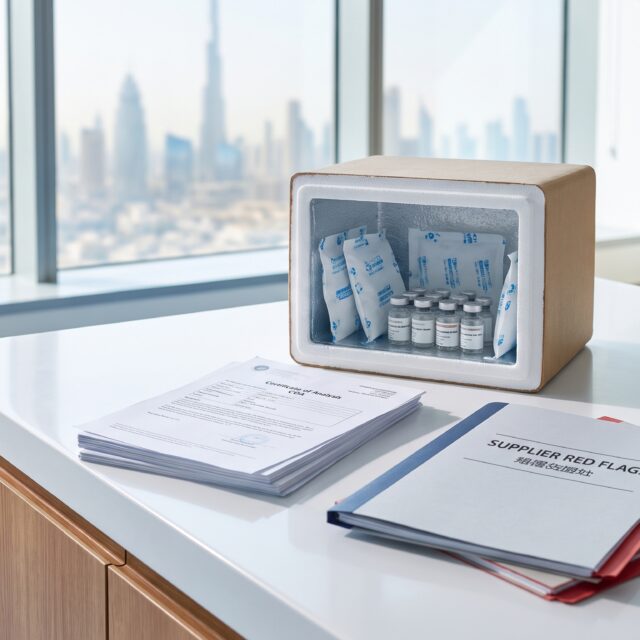
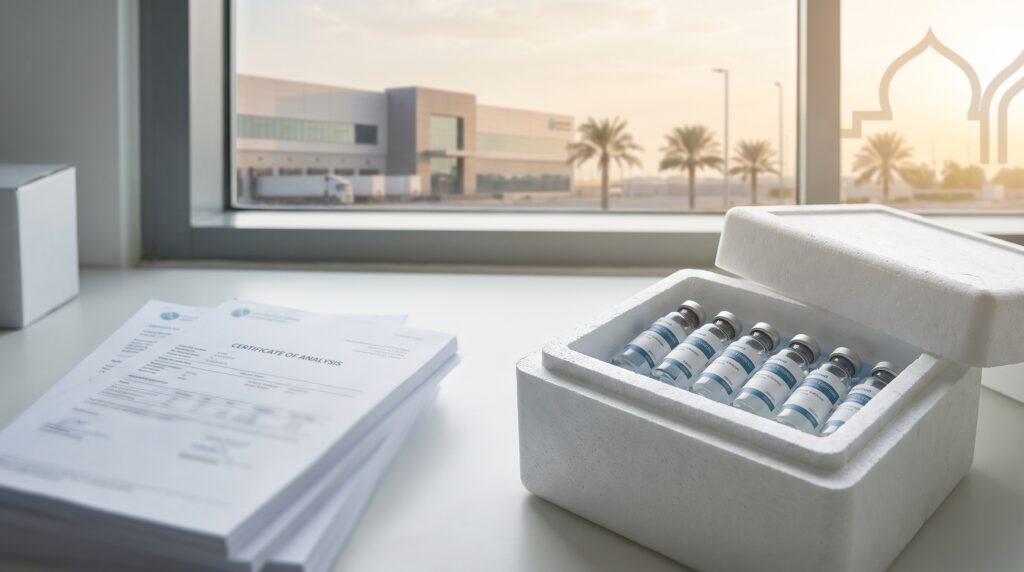
During these administrative holds, packages are frequently left in non-climate-controlled transfer warehouses or directly on hot tarmacs. A peptide that boasts a 99% purity on its Certificate of Analysis (COA) at the factory will suffer irreversible heat damage if subjected to 45°C tarmac heat for a week. By the time it arrives at your lab, the original COA is completely invalidated by the environmental exposure.
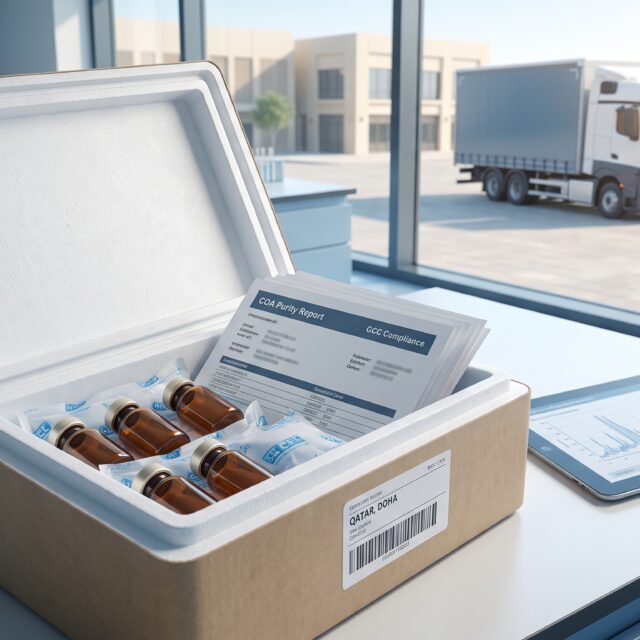
This is why savvy researchers and laboratory procurement officers are increasingly turning to trusted regional hubs. By utilizing suppliers situated within the GCC, buyers successfully bypass long-haul international delays. For example, relying on fast UAE and GCC delivery routing ensures that compounds are shipped using active or robust passive cooling logistics over much shorter distances. This radically minimizes transit-related heat exposure and avoids drawn-out international customs friction.
Evaluating Supplier Cold-Chain and Documentation
When sourcing research peptides in Saudi Arabia, evaluating a supplier’s operational logistics is just as important as reading their purity reports. A responsible supplier does not just sell a chemical; they engineer a secure, temperature-controlled pathway from their synthesis lab to your testing bench.
Crucial buyer checks to verify before purchasing:
- Transparent COA and HPLC/MS Testing: Ensure the supplier provides up-to-date, batch-specific Certificates of Analysis alongside High-Performance Liquid Chromatography (HPLC) and Mass Spectrometry (MS) testing. These documents verify the identity, mass, and purity of the compound before it leaves the facility.
- Climate-Aware Packaging: Does the supplier use insulated packaging, phase-change materials, or specialized ice packs designed specifically to withstand the Middle Eastern climate?
- Regional Stock Availability: Suppliers shipping locally from within the GCC significantly reduce the critical transit window. You want a procurement partner who already holds stock in a regionally secure, climate-controlled facility.
- Accessible Support and Secure Payments: Reliable suppliers offer immediate support for procurement and logistics queries, often through direct channels like WhatsApp. They should also provide secure regional payment gateways to ensure smooth institutional or independent ordering.
NOVA Labs prioritizes these operational details, ensuring that regional researchers have access to verifiable purity, robust packaging protocols, and local GCC logistical expertise to protect sensitive compounds from the harsh regional climate.
Essential Lab Equipment for Temperature Monitoring
For Saudi laboratories handling high-value peptides, standard consumer-grade refrigeration is often inadequate. Standard refrigerators frequently utilize auto-defrost cycles, which cause internal temperatures to spike and drop continuously to prevent frost buildup. This hidden cycling can degrade reconstituted peptides over time.
To ensure maximum stability, researchers should invest in dedicated biomedical refrigerators that maintain a strict, non-fluctuating 2°C to 8°C environment. Furthermore, utilizing continuous data loggers inside the storage units ensures that if a power outage occurs—a rare but possible event—the laboratory manager knows exactly how long the temperature deviated from the acceptable range, allowing them to assess compound viability accurately.
Conclusion & Next Steps
Mastering the peptide storage protocols required in Saudi Arabia is essential for maintaining the structural integrity, stability, and efficacy of your laboratory materials. By keeping lyophilized compounds safely in a deep freezer, strictly refrigerating reconstituted liquids, vigilantly avoiding the condensation trap, and understanding the severe risks of tarmac heat during customs clearance, researchers can prevent costly compound degradation.
Equally important is selecting a regional partner capable of executing secure, climate-conscious logistics. When you are ready to source premium, rigorously tested compounds backed by transparent, batch-specific documentation and highly reliable GCC shipping, explore our complete research peptide catalog to secure your laboratory’s inventory with absolute confidence.
References
- Saudi Food and Drug Authority (SFDA). (2023). Guidelines on Cold Chain Management for Temperature-Sensitive Products.
- ZATCA. (2023). Customs Clearance Procedures for Chemical and Biological Materials.
- International Society for Lyophilization – Freeze Drying (ISL-FD). Best Practices for Peptide Stability and Storage.
Disclaimer: The products and information mentioned in this article are exclusively for in-vitro laboratory research purposes only. They are strictly not intended for human consumption, diagnostic, therapeutic, or clinical use.
- Peptide Storage Temperature Sharjah: Practical Buyer Guide – NOVA Labs
- Buy MOTS-c in Saudi Arabia | Reliable Suppliers & COA Guide – NOVA Labs
- Peptide Storage Temperature Bahrain: Lab & Handling Guide – NOVA Labs
- Peptide Storage Guide | UAE Core Peptides
- How Can Pharmaceutical Logistics Meet Strict SFDA Compliance in Saudi Arabia? – CoolGo
- SFDA Compliance Guide for Saudi Food and Drug Authority Standards
Frequently asked questions
What is the correct peptide storage temperature in Saudi Arabia for unopened vials?
Unopened lyophilized (powdered) peptides should be stored in a laboratory freezer between -20°C and -80°C. This maintains maximum stability for up to 3 to 5 years. For medium-term storage, a dedicated biomedical refrigerator at 2°C to 8°C is acceptable.
How long do reconstituted peptides last in the fridge?
Once reconstituted with a suitable solvent like bacteriostatic water, peptides must be kept strictly refrigerated at 2°C to 8°C. Depending on the specific molecular structure, they typically remain stable for 14 to 30 days before degradation begins.
Can I refreeze peptides after they have been mixed?
No, you must avoid repeated freeze-thaw cycles. Freezing and thawing a reconstituted liquid fractures fragile amino acid bonds, causing rapid chemical degradation. If freezing is absolutely required, it must be done only once in pre-measured, single-use aliquots.
Why is customs clearance a risk for peptide shipments in the GCC?
Complex clearance procedures via ZATCA and SFDA can cause international shipments to be held at ports. If packages sit on hot tarmacs in extreme KSA summer temperatures without active cooling, the peptides will suffer irreversible heat degradation, invalidating their purity.
How do I prevent the condensation trap when opening a cold peptide vial?
To prevent ambient room moisture from ruining hygroscopic powder, remove the sealed vial from cold storage and place it in a desiccator or airtight bag. Allow it to slowly equilibrate to room temperature for 30 to 60 minutes before unsealing.
Nova Labs buyer tools
Ready to verify stock, testing and delivery?
Use the product page and lab report section to check availability, documentation, delivery timing and support before placing an order.
- COA / test-report checks
- Saudi Arabia delivery context
- Cold-chain handling
- COD and card payment options
- WhatsApp support